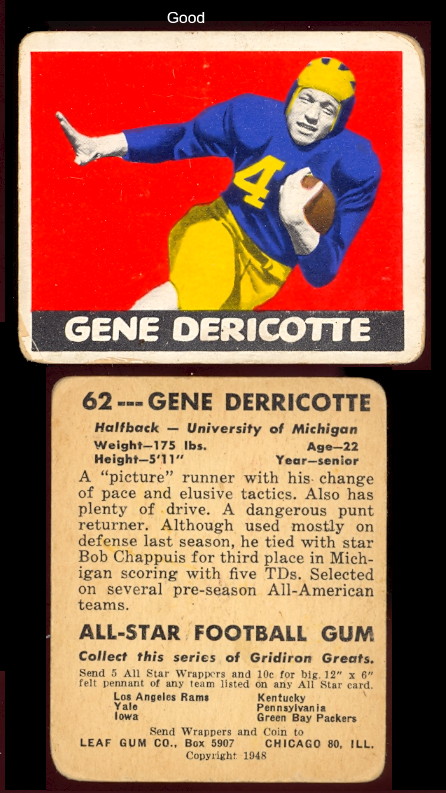
Gene Derricotte
From Wikipedia, the free encyclopedia
| Gene Derricotte | |
|---|---|
| Career information | |
| Position(s): | HB/PR/KR |
| Height: | 5 ft 10 in (1.78 m) |
| Weight: | 178 lb (81 kg) |
| Jersey №: | 41 |
| College: | Michigan |
| Career highlights and Awards | |
| Honors: | Michigan All-time Records Single-season punt return average (1947-) |


Eugene "Gene" Derricotte is a former American football player who played with the University of Michigan Wolverines from 1944-1948. He was one of the University's first African-American athletes in era when NCAA Division I college football was beginning to integrate. He established school records that still stand as a punt returner for the Michigan Wolverines football team. He also established several short-lived school interceptions records. He is also a Tuskegee Airman. He leveraged his military career and athletic excellence to achieve a successful career in dentistry while continuing to serve the military.
Contents |
[edit] College
Derricotte grew up in Defiance, Ohio. He enrolled at Michigan in 1944, where he became the first African-American to play in the offensive backfield for the Michigan Wolverines football program. Derricotte was an immediate contributor as the team's leading ground gainer in 1944.[1] Press reports in 1944 typically referred to his race, identifying him as "freshman negro halfback,"[2] the "Negro speedster,"[3], the "speedy negro freshman,"[4] or the "lithe Negro star."[5]
In December 1944, Derricotte was drafted into the United States Army. Dericotte was initially assigned as an artillery cannoneer with the 16th Separate Training Battalion in Fort Bragg, North Carolina.[1][6] He later transferred to the Tuskegee Airmen pilot training program in Tuskegee, Alabama. Derricotte graduated from the program in May 1946. With the war over, he was discharged, and he returned to the University of Michigan to continue his education.
When he returned from the war in 1946 he shared the starting duties at the left halfback position with Bob Chappuis, who went on to All-Big Ten Conference honors in 1946. After starting nine games at left halfback for Fritz Crisler in 1944,[7] Derricotte started five games to Chappius' four in 1946.[8] In the first game of the 1946 season, Derricotte threw a touchdown pass to Paul White and was described as the "sparkplug of the Michigan running game."[9] Derricotte broke his nose in a scrimmage after the first game and saw limited playing time, which gave Chappuis an opportunity to shine.[10]
Derricotte, who wore #41 while a Michigan Wolverine,[11] had an unusual college football career because he began by starting many games, but gradually became more of a return specialist. In 1946, Derricotte also set the school's single-season interceptions record.[12] By 1947, Chappuis had become an All-American halfback and Derricotte's only start was one game at quarterback.[13] In 1947, Derricotte averaged 24.8 yards on punt returns, which still stands as a Michigan school record (min 1.2 returns/game). In fact, Derricotte still ranks fifth in NCAA Division I-A history in average yards per punt return.[14] Oddly, the NCAA recognizes that he had 347 return yards on 14 returns that season (24.8). The University of Michigan claims he had 396 punt return yards that season (which would be 24.8 with 16 returns), but did not average at least 12.3 with a minimum of 15 returns to rank in the top ten in school history.[12] The Big Ten record book claims he did not have at least a 17.4 return average with a minimum of 10 returns to place in the top ten in conference history.[15] The 396 was a Michigan record from 1947 until 1990 when Tripp Welborne totaled 455 in 1990. In 1948, he again only had one start, but this time back at halfback under new coach, Bennie Oosterbaan.[16] Both the 1947 Michigan Wolverines football team, Fritz Crisler's last team, and the 1948 Michigan Wolverines football team were undefeated and finished the season ranked number 1 in the Associated Press polls.[13][16] The 1947 team referred to as "Michigan's Mad Magicians" is considered to be the greatest University of Michigan football team of all time.[17]
During his Michigan career, Derricotte returned four punts for touchdowns, which set a school record that has since been tied (but not exceeded) by Steve Breaston and Derrick Alexander.[18] He also returned three punts for touchdowns in one season, which was a Big Ten Conference record for more than 50 years until Ted Ginn returned four punts for touchdowns in 2004.[19] The record had been tied by both Ira Matthews of the Wisconsin Badgers (1976) and Tim Dwight of the Iowa Hawkeyes (1997).[20]

In the Associated Press poll at the end of the 1947 season, the Notre Dame Fighting Irish were ranked ahead of the University of Michigan, though both teams were undefeated. Some noted that every Southern AP voter had voted for Notre Dame, which had yet to integrate, whereas three of Michigan's star players (Derricotte, Bob Mann and Len Ford) were African-American. The Southern schools refused even to schedule games against schools that played African-American players.[21]
Michigan beat USC, 49-0, in the 1948 Rose Bowl game. Derricotte scored a touchdown on a 45-yard reception from Henry Fonde in the game.[22] Derricotte also completed a ten yard pass during the game.[23]
Over the course of his Michigan career, he set the career interceptions record. Neither Derricotte's career nor single-season interceptions records lasted very long. The career interception record lasted one season and the single-season record lasted three. He was also involved in only the third time Michigan had two 100-yard rushers in the same game.[12]
[edit] Professional career
Derricotte was selected in the first round of the AAFC draft in 1949 by the undefeated league defending champion,[24] Cleveland Browns.[25]
In 1950, Derricotte earned a degree in pharmacy. In 1958, he earned a further degree in dentistry. After receiving his degree in dentistry, Derricotte returned to the military, serving in Vietnam, as well as South Dakota, Massachusetts, Texas, Hawaii, Virginia, Illinois and the Air Force Academy before his retirement in 1985. Derricotte then relocated to San Antonio, Texas, where he started another career at the University of Texas Health Science Center. Derricotte retired in 2000.[26]
Derricotte was inducted into the U-M Hall of Honor in 1987.[27]
[edit] See also
[edit] Notes
- ^ a b Whoric, Johh H.. "Sportorials", The Daily Courier, Connellsville, Pa., 1945-03-09.
- ^ "Wildcats Down 20 to 0 at Half of Big Ten Game", San Antonio Express, 1944-10-15.
- ^ "Derricotte to Lead Wolves Against Penn", The Herald-Press, St.Joseph, Mich., 1944-11-02.
- ^ "Lund Will Fill Wiese's Shoes For Wolverines", The News-Palladium (Benton Harbor, Mich.), 1944-10-31.
- ^ Fischer, Leo. "Michigan Looks For Bright Season", The Port Arthur News, 1946-09-12.
- ^ "Derricotte In Training", The Lima News, 1945-05-23.
- ^ 1944 Football Team. The Regents of the University of Michigan (2007-03-31). Retrieved on 2007-12-07.
- ^ 1946 Football Team. The Regents of the University of Michigan (2007-03-31). Retrieved on 2007-12-07.
- ^ "Wolves Rip Hoosiers 21-0, Before 74,600", The Wisconsin State Journal, 1946-09-29.
- ^ "Derricotte Injured", The Oelwein Daily Register, 1946-10-03.
- ^ Bentley Historical Library -- U of M Football Rosters: Derricotte. The Regents of the University of Michigan (2003-08-25). Retrieved on 2007-12-07.
- ^ a b c Record Book. University of Michigan & Host Interactive (2007). Retrieved on 2007-12-27.
- ^ a b 1947 Football Team. The Regents of the University of Michigan (2007-03-31). Retrieved on 2007-12-07.
- ^ Official 2007 NCAA Division I Football Record Book. National Collegiate Athletic Association (August 2007). Retrieved on 2008-01-03.
- ^ Big Ten Football: Individual Records (All Games). The Big Ten Conference. Retrieved on 2008-01-03.
- ^ a b 1948 Football Team. The Regents of the University of Michigan (2007-03-31). Retrieved on 2007-12-07.
- ^ Jones, Todd (2007). "Michigan", in MacCambridge, Michael: ESPN Big Ten College Football Encyclopedia. ESPN Enterprises. ISBN 1933060492.
- ^ Record Book. mgoblue.com. Retrieved on 2007-12-07.
- ^ Ablauf, David and Jim Schneider (2004-11-20). Wolverines Headed to Rose Bowl Despite Loss at OSU. michiganfansite.com. Retrieved on 2007-12-07.
- ^ Big Ten Football: Individual Records (All Games). The Big Ten Conference. Retrieved on 2007-12-07.
- ^ John Kryk, "Natural Enemies: Major College Football's Oldest, Fiercest Rivalry," Taylor Trade Publishing, 2004, ISBN 1589790901, p. 145.
- ^ Madej, Bruce (November 1, 1997). Michigan: Champions of the West!. Sagamore Publishing. ISBN 1571671153.
- ^ Michigan's Bowl History. mgoblue.com. Retrieved on 2007-12-07.
- ^ History: 1948. clevelandbrowns.com. Cleveland Browns. Retrieved on 2007-12-07.
- ^ NFL Draft History 1930s and 1940s. University of Michigan & Host Interactive (2005-06-23). Retrieved on 2007-12-07.
- ^ Dr. Eugene “Gene” Derricotte. sactai.com. Retrieved on 2007-12-07.
- ^ Hall of Honor. letterwinnersmclub.com. Retrieved on 2007-12-07.
[edit] External links