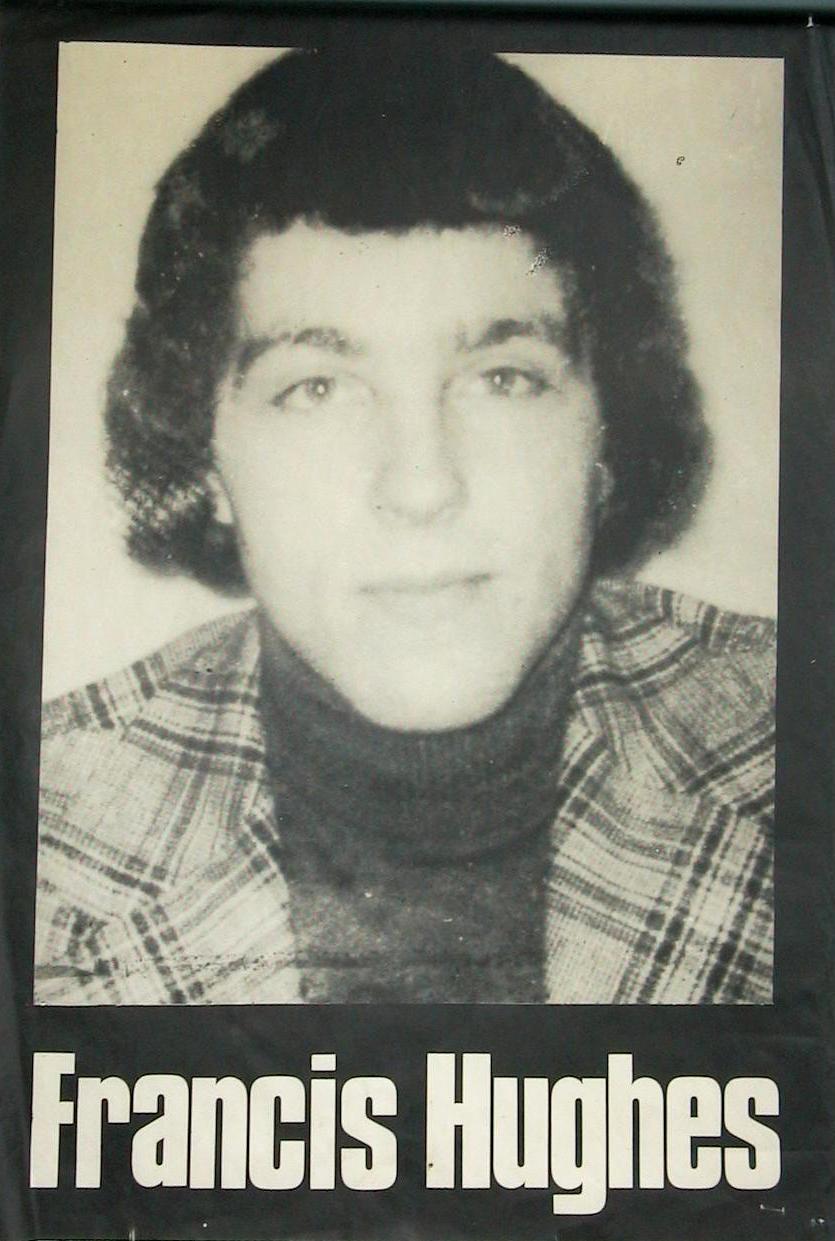
Francis Hughes
From Wikipedia, the free encyclopedia
| Francis Hughes Proinsias Ó hAodha |
||
| Paramilitary organisation | Provisional IRA | |
| Date of birth | 28 February, 1956 | |
| Place of birth | Bellaghy, County Londonderry | |
| Hunger strike started | 15 March 1981 | |
| Died | 12 May, 1981 | |
| Days on strike | 59 | |
Francis Hughes (Irish: Proinsias Ó hAodha[1]; 28 February 1956 – 12 May 1981) was a volunteer in the Provisional Irish Republican Army (IRA). Hughes was the most wanted man in Northern Ireland until his arrest following an ambush by the Special Air Service (SAS) in which an SAS soldier was killed. At his trial he was sentenced to a total of 83 years imprisonment, and he died during the 1981 Irish hunger strike in HM Prison Maze.
Contents |
[edit] Background
Hughes was born in Bellaghy, County Londonderry on 28 February 1956 into a republican family, the youngest of four brothers in a family of ten siblings.[2][3] Hughes' father Joseph had been a member of the Irish Republican Army in the 1920s and one of his uncles had smuggled arms for the republican movement.[3] This resulted in the Hughes family being targeted when internment was introduced in 1971, and Hughes' brother Oliver was interned for eight months without trial.[3] Hughes left school aged 16 and started work as an apprentice painter and decorator.[4] Hughes was returning from an evening out in Ardboe, County Tyrone when he was stopped at an Ulster Defence Regiment (UDR) checkpoint.[3] When the soldiers realised he came from a republican family, he was badly beaten.[3][4] Hughes' father encouraged him to see a doctor and report the incident to the police but Hughes refused, saying he "would get his own back on the people who did it, and their friends".[3][5]
[edit] Paramilitary activity
Hughes initially joined the Official Irish Republican Army, but left after the organisation declared a ceasefire in May 1972.[6][7] Hughes then joined an Independent Republican Unit along with Dominic McGlinchey and Ian Milne, before the three decided to join the Provisional IRA in 1973.[4][6] Hughes and McGlinchey took part in scores of IRA operations, including daylight attacks on Royal Ulster Constabulary (RUC) stations, bombings, and attacks on off-duty members of the RUC and UDR.[8] Another IRA member described the activities of Hughes:
| “ | He led a life perpetually on the move, often moving on foot up to 20 miles during one night then sleeping during the day, either in fields and ditches or safe houses; a soldierly sight in his black beret and combat uniform and openly carrying a rifle, a handgun and several grenades as well as food rations.[9] | ” |
On 18 April 1977 Hughes, McGlinchey and Milne were travelling in a car near the town of Moneymore when an RUC patrol car carrying four officers signalled them to stop.[8][10] The IRA members attempted to escape by performing a u-turn, but lost control of the car which ended up in a ditch.[8] They abandoned the car and opened fire on the RUC patrol car killing two officers and wounding another, before running off through fields.[8][10] A second RUC patrol came under fire while attempting to prevent the men fleeing, and despite a search operation by the RUC and British Army the IRA members escaped.[10] Following the Moneymore shootings the RUC named Hughes as the most wanted man in Northern Ireland, and issued wanted posters with pictures of Hughes, Milne and McGlinchey.[10] Milne was arrested in Lurgan in August 1977, and McGlinchey later in the year in the Republic of Ireland.[10]
[edit] Arrest and imprisonment
Hughes was eventually captured on 17 March 1978 near Maghera in County Londonderry after a gun battle with the SAS.[11] A member of the SAS, L/CPL David Jones,[12] was killed in the gun battle, and another SAS member was seriously wounded. Hughes was wounded in the leg. He managed to crawl away but was pursued and surrendered to British troops.
In February 1980 he was sentenced to a total of 83 years in prison. Hughes was tried for, and found guilty of, the murder of one British Army soldier (for which he received a life sentence) and wounding of another (for which he received 14 years) in the incident which led to his capture, as well as a series of gun and bomb attacks over a six-year period. Security sources described him as "an absolute fanatic" and "a ruthless killer". Fellow republicans described him as "fearless and active". Following his death, it emerged in court during the extradition proceedings against Dominic McGlinchey that Hughes' fingerprints had been found on a car used during the killing of a 77 year old Protestant woman, Hester McMullan, in Toomebridge in 1977.[13]


[edit] 1981 hunger strike
Hughes was involved in the mass hunger strike in 1980, and was the second prisoner to join the 1981 Irish Hunger Strike in the H-Blocks at HM Prison Maze. His hunger strike started on 15 March 1981,[14] two weeks after Bobby Sands became the first hunger striker. He was the second striker to die, at 5:43pm BST on 12 May, after 59 days without food.[15] His death led to an upsurge in rioting in nationalist areas of Northern Ireland.
His cousin, Thomas McElwee, was the ninth hunger striker to die. One of his brothers, Oliver Hughes now sits on Magherafelt Council.
The American city of Boston renamed the street the British consulate is on to Francis Hughes Street.[16]
[edit] References
- ^ Frank Hughes. SAOIRSE (November 1995). Retrieved on 2007-10-28.
- ^ (2002) Tírghrá. National Commemoration Centre, p. 233. ISBN 0-9542946-0-2.
- ^ a b c d e f Beresford, David (1987). Ten Men Dead. Atlantic Monthly Press, pp. 113–114. ISBN 0-87113-702-X.
- ^ a b c Dillon, Martin (2003). The Trigger Men. Mainstream Publishing, p. 122. ISBN 0-87113-702-X.
- ^ English, Richard (2003). Armed Struggle: The History of the IRA. Pan Books, p. 198. ISBN 0-330-49388-4.
- ^ a b Ten Men Dead, p. 115.
- ^ 1972: Official IRA declares ceasefire. BBC. Retrieved on 2007-10-21.
- ^ a b c d The Trigger Men, pp. 124–126.
- ^ The Trigger Men, p. 127.
- ^ a b c d e Ten Men Dead, p. 117–118.
- ^ Chronology of the Conflict 1978 — The University of Ulster's CAIN Project
- ^ Palace Barracks Memorial Garden
- ^ D McKittrick, Lost Lives, Mainstream Publishing, 2004. ISBN 184018504X
- ^ Chronology of the Conflict 1981 — The University of Ulster's CAIN Project
- ^ Second IRA protester dies in jail — BBC News "On This Day" report
- ^ "Legendary Volunteer dies on Hunger Strike", An Phoblact, Provisional Sinn Féin, 2006-06-11. Retrieved on 2006-08-08. (EN)
[edit] External links
- Hunger strike poster of Francis Hughes
- Video from the funeral of Francis Hughes
- Irish Hungerstrike Memorial Site
|
||||||||||||||