Talk:Eastern Europe
From Wikipedia, the free encyclopedia
.gif/75px-Rotating_earth_(large).gif)


.svg/62px-Wikiproject_Europe_(small).svg.png)


[edit] Cetral Europe
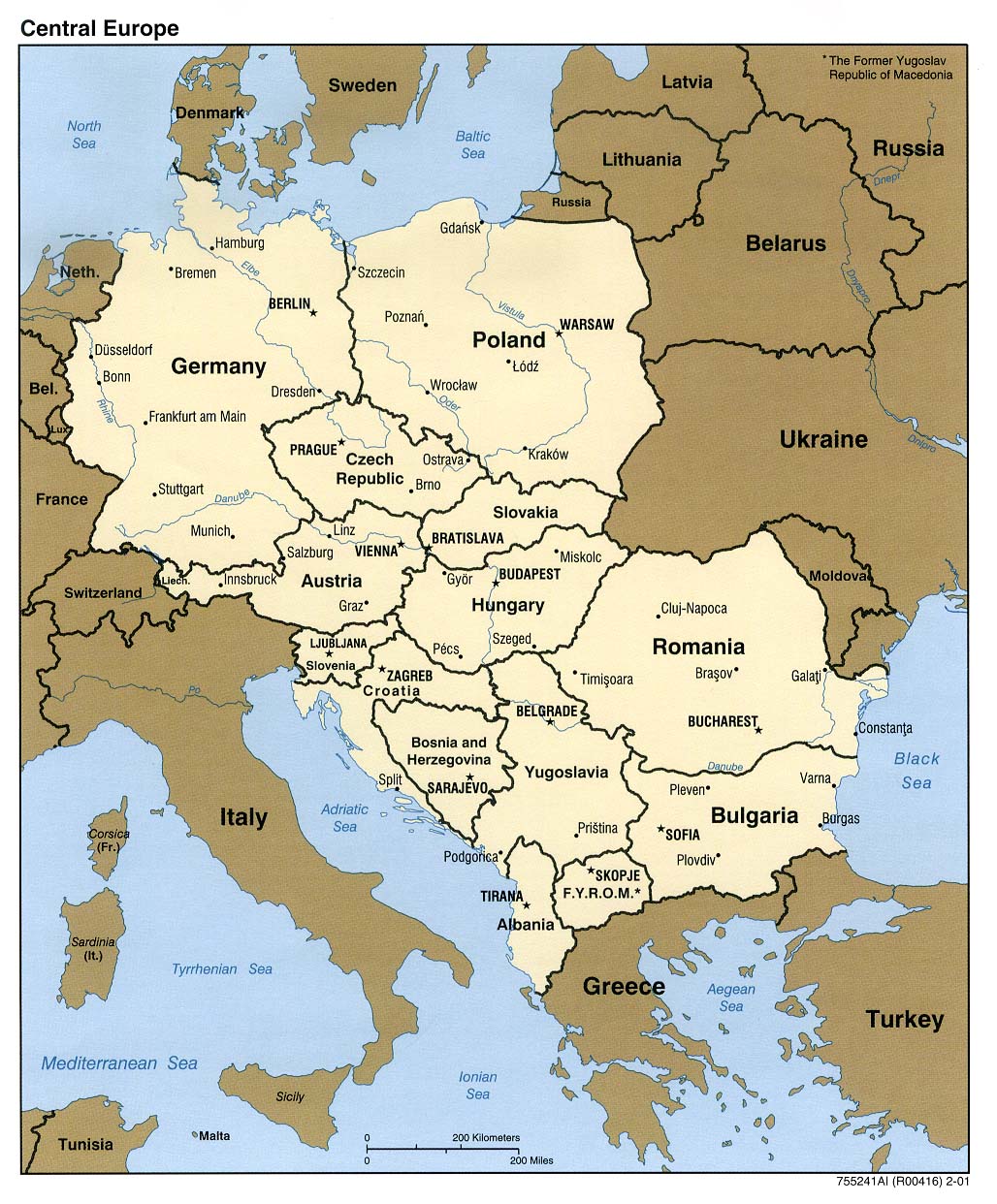
Where is a Central Europe? I think, it could be better at Czech or Slowak rep.
[edit] Transcaucasus
Are Georgia, Azerbaijan, Armenia part of Eastern Europe? - User:Olivier
- I would assume they would be considered to be so when considered to be part of Europe at all; see Talk:Europe. --Brion
Culturaly Georgia and Armenia ARE EUROPA. They both are cristians. But culturaly they are more like southern Europe. Especialy much in common with Basque country and Sicilia. North Caucasus (fo example Chechenia) are more like Asia. 159.148.71.250 06:04, 14 May 2007 (UTC)
- Not really. They should be put in the same region as Turkey, if anything. And speaking of Christianity, the Assyrians, for instance, are Christian as well, but I don't remember anyone calling them European. Humanophage 20:23, 25 June 2007 (UTC)
[edit] former Soviet Union
In fact, in the Eastern Europe article, listing the "former Soviet Union" is too vague. Some of the former republics geographically belong to Europe (Belarus, Estonia, Latvia, Lithuania, Moldova, Ukraine, part of Russia)- according to the Europe article. Some others clearly do not (Central Asian republics, for instance). The article should probably give more details about that. - User:Olivier
[edit] East Germany
Shouldn't the former Eastern Germany be included as having historically been part of Eastern Europe? - User:Olivier
I wouldn't describe Poland as part of Eastern Europe. They belong culturally (they're roman catholics) and politically to Central Europe.
- Hey, the same arguments would apply to Croatia, but it's a moot issue... --Shallot 14:32, 10 Feb 2004 (UTC)
-
- Uh, so being Catholic makes you Western European? That's interessting. Are the Philhippines and all of South America western european too?Thehairthatdidntgrow 23:58, 7 June 2007 (UTC)
If you want to DIVIDE EUROPE, divide it in anthropological terms, - that is - racially. Then most of East, Central, West and North Europe or Caucasoid Europe will become the true Europe while parts of East and South Europe will become pro-Asiatic, Mediterranean stock and Middle Eastern Europe. DO NOT divide by income, religion or political system. —Preceding unsigned comment added by 69.11.161.52 (talk) 17:29, 21 September 2007 (UTC)
[edit] Russia
Since when is Russia not part of Eastern Europe? Is this your own new definition of that term in the USA and Britain? Note that elsewhere in the world Eastern Europe has always included Russia. -- Greetings from a German intellectual from Wikipedia Germany, User:Woldemar
- I fixed that blatant omission. --Shallot 14:32, 10 Feb 2004 (UTC)
Russia (RF) is Eastern Europe all the way to Japan even if they own the conquered Asian lands, but same as predominantly Caucasoid North America (US, Canada) owns some previously non-European lands. Many, some or even most Russians indeed are of a Eurasian stock, mixed blood line of Caucasoid, Mongoloid and Semitic genes. And then look back 20,000 years ago - who owned the North Europe during the Ice Age? No one. It could become Asian or African as well. North India was the place where all the Caucasians came from. Stop playing the sand box game and GROW UP. —Preceding unsigned comment added by 69.11.161.52 (talk) 17:32, 21 September 2007 (UTC)
[edit] old and new
It seems to me that we need two lists -- the groups of countries that composed Eastern Europe during the Cold War (basically the Soviet sphere of influence), and what became of that, i.e. how things are named right now. --Shallot 14:32, 10 Feb 2004 (UTC)
[edit] communist or Communist?
I'm not an expert on capitalization rules in English, but see: Communism#Writing "Communism" or "communism". -- Kpalion 11:55, 20 Nov 2004 (UTC)
- In the context of generally describing these countries as "communist", I don't think it needs capitalization. The parties which formed those governments weren't all called "Communist", either. --Joy [shallot] 17:53, 20 Nov 2004 (UTC)
[edit] "Problems with this definition"
Ronline, why didn't you post this fairly slanted text in Talk first so that we can discuss it? A cursory look at the page history would have revealed that there had been disagreements regarding the definitions before, let's not repeat history... --Joy [shallot] 10:28, 31 Jan 2005 (UTC)
- What do you mean by "this fairly slanted text"? The reason I included it is to clear things up a bit regarding what is and what is not Eastern Europe. The first paragraph of the article is an introductory statement, while the second paragraph ("Contemporary Eastern Europe") puts forward the correct definition of Eastern Europe. "Extended Eastern Europe" refers to the definition of Eastern Europe containing all of former-Communist Europe. There is also a section, the one I wrote, about problems with this definition. This argues, in what I see as a NPOV manner, why the extended definition is problematic (first paragraph). Other terms, such as New Europe, are also discussed. I don't see how this inclusion will cause arguments, especially since it is more NPOV than before. Before, the article basically was written from the point-of-view of an extended Eastern Europe, which causes controversies in Central Europe, Northern Europe and Southeastern Europe. It is already enough that the non-Eastern European former-Communist countries have to live with being included in this article in the first place. Ronline 06:10, 6 Feb 2005 (UTC)
[edit] Styles and/or HTML
When I look at this page with Firefox, I don't see the map. I see it with IE, though. Perhaps there's some invalid HTML or CSS.
[edit] Inaccuracy of Recent Edit
The recent edit introduces several inaccuracies that are confusing:
- Removes Baltic countries -- the 3 Baltic countries are commonly included in today's identification of Eastern Europe
- Unknown and confusing edit as end
- Russia is not part of Eastern Europe (when people talk about this region, they always state "Russia and Eastern Europe")
- Misleading and inaccurate map -- a proper map would color the countries listed, maybe coloring Russia a different color and Central Europe, see that page, a different color
--Noitall 13:10, July 20, 2005 (UTC)
- To mitigate Noitall's confusion:
- There is no common "today's identification of Eastern Europe". What may be common identification in the local newspapers of, e.g., West Virginia is not necessarily common in European English-language press. In today's British press, for example, one finds Estonia, Latvia, Lithuania, Poland, Slovakia, etc. more often in the same group (sometimes Central, sometimes Eastern Europe, sometimes "EU accession countries", etc.), and very rarely would one see, e.g., Poland in CE and Lithuania in EE in the same source. After all, all these countries are members of the European Union (news of which, of course, travel slower to the other side of the Atlantic).
- Europe can be divided into two: WE/EE (the question being where to draw the boundary). However, Europe cannot be logically divided into four: WE/CE/EE/Russia; as you seem to think "people talk about". One cannot carve out CE, ignoring the existence of NE (and SEE, etc.)The introduction of CE and NE indeed creates some confusion with the three Baltic nations as they could be classified into either CE or NE (in any case, much more than into EE), in many ways the closest country to Catholic Lithuania is Catholic Poland, and to Lutheran Finnic Estonia is Lutheran Finnic Finland.
- Saying "Russia is not part of Eastern Europe" is nearly equal to saying "Russia is not part of Europe", which is inaccurate, to put it diplomatically. "Russia and Eastern Europe" in Cold-War-speak usually translated to "USSR and its communist satellites".
- Of course, neither map is perfectly accurate. Ideally an accurate and civilised map should have one colour for EE, one for NE, one for CE, one for SEE, and then (as you wish) perhaps one shade for Russia and another for the rest of EE, then the Baltic countries in NE/CE stripes, some CE stripes covering N&W-Ukraine, some SEE stripes over Moldova, Croatia in CE/SEE stripes, Greece and Cyprus in SEE/EE stripes etc. etc. However, the folks in West Virginia might consider it even more confusing... so there you go, know-it-all American friend. Anon 10:25 CET 21 July 2005
-
-
- Ok, I only have time for one comment right now. Russia is not Eastern Europe. It is so far out is is frequently called Asia or Eurasia. This term has no meaning at all, and neither does the term "Europe", if Russia is included. --Noitall 14:06, July 21, 2005 (UTC)
-
-
-
- The Baltics are always included in Eastern Europe. They are also included in Northern Europe, and this page appropriately provides a reference to it. It is obviously possible to be in two overlapping categories. But Northern Europe does not have the usefulness and meaning that this does, and any discussion can be on the Baltic page. --Noitall 19:28, July 21, 2005 (UTC)
-
-
-
-
- "Baltics are always...", "Northern Europe does not have the usefulness..." -- whose intelligence are you trying to insult with your misinformed arrogance? Are you sincerely suggesting to Estonians that amongst Finland, Russia, Moldova, and Poland there is only one country with which Estonia "always" "usefully" belongs to the same region, and that country is... Moldova?! Good clean fun. --3 Löwi 22:11, 21 July 2005 (UTC)
-
-
-
-
- What is your argument? It makes no sense whatsoever. Are you arguing just to stir up trouble? Are you arguing that Finland and Poland belong in Eastern Europe? THIS PAGE IS EASTERN EUROPE PAGE, NOT NORTHERN EUROPE. Go on that page if you have some argument about Northern Europe. Let's stick to the topic. --Noitall 23:43, July 21, 2005 (UTC)
-
-
-
-
- OK. How simplistic an argument would you rather prefer? The point is that Estonia is no more Eastern European than Poland. What you say, that Poland belongs to Central Europe and Estonia belongs to (Far-)Eastern Europe, as Russia is not in Europe at all -- that makes no sense whatsoever. Or if you want it even more simplistic, I shall paraphrase what you said: this page is about the region of Europe where I happen come from, not about America, where I reckon you are. So, if you have argument, go on that USA page... Cheers, --3 Löwi 07:24, 22 July 2005 (UTC)
-
-
- Your edits on the page are getting better, but we are still not there. Eastern bloc included Central and Eastern Europe along with Russia. Eastern Europe never included Russia. That is why there is a difference in meaning with the terms. The most relevant should be how the divisions are being used today, and my original list of countries is accurate (actually, it is Central Europe which should be more difficult, not Eastern Europe). --Noitall 23:06, July 22, 2005 (UTC)
-
- In the Cold War speak it was indeed Eastern Bloc = "old Eastern Europe" + USSR. In other words, "Eastern Europe" then did not include Russia, Ukraine, Belarus, Moldova and did NOT include the Baltic countries (all of them were "in USSR", and not in "old Eastern Europe"). I understand that you understand why some "old Eastern European" countries are now classified into "new Central Europe" or into Balkans. Trust me, you will see fewer difficulties once you also understand the equally valid reasons for including the Baltic countries (which weren't even in the "old Eastern Europe", mind you) now in either the "new Northern Europe" (esp. Est. and Lat.) or "new Central Europe" (esp. Lith.). Cheers, --3 Löwi 00:13, 23 July 2005 (UTC)
Ok, not a bad way of introducing the para. Couple comments on existing:
- European countries of the former "Eastern Bloc" - good beginning, but the rest is redundant (Russia not in Europe) and Soviet Union makes it incorrect
- the western boundary of the former Soviet Union - redundant and unneessary, addressed the Eastern bloc already and have a para on CIS in here
- the western boundary of historically Eastern Orthodox and Islamic countries - totally confusing and not helpful, such analysis belongs down below in description
- some other arbitrarily chosen boundary in the west - my edit below encompasses (and this really says, in summary, "we have no idea")
Need to add mine, which is accurate, but I concede that there are other versions of Eastern Europe:
- the variously and vaguely defined area of Central Europe - perhaps this should be labeled "new Eastern Europe"
--Noitall 04:21, July 23, 2005 (UTC)
- 3 Löwi, I am afraid that you are adding in your own original research and thoughts. This is a world page. One way, the most common way, the world looks at this region is West to East (or vice versa). Since you live in the area, you might have your own way of emphasizing, perhaps using your North to South distinction. This is not appropriate for the Eastern Europe page, please go to the Northern Europe page. And your own personal viewpoint is not appropriate in any event. --Noitall 14:35, August 3, 2005 (UTC)
-
- I am afraid, Noitall, that you are mixing up fact with fiction (and a certain obsession with the concept of Central Europe, at the expense of other regions). Please take out the map and check whether, e.g., Moldova lies "between" Russia and Central Europe (your definition). I don't know what is your definition of "the area" you think I live in (in fact, last 4 years in UK, before that 7 years in USA) and what is your definition of the world, but I can assure that in the British press seldom does one see Romania and Bulgaria classified as Central Europe. The credit for this (original:) idea goes to you on the other side of the Atlantic. Cheers, --3 Löwi 17:21, 3 August 2005 (UTC)
[edit] American stereotype
- BTW, on an entirely unrelated issue, you made a comment before that I believe is the stereotype of Americans in Europe and elsewhere. You would be suprised at the international inter-relationships here. All of our Ocean City, Maryland is currently filled with summer students from Eastern Europe (I guess if we decide where it is). Our waterpark features Belarussian divers. A major Russian newpaper is produced in Baltimore, Maryland.[1] The Russians have a dacha nearby on the shores of the Chesapeake. All the Embassies are in Washington, D.C. And I could go on and on. We are a nation of immigrants and many people embrace those backgrounds. --Noitall 04:50, July 23, 2005 (UTC)
- And I should not forget, the Capital of Maryland, Annapolis, Maryland is a "sister city" with Tallinn, Estonia. --Noitall 04:54, July 23, 2005 (UTC)
[edit] Map
I'd put this on the map talk page, but it is unlikely that anyone would see it. I think that the map should have a key that says what the colors stand for. I believe that these are the divisions.
- Turquoise - Central Europe
- Blue - Northern Europe
- Red - Western Europe
- Orange - Eastern Europe
- Green - Southern Europe
- Purple - Asia
-- Kjkolb 22:18, 25 March 2006 (UTC)
[edit] Bosnia , Croatia, Montenegro -> Yugoslavia???
Listen, I am sick of people constantly arguing that Russia is not part of Eastern Europe. There is nothing you can do about that fact. If you are ashamed of it, tough luck. I do want to clarify that putting Romania and Bulgaria out of Eastern Europe is incorrect. Go to [[2]] and see for yourself. They do belong in it. Now, Bosnia, Croatia, (Montenegro -> (Which should split April 2006)) should not be put under the same color that Romania and Bulgaria are. Yes, the all belong to the Balkans, but that (Balkan) is only a region. Yugoslavia was no corrupt like the rest of the Eastern Bloc countries. Learn HISTORY before speaking and arguing. Josip Broz Tito created along with Nehru and Nasser formed the Non-Aligned Movement. YUGOSLAVIA did not belong to either NATO or EASTERN BLOC. The devastating Russian influence that corrupted the nations of Poland, Czech Rep., Slovakia, Romania, Moldova, Bulgaria, the (Baltic States) etc., did not affect Yugoslavia.
Also the Rolling Stones came to Zagreb in the (June 21-22 1976) 1970s showing that Yugoslavia had it better than any Eastern Bloc nation. In conclusion, along with the History Channel, in Russia people were forbidden from listening tot he Beatles, etc.!!!!
Not even through location, territory, language, culture, economy, and politics can you say that the Former Yugoslavia countires were in the same geographical filed as Romania and Bulgaria. Come on people get it right. --Kseferovic 12:17, March 29, 2006 (UTC)
- Sure, Romania and Bulgaria are backwards, not like the majestic and developed Yugoslavia. All this coming from an user with "-ic" at the end (you know what I mean). Geographically it is incontestable that they are in Central Europe, together with Poland, Lithuania, Latvia, Estonia, Finland, Italy, Germany, Czech Republic, Austria, Hungary, Denmark, Sweden, Norway, Greece, Albania, Macedonia, Serbia, Croatia, Bosnia and European Turkey. If you divide Europe in 3 equal parts, the border between Eastern and Central Europe is exactly in Istanbul. Which puts both Romania and Bulgaria fully in central Europe. Putting them anywhere else is just politics. "Not even through location, territory, language"? What do you mean? The language is slavic, much closer to Russian than Romanian which is closest to Italian. Bulgarian is even closer to Russian, but this still neutralizes your argument.
[edit] Unnecessary map?
Did anyone notice that the very first map of the article, is completely useless and unrelated to the article?
I mean, it's regions aren't even labeled properly (the only thing that's labeled is the supposed "Eastern Europe" and it lacks proper borders.
Also, the countries that are striped are EXTREMELY confusing since there is absolutely no explanation of their meaning. Hell this map even lacks a proper legend.
I say it should be replaced with a better map, such as the one here http:// www.mapsofworld.com/europe-country-groupings/eastern-europe-map.jpg , or something similar. --Lenev 23:41, 5 April 2006 (UTC)
[edit] This is quite possibly one of the most misguided articles I have ever seen on Wiki.
This article is a joke and demonstrates perfectly one of the major flaws of Wikipedia; people advocating a certain viewpoint rather providing information. Obviously there is no set definition of a vague region like Eastern Europe but this article goes out of its way to avoid the most commonly held definition of the region in the English-speaking world. The idea that Eastern Europe consists only of former Soviet countries like Russia and Belarus while excluding the Baltics, Poland, etc. may have some legitimacy in some circles but just is not the commonly used defination in English speaking countries. Obviously being considered a part of Eastern Europe is offensive to some in certain countries that resent being seen as Eastern Europe but that is no excuse for the silly state of this article. Its ridiculous. Not one mention of the commonly used definition of the region as including countries like Poland, Hungary, or Lithuania and somebody even edited the UN list so that five of the countries the UN defines as Eastern European were removed from the list. Just an article really going out of its way to emphasize how hard it is to define the region or describing it as a post-world war II all the while the fact it is a commonly used term in the world and has a common meaning in English-speaking countries. Discuss the vagueness of the term Eastern Europe and the fact that some people are offended by it but don't make this article a joke by utterly ignoring the most definition for the region in English-speaking nations like Britain, the US, or Australia. --Westee 15:53, 9 August 2006 (UTC)
[edit] This is what the UN are for
Wikipedia does not represent any 'commonly used definitions' of some informal unwarranted conceptions like 'The English Speaking Countries.(in response to Westee's post)
And the map in this article is JUST hilarious representing another conception of how the Europe should be divided in regions. Obviously a conception of a Polack, who apparently is having major difficulties with where to pigeonhole all the other countries after Poland has been included in Central Europe.
Actually being labled an EastEuropean is very stigmatizing and i think the UN map is a wee bit incomplete not representing Central Europe.
my point is why the hell couldn he just fox up the central europe and leave the rest of the map as the UN-the most authoritive source there could ever be, made it. In comparison with the UN map Slovenia has been moved from South Europe to CE(??????),the Baltic States have been moved from Northern Europe to Eastern Europe (did that make him feel better or what??????)Romania is still an East European country whereas Bulgaria has been moved to southern europe.. and so on(not to mention that the Caucasus has all of a sudden become belonging to Europe)
It's just ridiculous I just saw how The Baltic States have gradually been tranferred from Northern Europe first to CE (only Lithuania i wonder does that have to do anything with the close historical linkage between Lithuania and Poland..)and then to Eastern Europe.
actually i don't care that much while The Baltic States are considered belonging to Northern Europe in the article about Northern Europe..
- Agreed on the point that the article should stick to official definition, as done in Western Europe. As of now it is misleading an plainly bad. But that what makes wikipedia so lovely. Thehairthatdidntgrow 00:03, 8 June 2007 (UTC)
[edit] Feudalism
The peoples to the west and north of the Huntington line are Protestant or Catholic; they shared most of the common experiences of Western European history -- feudalism, the Renaissance, the Reformation, the Enlightenment, the French Revolution, and the Industrial Revolution.
In fact feudalism existed in Eastern Europe just as well as in Western Europe.--Nixer 09:38, 9 September 2006 (UTC) Eastern Europe and especialy Russia still have much feudalism. Industrial revolution was everywhere, just in Russia it ended with communist revolution;) 159.148.71.250 06:13, 14 May 2007 (UTC)
[edit] 1st Map
The first map currently uses an image which quotes "Regions of Europe According to: http://wikitravel.org/en/Europe " as its source, however the representation (region names and country groupings) are different from the quoted source. --3 Löwi 08:39, 25 September 2006 (UTC)
[edit] Czech Republic
It is a part of eastern europe only because of cold war era. Historically as a member of Holy Roman Empire there is no doubt it is a Central Europe. But for era 1945-1989 it is true and correct. ≈Tulkolahten≈≈talk≈ 22:44, 18 December 2006 (UTC)
- Geography has not much to do with the cold war blocks. --Cepek 12:50, 8 April 2007 (UTC)
-
- The definition of Western, Eastern, Northern and Southern parts of Europe are only based on physical geography to a minor degree, I would say. The same with the whole definition of Europe. For the most part, it's just race and culture, as it was reasonably pointed out in the Catholic Encyclopedia. Humanophage 20:38, 25 June 2007 (UTC)
[edit] Please check
Could someone familiar with this article please check out Zenit4ever's contributions to it? The user seems to be rather unconstructive. http://en.wikipedia.org/wiki/Special:Contributions/Zenit4ever Greswik 14:45, 20 March 2007 (UTC)
[edit] Turkey
Turkey is definitely in Western Europe because it is Muslim and NATO member.--Certh 09:14, 24 March 2007 (UTC)
[edit] UN definition and map
the countries listed as being in eastern europe, as defined by the UN stats devision, do not correspond to the list given on this page. e.g. czech repbulic is in eastern europe (going by UN source), but not listed here.
- Where should Austria belong? Have you ever read Central Europe? --Cepek 12:45, 8 April 2007 (UTC)
- One more comment. UN geographical region and composition codes do not define Central Europe(!)
- would you say that central Europe does not exist? If we deny existence of Central Europe, then the Czech republic really belongs to the (UN) Eastern Europe. If you really think this the case, please start with deleting article Central Europe first. --Cepek 13:14, 8 April 2007 (UTC)
- I have read central europe. This is not a matter of opinion. Czech is in Eastern Europe. Austria is in Western Europe. Bear in mind this is an English language page, and in English there is no doubt as to this. The terms East, West, North, South are about more than physical geography, and the reluctance of Czechs to consider themselves part of Eastern Europe has nothing to do with this article.
-
- ... Czech is in Eastern Europe. Austria is in Western Europe, your logic is superb, could you please tell me where did the former Austrian Empire belong? --Cepek 15:16, 8 April 2007 (UTC)
Also, the UN stats division is a good source. If we were to consider Czech to be in Central Europe then we would need an equally good source. Other than Kundera's speeches, I can'f find anything of a similar level of authority as the UN.
- I must repeat it again, there is nothing like Central Europe according to UN classification. Thus the article Central Europe must be deleted! Do not be ridiculous. --Cepek 14:36, 8 April 2007 (UTC)
Jamierc 13:46, 8 April 2007 (UTC)jamierc
-
- It's not just the Czechs, it's everyone. Eastern Europe has such a stigma attached to it and nobody cares where the centre is for one to east and another west. Estonians identify closely with Finns, Latvians and Lithuanians equally try to forge a relationship with the Nordic states, Belarussians, Czechs, Poles and Slovaks boast something of a "German" character about themselves. Hungarians long for their past union with Austria, Slovenia also feels Austrian in character - Croatia, Bosnia, Montenegro and Albania feel the need to be more "Meditteranean" and look accross the water to Italy, whilst Romania, Bulgaria, Serbia, Macedonia like to identify with the Greeks, much due to Orthodox church. So it leaves only Russian Federation as Eastern Europe but they too deep down probably spend their idol hours trying to establish behavioural patterns with the Dutch and the Belgians. In Croatia, the older wiser less-actively political folks joke about the change in attitude they witnessed in the last decades: you used to have Eastern and Western Europe when there was an iron curtain and now Eastern Europe suddenly doesn't exist any more! Everyone has come out of the closet, spoken ill of communism and sought to forge links to their nearest Western European neighbours. Poles, Czechs, Slovenes, Serbs (mainly from Vojvodina) are all CENTRAL Europeans. You'd think this would make them a new social group which includes Switzerland, Austria, Lichtenstein and Bavaria, but the residents of them countries STILL call THEMSELVES Western Europeans, so if there's a west, there is also an east. The young ignorant "former" Eastern Europeans generally feel that theirs is the only country with a modern scene, and that miraculously they belong to western/central Europe but the other Eastern European countries are trapped behind time! Today, Croatia is part of a trading block with one one other country; it is called the Central European Free Trade Agreement and the partner is Macedonia. Funny I know. Originally it was formed by old Comecon states, Poland, Hungary, Czechoslovakia etc. But who cares? The creation of this fiasco served as nothing more than a transition into joining the EU - first, they turn their backs on Moscow, then they rejoin each other (effectifely having thrown Moscow out of their gang), then they all apply to join the EU with their leaders spending 15 years following the US and the UK leaders with the begging bowl, sending their soldiers to help them wherever they interfere, swearing lifelong allegience. Then they abandon the marvelous CEFTA. Today, its only "Central European" states are Croatia and Macedonia, because the others abandoned us when they joined the EU. Apart from the fact that Macedonia and Croatia are candedates for joining the EU, we will next year be joined by the rest of the ex-Yugoslav countries with the pleasure of Albania and Moldova or so I'm told. In Croatia we joke, that Central Europe (not including pre-2004 EU members or Switzerland or Austria) is the new Eastern Europe. My point is, don't blame the Czechs, they are not alone in this. Balkantropolis 14:11, 8 April 2007 (UTC)
-
-
- Before any other discussions one point must be clarified. Is there anything like Central Europe or not? Why is German point of view in this case different than that of those who speak English? Also the map must be censored because it does not agree with UN division of the world. --Cepek 14:57, 8 April 2007 (UTC)
-
-
- I'm going to let this lie. Its obviously more important to czechs that they are not part of eastern europe. Perhaps if you keep fighting, one day you can change the history books completely and convince people that Czech is actually part of Western Europe. You apparently dont care about content being attributable to a reliable source, so why not change it to Western Europe.
Incidentally I dont care about the German term of Mitteleurope, this is an English page, and so English linguistic terms count. Balkantropolis - interesting post. Jamierc 18:55, 8 April 2007 (UTC)jamierc
- Taking it calmly, my edit was wrong and I must apologise (the division used here is based on the UN clarification, no discussion). My point of view is that there is no logic in UN division of Western and Eastern Europe. Or is there? The UNSD is clearly based on the former postwar Iron Curtain frontier. And the line was drawn in Yalta Conference. Am I trying to change the history books? But you are right that there are more important things to fight for than UN countries codes.. --Cepek 20:43, 8 April 2007 (UTC)
The UN definition is correct.--67.118.133.134 20:45, 8 April 2007 (UTC)
Central Europe exists:
- http://www.britannica.com/ebc/article-9362142 Country, central Europe.
- http://encarta.msn.com/encyclopedia_761556878/Czech_Republic.html landlocked country in central Europe,
- https://www.cia.gov/cia/publications/factbook/geos/ez.html Location: Central Europe, southeast of Germany
and even UN works on new political divison of Europe with term Central Europe [3] --Li-sung 22:55, 8 April 2007 (UTC)
Jamierc, you have reverted Central Europe in Czech Republic again. Frankly speaking I am a bit surprised. Do you consider the arguments presented by Li-Sung irrelevant?
Czech lands have thousand years of history and tradition of belonging to European western civilisation and four decades of Soviet communists' rule. Does the latter mean more to you? Could you understand that for people who had to live under foreign Soviet rule this might be arrogant or even offensive? Have you read the reasoning given in http://unstats.un.org/unsd/geoinfo/gegn23wp48.pdf ? --Cepek 08:27, 9 April 2007 (UTC)
-
- Li-sungs points were good, and well-sourced. I'm not concerned about offending Czech sensibilities,just concerned in not being self contradictory. ie how can both Eastern Europe and Central Europe article both claim Czech to be part of themselves, and how can we use the UN stats as a source, but then contradict it in the Czech article?
-
- Any idea how to reconcile this? Is it ridiculous to say something like 'Czech has strong historical links to both Central and Eastern Europe' ?
-
- My main point is that we shouldnt base english language articles on fear of offending ex-communist countries, but rather on accepted terminology, and consistent sources. I wouldnt argue with te Czech language article on Eastern Europe, or the Czech Republic (vnitrozemský stát ve střední Evropě)
-
-
- Does not the problem stem from the fact, that English speaking countries traditionally have not been much involved in Central and/or Eastern Europe? (my comment: unfortunately). I read several Russian articles like Восточная Европа today and to my surprise they agree with the Czech point of view (I had expected them to see the frontier of Eastern Europe placed much farther to the west; ... well, the articles I read today were not very good and with some really terrible mistakes).
-
-
-
- I am sure that your sentence Czech has strong historical links to both Central and Eastern Europe is correct and surely acceptable but it does not solve the problem if Czechs belong to Central/Eastern Europe. What I would like to say is that the articles Eastern Europe and Central Europe are both good and I have nothing against them. Personally I would be quite happy if in the Czech Republic the wording could be a landlocked country in Central Europe.
-
-
-
- Also I went through articles Poland, Slovakia and Hungary and all of them claim their countries to be in Central Europe. Does it represent a problem to the English language?, I hope not. The history of Central and/or Eastern Europe has been complicated and difficult. I was never offended myself being called Yugoslavian (used to be a common mistake) I just took it as a mistake. Similarly I feel that when I am called easterneuropen (how should I translate východoevropan, západoevropan, středoevropan?) I feel that it is not correct. What is typical for central European countries is (quote) ... synchronic or diachronic existence of Protestantism and Catholicism, while Orthodoxy and Islam play only marginal roles. There is nothing bad on Orthodoxy neither on Islam but this is not our tradition. Cepek (talk • contribs) 14:32, 9 April 2007 (UTC).
-
[edit] About Estonia
Estonia is Eastern Europe, not northern. this is a really serious mistake. Yoosq 12:16, 24 April 2007 (UTC).
- Are you sure of that ? MaCRoEco 21:56, 25 April 2007 (UTC)
- Of course i'm sure, i even asked my geographic teacher. Yoosq 13:40, 26 April 2007 (UTC).
- In fact, all the three states asked not to be considered Eastern Europe.--Certh 06:46, 30 April 2007 (UTC)
- None wants to be Eastern Europe;) 159.148.71.250 06:09, 14 May 2007 (UTC)
- Estonia is an Eastern european country.
- It's not "better" nor "worse" to be Eastern European, it's a question of culture - hope you're not anthropocentric. It may be weird to be called Eastern European if someone is not. Eastern Europe has different (Byzantine) culture than the Baltic states. The Baltic States are NOT one entity as well. Estonia is Scandinavian, in fact they are Finnish people and Estonian is a language of Finnish family. That's why there are so many conflicts between Estonians and Estonian Russians (Russians - very Slavic, warm, talkative while Estonian people are rather Nordic: a bit cold and silent). Latvian culture is marked by German Balts (which are often not of German origin) and German culture predominates there. Lithuania was historically in union with Poland and presents Central European culture (Vilnius as Jerusalem of the North as described by P. Matvejevitch). Montessquieu (talk) 23:35, 21 March 2008 (UTC)
- Estonia is an Eastern european country.
- None wants to be Eastern Europe;) 159.148.71.250 06:09, 14 May 2007 (UTC)
- In fact, all the three states asked not to be considered Eastern Europe.--Certh 06:46, 30 April 2007 (UTC)
- Of course i'm sure, i even asked my geographic teacher. Yoosq 13:40, 26 April 2007 (UTC).
[edit] Kazakhstan and Turkey
'Kazakhstan
Note that Turkey is in fact an Eurasian country, but is not counted as an eastern-European eurasian country' What? Why does Kazakhstan are included in Europe? It is pure Asia. But if Greece are included as Eastern Europe, Turkey also should. Even if they don't like each other, they are much the same. 159.148.71.250 06:09, 14 May 2007 (UTC)
Geographically europe's borders are the Ural mountains, the Caucasus mountains and the bosphorus, thus both Turkey and Kazakhstan are, to a small part, in Europe.Thehairthatdidntgrow 22:29, 7 June 2007 (UTC)
- First of all, Greece is included in Southern Europe. And then Turkey is about as European as Kazakhstan. Indeed, the sole reason why Turkey might be likened to Greece is that the Turks conqured a part of Byzantium, which was Greek at its core. But certainly it's not a viable reason, otherwise you could treat the Mongols as Europeans, since they conqured a part of Europe as well. So did the Arabs and the Berbers at one point. Turkey is by no means a barbaric country, but why should that automatically mean that it's European? Humanophage 20:41, 25 June 2007 (UTC)
Turkey shouldn't even be mentioned in a European map... It has nothing to do with Europe. Iaberis (talk) 05:43, 19 January 2008 (UTC)
[edit] What the heck Finland is doing in this article?
I think someone made a mistake when he or she made part of Finland to be marked to be part of Eastern europe. This is a clear big mistake. They were not part of communist countries during the Cold war.
- As you can read from the article there are several different definitions of the term. Finland is, in fact, geographically at the northeasternmost edge of europe. Thehairthatdidntgrow 22:26, 7 June 2007 (UTC)
"East" does not equal "Communist". Okay? Finland geographically is in the very eastern Europe. Or North-East to be exact, along with Western Russia. Culturally Finns (so did the "east european" Estonians and Hungarians as well) came from the area of Urals which is considered borderline with Asia (Eurasia). Caucasoids live and lived in Central and Western Asia for milleniums. What you are trying to achieve is a financially backed economical racism. For instance, Czechia or Lithuania is geographically more west than Finland and culturally too. It does not mean we are inferior to the Finns just because we were under a dictatorship (let's not call it a communism, okay?) for 30-50 years. Communism does not equal East. East is a geographical term while "communism" or "dictatorship" is a political term.
If we draw a straight West-East line - Sweden, most of Norway, most of Italy, 1/2 of Germany, most of Austria will become East Europe (geographically). Culturally Western Ukraine is West Europe while Greece and Finland are East Europe (culturally) or anthropologically can even be considered Asian or Eurasian. Culturally parts of Turkey is Europe. So is Cyprus or Malta. Also: Moldova used to be part of Romania not so long ago. Once Romania integrates with the EU Moldova will probably reunite with Romania. No East or West, just EUROPA. So why don't you PLEASE STOP diving Europe! Just my lithuanian 2 cents. —Preceding unsigned comment added by 69.11.161.52 (talk) 17:24, 21 September 2007 (UTC)
- "Finland are East Europe (culturally) or anthropologically can even be considered Asian" heh, that's your 19th century racism, according to modern science, Finns are anthropologically most European people of the World. —Preceding unsigned comment added by Wikinist (talk • contribs) 19:25, 15 May 2008 (UTC)
To be honest, it looks like you have not studied geography enough. As we all know Finland does not have any Asian features, instead Finland is culturally completely Western European, I am not sure about Greece though. And looks like I can agree, lets stop diving Europe :) --88.195.244.136 (talk) 05:57, 18 November 2007 (UTC)
[edit] on map_east_europe.svg
Europe does by no definition stretch itself further than the Ural mountain chain firstly. Secondly it is not clear what kind of "Eastern Europe" it shows and in what context it shows it, there are there are several different definitions... therefore I delete it for now :) Thehairthatdidntgrow 22:22, 7 June 2007 (UTC)
Let me guess.... this is a discussion on "who's whom... or who's richer and who's better"... right? Yet another (unsuccessful) attempt to divide Europe. Why don't you just draw straight lines even if the lines divide single countries and call it a shot. Geographical division and only. No political,no economical, no who's whom or who's richer. In fact, Finland has been called as "The 16th Republic" (of the USSR) for it's close ties and obedience of the Soviet dictatorial regime. Austria is clearly in Eastern Europe, even I'd say Vienna looks and feels like Eastern Europe. Look, east European Czechia or Slovenia are now richer than west European Portugal. Soon other "east" European countries will become richer than almost anything in the "west". You will see, it will happen in our lifetime. My preference is to not divide Europe but to unite it. Difficult, but can be done (right). STOP diving Europe! I am Lithuanian and I don't care where (east, west, heaven, hell or central stone) I live. STOP DIVIDING EUROPE! —Preceding unsigned comment added by 69.11.161.52 (talk) 17:12, 21 September 2007 (UTC)
[edit] Huntington, religions and civilizations
"As the ideological division of the Cold War has now disappeared, the cultural division of Europe between Western Christianity, on the one hand, and Eastern Orthodox Christianity and Islam, on the other, has reemerged." Because Huntington says so? WTF? "It follows the so-called Huntington line of "clashing civilizations" corresponding roughly to the eastern boundary of Western Christianity in the year 1500. This line runs along what are now the eastern boundaries separating Norway, Finland, Estonia and Latvia from Russia, continues east of Lithuania, cuts in northwestern Ukraine, swings westward separating Transylvania from the rest of Romania, and then along the line now separating Slovenia, Croatia and northern Serbia from the rest of ex-Yugoslavia. In the Balkans this line coincides with the historic border between the Hungarian Kingdom (later Habsburg) and Ottoman empires, whereas in the north it marks the then eastern boundaries of Kingdom of Sweden and Teutonic Order, and the subsequent spread of Lutheran Reformation. The peoples to the west and north of the Huntington line are Protestant or Catholic; they shared most of the common experiences of Western European history -- feudalism, the Renaissance, the Reformation, the Enlightenment, the French Revolution, and the Industrial Revolution.
The 1995 and 2004 enlargements arguably brought the European Union's eastern border up to the boundary between Western and Eastern Orthodox civilizations." Again, what the heck is Eastern Orthodox civilization? "Most of Europe's historically Protestant and Roman Catholic countries (with the exception of Iceland, Norway, Switzerland, Croatia, and the various European microstates) were now EU members, while most of Europe's historically Eastern Orthodox countries (with the exception of Greece and Cyprus) were outside the EU." The middle ages have long passed, the inclusion criteria in the EU does not depend on what the population believes for fuck's sake. Aside from that the article is about Eastern Europe, not the EU.
"This was, however, temporary, as the 2007 accession of Bulgaria and Romania, both predominantly Eastern Orthodox and located in Southeastern Europe, have shifted the EU's borders further east to reach the west coast of the Black Sea." Wow. So what?
-
- First sign your comments. Second, I don't see any discussion here so your removal of that section was not warranted. I don't exactly see how the section in question is "racist" but I do see how it's important for it to remain in the article. Huntington is one of the most widely read and respected political scientists which gives his opinions more weight than virtually anything any editor may write here. JRWalko 17:17, 24 June 2007 (UTC)
This article presents Huntingtons book with hisview/definition of "civilization along religious lines" as a source and reference. Reading his article he himself seems to have recanted/changed his views and conclusions. Besides all that Western Europe and Eastern Europe aren't and never were so easily defined. Poland and Slovenia are largely Catholic, while Greece is largely Greek Orthodox yet... they seem to be on the other camp (you know what I mean). Then we have Albania, and others with large muslim populations. These are only the major examples, there are more that show that Huntington was simply wrong. Does his (recanted) view upon the matter have to appear at all? The religious point should be mentioned (a la Western Europe) but his view and his didn't somehow redefine the whole concept of Eastern Europe, simple as that. In my opinion we should remove all references to his book asap. Flamarande (talk) 11:10, 24 November 2007 (UTC)
[edit] Organization of article
The article contains a very long lead section before the first section title. It needs to be divided up in a more sensible way. Also, the lead section includes a numbered list of two definitions of Eastern Europe as if they were the only ones, but if they were, the rest of the article wouldn't be needed. Someone (with more knowledge than me) needs to clean this up. 208.76.104.133 20:01, 29 July 2007 (UTC)
[edit] Comparasion and future improvement of this article
Hy, I have been comparing this article with the current Western Europe article and there a couple of points I want to make. Yes I'm very aware that that article isn't perfect (is anything here in Wikipedia?). but to be honest I think that it is simply better and easier to understand.
This article simply tries to do too much. It tries to present too many views which necessarly conflict with each other.
This article is in conflict with itself (see above).
This article seems to neglect a bit the vital importance of the Cold War in defining this term. Wether we like it or not, it largely defined Western and Eastern Europe till this day.
This article has some images and this is fine, but it lacks a single easy-to-understand image.
This article has too many and too large blocks of text.
This article presents Huntingtons view/definition of "civilization along religious lines". Reading his article he himself seems to have changed many of his views. Besides all that Western Europe and Eastern Europe were and aren't not so easily defined. Poland and Slovenia are largely Catholic, while Greece is largely Greek Orthodox yet... they seem to be on the other camp (you know what I mean). Then we have Albania, and others with large muslim populations. Does his (out-dated) view upon the matter even appear at all? The religious point should be mentioned (a la Western Europe) but his view didn't somehow redefine the whole concept of Eastern Europe, simple as that.
A similar point is the language view. Romanian is a Romance language (Latin). It isn't a simple matter of "Eastern" Slavic VS "Western" Germanic, Celtic, and Romance languages (where are the Basque and Greek languages? :). In the other hand this notion does exist in some views.
Having said all of this, I'm truly interrested in helping and improving this article. While I'm interrested in largely following the example of the Western Europe article, it will certainly not be a simple copy of that article. Yes, I think that some stuff will have to be deleted (hey be bold and all that) but no I'm not planning to delete everything. I'm also not interrested in any kind of revert-wars, thus I am listing all this stuff so that it can be debated in an honest and open way. Thanks Flamarande 03:30, 23 September 2007 (UTC)
[edit] Original Research from the beginning to the end in the introcution
This article starts off with a long list of sweeping generalisations. No attempt is made to source weasel terms like "In common perception", "commonly associated". In fact, the whole introduction sounds not a little bit like original research. It's claimed that Western Europe as defined in the article is different from Eastern Europe by "differences of culture, politics and economis". According to whom? It seems like the ideas of some editor with a very vague idea of Europe who doesn't even try to explain his ideas.
Culture Does anybody really want to claim that Greece is culturally closer to Norway and the UK than to Bulgaria and Serbia? There are many cultural boundaries (Religion, history, language groups etc.) in Europe, virtually none of which conforms to the division proposed here. Perhaps somebody would care to explain which cultural traits that unite this so called "Eastern" Europe on one side and "Western" Europe on the other?
Politics That would have been true twenty years ago but certainly not today. Both the so called "Eastern" and "Western" Europe are both home to some very well-functioning democraties and to some less well-functioning. Twenty years ago, this would have been a question between democraties and dictatorship but what political differences are there now?
Economics This is perhaps the funniest of them all and once again reveal a severe lack of insight on behalf of the author(s). Their proposed "Eastern" Europe is home both to the most state-controlled and the most liberal economies in Europe. Neither the proposed "Western" or "Eastern" Europe have any common economic system, far from it.
Then we get even more original research, claiming that "Western Europe" is "commonly associated" with liberal democracies. I doubt anyone would call Greece a very liberal democracy while Slovenia and Estonia well could be called so. And "Capitalism"?? Give me a break, most states in the so called Eastern Europe are more capitalistic than countries such as Sweden, Norway or Finland. And then we get the funny idea that "Western Europe" is associated with the "European Union". Funny, as the "western" countries of Norway, Iceland and Switzerland aren't in the union while most "Eastern" countries are. All in all, the whole introduction is just a long orgy of original research and no actual knowledge. The real article starts with the definition by the UN, a definition that is very different from the OR proposed in the introduction, and also much more accurate. Unless some very authorotative sources are provided instead of the present OR introduction, the whole introduction should be deleted. The articles on Northern Europe, Central Europe and Southern Europe conform both to each other and to the UN definitions. As far as I remembered Western Europe and Eastern Europe also used to conform to that untill the present introductions with all their original research and lack of knowledge were added. They should be removed swiftly for many reasons, not least the poor quality, the lack of conformity with other articles and especially the fact that it's all opinions and original research. JdeJ 14:44, 3 November 2007 (UTC)
- Hmmm. It seems to me that you want the (nearly) impossible. The main question is: "What precisly is Eastern Europe?" The true answer is: "It is only a geopolitical idea, which lingers inside the mind of many ppl. The main influence over this idea was and still continues to be the Cold War." Your answer and opinion IMHO seems to be: "Absolutly nothing. Western Europe and Eastern Europe are undistinguishable from each other. The only thing that is valid today is the UN definition. Everything else is to be ignored and to be ridiculed." I honestly can't agree with your view upon this matter.
- You seem to have completly forgotten to read the main body of the article. By far the main influence (but not only) over this term (and over the twin idea of "Western Europe") was the Cold War. The Cold War lasted from 1945 until 1989. 44 years which had a huge impact upon everything. On one side was Western Europe with Democracy (politics) and Capitalism (economics). On the other side Eastern Europe with Socialist Republics (i.e. single-party dictatorships) and Socialism (State controled economies).
- Your knowledge about Greek politics seems to be quite lacking. The Regime of the Colonels ended in 1974 and modern Greek democracy is quite secure and gives all modern liberties. I suggest you read the articles about Greece and Metapolitefsi in particular.
- The big (and real) problem is that this "vision" of the separation was also merged/jopined with other older notions (and ideas) which aren't 100% true and accurate. Some of them are simply wrong, others aren't 100% accurate.
- In the mind of many ppl Western Europe speaks Celtic, Latin, and Germanic family languages while in Eastern Europe the Slavic languages are spoken. This isn't 100% true at all, but the notion exists and perists and yes it influences the two terms.
- How about religion? Most countries in WE are Catholics or Protestants while most countries in EE are of the Christian Orthodox tradition. Again this simple view isn't 100% acurate. Poland is mainly Catholic, while Greece, which is considered the craddle of the "Democratic Western individualistic world", is Christian Orthodox.
- And let us not deny another controversial influence upon these two concepts: the racial/cultural notion. On one side the Celts, Latins, Anglo-Saxons and Germanics VS the Slavs. Again not 100% accurate yet it has influence upon this matter.
- Another influence is the European Union (and the EU was also influenced on its turn). Don't forget that the European Union was created during the Cold War and most of its trends, contents, and ideas reflect this. The initial countries were Western European countries.
- To cut things short: All these notions (and some others) have all a certain degree of influence over the two terms. You probably don't agree with this. To avoid any kind of revert war I'm going to provide your requested sources. Flamarande 19:16, 3 November 2007 (UTC)
- I seriously advise you to read this: [4]. It is a discourse of Toomas Hendrik Ilves, then a minister of the Estonian goverment. I think if you read it carefully you will see that he presents the "commonly accepted vision of Eastern Europe" (and by contrast one can understand the "commonly accepted vision of Western Europe") and shows how many notions ppl have are many times mistaken; some completly ridiculous while others simply not quite acurate. But yet all these notions influence how all of us see Western and Eastern Europe.
- Your user-page says that you read the "The Economist". If you still have it, please take the October 20th-26th 2007 edition and read carefully the "Baltic blues" article (page 92): "Some fear the region could be eastern Europe's Achilles heel." This refers to the Baltic states. I read the Economist too (besides some other newspapers, books, etc) and I meant this kind of use: in economic newspapers (media in general) by "comon use and perception".
- On the other hand I have nothing against serious improvements of the article in general and of the entry-section in particular. I can only suggest that you use the Talk-page before you acuse someone of Original Research and weasel words. And that you improve the entry into something before you start to scream: "OR, OR, Weasel words, Weasel words, KILL, KILL, BURN, BURN. Take no prisoners!" That atitude is not very helpful at all. Debate (presenting your reservations) instead of accusing (making fun of someones knowledge upon the matter, knowledge which might be wrong or not). Please do not make fun of another user. Flamarande 16:54, 4 November 2007 (UTC) In case you haven't noticed I tend to be quite honest and quite sarcastic.
-
- I suggest we do something about the lead ASAP because we can't have something like that up there for too long. Eastern Europe is certainly not currently a geopolitical concept. It may have been during the brief period of communism but certainly is not now. There clearly is an "Eastern" Europe and there's countries that clearly fit the bill geographically (for example Belarus). Once you start getting into geopolitical arguments and then claim there's some difference between politics and economics you get into a really gray area. For example by the current definition of the article Poland is considered Eastern European. Yes that may be what many people think but that almost entirely stems from the country being under communist control for almost half a century. There's hardly any "political" issues there, Poland had the same political system (in fact more liberal through most of history) than its western neighbors. It also was historically economically the same as them. So to draw some line at the German border is to simply further the same kind of revisionist ideas that Stalin came up with. I don't think Czechs would ever consider themselves Eastern European "politically" and "economically", they probably have nothing in common with any of the states further east in those areas. Or Hungarians for that matter, seeing as they are far closer to Austria than to Romania in virtually every aspect. The point is that the idea of Central Europe exists for a reason.
- So my bone to pick is not with the existence of Eastern Europe but rather with the classification of countries as Eastern European and then claiming that they are that because of some political or economic issues. That's clearly false. JRWalko 01:12, 6 November 2007 (UTC)
-
-
- Correct it then, by replacing the definition/reasons (why all these coutries are considered part of Eastern Europe) with something more accurate. Perhaps history, language, and culture? But don't forget that the Cold War still is the largest influence over "Eastern Europe" as a whole. Don't be fooled: Poland, the Check Republic, and Hungary (and all the others) are overwhelmingly considered part of Eastern Europe by the English-speaking world. Just pick up a serious newspaper (like the Economist) and read a couple of articles about these countries; the notion that they are a part of Eastern Europe will appear for sure. Let us not even speak of popular newspapers which sometimes present an absolutly wretched (and wrong) vision of Eastern Europe...reminds alot of Borat, a good comedy which showed how many of these ideas are simply stupid and even funny sometimes. And yes I know that Borat was over Kazakhstan and not over Poland, Hungary, etc.
- While the term "Central Europe" is slowly appearing here and there, it simply is still widely under-used these days, creating the problem that while the citizens of some countries may consider themselves part of a Central Europe (noone wants to be part of Eastern Europe these days) this isn't considered as such by the majority of ppl from other countries. Probably this will change with the passing of time but until then...
- A basic problem is that some ideas/notions (of "Western Europe", "Central Europe", and "Eastern Europe") simply don't agree with each other. There are some who consider Germany part of a Central Europe while others (these days the overwhelming majority) consider it part of Western Europe. As they are speaking of an idea (which is hard to use as definitions are applied/accepted or not, and many times apllied but never 100%) both of them' might even be right. These ideas/vision/realities/definitions many times change with the passing of time.
- To cut it short. You shouldn't try to change all the three articles to such a point that all the three agree 100% with each other. While I didn't work on it I quite agree with the article Central Europe, particularly with: "The understanding of the concept of Central Europe varies considerably from nation to nation, and also has from time to time.". However the notion and definition of Western Europe and Eastern Europe are way more secure, again due to the Cold War. Flamarande 14:04, 6 November 2007 (UTC)
-


Why would you think that 45 years of the Cold War should determine where a country is placed? My point is that those countries being in Eastern Europe is not the norm. In fact it is a historical abnormality. Look at the articles for Austria, Germany, Czech Republic, Poland, Hungary, all those countries are said to be in Central Europe both now and historically. These countries have far more in common with each other geographically, economically, and politically, than they ever have had with any of their eastern neighbors. So to simply lump some of them into one category is unfair especially given the fact that East Germany has somehow been excluded from this.
Look at these lines of division, they are political and economic, they clearly conflict with the current definition in this article. When Brits talk about some of these countries they probably do in fact consider them Eastern European but Americans on the other hand talk about building missile defenses in Central Europe. Reuters, also a British company also uses the "Central" scheme. All in all the lead can't make sweeping generalizations as to who is where. It needs to be general and point to the specific historical concepts of the term that are found in the body of the article. JRWalko 14:42, 6 November 2007 (UTC)
- So in your opinion we should simply pretend that the Cold War never happened, and simply deny and ignore the huge impact the 45 years had upon everything? It isn't a matter of fair or unfair, it is a matter of accuracy and facts. Eastern Germany wasn't excluded; it simply ceased to exist! It was absorbed by Western Germany. I took a look at the articles you mentioned and the article of Germany quite correctly says that Germany is part of Western and of Central Europe. The same goes to Poland. The other articles are as you claim (noone wants to be a part of Eastern Europe these days :).
- As for the maps you presented: the OCDE map only shows which countries are members of the OCDE, nothing more, nothing less. The Religion map shows that religion shouldn't be used at all. The Human development map is honestly quite puzzleing, the criteria is unclear, and a map which gives equal status to Germany and Romania (just an example of the obvious) is a bit dubious. As for Huntington's map I will only say that he himself recanted his views (at least according to his article).
- Still I'm always open for genuine improvements. You can (and probably should) include in the entry that some of the listed countries are also considered part of Central Europea (please don't remove any of them). Perhaps behind the countries in question? Flamarande 21:51, 6 November 2007 (UTC)
Well I used the maps to argue that there is no political or economic basis for a claim that Eastern Europe is defined in those terms. OECD and HDI maps demonstrate the far higher economic development of some of the states. The economic argument is entirely void for the last 1000 years with the exception of the 45 years of communism (even then Central Europe was FAR more liberal than other communist countries). Same can be said of politics (as religion has been the chief determinant of conflict in European history). So yes, the Warsaw Pact obviously happened but it no longer exists and this article should reflect this. The Central European countries that I'm arguing about only became Eastern European as a result of the Warsaw Pact. My issue with this was that as East Germany was in the Warsaw Pact one could argue that Germany now is partly Eastern European. Now clearly that's not the case and I simply want that reasoning to be extended to the other countries that had identical history of both political and economic development as their western neighbors.
To me this is not an issue of those countries not wanting to be Eastern European, it's that those countries don't wish to be called something they are not. Anyway, not to make this too long but I propose similarly that we denote that in geopolitical terms some of those countries have only been Eastern European briefly. I just think it's a little strange to say that Czech Republic has been considered Central European since the 800s and suddenly become Eastern European having nothing in common with the other members of that grouping other than some basic lingual roots and 45 years of communism.
So, my proposal: Eastern Europe is a geopolitical concept....as it is now. It includes these countries....all the countries that indisputably are considered E.European. And then something along the lines of "these Central European countries are sometimes considered E.European as a result of their membership in the Warsaw Pact but are not part of the current geopolitical concept of E. Europe." something like that and obviously open to revisions. What do you think? JRWalko 02:16, 7 November 2007 (UTC)
- Ok I hope you agree a little bit more with the present form of the article (to be honest yesterday I was simply way too tired). I honestly think the explainations are quite fair and also accurate (the 2nd is a must). Many countries of the region are simply considered part of CE and/or of EE at the same time. It largely depends upon the POV of the source in particular. If you see something which should be further improved please let me know. Flamarande 20:34, 8 November 2007 (UTC)
-
- I'm really leaning towards reverting to the 2006 and early 2007 version of the definition. The issue here is that this article can't just offer the Western Europe POV on this issue. As the whole concept of what this article says is Eastern Europe was German to begin with there's clearly a POV issue here. The article needs to show the two definitions of this term. The first one is that which was used for hundreds of years (Central Europe exists, Europe is split along religious, economic, political lines) and the second one is that which is often used today but only came about as a result of the Warsaw Pact. An Encyclopedia is meant to educate and not reinforce a faulty understanding of the concept. Central European counties need to be clearly separated because they only fall into this category in that one definition. You can't have the lead establishing one definition and then the article stating that it's only sometimes true. When I find some time I'll write a proposal. JRWalko 02:00, 9 November 2007 (UTC)
-
-
- I honestly don't understand what you mean with: "the whole concept of what this article says is Eastern Europe was German to begin with there's clearly a POV issue here". I looked but couldn't find a statement of: Eastern Europe was at the beginning German(ic) (or something similar). But I might be forgetting or not seeing something. As for giving another definition for Eastern Europe (the older definition before 1945) I'm just going to say that I'm going to wait (for your proposal) and see. Perhaps the article can present both definitons. But don't forget that "Central Europe" includes countries from both current Western Europe and Eastern Europe (we shouldn't simply remove the coutries from both articles). In the end if the improvements are genuine and fair I will not oppose them. Flamarande 12:15, 9 November 2007 (UTC)
- I was referring to the historical habit of the German empire to refer to the Russian empire as encompassing Eastern Europe (Russia historically made the concept inclusive in order to increase its sphere of influence whereas Germany made it exclusive in order to demonstrate how Russia was a threatening state). I wasn't exactly right to say it was German to begin with but it was largely popularized in that era and simply carried on into modern times. Anyway, I didn't notice your modifications to the lead earlier, they're very good. Please don't get me wrong, Eastern Europe is most definitely a geopolitical concept these days but that idea doesn't include Central Europe. Eastern Europe that includes Central European countries is only a Cold War era definition. To quote the a book on this (cited in Mitteleuropa)"And what about the Czech Republic and Slovakia? Under every regime they appeared in atlases on maps of Central Europe. However, during the Cold War geopolitics placed Czechoslovakia in the East. It happened in spite of the fact that Prague is to the west of Vienna, Athens and Istanbul, which belonged to the West. Thus, Cold War Western Europe was more Atlantic than European." Prussia was also not an Eastern European state despite occupying regions even to the east of Central Europe. I'm also short on time so I don't know when I'll be able to get to writing something good with citations but hopefully it will be soon. JRWalko 22:00, 9 November 2007 (UTC)
- I honestly don't understand what you mean with: "the whole concept of what this article says is Eastern Europe was German to begin with there's clearly a POV issue here". I looked but couldn't find a statement of: Eastern Europe was at the beginning German(ic) (or something similar). But I might be forgetting or not seeing something. As for giving another definition for Eastern Europe (the older definition before 1945) I'm just going to say that I'm going to wait (for your proposal) and see. Perhaps the article can present both definitons. But don't forget that "Central Europe" includes countries from both current Western Europe and Eastern Europe (we shouldn't simply remove the coutries from both articles). In the end if the improvements are genuine and fair I will not oppose them. Flamarande 12:15, 9 November 2007 (UTC)
-
[edit] Recent edits by Miyokan
The document which you have removed CLEARLY STATED that a revision to the UN definition is due. An excerpt says: "The subdivision of Europe into larger cultural regions to be advertised by this paper starts from a notion of Central Europe, since a geographical notion of Central Europe has early developed, was intensively discussed in the 19th and 20th centuries up to Europe’s partition into two antagonistic political blocs, and enjoys a certain renaissance thereafter." READ THE ACTUAL SOURCE. This comes from the UN GROUP OF EXPERTS on geographical names. How are you gonna dispute this?
Secondly the UN is ONE source. The CIA Factbook again CLEARLY states that these states are in Central Europe. There's thousands of works that don't place these countries in Eastern Europe and nevertheless I left them there WITH A NOTE because of Cold War influence over recent texts.
Thirdly, it was very nice of you to denounce my SOURCED version as that of a "Pole wanting to exclude Poland from Eastern Europe". How professional - especially coming from a Russian editor editing primarily on Russian matters. You've clearly shown your opinion here. Those Poles, they just keep revising our good old Soviet history.
Even though I repeatedly suggested discussing this you have not done that. My version didn't include anything revolutionary. I left those countries under the definition and attached a note and source to each to clarify the concepts at hand and maintain a correct definition that didn't contradict with other definitions.
There are MANY definitions of this concept over a wide historical period and this article must reflect that. JRWalko (talk) 03:53, 6 December 2007 (UTC)
- Yes, there is a Central Europe. Nihil novi (talk) 04:43, 6 December 2007 (UTC)
The document which you have removed CLEARLY STATED that a revision to the UN definition is due. An excerpt says: "The subdivision of Europe into larger cultural regions to be advertised by this paper starts from a notion of Central Europe, since a geographical notion of Central Europe has early developed, was intensively discussed in the 19th and 20th centuries up to Europe’s partition into two antagonistic political blocs, and enjoys a certain renaissance thereafter." READ THE ACTUAL SOURCE. This comes from the UN GROUP OF EXPERTS on geographical names. How are you gonna dispute this?
Of course I read the source, which is why I removed the misrepresenting paragraph.
Here is what you wrote before:
"In 1996 the UN Group of Experts on Geographical Names suggested a revision of this definition to exclude from it Central European countries that didn't satisfy its definition of Eastern Europe which was described: "in the cultural sense coincides with this part of Europe under Byzantine and Orthodox influence, which has only randomly been touched by an Ottoman impact, but significantly been shaped by Russian influence during the Russian Empire (from the middle of the 16th century up to 1917) and in the Soviet period (1917-1992)."
Nowhere in the article does it say they are "suggesting a revision of this definition to exclude from it Central European countries that didn't satisfy its definition of Eastern Europe which was described". Point to me exactly where they are saying that they are thinking of revising the Eastern European definition to exclude Central European countries. The article was written upon request of the Translation Service of the European Commission through the German Foreign Office about "expertise on the subdivision of Europe into larger regions according to political criteria.". It is discussing the various "areas" Europe could be divided into - no where does it say anything about revising the UN Eastern Europe definition to exclude Central European countries that did not satisfy the criteria. It outlined the criteria for each "area" of Europe (Central, Southeast, East, North, West South Europe), but did not talk about changing the current definition of Eastern Europe to exclude countries that fit the Central Europe criteria.
"Thirdly, it was very nice of you to denounce my SOURCED version as that of a "Pole wanting to exclude Poland from Eastern Europe"
My most recent revision kept all of your information, but merely moved the official United Nations definition of Eastern Europe to the beginning. Let me remind you, the United Nations encompasses encompassing almost every recognized independent state in the world, it is the the definitive authority of which all those countries are members of, far more authoritative than discussion from 'William Wallace'. Official definitions in articles always go first, followed by discussion about why this definition is not always used. I do not understand your aversion to placing the official UN definition first, since I have kept all of your discussion.
Furthermore, there are problems with information which seems like original research. For example: "Eastern Europe generally includes the following countries: Russia, Belarus, Ukraine and Moldova" - No definition of Eastern Europe EVER includes merely these 4 countries. I suggest removing this sentence completely.--Miyokan (talk) 12:08, 6 December 2007 (UTC)
-
- Let me just comment that the geographical authority and credibility of the United Nations is none whatsoever. The UN is a political organization and not a group of scholars or teachers of geography. Your tone is way too aggressive: "Seems like a Pole does not want Poland to be included in the definition of Eastern Europe". I suggest that you grow a more moderate tone. Flamarande (talk) 14:08, 6 December 2007 (UTC)
The source in question states "The subdivision of Europe into larger cultural regions to be advertised by this paper starts from a notion of Central Europe, since a geographical notion of Central Europe has early developed, was intensively discussed in the 19th and 20th centuries up to Europe’s partition into two antagonistic political blocs, and enjoys a certain renaissance thereafter. When the term “Central Europe” is defined, defining the rest of Europe’s larger regions is not a problem anymore". What is unclear about this? The paper advertises the subdivision of Europe into larger regions based on cultural criteria.[5] from a group of experts following a careful discussion. This in itself is proof that the current definition is either imperfect or not universally accepted. A country is not something because the UN says so just as this concept does not have one definition. The source talks about a "practical need" for this revision and even defines Eastern Europe for us - which is the reason that paragraph was inserted. Their revision is exactly due to the exclusion of Central Europe and thus pertinent to this discussion.
The sentence you want to remove is part of the article. E.E. generally includes...and it runs down the countries included in the definition from the most commonly included to those least commonly included. Obviously Belarus is considered E.E. by far many more definitions than Croatia.
My revision was done as a means of reconciling differences between definitions. The Baltic countries are part of the definition of Northern Europe just as some Balkan countries are part of Southern Europe. By placing the already imperfect UN definition as the holy definition of the concept you're ignoring vast differences in the view of this idea. Russia is not an Asian country despite being a country that's partly in Asia. People just don't describe it like that for a number of reasons. Yet you're trying to do exactly that to E.E. - create some arbitrary ironclad definition of the term where there isn't one.
By portraying the UN definition as the leading or most accepted view you're inherently creating bias and ambiguity in this article. JRWalko (talk) 02:57, 7 December 2007 (UTC)
[edit] UN vs CIA factbook
I suggest both definitions to be included and described. The UN definition is important and valuable. So is the CIA Factbook. There is nothing wrong in reflecting an existing ambiguity. Pundit|utter 20:53, 6 December 2007 (UTC)
- I added the CIA Factbook definition. As the UN definition is listed as first in the body of the article, it makes sense to keep the images otherwise. I eliminated the flags - they occupied 1/3 of the screen and didn't add any informational value. I hope this resolves some of the issues signalized in this discussion. Pundit|utter 21:19, 6 December 2007 (UTC)
[edit] Lack of historical perspective and other glaring flaws
This article, and the Western Europe article that closely mirrors it, both have an overly simplistic and shortsighted view of what exactly "Eastern" or "Western" Europe are. Although both mention much older antecedents in the Roman era or the Great Schism of Christianity, by and large they treat the concept of a Europe divided into "East" and "West" as a largely (one might say purely) Cold War phenomenon.
In truth, as Larry Wolff documents in his excellent "Inventing Eastern Europe: The Map of Civilization on the Mind of the Enlightenment," this general idea of a Europe divided into "Eastern" and "Western" halves has an older lineage, dating back at least to the Enlightenment, when (mostly) French Enlightenment thinkers like the philosophes struck upon the idea of an "Eastern" Europe as a necessary foil to show both how "backward" the "East" was and how much progress the "West" had made in becoming "enlightened."
If I had a copy of Wolff's book handy, I might be able to provide further citations, but for now I mention it here in the hope that someone else will take up this lead.
It would also be worth noting (though perhaps this doesn't suit Wikipedia's preference for "cut and dry" "facts," even though this is an abstract concept that is very fluid) that many of the different criteria are subjective and thus reveal more about the personal predilections and agendas of those doing the defining than they do about the areas and peoples being defined. Maybe the best example (aside from that of the philosophes as recounted by Wolff) is the self-identification of many of the peoples who inhabit some of the areas included under varying definitions of "Eastern Europe." For example, the famous Czech novelist Milan Kundera was a prominent advocate of claiming that Czechs like him were actually "Central Europeans," and are artificially lumped in as "Eastern Europeans." He started arguing this back in the Communist era, but he's kept up with this theme since then. (He returns to it, in a less direct form, in an essay he wrote for the New Yorker at the end of last year or beginning of this year.)
Along those lines, it's also worth noting that there are many scholars and non-scholars, both within the region and without, who prefer more fragmented divisions of Europe in their terminology (e.g. "Central Europe" or even "East Central Europe"), instead of the East-West binary.
And, something that seems lost to a certain extent is the fact that whatever the criteria, none of them actually correspond very strictly to geography. Try using geography alone to justify why Vienna, about four or five hours southeast of Prague, was a "Western" capital during the Cold War, yet Prague belonged to the "East," yet lies to the west of Vienna. —Preceding unsigned comment added by 78.98.218.53 (talk) 22:19, 26 December 2007 (UTC)
[edit] UN definition?
Can anyone confirm that the UN defines or has defined Eastern Europe? In the sense that, say, ISO norms are defined? I have seen some categorization for statistical purposes [6], but that one does not seem to be a binding definition. Or should we conclude that the UN defined 616 to be the number that represents Poland?'
My guess is that the logic of that statistics office, East Germany was part of Eastern Europe until 1990. Now it is part of Germany and therefore of Western Europe. So there also seems to be a problem with the well-definedness of the property "part of Eastern Europe". Yaan (talk) 12:29, 11 January 2008 (UTC)
-
-
- Sources for the claim that the UN never really defined 616 as the number that represents Poland? The United Nations Regional Information Center for Western Europe's definition of Western Europe seems to include Greece and Malta, maybe we should add that important piece of information - almost directly from the most authoritive source available on the planet - to the Western Europe page? Yaan (talk) 23:26, 11 January 2008 (UTC)
- What I'm suggesting is adding sources to information in articles, whenever possible and appropriate, naturally including Western Europe. I don't find the information about 616 neither important nor relevant, I'm assuming that Well-defined used it as a rhetorical example only. Pundit|utter 23:37, 11 January 2008 (UTC)
- Oh, but remember though that UN may not necessarily be the most authoritative source on the planet mainly because it is a political organization, driven to huge extent by different groups of interest. It does not, however, make it non-qualitative resource and definitely should be added - only treated with caution (in cases where there are contradictory data). Pundit|utter 23:39, 11 January 2008 (UTC)
- Alright, I don't really think the UN is unreliable. What I mean is that we may be giving undue weight to something which might just be some working definition. I might call Russia a European country in one context and a European one in another, and yet I would never agree that my convenient labelling constitutes a definition - or even my defintion. Yaan (talk) 00:37, 12 January 2008 (UTC)
- Oh, but remember though that UN may not necessarily be the most authoritative source on the planet mainly because it is a political organization, driven to huge extent by different groups of interest. It does not, however, make it non-qualitative resource and definitely should be added - only treated with caution (in cases where there are contradictory data). Pundit|utter 23:39, 11 January 2008 (UTC)
- What I'm suggesting is adding sources to information in articles, whenever possible and appropriate, naturally including Western Europe. I don't find the information about 616 neither important nor relevant, I'm assuming that Well-defined used it as a rhetorical example only. Pundit|utter 23:37, 11 January 2008 (UTC)
- Sources for the claim that the UN never really defined 616 as the number that represents Poland? The United Nations Regional Information Center for Western Europe's definition of Western Europe seems to include Greece and Malta, maybe we should add that important piece of information - almost directly from the most authoritive source available on the planet - to the Western Europe page? Yaan (talk) 23:26, 11 January 2008 (UTC)
-
[edit] Absolute Lack of honesty involving the CIA map
Pundit why??? why did you do that? Really I got sad after seeing that you d~id that.
You know both of your maps about the CIA are wrong. Following your logic Spain is not Western Europe, and yet you put Spain as part of Western Europe and added a sidenote. But here that same convention was not applied. Worse do you really think that the CIA doens't consider Germany as part of Western Europe?? Removing Germany of Western Europe is ridiculous.
That was shameful of you to distort Wikipedia over your personal beliefs. Why did you do that? I am deleting both maps you made about the CIA, they are wrong and deep down I am sure you know it as well.
The very article says: "Eastern Europe is a concept of a geopolitical region recently influenced by the Cold War. Its borders are defined more by culture than by clear and precise geography."
EconomistBR (talk) 16:03, 19 January 2008 (UTC)
- Dear EconomistBR. If I may kindly ask, please assume good faith. If you would be so kind as to, perhaps, read the source, you will find out that of course CIA does not perceive Germany as a part of Western Europe, and classifies it as Central Europe. Spain, on the other hand is Southwestern Europe (which, as you probably know, means combining "Western" and "South"). Please, make the effort and be civil, in particular by refraining from sentences like "That was shameful of you to distort Wikipedia over your personal beliefs. ". Apart from your clear disappointment with the CIA World Factbook and myself, I think I am missing your argumentation. Are you saying that the source is not verifiable? Or that it is wrong? If your view is the latter, please observe that Wikipedia should reflect many views, if they are notable - this clearly is the case here. Pundit|utter 16:10, 19 January 2008 (UTC)
Good faith?? Why did you leave Spain (South-western) 'in Western Europe and at the SAME time left Romania (South-eastern) out of Estern Europe?Why?? When I read that you did that my blood boiled.
Also what makes you think that that's how the CIA sees Europe? The distortion is on this notion. You are a smart man, you must know that Western Europe is part of a geo-political notion not merely geographical.
You must have learned that somewhere, that is not how the CIA sees Western Europe, the CIA was simply locating Germany and Italy on Europe and you distorted tha twice.
Do you want to take this to administrators? I wouldn't mind. I dare an administrators say that the CIA sees Italy as not part of Western Europe. EconomistBR (talk) 16:25, 19 January 2008 (UTC)
-
- Dear EconomistBR, thank you for your constructive feedback - you are right that Romania should be added. Actually, perhaps the whole CIA division should be reflected on the map. It does not, however, make your argument about Germany any more valid. Also, the map distinguishes the countries which are labeled as Eeastern European by CIA - while adding Southeastern countries to the picture may be a good idea, it does not make the map unfair or dishonest, as you were so kind to call them. You are more than welcome to take your issues to any administrator, however you seem to be misunderstanding how verifiability works in Wikipedia. It does not matter what any administrator thinks about the subject of the article - what matters is only what the notable, verifiable third-party sources say. Pundit|utter 16:40, 19 January 2008 (UTC)
First of all, I'd like to recommend EconomistBR to adopt a slightly more polite tone. You are of course entirely entitled to disagreeing with Pundit, but that doesn't justify callin him dishonest. On one crucial point, I agree with EconomistBR. No good link is provided to support the claim of how CIA sees Europe. The current link goes to the start page of the Factbook, not to any page containing relevant information to this topic. So would EconomistBR please address other editors in a calm and polite way and would Pundit please add a link where this claim can be verified. Thanks JdeJ (talk) 17:08, 19 January 2008 (UTC)
- Hi JdeJ and thank you for your comment. While I would be very much for providing detailed separate links, CIA World Factbook does not allow linking to the countries' pages (the results of the search are not linkable). Finding the information is extremely easy, though - there is a drop down menu with the list of countries. Thus, I believe that the current source is provided as well as possible (keep in mind that the Factbook also has a printed version, but for the convenience of Wiki-readers the link is provided to their online database), and it is easily verifiable. Pundit|utter 17:12, 19 January 2008 (UTC)
CIA: The World Factbook Germany and Italy are part of Western Europe
Following quoted extracted from CIA: The World Factbook
"The UK, a leading trading power and financial center, is one of the quintet of trillion dollar economies of Western Europe."
"Per capita GDP exceeds that of the four big economies of Western Europe."
"and a per capita GDP larger than that of the big Western European economies."
"The introduction of the euro as the common currency of much of Western Europe in January 1999"
This proves that the CIA notion of Western Europe is different than the geographical notion of Western Europe. Also the CIA notion of Eastern Europe is different than the one of it's geographical factbook.
EconomistBR (talk) 17:13, 19 January 2008 (UTC)
- Dear EconomistBR, thank you for proving that the source is easily accessible after all. If you're making an argument about Germany, I'm not sure if citations about the UK are fully applicable. Also, citing random excerpts from narratives, even if contradictory, still does not refute the simple fact that the CIA World Factbook gives "location" section for each country, and in the case of Germany it is Central Europe, while for Italy it is Southern Europe. I hope you were able to find this information and that you will kindly restore the deleted map. Thank you. Pundit|utter 17:21, 19 January 2008 (UTC)
Come on man be honest!!!!! What is the quintet of trillion dollar economies of Western Europe." to which the CIA was reffering to?
CIA: The World Factbook: There is Central and Eastern Europe only
"The Austrian economy also benefits greatly from strong commercial relations, especially in the banking and insurance sectors, with central, eastern, and southeastern Europe."
"The Czech Republic is one of the most stable and prosperous of the post-Communist states of Central and Eastern Europe."
Noticed how Eastern Europe is capitalized and southeastern Europe isn't?
Tha means that he CIA doens't recognize southeastern europe as a subdivision of Europe. EconomistBR (talk) 17:26, 19 January 2008 (UTC)
The quintet of trillion dollar economies of Western Europe" is Italy, germany , UK, France and Spain. Let's move one.... can we? —Preceding unsigned comment added by EconomistBR (talk • contribs) 17:28, 19 January 2008 (UTC)
-
- Dear EconomistBR, your continuous insults and doubting my honesty begin to be slightly disturbing. I don't know where you take the citations from. The categorization I gave comes from the "localization" section, given at each country's page (drop-down menu in the CIA WorldFactbook). I don't think capitalization should be treated as a proof of the CIA's perception, especially when contradictory with their plain explicit categories. Also, in no place was I trying to make a point that the UK is not in Western Europe. As a matter of fact, I agree with the CIA World Factbook that its location is Location: Western Europe, islands including the northern one-sixth of the island of Ireland between the North Atlantic Ocean and the North Sea, northwest of France. I am missing your point - are you saying that the categorization used for countries in the CIA World Factbook is not a valid source? If yes, give arguments. Pundit|utter 17:35, 19 January 2008 (UTC)
My attempts to solve this issue by common agreement have been defeated, my evidence refused. I am now officially requesting administrators for help.EconomistBR (talk) 17:42, 19 January 2008 (UTC)
[edit] Third opinion
Hello. I'm here because EconomistBR asked me to on my talk page. Admins do not issue rulings on content, but I'm happy to provide a third opinion in my capacity as random user, if I may. (For future reference, see WP:3O.) Now, if someone would explain very briefly and very clearly what content exactly is disputed, that would help a lot. Sandstein (talk) 18:03, 19 January 2008 (UTC)
- Thanks for your input. The main dispute is over this revert. In short, EconomistBR removed a map and a part of the article which gave the countries' categorizations from the CIA World Factbook (the factbook gives, for each country, a section on "location"). These categorizations include "Eastern Europe", "Central Europe", "Southern Europe", and according to them Germany is e.g. listed as Central European. I found it relevant for the article, but EconomistBR believes these data to be ludicrous, and demands its removal (also by stating that CIA in fact and in other sources uses different categorizations). Pundit|utter 18:10, 19 January 2008 (UTC)
- I do not believe that the Factbooks, published over several years by different authors, attempted to be consistent on this point. It would be better to acknowledge that there are two systems, one dividing Europe into two along the Cold War border, the other into three. Septentrionalis PMAnderson 19:01, 19 January 2008 (UTC)
-
-
- With all due respect, I looked through the Factbook and it does seem pretty consistent. Also, I'm not sure if it is accurate to claim there are TWO systems - if you have resources for that, they are most welcome. Pundit|utter 20:31, 19 January 2008 (UTC)
- No, clearly there are at least three; making the former Russian frontier the end of Central Europe is an extreme position, novel with whoever wrote those books after the breakup of the Soviet Union. Septentrionalis PMAnderson 01:30, 20 January 2008 (UTC)
- I agree with you. What I'm saying is only that Wikipedia should reflect many typologies and views, as long as they are verifiable, notable and relevant - this, in my opinion, is the case of location typology CIA World Factbook uses (I actually found it pretty interesting at least). Pundit|utter 03:37, 20 January 2008 (UTC)
- No, clearly there are at least three; making the former Russian frontier the end of Central Europe is an extreme position, novel with whoever wrote those books after the breakup of the Soviet Union. Septentrionalis PMAnderson 01:30, 20 January 2008 (UTC)
- With all due respect, I looked through the Factbook and it does seem pretty consistent. Also, I'm not sure if it is accurate to claim there are TWO systems - if you have resources for that, they are most welcome. Pundit|utter 20:31, 19 January 2008 (UTC)
-
[edit] Request for comment
As lengthily described above, the main dispute is over this revert. In short, EconomistBR removed a map and a part of the article which gave the countries' categorizations from the CIA World Factbook (the factbook gives, for each country, a section on "location" - and it does so pretty consistently). These categorizations include "Eastern Europe", "Central Europe", "Southern Europe", and according to them Germany is e.g. listed as Central European. I found it relevant for the article, but EconomistBR believes these data to be ludicrous, and demands its removal (also by stating that CIA in fact and in other sources uses different categorizations). In my view the categories used by the CIA World Factbook are not less relevant that UN definitions, and enrich the article. Pundit|utter 21:19, 19 January 2008 (UTC)
- Whether Germany is considered part of Western Europe or Central Europe may depend, I suppose, on whether one wants to use a bipartite or tripartite division of Europe. The Wikipedia "Germany" article describes this country as "a country in west-central Europe." Nihil novi (talk) 22:03, 19 January 2008 (UTC)
- I'm not disputing this, I fully acknowledge the variety of typologies and, personally, I don't even have any definite opinion on this matter. The only important issue here is whether one of the typologies (used by the CIA Factbook) should be expelled (I don't see any grounds for this, as it is reliable, verifiable and consistent). Pundit|utter 22:35, 19 January 2008 (UTC)
- I agree with Pundit that Image:CIA Eastern-Europe-map.png should be included in the article to illustrate one of several typologies of the divisions of Europe. Frankly, I find myself unable to understand EconomistBR's apparent objections to the inclusion of this map: what exactly are the objections to including the CIA's take on this matter? Sandstein (talk) 23:03, 19 January 2008 (UTC)
- I'm not disputing this, I fully acknowledge the variety of typologies and, personally, I don't even have any definite opinion on this matter. The only important issue here is whether one of the typologies (used by the CIA Factbook) should be expelled (I don't see any grounds for this, as it is reliable, verifiable and consistent). Pundit|utter 22:35, 19 January 2008 (UTC)
- Eastern Europe and Western Europe are geopolitical terms and have been so since the end of WWII. Geographically speaking the maps are also incorrect. Russia is not Eastern Europe (as stated by CIA) while Portugal and Spain are not Western Europe. EconomistBR (talk) 17:37, 20 January 2008 (UTC)
[edit] CIA's geographical and geopolitical definitions
My point is simple, CIA's geopolitical definition of Western Europe is not what this map is showing.

Proof: Quotation from CIA The World Factbook.
- "The UK is one of the quintet of trillion dollar economies of Western Europe."
This "quintet of trillion dollar economies of Western Europe" refers to: Spain, Italy, Germany, UK and France. Hence according to CIA's geopolitical definition Germany and Italy are Western Europe.
CIA's geographical definition of Western Europe is also not what this map is showing. Pundit took the liberty of considering south-western Europe as Western Europe, even though he notes that Spain and Portugal are not Western Europe according to CIA's geographical definition of Western Europe.
So according to CIA's own definition this map is wrong and inaccurate both in geographical as in geopolitical terms .

]]
The Eastern Europe map is wrong because CIA's geopolitical definition of Eastern Europe is stated as: Source: https://www.cia.gov/library/publications/the-world-factbook/appendix/appendix-b.html
countries in transition: a term used by the International Monetary Fund (IMF) for the middle group in its hierarchy of advanced economies, countries in transition, and developing countries; IMF statistics include the following 28 countries in transition: Albania, Armenia, Azerbaijan, Belarus, Bosnia and Herzegovina, Bulgaria, Croatia, Czech Republic, Estonia, Georgia, Hungary, Kazakhstan, Kyrgyzstan, Latvia, Lithuania, Macedonia, Moldova, Mongolia, Montenegro, Poland, Romania, Russia, Serbia, Slovakia, Slovenia, Tajikistan, Turkmenistan, Ukraine, Uzbekistan; note - this group is identical to the group traditionally referred to as the "former USSR/Eastern Europe" except for the addition of Mongolia"
This quote shows that CIA's geopolitical definition of Eastern Europe is: Eastern Europe less the former USSR countries.
I could accept that the CIA devides geopolitically the former Soviet block as: Eastern Europe and Central Europe.
Geographically Eastern Europe doesn't include Russia, CIA clearly states that Russia belongs to Northern Asia, nowhere in that document the CIA states that European Russia belongs to Eastern Europe. So Russia should not be colored because it's misleading.
So the Eastern Europe map is wrong in both geopolitical and geographical terms.
Another thing, why are we using the geographical definition? The geopolitical is way more relevant. EconomistBR (talk) 02:03, 20 January 2008 (UTC)
Dear EconomistBR, finally you begin to use arguments. The link you provided does not, however, define Eastern Europe (EE is mentioned in one category with former USSR countries, and I'm sure you know some of them are in Asia). CIA refers to the common language, but please note how it differentiates in your own citation:
-
-
- this group is identical to the group traditionally referred to as the "former USSR/Eastern Europe"
-
clearly CIA refers to external, traditional typology. They want to reach the reader, who may use the traditional divisions, while they do not use them by themselves in localization descriptions. Also, you seem to omit the fact that this "inconsistency" appears when they define somebody else's term (IMF's).
Also, you say that CIA states that Russia belongs to Northern Asia. This is a half-truth, and in our dispute it is amazing that you resolve to such major omission. Let me cite the full location description for Russia:
-
-
- Northern Asia (the area west of the Urals is considered part of Europe), bordering the Arctic Ocean, between Europe and the North Pacific Ocean
-
This description is, in my view, a justified reason to shade Russia as potentially within the general scope of interest of the article on Eastern Europe. Please note, that as Russia is a pretty big country, even CIA may find a simple categorization difficult.
Your point about Southwestern and Southeastern is valuable, but I already agreed that adding more nuances to the map may be a good idea, and also it is not the major point of our discussion here (after all, a caveat can be added saying that Spain is Southwestern and it'll suffice, it definitely is not a reason to delete the whole map, after all).
Finally, you're trying to prove that CIA uses both geographical and geopolitical terms. Let's agree they do (although, as I showed you, the case may be that they both use a consistent system of categories, but also refer to "traditional references", namely the common language - not necessarily reflecting their own view, but explaining the text more easily to the reader). The only important thing for our discussion here is whether the CIA localization categories, which are consistently presented in countries' presentations, can be used as one of the typologies in describing Eastern/Western Europe. It is clear to me that they are relevant and also add variety and a plethora of views on the issue, be it political, geographical, or combined. So far you failed to provide arguments against it, apart from your own view that this is (quote) "ludicrous" (end of quote). Nobody argues here that the CIA localization descriptions are a supreme source of knowledge, or that only this typology is true. However, it does exist, is verifiable, and also pretty notable. Pundit|utter 02:31, 20 January 2008 (UTC)
I am not going to try to convince your anymore, I seek a compromise. Looking concerning CIA's geopolitical definition of Eastern Europe I am willing to settle for a division: Central and Eastern Europe. Everything south-eastern falls into the Eastern Europe. Greece and the Baltic states are left out.
Concerning CIA's geopolitical definition of Western Europe I am willing to settle for a addition: Italy, Germany, Scandinavia, Switzerland and Austria are included.
CIA's geographical views about those division should not be included or mentioned.
How do you want the map to be? EconomistBR (talk) 04:19, 20 January 2008 (UTC)
Why CIA's definition matter? EconomistBR (talk) 04:39, 20 January 2008 (UTC)
-
- Dear EconomistBR, I don't think facts are negotiable, alas. Either the CIA World Factbook categorizations used in "location" section are to be admitted, and then our presentation should reflect what they write, or they should be out. I can't see any reason to distort the source information - it would be a serious violation of reference practices, to the detriment of Wikipedia. Also, you're asking why does the CIA definition matter. Well, it matters as a recognizable, valid, reliable third-party source, helping to widen the view on the topic of the article. If we had e.g. 20 of very similar approaches, it would probably not make much sense to cite them all and depict them on maps. However, for now, we have the UN view and that's it. It is me who should ask you why is it so utterly important for you to either cut out a map correctly presenting the CIA's divisions, or alter it. For now, you're fighting a battle to diminish the informational value and polyphony of presented typologies or, in a "compromise" proposal, to falsify the data. This much more calls for a reason than adding a referenced, dependable and recognizable source. Pundit|utter 13:12, 20 January 2008 (UTC)
"falsify the data"??? Me??? Well, you obviously don't know what compromise means.
I try to be nice and reach an agreement and you instead of even considering it accuses me of "falsifying the data". Well fine... I have quotes that support my view, you have quotes that support your view. So we might stay here forever.
- You refuse to understand the differences between geography' and geopolitics. Your CIA maps reflect CIA geographical views and are incorrect nonetheless. (Russia, Spain and Portugal must NOT be colored). Yes, I am splitting hairs here.
- I don't see why CIA should mentioned, it's an Intelligence Agency not a University.
- I don't see why geographical views should be mentioned. EE and WE are geopolitical terms and have been so since the end of WWII.
EconomistBR (talk) 17:26, 20 January 2008 (UTC)
-
-
- You suggested that we should agree on your own definitions - you wrote:
-
-
-
-
- Concerning CIA's geopolitical definition of Western Europe I am willing to settle for a addition: Italy, Germany, Scandinavia, Switzerland and Austria are included.
-
- as this is in clear dissonance with the CIA World Factbook's descriptions used in the location section, you are either proposing to replace CIA's typology with your own, or to falsify the sources (keep the references, but claim that the Factbook says something else than it really does).
- Secondly, you seem to believe that I don't understand the notion of consensus. To me it means the process of reaching a satisfying and balanced conclusion, but not through negotiating the facts as they are per se (after all, if you claimed that the Sun is yellow, and I insisted it is blue, it would not be reasonable to resolve the dispute by agreeing it is green). To me the question here is not whether CIA is right or wrong, but whether it is a source satisfying our criteria and whether their typology is relevant for the article. Of course, however, I very much do appreciate the fact that you try to be nice.
-
-
- The reasons for direct inclusion of the typology are clear: it is verifiable, it is notable, it is consistent, and it is straightaway related to the topic of the article. Arguments for exclusion are much more vague and rely on scarce evidence (in one place CIA, when describing the terms used in laymen words, refers to traditional perception of USSR and Eastern Europe) and on subjective assumptions. Deciding what CIA had in mind (geography, geopolitics, politics, etc.) is a process of creative interpretation. As you are eager to propose changes and "corrections" to their typology and you are in general willing to contest their view, I suggest you collect your thoughts and get them published in an academic journal. Sadly, as long as you don't, Wikipedia articles cannot rely on our personal beliefs, as these easily fall under original research rule (which, I'm sure, you've heard about).
-
- Finally, it seems to me that, observing that you do not have a point challenging the typology itself, as it is consistent, you decided to challenge the source, by saying:
-
- I don't see why CIA should mentioned, it's an Intelligence Agency not a University.
-
- If indeed your doubts are about citing reliable sources and you are discrediting the reputation for fact-checking and accuracy of the CIA World Factbook, I think our dispute can be resolved easily on the board.
- Finally, it seems to me that, observing that you do not have a point challenging the typology itself, as it is consistent, you decided to challenge the source, by saying:
[edit] enriched maps
In order to address the issues mentioned by EconomistBR, I prepared the new maps, both for Eastern and Western Europe, according to the source.


I do hope this resolves this issue for good - after all this is EXACTLY what the reliable source says. By the way, by observing the classification of Greece, it is clear that CIA World Factbook typology is definitely not entirely geographical. Pundit|utter 18:56, 20 January 2008 (UTC)
Great, we are on the path to an agreement.
Problems:
- The colors are two similar, the color must be different. The color right now are merely different tones of orange.
- Geographically, the CIA considers the Baltic States as Eastern Europe, so they must be painted.
Geopolitically the Baltic States are no longer Eastern Europe, they are simply the Baltic States. Wikipedia recognizes this. http://en.wikipedia.org/wiki/Baltic_countries CIA does too: "The Baltic countries (Estonia, Latvia, Lithuania)"
- CIA recognizes Montenegro. The map doesn't show Montenegro. But if you want I could ignore that mistake because the UN doens't yet recognize Montenegro.
- The maps must make clear that they reflect CIA's geographical views as stated on The World Factbook.
EconomistBR (talk) 19:29, 20 January 2008 (UTC)
-
- You're right about the Baltic states, I'm correcting this straightaway, as in the Factbook their location is clear: Eastern Europe. About the coloring - it doesn't make much sense, in my view, to use different colors, as they are to incline the same feature (belonging, respectively, to Southeastern or Eastern Europe, in CIA World Factbook typology). Different shades are typically used for that in cartography and I follow this tradition. However, as you say they are too similar, so I increased the difference. Per proper mentioning the source - of course source always has to be given. Pundit|utter 21:34, 20 January 2008 (UTC)
- Please note this source, which uses Eastern Europe of the Baltics as well as other European members of the CIS; it appears to use Central Europe for the former satellites. There is no one "correct" classification here; and both of you might bear in mind ArbCom does include both Silesia and Lithuania in its general sanction on Eastern Europe. Please leave each other's comments alone. Septentrionalis PMAnderson 21:39, 20 January 2008 (UTC)
-
- Dear Septentrionalis, I think you missed our discussion :) We're not deciding "how it is" in any way, the only dispute we're having is whether the CIA World Factbook information can or cannot be included and reflected on a map. We both, I'm sure, are well aware of many other typologies. Pundit|utter 22:11, 20 January 2008 (UTC)
- See? Didn't I tell you? People don't bother to read anything. I don't blame them though, there is lot to be read.
- Dear Septentrionalis, I think you missed our discussion :) We're not deciding "how it is" in any way, the only dispute we're having is whether the CIA World Factbook information can or cannot be included and reflected on a map. We both, I'm sure, are well aware of many other typologies. Pundit|utter 22:11, 20 January 2008 (UTC)
Well Pundit, just informing that I am waiting for the new map versions, so that get close into reaching an agreement. —Preceding unsigned comment added by EconomistBR (talk • contribs) 22:39, 20 January 2008 (UTC)
- Ok, you agree with the maps and I agree with the maps. Good, now they can be added.
- Now the legends...I added the word "geographical" to the map legend for the sake of precision, clarity and to avoid confusion. Do you agree with it?
EconomistBR (talk) 23:41, 20 January 2008 (UTC)
-
- Honestly, I would rather avoid this. First of all, I believe it is a matter of interpretation (we already discussed this and I respect your view, but I disagree - per Greece case. In my understanding this clearly is not about geography and geopolitics are involved). Secondly, and perhaps equally importantly, it is a legend for a map, it cannot be elaborative and descriptive. Also, I believe that as a rule of thumb Wikipedia should avoid descriptions like that. They convey an opinion, so let's stick to the rules and let the facts speak for themselves. Agreed? Pundit|utter 23:47, 20 January 2008 (UTC)
[edit] Progress has been made
Ok, we clearly made progess. But another problem arises. I knew you would not like this. I am frustated at your insistance to pass to CIA's geographical country location as anything more than the exact locations of them in Europe. Only Malta, Italy and Greece as classed as Southern-Europe. Slovenia and Croatia are classed differently.
To clearly state the map as CIA's geographical definition is of vital importance otherwise the reader could be mislead.
When the CIA mentions "Western Europe" on The World Factbook to which countries do you think the CIA is reffering to? —Preceding unsigned comment added by EconomistBR (talk • contribs) 00:15, 21 January 2008 (UTC)
-
- This is why I don't think it makes any sense to label their typology as entirely geographical. They consistently give location sections for all countries. We report these locations, also on a map. That's it, no philosophical disputes what is geographical, what is political, and what is both - this is irrelevant, as we're only bringing the information from a reliable source. Data speak for themselves. I am not trying to pass ANYTHING as more than it is. It seems to me, however, that you try to label the location typology as entirely geographically based (which, as we see from the case of Greece, is completely untrue, as geographically Greece is more Eastern than e.g. Croatia). Per your question: "Western Europe" is a location The World Factbook uses for the UK, Ireland, France, Holland and Belgium. This label is also shared by Spain and Portugal as they are "Southwestern". Pundit|utter 00:22, 21 January 2008 (UTC)
"you try to label the location typology as entirely geographically based " It is entirely geographically based, CIA stated as such. Geography>>Location. CIA wrote "Geography"--->"Location" so it IS the geographical location, nothing more. We must state it as such. The thing is that you don't like the term geographical location, it's derrogatory.
By adding the term "geographical" we make it clear that the maps may be different from CIA's geopolitical definition of EE and WE.
As for Greece being East, well Germany is also more eastern than France so...and Southern Europe is NOT a geopolitical definition. Cyprus is on the Middle East, how do you explain that? Cyprus is not even on Europe. Cyprus is populated by both Greeks and Turkish. So if the CIA would have bundled Cyprus together with Greece and Turkey. EconomistBR (talk) 00:46, 21 January 2008 (UTC)
-
- The word "geographical" is not derogatory (what made you think it is?). It only is misleading, as it may suggest that the location description is merely based on position on the map, and it clearly isn't. Again - you seem to go over the case of Greece, which completely refutes your stance. If CIA Factbook's typology was geographical, countries located West of Greece (which is Southern European) would not be called Southeastern. Obviously though, the typology is geopolitical, and not geographical. I'm not sure what your point with France and Cyprus is. Also, you seem to confuse CIA and CIA World Factbook. The latter consistently presents a typology, while I don't know anything about the CIA in general and their vocabulary. Finally, you repeatedly use the word "geopolitical". If you insist on making a distinction between geopolitical and geographical locations, you must prove, that the World Factbook indeed uses this distinction as well, and that in case of all disputed countries it assigns them a separate, geopolitical label. Please, do not hesitate to bring this evidence forward, as only if it is somewhere (and I honestly unsuccessfully looked for it) it makes any sense to use this division. Otherwise it is only yet another weasel word, meant to diminish the presented typology, and in the same time a subtlety not used by the original source. Pundit|utter 00:59, 21 January 2008 (UTC)
Economic Overview. The World Factbook Source: "https://www.cia.gov/library/publications/the-world-factbook/fields/2116.html" "The UK, a leading trading power and financial center, is one of the quintet of trillion dollar economies of Western Europe."
"quintet of trillion dollar economies of Western Europe." Which are the 5 countries of Western Europe that have a trillion dollar economies? EconomistBR (talk) 01:11, 21 January 2008 (UTC)
-
- Interpretations, assumptions, and guesswork - all in lack of any definitions and, as I assume, after a lot of searching. I'm not saying that your deductions are faulty, but if you perceive the cited sentence as a definition, potentially challenging the consistent typology, I am quite surprised. Isn't it clear to you that in this case the Factbook is not presenting a typology but referring to Western Europe as a general, laymen term? Surely it does not mean that the typology they consistently use for countries is in any way wrong (not to mention the fact that it is used for 27+ countries, while you found one guesswork indicator from everyday language phrase). Honestly, if you want to make your point valid, please:
-
- - Logically and consistently explain the case of Greece ("geographically" located as Southern, while countries West of it are "geographically" Southeastern), if you still insist the typology is geographical.
- - Prove that the for every country on the map the Factbook uses the distinction you want to put in their mouth (geographical versus geopolitical).
-
- Once you do, I will gladly consider introduction of your wording, although at the moment it seems to me arbitrary and POV. Pundit|utter 01:21, 21 January 2008 (UTC)
- Interpretations, assumptions, and guesswork - all in lack of any definitions and, as I assume, after a lot of searching. I'm not saying that your deductions are faulty, but if you perceive the cited sentence as a definition, potentially challenging the consistent typology, I am quite surprised. Isn't it clear to you that in this case the Factbook is not presenting a typology but referring to Western Europe as a general, laymen term? Surely it does not mean that the typology they consistently use for countries is in any way wrong (not to mention the fact that it is used for 27+ countries, while you found one guesswork indicator from everyday language phrase). Honestly, if you want to make your point valid, please:
- I am not being arbitrary and POV. CIA says Geography--->Location, that means purely geographical location and not geographical location slightly influenced by geopolitical considerations.That's totally POV.
You are putting word into CIA's mouth, you should try to reflect CIA's views and NOT interpret them as you are doing. Trying to pass Greece's geographical location, which CIA clearly STATED as such, as a geopolitically influenced location is POV.
EconomistBR (talk) 01:37, 21 January 2008 (UTC)
-
- wait, so you both believe the term is geographical and acknowledge the fact, that the notions of geographical East and West are not respected there? Also, please show me that the division of geopolitical-geographical is present in the CIA World Factbook, so that we can agree it should be reflected. Pundit|utter 02:01, 21 January 2008 (UTC)
The thing is: You create a map using geographical information (as stated by CIA) but then refuses to call the map as a geographical map.
The map you created is a geographical map and not a geographical slightly geopolitical map.
Do you want to turn the map into a geopolitical one? EconomistBR (talk) 02:13, 21 January 2008 (UTC)
-
- It is just that you're using categorizations that are not in the source. By making the distinctions not present there you're trying to dilute and (in your own words) derogate the typology. But I tell you what - let's call it "geographical" in the body of the article, and keep the legend succinct. Does it sound compromise enough? Pundit|utter 02:49, 21 January 2008 (UTC)
I found a problem. The CIA considers west of the Bosporus Southeastern Europe. Therefore European Turkey must be painted as well and included in Southeastern Europe. https://www.cia.gov/library/publications/the-world-factbook/geos/tu.html
I am quoting CIA, they supplied us with geographical information. To say that CIA's geographical location is a bit geopolitical is pure assumption. To say that Greece geographic location (as stated CIA) is also geopolitical is speculation.
Ok, I could accept a compromise.
"===CIA===
The CIA World Factbook[1] geographically defines Eastern Europe as: Estonia, Latvia, Lithuania, Belarus, and Ukraine. While Southeastern Europe is comprised of: Albania, Bulgaria, Bosnia and Herzegovina, Croatia, Serbia, Macedonia, Romania, Montenegro and part of Turkey."
The word "geographical" would be removed from the map legend and the word "geographically" would be added once to the body or the article. Do you agree? EconomistBR (talk) 18:22, 21 January 2008 (UTC)
-
- Fine. I propose to cut and paste the following paragraph then:
-
- On the other hand, the CIA World Factbook[2] geographically defines countries such as Austria, Czech Republic, Germany, Hungary, Poland, Slovakia, Slovenia, as located in Central Europe, while contries such as Belarus, Estonia, Latvia, Lithuania, and Ukraine are Eastern European, and Albania, Bulgaria, Bosnia and Herzegovina, Croatia, Serbia, Macedonia, Romania, Montenegro and part of Turkey are considered Southeastern European. Russia is defined as a transcontinental country.
-
- Pundit|utter 18:38, 21 January 2008 (UTC)
- Fine. I propose to cut and paste the following paragraph then:
I don't know why we are mentioning Central Europe, but I will accept it. Now the paragraph is cluttered, so I reorganized it.
On the other hand, the CIA World Factbook[3] geographically defines:
- Central Europe: Austria, Czech Republic, Germany, Hungary, Poland, Slovakia and Slovenia
- Eastern Europe: Belarus, Estonia, Latvia, Lithuania, and Ukraine
- Southeastern Europe: Albania, Bulgaria, Bosnia and Herzegovina, Croatia, Serbia, Macedonia, Romania, Montenegro and part of Turkey
- Russia is defined as a transcontinental country. —Preceding unsigned comment added by EconomistBR (talk • contribs) 19:04, 21 January 2008 (UTC)
-
- Mainly because of the countries overlap from the UN definition. I believe the continuous paragraph is better than the list you prepared (especially because technically Turkey is transcontinental, too). Also, perhaps a consistent use of nouns (Europe) or adjectives (European) could be applied? Otherwise, sounds fine. Pundit|utter 19:13, 21 January 2008 (UTC)
- Why would Turkey cause the paragraph to be more informative?EconomistBR (talk) 19:44, 21 January 2008 (UTC)
- I think that the list makes for easier reading. And you used a list on the Western Europe article, as well.
EconomistBR (talk) 19:44, 21 January 2008 (UTC)
[edit] Map added, last considerations
-
- Oh, whatever, I guess, it just seemed to me more elegant to have one paragraph, but it is of the most minor importance. I posted the paragraph in your version and the map (as the UN definition goes first in the text, it seems only fair to put the maps otherwise). Pundit|utter 19:52, 21 January 2008 (UTC)
Good, I am glad that we are really close into reaching a agreement after only 3 days. The list mistakenly included Portugal and Spain in Western Europe. How is that going to be corrected? A suggestion:
"Western Europe:
.svg/22px-Flag_of_Belgium_(civil).svg.png)


Southwestern Europe:


" EconomistBR (talk) 20:35, 21 January 2008 (UTC)
- I corrected the list. I now consider this matter resolved.
- Well, I really look forward into negotiating other matters with you again. This agreement was reached in record time.
EconomistBR (talk) 23:08, 21 January 2008 (UTC)
[edit] An Armenian finds a source that puts Armenia in Europe, what does he do? He adds it!
The Armenian Aivazovsky wants his nation in the European Union, so why not distort this enclyclopedia for the sake of that goal?
Why is it a distortion? The view of Armenia in Eastern Europe is not mainstream, it is at best a fringe point of view.
So now, the articles Eastern Europe and Armenia list this country as if it were in the EE. Deep nationalism will blind them from the truth and stop anyone from correcting that.
It's unbelievable, people use Wikipedia to promote their personal goals without a shred of shame. It's sad, people distort this encyclopedia and use it as a simple tool to promote their personal view.
That souce is not easily verifiable, can somebdy confirm that? I mean, Time magazine putting Azerbaijan in EE? I have a really hard time believing that. EconomistBR (talk) 23:13, 26 January 2008 (UTC)
[edit] Where's Central Europe
prior to the Second World War Europe came in several flavours- Wstern, Esatern, Northern, Southern and also Central, often called Mitteleurop, also the name of a company that operated sleeping cars.
The polarising split of the resolution of WWII left us with just two Europes east and west. Why doesn't the article face up to the new realities? —Preceding unsigned comment added by Chasnor15 (talk • contribs) 19:40, 16 March 2008 (UTC)
- The introductory map (UN Statistic Division) suggests that it's an official UN's division of Europe's regions. According to the introduction to the "Standard country or area codes and geographical regions for statistical use" section, "The assignment of countries or areas to specific groupings is for statistical convenience and does not imply any assumption regarding political or other affiliation of countries or territories by the United Nations". What is more, the UN do not define Eastern Europe in the presented way - compare the map of Central and Eastern Europe (UN Cartographic Division) or UNESCO official information sources on education.
- Central Europe does exist in the UN system, the "traditional" division of Europe into four regions is just for statistical use - it was rational at the moment of its creation as "Eastern Europe" as presented on the map was one economic bloc at that time.
- I propose to a) remove the UN map b) change the map order - put CIA World Factbook map first and clearly indicate that the UN map is just for statistical use and does not imply any assumption regarding political/other affiliation of countries by the UN. Regards, Montessquieu (talk) 22:58, 21 March 2008 (UTC)
[edit] "Academic" ????
What does it mean ??????????? "Another indicator of inclusion into Eastern Europe may be the perception and categories used by academics specializing in the region. School of Slavonic and East European Studies at University College, London is gathering publications on the following categories". Af first, it's a very prestigious school of Slavonic AND East European Studies! It does not occupy with Eastern Europe but with the Slavonic world. For example, see their MA Programme in Central and South-Eastern European Studies. Finally, I do not agree that any academic institution could define the region according to it's research area. I removed this text as it's senseless. Montessquieu (talk) 23:19, 21 March 2008 (UTC)
[edit] Western Europeans definition of East Europe
In my opinion, the definitions of East Europe given in this article do not reflect the widely accepted meaning of this term in Western European society nowadays or at least, this definition does not have the prominent place it deserves. I think that this Western European view of East Europe is important within its definition for obvious reasons.
It would be quite important not to loose the informative purpose of an encyclopedic entry. I can imagine that someone may search wikipedia in order to better understand what is meant by “East Europe” in most mass media.
In order to address this I would like to mention the following facts:
For Western Europeans, East Europe is referred to as the group of countries where Eastern Europeans come from. These countries are widely perceived as Eastern European countries because they were members of the COMECON. Some may oppose this view regarding it as something from the past which does not account for Eastern Europe definition nowadays. In order to respond to this, I would like to refer to the Eurovision Song Contest voting system of 2008 which is deliberately design to diminish the support that many East Europeans countries have shown for each other. This is relevant since this contest is supposed to have a NPOV.
The fact that these countries widely vary with each other is irrelevant for the perception held by most Western Europeans.
Some maps used in this article seem to imply that countries such as the Baltic states or the former republic of Yugoslavia are not part of Eastern Europe. Although this may be the case for specific political definitions or even for geographical or economical concerns, it is not representative of the general view that exist on them. Hence one may read the text and end up thinking that when the term East Europe is used in the media, it does not refer to the Baltic states or the former republic of Yugoslavia or to those countries that may be part of “Central Europe”. And this is simply not the case.
I fully understand why many editors are interested in reflecting the differences of several eastern nations. But this is not relevant for the meaning that this term holds now a days and I think that this discussion is due to nationalistic reasons more than to the genuine intention of informing about it.
If there is consensus about his point, we could edit the definition of East Europe.--Arcillaroja (talk) 15:30, 30 March 2008 (UTC)
- I really appreciate the fact that you are showing concern for this article.
- This article is plagued by nationalist edits: You have Azerbaijanis wanting to be Eastern Europeans, Polishes wanting to be Central European, Romanians wanting to be Southern Europeans, Lithuanians wanting to be Scandinavians and so on. It's a mess and I think it's sad. People are more concerned about their political views than about Wikipedia.
- I agree with you. The term Eastern European usually refers to the former COMECON. But the major problem is finding a definite source to use as defintion.
- Do you have any good sources? Like universities. ⇨ EconomistBR ⇦ Talk 18:48, 30 March 2008 (UTC)
-
- It's not about "wanting" to be Eastern/Western/Northern/Southern/Central European - it's just to prevent from weird classifications made by people who accept the fact that some terms "usually refer" to something, with no factual/scientific reason.
- PS. Lithuanians have never "wanted" to be Scandinavians, rather the Estonians (who are Finnish nation - yes, the Baltic states do differ). I'd advise you to get some readings about Central Europe (there are many sources) before you start discussing the topic. Regards, Montessquieu (talk) 16:31, 31 March 2008 (UTC)
-
-
- You make a crucial mistake in considering that all Lithuanians are the same (yes - Lithuanians do differ). There are Lithuanians who want to be seen as Scandinavians, other Lithuanians want to be considered Eastern Europeans, some want to be Northern Europe, others still want to be Western Europe etc...
- So this single person (could be Polish, Estonians whatever) hunts and finds a reliable source agreeing with his/her nationalist views and then comes to Wikipedia to edit this page according to his/her nationalism. They think: "So what this view is not mainstream or widely accepted?"
- The result you see in this article. It now reflects basically every single fringe view of Eastern Europe in existence.⇨ EconomistBR ⇦ Talk 20:31, 31 March 2008 (UTC)
-
-
-
-
- That's true. The same with the article on Central Europe. The problem is that many Western Europeans usually know hardly anything about Central Europe and regard Berlin as the beginning of Siberia. Why is it so important to distinguish Central Europe and Eastern Europe? The culture. They are a bit two different worlds. Even during the communism, East-Central European states distinguished from the rest - mainly culturally. The study of Central Europe was forbidden by the communist authorities (it made problems for the communist cultural policy). Western Europe was not interested in it any more (it was still a research topic for Central European scientists who immigrated to the West) and eastern part of Central Europe became a "terra incognita", or even a part of Russia. After the fall of communism, social sciences are free to perform the research on Central Europe and they do, but the mentality of Western Europe changed. Eastern Europe = COMECON. Yes, we still have the Iron Curtain in our heads. Hungary, the Czech Republic, Slovakia, Poland, Lithuania, Estonia, Latvia - they don't have Eastern European culture. The economic argument is also senseless now. Historical arguments don't exist as well - their "western" history began in 10th century, 45 years of communism marked the society but didn't manage to "Easternise" it (the communism itself was an external interference and has never been accepted there). I am open to discuss any arguments here.
- PS. Just to give an example: what do you think about placing Austria in Eastern Europe? In April 1945 the Red Army occupied the country and there there was a separate Soviet zone. They were lucky enough that the Great Four allowed Austria to declare independence in 1955. Hungary, Poland and Czechoslovakia didn't have that luck. If there was no Austrian State Treaty of 1955, Austria would 'be' Eastern Europe today (in the COMECON meaning). Is it logical? Culturally - there's no bigger difference between the countries. Montessquieu (talk) 12:04, 1 April 2008 (UTC)
-
-
-
- I see your point, but EE was never a cultural division of Europe, it was an economic division of Europe, at least in the 20th century it has been so. The term CE has not been as much used in the media because it doesn't refer to an economic division of Europe.
- IMO the economic argument is only now becoming senseless, as the GNP of EE rises the economic divide between WE and EE will disappear rendering the EE definition useless.
- Right now, when the media, or the CIA mentions EE they usually refer to the group of European countries that have a GNP significantly lower than WE but that are growing at a faster pace than the WE. In this sense EE refers to the growing economies of the EU. Nothing derogatory about that.⇨ EconomistBR ⇦ Talk 01:02, 2 April 2008 (UTC)
Dear Montessquieu: Firstly, I would like to ask you not to make suppositions about my lack of information. The whole point I want to make is that when you read an article in Western mass media nowadays and the term "Eastern European countries" is used, they mostly refer to former COMECON nations. Luckily, there is some change and there is an increasing distinction between Eastern and Central Europeans in media. But this is still a minority and did not hit the average citizen in the west. Proof? Wait and see how western mass media will inform about the next Eurovision contest. I agree with you in that this is the product of pure ignorance from western Europeans. But that is not the point. We are not here to educate, we are here to inform. I think that this article is not there for "educational purposes". This is a clear example of why wikipedia is not seen as NPOV source by many.
As for academic sources on this discussion requested by ⇨ EconomistBR ⇦, I would like to bring to your attention the following book: The borderlands of western Civilization (1952) by Halecki. —Preceding unsigned comment added by Arcillaroja (talk • contribs) 07:34, 11 April 2008 (UTC)
- I was not making suppositions about anyone's lack of information. It was just my personal feeling after quite a long time spent in prestigious Western educational institutions. Just to give a few examples: professors of literature surprised that the Poles can't read Pushkin in original version, lecturer of European constitutional laws talking about "new states that emerged after 1945" and surprised that those "new states" have had their constitution before France did, law students after a comparative course on European constitutional laws having no idea where Poland is situated. Of course, it's not everywhere like this, but with this experience (and many other, much more embarrassing) I don't need any proofs what does Eastern Europe mean in Western mass media.
- Wikipedia is to inform - and information should be far from colloquial language and "general image" presented by mass media. Information has to be based on facts.
- As for the definition and map order: I think CIA Factbook should come before UN, as "The assignment of countries or areas to specific groupings is for statistical convenience and does not imply any assumption regarding political or other affiliation of countries or territories by the United Nations". Montessquieu (talk) 11:08, 12 April 2008 (UTC)
-
- I absolutely agree with you and that is why I'm so surprised that this piece of information is not in a more prominent place in the article. Of course it should also appear why this information is inaccurate as you say. But that does not mean that it should not be mentioned for purely informative purposes. And the fact is that colloquially and in most western media, the term eastern European countries is used to refer to former COMECON members in Europe. I don't understand why to avoid it. It's better to recognize this fact and then inform why this is inaccurate.
-
- Btw, I also think that the UN map is very confusing. People tend to skim information. Images play a main role in this process. They see the map and then the neutrally disputed sign and that is the end of the story. People stop reading. Bad business for wikipedia. This article should be far more schematic and not assume that everyone reading it is a scholar. Maps should not have such predominant role.--Arcillaroja (talk) 02:27, 13 April 2008 (UTC)
[edit] EE
- EE as an economic entity appeared in 16th century, when WE (west from Elbe) started to industrialise and EE (east from Elbe) took a typically agricultural character. Before the 16th century, Western Europe's edge was Poland's eastern border - the only division that existed was the cultural one. It was the east of Western Europe where Latin civilisation had to be defended from eastern invasions (see e.g. Battle of Vienna).
- There was Latin culture in the West and Byzantine culture in the East. It's not difficult to see that Central Europe is the territory of "cultural" WE and "economic" EE.
- As to the economy - it's not the GNP that defines various regions (it changes very fast and cannot be a stable criterion) but economy's structure. CE's economy is traversing through the Western model (it'll still take some time - the effects of communism are not so easy to remove), but it's (widely understood) culture has developed its specificities - that's why it'll not become WE, even if there won't be any difference in terms of economy. The same - even if EE's economy catches up WE, CE will become distinct because of its culture. Montessquieu (talk) 17:28, 2 April 2008 (UTC)
-
- The 16th century definition of EE is useful to show how this term has evolved through the centuries. I would like to see that added to the article.
- The GNP doesn't change fast at all...it changes at most 5-7% a year minus population growth, minus WE GNP growth. That's slow. Therefore the GNP per capita is part of the economic structure of a region.
- I agree with you when you say that the economic sub-regions are defined by the economic structure as a whole. I just mentioned GNP to make it more specific. Overall EE presents some particular economic characteristics that make the use of the term EE useful to the reader.
- The cultural defintion of CE and EE is simply not used. So the term EE now represents simply a region of Europe that is growing at a faster pace than the WE. Although I understand that there are other ways to define EE (ex. cultural lines), the economic definition is the one being mostly used. The same argument is valid for the terms Latin America, South East Asia, Sub-Saharan Africa, Rust belt, etc...⇨ EconomistBR ⇦ Talk 19:02, 2 April 2008 (UTC)
- It seems you are making assertions convenient for your own point of view. Honestly, while being a Ph.D. holder in economics (with a specialization in management), and while having stayed at 3 American universities from the top-15 of many world rankings (in two cases being invited by European studies centers) I don't believe that the definition of EE is mainly economic. If you claim it is used most often in this sense, try to prove so, but I don't think such a statement can even be proved at all. take care Pundit|utter 19:20, 2 April 2008 (UTC)
-
- Bloomberg: http://www.bloomberg.com/news/regions/easteurope.html
- Deutche Welle: http://www.dw-world.de/dw/article/0,2144,1184944,00.html
- Spiegel: http://www.spiegel.de/international/spiegel/0,1518,391649,00.html
- Guardian: http://www.guardian.co.uk/feedarticle?id=7434459
- BBC: http://www.guardian.co.uk/feedarticle?id=7434459
- Pundit, I just wished you would leave passion and emotion aside and accept that when the expression EE is mentioned in the media they are referring to the countries that became capitalist in 1989. But you won't accept that, and we've had already a big discussion about this.
- Back then I had to argue for over a week in order to partially correct 2 maps that you added in spite of knowing that they were incorrect from the start.⇨ EconomistBR ⇦ Talk 18:17, 3 April 2008 (UTC)
- BBC: http://news.bbc.co.uk/2/hi/europe/3592204.stm
- Financial Times: http://search.ft.com/ftArticle?queryText=%22central+europe%22&y=0&aje=true&x=0&id=071106000486&ct=0&nclick_check=1
- Interfax: http://www.interfax.pl/
- The Times: http://travel.timesonline.co.uk/tol/life_and_style/travel/article599679.ece
- The Economist: http://www.economist.com/business/displaystory.cfm?story_id=9370576
- DW: http://www.dw-world.de/dw/article/0,2144,3202785,00.html
- UN AIDS: http://www.unaids.org/en/CountryResponses/Regions/NAmerica_WCEurope.asp
- IMF: http://www.imf.org/external/cee/index.htm
- EINNEWS: http://www.einnews.com/centraleurope/
Does it change anything? Montessquieu (talk) 20:20, 3 April 2008 (UTC)
- Dear EconomistBR, I am sorry to inform you that I agreed on your factually misleading changes to the maps ONLY because I found it more constructive than to insist on being literally 100% correct. Your changes made the maps incorrect for most readers (only very careful and educated ones will be able to receive the actual information properly). Apparently however, you seem to believe that I am somewhat passionate or emotional about the subject, which is not true. I would actually say that your insistence and being impermeable to any argumentation makes your stance not particularly open. When I recall your first comments on my edits, clearly constituting a personal attack and an assumption of bad faith (which I decided not to take against you, as I am usually quite calm), I am surprised that you attribute emotionality to everybody but yourself. Additionally, if you clearly claim that you were "knowing that they [the maps] were incorrect from the start", apparently you're not ready to accept the facts that do not go in line with your own point of view. If they do not support your ideas, too bad for the facts. I find it quite unusual, especially for somebody who, at least in a nickname, makes some claims to economics (or any other science, for that matter). Would it be too much to ask what your academic situation is (student/graduate/scholar, etc.)? As Montessquieu just showed you, the issue is much less straightforward than you would like. Per the links provided by you: they prove, at best, that the discussed notion is sometimes used just as you describe it, but proves totally nothing about frequencies (which would be important to defend the, otherwise weasel-like, sentence about the term being most commonly used under one particular meaning). I wish you a very good day with a hope for some chill-out, as well. Take care :) Pundit|utter 22:07, 3 April 2008 (UTC)
-
- "literally 100% correct" ??!! Correct? That's dishonest. It either proves that you are really passionate about this issue or that you are incapable of admitting your mistakes.
- EE article criteria: South-Eastern Europe ≠ Eastern Europe
- WE article criteria: South-Western Europe = Western Europe
- You have a PhD...are you really going to insist that your criteria was correct??
- Your double criteria is what is wrong not your interpretation. You should simply admit that you made a mistake, because that double criteria is a stain in your reputation.⇨ EconomistBR ⇦ Talk 01:53, 5 April 2008 (UTC)
- "literally 100% correct" ??!! Correct? That's dishonest. It either proves that you are really passionate about this issue or that you are incapable of admitting your mistakes.
-
-
- Dear EconomistBR, you're throwing off judgements easily again. Please, don't call other editors dishonest. Perhaps you should read this guideline. I'm sure you learned the general rules of sets in mathematics: elements can belong to different sets in the same time. In case of South-Eastern countries they can be categorized both as Southern AND as Eastern. This is quite logical and I hope you will admit at least that it is one possible interpretation (with yours, claiming that South-Eastern is a totally different set, without overlap with Southern nor Eastern, being another interpretation). I do believe that you were incorrect and also not open to facts. However, I was and am glad that we reached a consensus. I do insist, still, that you should try to comply with the policies and not accuse others of dishonesty. Finally, as you're using a nickname suggesting academic credentials, I repeat my question: are you in any way educated in economics or undergoing such education? Pundit|utter 02:33, 5 April 2008 (UTC)
-
- @Montessquieu
- Ok, you are right, I am WRONG (see, really easy!!!!). The links you provided destroy the point I was trying to make. It's indeed very hard to precisely define EE. Still, I was able to produce links showing when EE is mentioned on the media it refers to the countries that became capitalists in 1989. Your links however show that the term is loosely defined.
- Can we add then that EE is a very loosely defined term to the head of the article? I now think that it's necessary.⇨ EconomistBR ⇦ Talk 01:53, 5 April 2008 (UTC)
-
- In case you haven't noticed, this is exactly what he was proving. He showed that the term is not used in just one meaning, what your point was. And I don't even want to bring the example of Finland (economic growth plus geographical location) to show that EE is not only an economic term :) Pundit|utter 02:33, 5 April 2008 (UTC)
[edit] Median Europe
What do you think about THIS? Montessquieu (talk) 08:18, 5 April 2008 (UTC)
- Median Europe??!!! But what do we do with this article?
- @Montessquieu
- Most interesting! Pundit|utter 15:31, 5 April 2008 (UTC)
- Ok, you are right, I am WRONG (see, really easy!!!!). The links you provided destroy the point I was trying to make. It's indeed very hard to precisely define EE. Still, I was able to produce links showing when EE is mentioned on the media it refers to the countries that became capitalists in 1989. Your links however show that the term is loosely defined.
- Can we add then that EE is a very loosely defined term to the head of the article? I now think that it's necessary.⇨ EconomistBR ⇦ Talk 16:46, 5 April 2008 (UTC)
- The thing is that most terms that are used in different contexts are loosely defined. Also, the article already reflects different approaches to the issue. However, to address your concerns I added a couple of words about the imprecision - change wording if you want, but please do not expand it too much :) Pundit|utter 17:17, 5 April 2008 (UTC)
The head of the article is contradicting itself, because while it states that the term EE lacks precise definition the head of the article at the same time states that EE is "defined more by culture than by clear and precise geography". Since we don't have a precise definition we can't say that. I tagged it for lack of sources, but the fact is that the statement~IMO should be removed because it is at best based on some of of the many different definitions existent.⇨ EconomistBR ⇦ Talk 23:49, 5 April 2008 (UTC)
- Yeah, I made another mistake writing that. I thought about it and that sentence simply represents one of the different definitions, it only needs a source. Now IMO since there isn't a single precise definition we could identify the main types of definitions as if they were schools of thought. I think that it might be possible to identify 3 or 4 main ways to define EE. I don't know which those 3-4 main ways of defining EE are. But already there are similarities:
- Most interesting! Pundit|utter 15:31, 5 April 2008 (UTC)
-
-
- CIA's and University of Texas' way of defining the EE are apparently the same.
-
http://www.lib.utexas.edu/maps/europe/central_europe_pol01.jpg So that could be one of the main ways of defining EE.
-
-
- Central and Eastern Europe - This seems to be another pattern emerging, the definition that makes no distinction of Central or Eastern Europe.
-
-http://www.uis.unesco.org/profiles/EN/EDU/countries40326.html
-http://www.loc.gov/rr/international/european/cee/cee.html
-The BBC would fall on this category, since we have sources of the BBC making no distinction of Central and Eastern Europe.
-
- ⇨ EconomistBR ⇦ Talk 06:26, 6 April 2008 (UTC)
The article on Median Europe is almost ready, feel free to discuss it on the Talk Page Montessquieu (talk) 23:51, 6 April 2008 (UTC)
- "Cental and Eastern Europe" as a definition that makes no distinction of Central or Eastern Europe: here you have a website where "no distinction" is made between Central and Western Europe :) CEE is used to avoid the term "Eastern Europe" which would include Central Europe. "CEE" sometimes means East-Central Europe, and sometimes East-Central and Eastern Europe. The term is used, but I couldn't find any analysis explaining it, it seems that the academics regard it as senseless (or would like to define it but it proved impossible). Montessquieu (talk) 17:05, 16 April 2008 (UTC)
[edit] Romania, again
I tried to come to a truce between the disputants by digging for information and describing Romania under "other countries", with sources for both Central and Southeastern location, but apparently some editors don't like the sources. Is really referring to NATO and CIA World Factbook, and describing the ambiguity of Romania apparent from the sources, my own POV? Pundit|utter 18:32, 7 April 2008 (UTC)
[edit] UN Group of Experts on Geographical Names
United Nations Group of Experts on Geographical Names is composed of the following divisions (the divisions are geographical or linguistic, only those concerning Europe are mentioned here):
- Baltic Division
Estonia, Latvia, Lithuania (Chair: Ms. Aule Kikas, Estonia) Web site: http://www.eki.ee/knn/ungegn/index.htm
- Celtic Division
France, Ireland (Chair: )
- Dutch- and German-speaking Division
Austria, Belgium, Germany, Netherlands, South Africa, Suriname, Switzerland (Chair: Mr. Peter Jordan, Austria)
- East Central and South-East Europe Division
Albania, Bosnia and Herzegovina, Bulgaria, Croatia, Cyprus, Czech Republic, Greece, Hungary, Poland, Serbia, Slovakia, Slovenia, The former Yugoslav Republic of Macedonia, Turkey, Ukraine (Chair: Željko Hećimović, Croatia) Web site: http://www.sigov.si/kszi/division/index.html
- Eastern Europe, Northern and Central Asia Division
Armenia, Azerbaijan, Belarus, Bulgaria, Kyrgyzstan, Mongolia, Russian Federation, Ukraine, Uzbekistan (Chair: Mr. V. Boginsky, Russian Federation)
- East Mediterranean Division (other than Arabic)
Cyprus, Israel (Chair: Mr. Naftali Kadmon, Israel)
- French-speaking Division
Belgium, Benin, Cameroon, Canada, Côte d'Ivoire, Djibouti, France, Guinea, Lao People's Democratic Republic, Lebanon, Luxembourg, Madagascar, Mali, Monaco, Romania, Sao Tome and Principe, Switzerland (Chair: Mr. Pierre Jaillard, France) (Secretary: Ms. Danielle Turcotte, Canada) Web site: http://www.divisionfrancophone.org
- Norden Division
Denmark, Finland, Iceland, Norway, Sweden (Chair: Dr. Peder Gammeltoft, Denmark) (Vice-Chair: Mr. John Jensen, Denmark)
- Romano-Hellenic Division
Belgium, Canada, Cyprus, France, Greece, Holy See, Italy, Luxembourg, Moldova, Monaco, Portugal, Romania, Spain, Switzerland, Turkey (Chair: Mr. Salvatore Arca, Italy)
- United Kingdom Division
Guyana, Jamaica, South Africa, United Kingdom of Great Britain and Northern Ireland, New Zealand (Chair: Mr. David Munro, United Kingdom)
UNGEGN DIVISIONS —Preceding unsigned comment added by Montessquieu (talk • contribs) 13:12, 12 April 2008 (UTC)
I changed the order of definitions - there's no precise UN classification, CIA World Factbook does have one. Montessquieu (talk) 10:01, 24 April 2008 (UTC)
- Could you explain why France is in the Celtic division while the UK, Spain and Belgium for instance are not?
[edit] POV tag
This is about tag cleanup. As all of the tags are more than a year old, there is no current discussion relating to them, and there is a great deal of editing done since the tags were placed, they will be removed. This is not a judgement of content. If there is cause to re-tag, then that of course may be done, with the necessary posting of a discussion as to why, and what improvements could be made. This is only an effort to clean out old tags, and permit them to be updated with current issues if warranted.Jjdon (talk) 20:17, 28 April 2008 (UTC)
- I am sorry but there is discussion over this article's tags. We just paused it because of a huge on going edit war at the Central Europe article.
- If you want to join the dicussion and please DO SO, post your comment on this section: Talk:Eastern_Europe#Western_Europeans_definition_of_East_Europe.
- If you don't want to join the debate, at least give us your opinion about this article.
- ⇨ EconomistBR ⇦ Talk 04:39, 29 April 2008 (UTC)
[edit] The interpretation of UNGEGN is totally distorted
The source itself says that the division is about Eastern Europe, Northern and Central Asia Division but Montessquieu ignored that aspect and chose to consider Northern and Central Asia as being part of EE, but yet he didn't choose to consider East Central and South-East Europe Division as being part of EE.
How can South-East Europe not be EE but Central Asia be EE? As a result of this distorted interpretation Kyrgyzstan and Mongolia are now part of Eastern Europe.
Also the map that accompanies the definition is clearly wrong since the green area encompasses all of Western Europe as if it were 1 region. In fact the green region represents about 7 separate and independent divisionsand France, for example, belongs to 3 diffferent divisions.
Most importantly the UNGEGN deals with linguistic/geographical divisions, that's why they have such divisions such as:
- Dutch- and German-speaking Division
- Latin America Division
- Portuguese-speaking Division
- Romano-Hellenic Division
- USA/Canada Division
Wikipedia does not consider Romano-Hellenic Division as a geographical subdivision of Europe.
I fear that I'll have to babysit this article forever. ⇨ EconomistBR ⇦ Talk 08:34, 3 May 2008 (UTC)
- That's why I mentioned the exact name of the group, I thought it's clear that Eastern Europe, Northern and Central Asia are three different regions, and European territories of this group should belong to Eastern Europe. I didn't decide to cite only European countries, as there are still disputes about this (is Russia European, Eurasian or something else?). The green area was the rest of Europe, not Western Europe, there was no suggestion like this. However, you can add some more precise map.
- It's not by chance that East-Central and South-East Europe form a separate division - those regions do differ from Eastern Europe, especially East-Central Europe is culturally distinct. Montessquieu (talk) 19:16, 5 May 2008 (UTC)
I see your point, I just complained to the fact that the East-Central and South-East Europe was not being mentioned on an article about EE while Mongolia was, it made no sense. I updated the definition, I think it is more complete now.
I drop any objection to the inclusion of this source as a definition, I found this document that only increases the legitimacy of your finding:
- RESOLUTIONS ADOPTED AT THE NINE UNITED NATIONS CONFERENCES ON THE STANDARDIZATION
OF GEOGRAPHICAL NAMES - http://unstats.un.org/unsd/geoinfo/uncsgn/RES%20(UN)%20E%20updated%20(1-9%20CONF).pdf
Montessquieu you found a great source but since a UN resolution adopted it, we must not split the divisions as defined by the UN.
Could someone please update the map? ⇨ EconomistBR ⇦ Talk 22:40, 5 May 2008 (UTC)