Talk:D-pad
From Wikipedia, the free encyclopedia


Contents |
[edit] Gunpei's original term
I've been unable to find this information since I first read it. Originally, there was another name to Gunpei's d-pad... I think it was "cross (something)"... can anyone enlighten us on this? --anonymous
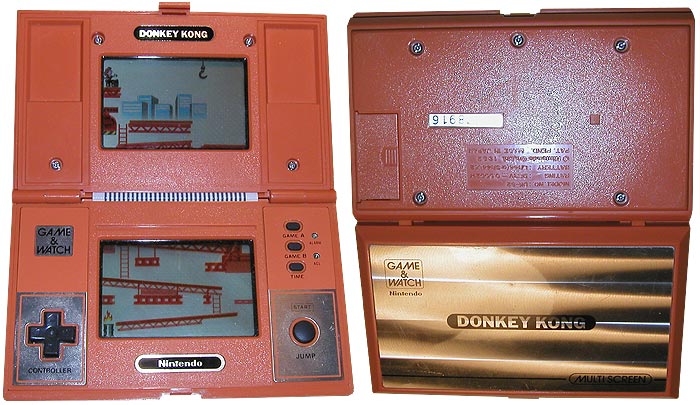
- Well, anonymous, here's what I know about early Nintendo pads. On the early Game and Watches (the nonconnected style ones that most resemble Entex's design) like this one, Nintendo just called them the "+ Control".
- Once they shifted to a connected-style Dpad like this one, they called it the "Controller". Note that they're not referring to the whole setup when they say "controller"; they've got a seperately labeled jump button. I don't think Nintendo has referred to their pads as "cross pads", although I'm open to correction if anyone knows differently. Daniel Davis 08:31, 23 January 2006 (UTC) (Doom127)
Thank you for your reply. I think we almost had it. I said cross, you said control... after searching, "Control Cross" seems to be the original term Gunpei used to describe it. It might've been something I read in David Sheff's Game Over. Without reading it over again, I don't think I could find a quote. But the "control-cross" term is used on Gunpei Yokoi's wikipedia article. Since it refers to the D-Pad, it's probably worth mentioning on here too (even if it doesn't state specifically that he penned the term). 24.165.203.79 04:04, 24 January 2006 (UTC)
- I believe the term is "cross key." Source
[edit] Microvision
Shouldnt the Microvision handheld be removed from the list of systems with a D-Pad? While it did have directional buttons it didnt have a D-Pad.
- That's wrong. The Microvision had several different types of control system, each of which was incorporated seperately into its cartrige designs. That basically meant that each cartridge itself contained the actual pad design, and underneath the cartridge was contained the underlying switches. Cosmic Hunter was a Microvision cartridge that had a D-pad specifically as defined here:
- "A four-directional switch which can be turned on and off in four directions, which comprises a base plate having a plurality of electrodes formed thereon (Microvision has this), a key top having an indication showing predetermined four pressing directions in an identifiable manner (Microvision's Cosmic Hunter game adds this), a support member constituting a fulcrum between the base plate and the key top, a plurality of conductive rubbers disposed opposing to the plurality of electrodes so as to be in electrical contact with corresponding ones of the electrodes (the microvision has this too), and a sustaining member having the plurality of conductive rubbers fixed thereto and having elastic force for sustaining the conductive rubbers so as not to be in contact with the electrodes when the key top is not pressed. (and this too)"
- In a nutshell, Nintendo defines a dpad as a single plastic keytop with directional indicators that fits over a series of rubber switches; when the keytop is pressed downward, it in turn depresses one or more of the hidden rubber switches underneath it, completing a conductive circuit and thus telling the game console to do whatever it should do whenever that conductivity is activated.
- Basically, the only thing that seperates, hardware-wise, Nintendo's design from the Microvision's design is that, since the top of the keypad is built into the cartridge itself, it can be removed.
- In otherwords, the Microvision DOES have a d-pad, and should remain on this list. —The preceding unsigned comment was added by 67.5.191.119 (talk) 08:52, 5 January 2007 (UTC).
[edit] Sony
In the same vein as the above comment, shouldn't the PSX, PS2, PS3 and PSP be removed from the list?
From memory, they also have separate buttons for each direction. bjmurph talk‽ 15:25, 14 October 2007 (UTC)
- In any case, something should be mentioned about the difference... the WonderSwan has the same layout. Esn 07:27, 24 October 2007 (UTC)
- I disagree. They operate identically (the Sony pads are actually connected as a single unit underneath the pad surface), not warranting extra space devoted to it. The differences in variation- whether it be pads that are circular, cross shaped or a segmented cross, all work in the exact same manner. A minor asthetic difference in the pad's appearance doesn't change its operational functionality. And, in regards to your edit comment before, Dpad DOES = Directional Pad, which is why there's a D in it. Which stands for Directional. 67.94.201.2 05:45, 27 October 2007 (UTC)
[edit] incorrectness and stuff
the [analog stick] article says "The analog stick has greatly overtaken the D-pad in both prominence and usage in console video games." whereas this article says "A D-pad (short for directional pad) is a tetradirectional (4-direction) control found on nearly all modern video game console gamepads and game controllers"
also It doesn't mention that most D-pads are 8-direction because you can pres 2 at the same time —Preceding unsigned comment added by Veggieburgerfish (talk • contribs) 22:46, 24 December 2007 (UTC)
[edit] direction controller for left-handed people?
Why are these things always put on the left hand side of the controller, given that most people are right-handed? They give left handed players an unfair advantage. 70.20.228.140 (talk) 05:33, 7 January 2008 (UTC)
[edit] Sega's coining of the term
The actual term "D-pad" was coined by Sega. The company used the term when describing the controllers for the Genesis system in instruction manuals and other literature.
I'm certain it was used in manuals for the Master System too. The console itself was released long before the Mega Drive/Genesis (but on the other hand it's possible that the term "D-pad" was only used in manuals for Master System made after the Mega Drive's launch). Can anyone confirm whether there are any manuals for pre-1988 Master System games that used the term? --Nick RTalk 14:19, 16 January 2008 (UTC)
I believe Nintendo specifically uses the term "Control Pad" to reffer to the cross key. They have done so since the NES. —Preceding unsigned comment added by 72.77.232.145 (talk) 11:19, 25 January 2008 (UTC)
I had always assumed the term came from lettered annotations of controllers: A button, B button, C stick, D pad, etc. Especially the N64 controller. I know it's hard to prove a negative, but was that not the case? - RubyJester (talk) 14:27, 7 March 2008 (UTC)
[edit] Patenting
In 1982, Nintendo's Gunpei Yokoi updated this idea, shrinking it and altering the points into the familiar modern "cross" design for their Donkey Kong handheld game. The design proved to be popular for subsequent Game & Watch titles, although the previously introduced non-connected D-pad style was still utilized on various later Game & Watch titles, including the Super Mario Brothers handheld game. This particular design was patented.
Which design? I don't know the answer myself and this paragraph is unclear. I think it was the cross design that was patented? Lot49a (talk) 10:44, 18 April 2008 (UTC)