Talk:Convergent evolution
From Wikipedia, the free encyclopedia

[edit] Convergent/Parallel evolution and subsequent animal classification
Is there a categorization of animal that groups them based in their morpohology, that is, in the total of their phenotypes? Ignoring phyllogenetic trees and all... Just based in what "looks alike"? Mmm... For example placing tazmanian devils with coyotes and dogs... Placing rhinos with triceratops and worms with snakes or cats with saber-tooth tigers? Undead Herle King 09:09, 24 June 2007 (UTC)
[edit] Sentence modified
I changed "also developed similar to insects due to the need to detect smells in the air." There is no directed evolution. Evolution is thought to be a blind and purposeless process. Birds did not evolve wings because they needed to fly. Giraffes did not evolve long necks because they needed to feed on tree leaves.
The idea of "nature did this and that because of this and that" has no room in a materialistic world view. Everything is just pure chance of mutation and merciless natural selection.
- And of course a materialistic worldview is the only valid one, right?
Rebuttal: This view is that of this particular author and is not accepted by everyone, a large group believe that giraffes actually did evolve long necks in order to reach the new 'type' of trees which had leaves taller. They developed and evoloved in order to reach a environmental niche which hadn't as yet been utilised. (Aswell as other reasons i'm not going to go into now). This topic is still greatly debated and i urge you to research using other materials in order to reach you opinion.
Commenting on the rebuttal: The point about evolution being directed should be clarified. Giraffes did not "evolve long necks in order to reach the new 'type' of trees which had leaves taller. They developed and evoloved in order to reach a environmental niche which hadn't as yet been utilised." This implies foresight and a goal, neither of which exist. This should be phrased as "those giraffes that happened to have longer necks were better able to survive and reproduce, and passed on the alleles for longer necks in a higher proportion compared to other alleles." However, there is compelling evidence that giraffe necks are not adaptations for feeding at all, but rather for combat. I recommend the article "Winning by a neck: Sexual selection in the evolution of giraffe" by RE Simmons and L Scheepers, published in American Naturalist Vol. 148, no. 5, pp. 771-786. Nov 1996. The gist of it is that:a) male giraffes fight for mates by clubbing each other with their heads/necks, b) during the dry season when food is scarce, giraffes still feed on lower vegetation available to other browsers, and c) the neck has increased much more than the legs, even though legs provide a much more economical way of gaining height. Even though it seems "obvious" that the long neck is for feeding on higher leaves, it is important not to make conclusions without investigation.
[edit] Marsupials vs placentals
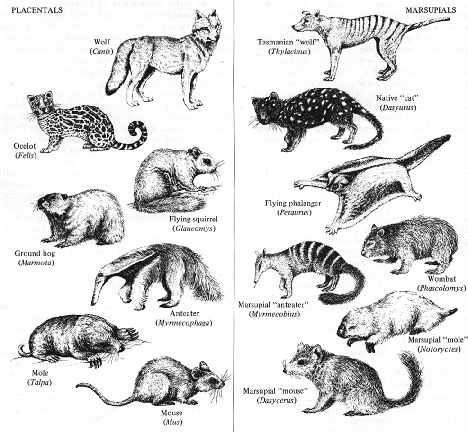
What about the marsupials of australia vs the placentals of everywhere else? Isn't this considered an example, too? There are bear-like, mouse-like, wolf-like, squirrel-like marsupials. - Omegatron 01:32, Jan 3, 2005 (UTC)
http://www.nwcreation.net/images/marsupials.gif maybe public domain?
[edit] Yes, and there are some good examples
Campbells Biology 7th edition notes these in a nice chart on page 969 (Marsupial/Eutherian): Plantigale/Deer Mouse Marsupial Mole/Mole Sugar Glider/Flying Squirrel Wombat/Woodchuck Tasmanian Devil/Wolverine Kangaroo/Patagonian Cavy —Preceding unsigned comment added by 24.95.246.192 (talk) 05:16, 9 December 2007 (UTC)
[edit] New paragraph moved for discussion
I removed the following paragraph from the article.
- several anti-evolutionist critcisms have pointed out that the explanation of convergent evolution make darwinain homologies basically immune to critcism, one of many ways it is alledged evolution makes itself virtually immune to falsification, and hence "unfair". Some authors have gone as far as to claim that darwinism is compatiable with all (or basically all) possible worlds, hence making it unscientfic, or even pseudoscientfic, using the hypothesis of convergent evolution as a example of such "data avoidance", CF popper. Evolutionary biologists usually respond by saying that evolution only has so much "wiggle room" and hence if false could be proven so by certain results.
Could someone explain how convergent evolution makes evolution unfalsifiable? That doesn't make any sense to me, although I should disclaim that I am a firm believer in science and religious criticisms of science rarely make sense to me. Can the contributor provide any scientist works that allege such problems with evolution's falsifiability (since the criticism seems to be of scientific problems with evolution, and not of the "my book says it's not so" variety). — Knowledge Seeker দ (talk) 09:22, 7 Jan 2005 (UTC)
- Doesn't make sense to me, either. - Omegatron 23:22, Jan 22, 2005 (UTC)
As I hold this view myself, I'll try to explain. When one is trying to support or discredit evolution, one looks at the animals alive today and judges whether they show evidence of having evolved that way or were more or less created that way. Things like amphibians support evolution, because they're seemingly a transitionary stage between fish and reptiles, but to see two creatures that look nearly identical yet are supposedly genetically very different would imply that they were created that way by a higher being that enjoyed that shape. Because evolution is said to be random, i.e. mutations happen completely at random and hopefully only beneficial ones make it into the gene pool, it would be an amazing coincidence for the same set of mutations to occur -twice-, just like lightning striking twice. (for that matter, a lot of scientists believe it's an amazingly rare phenomenon for any mutation to be beneficial) For a creationist, this seems like a good argument, then evolutionists come out with 'convergent evolution' without any explanation as to -why- it occurs, but simply a claim that it does, as a defense.. and to us it seems an unfair defense, as it's completely unfalsifiable. When evolution follows expected rules, it makes sense, yet when it doesn't, they seem to make up new rules to -make- it make sense. Understand?
- I don't believe that organisms that have some similar property but that are genetically different (why the supposedly?) implies that they were created that way. There is more than one way to accomplish a certain task, like construct an eye, for instance. Evolution is decidedly not random: mutations may be, but the ones that survive, and therefore the progression of the gene pool, is highly directed—that's why evolution works. You are correct that it would be unlikely for the same set of mutations to occur twice—but organisms displaying convergent evolution have similar features from entirely different genes. I don't believe convergent evolution is a new concept that scientists have recently come up with, but I will try to explain why it occurs. Fins arose in the early vertebrates (the fish) presumably because they help the animals to move faster and more efficiently, and therefore are more likely to survive. However, they're not too useful on land, although legs are, which is why land animals have these. But the group of mammals that spent increasing amounts of time in the water had an advantage if they could swim more efficiently, and this was likely the reason for the progression of forelimbs to flippers and the regression of the hind limbs in the dolphins and whales (and the muscular tail). There are only so many ways to propel oneself in the water; it is not surprising that a smooth, solid (as opposed to having separate digits) appendage occurs in both sharks and dolphins, animals that very superficially resemble each other (enough so that dolphins were once considered to be fish, like sharks). Even human swimmers use a similar apparatus (flippers that are smooth, rubbery, solid, and with a large surface area) to help them move through the water, since our appendages are clearly not well-suited for aquatic travel. The similarity between dolphins and sharks is superficial, however. Dolphins are "warm-blooded" like other mammals, give birth to live young, and need to breathe air like other mammals. Most telling, however, is the anatomy of the homologous structures. The fins of a shark are constructed like the fins of other fish, and sharks too swim with their tail oriented vertically, moving from side to side. Dolphins, however, are descended from land mammals like we are. The bones of their flippers include a shortened humerus (arm bone), radius and ulna (forearm bones), carpals, metacarpals, and five "fingers", with the corresponding numbers (three phalanges for the 4 fingers, two for the "thumb"), just like in us. Why dolphins should have a distorted "hand" inside their flippers makes little sense from a design perspective, but makes perfect sense considering their origin. Incidentally, most whales/dolphins don't have hind limbs, although some have tiny vestigial ones deep inside their bodies. Also, the spine of a dolphin is like ours—it bends more easily and more powerfully forward and backwards (or for the dolphin, up and down), not side to side—so their tails are oriented horizontally and they move their tails up and down to swim. In fact, it is similar to the way a human with flippers swims—and different from the sharks and other fish. That's convergent evolution—superficially similar structures, to accomplish the same task, but arising by different routes. Convergent evolution would be expected, not a surprise. As for your point of the appearance of new rules, I'm afraid that's how science works. If new evidence arises, then you try to find a new theory that best explains the available evidence. Sometimes it means modifying the theory. Sometimes it means coming up with a whole new theory. If new information comes to light, we modify or discard the theory, instead of stubbornly clinging to it as overwhelming evidence continues to accumulate. — Knowledge Seeker দ 05:33, 18 October 2005 (UTC)
Could someone just please post a link to an article which describes how convergent evolution occurs, instead of just giving examples? I think this would mollify the folks crying "unfalsifiable". - LyleK
- There aren't any, that's the problem. Nobody knows "why" or "how" it works, it's just a term made up to explain an observation.
-
- B-U-L-L-S-H-I-T to the nth degree. Look up natural selection and ecological niche and population genetics and exaptation in any good encyclopedia anytime. This is not the 19th century anymore.
- "it's just a term made up", yeah, right... Do me a favor: learn to read. You can write, so not all hope's lost...
- Sop you wanna have an example? Here goes:
- Shrew-like mammal lives on ground, has forelimbs, can dig a bit. Some descendants dig better than others. Some decendants are also mutations, freaks, cripples, you name it - but they can still make some sort of living. Some of these happen to have clubby hands and stumpy fingers. Makes them better diggers, if nothing else.
- Repeat for say 500.000 generations.
- Repeat again, this time with a sort of grasshoppery insect.
- Result? Moles and mole crickets.
-
- This could essentially be done for any case on the list - the bottom line is that in evolution, any property that doesn't kill you will get tried out. And "any" is, basically anything that natural variation is able to produce (including heritable diseases). And that is a lot.
- The problem with people like you is, you have NO FRICKIN IDEA HOW MUCH it is. You have noit the slightest inkling of understanding what biodiversity is or what it means.
- There is one case in the list where I am abolutely sure that I at least cannot give an answer, and I think nobody can. The look-alike longspur and meadowlark.
- Assuming that Genesis is right and Darwin is wrong [which may well be so, but shutting your ears and singing "lalala no evidence can't hear you" won't get you anywhere], the closest thing to a "proof" for that would be a bunch of songbirds that are pretty irrelevant in the big scheme of things.
- What does this tell you about God?
- (Believe me - you'll be better off with trusting in evolution. God, if He exists, is either a bitch who finds it more important to create mosquitos and beetles than to care about humans, or a freak on LSD.) Dysmorodrepanis (talk) 04:27, 16 February 2008 (UTC)
[edit] parallel convergence
please clarify the difference between parallel and convergent evolution - Omegatron 23:22, Jan 22, 2005 (UTC)
Done. Let me know if you feel this requires further elaboration - Gdvorsky 19:54, Jan 22, 2005 (EST)
- i think i get it, but it requires me to think about it a second. some examples would be great. eyes are used as examples in both articles, which probably contributes to my misunderstanding. - Omegatron 04:07, Jan 23, 2005 (UTC)
-
- Oh! i get it, i think:
- convergent evolution: insects, octopuses, and fish-->birds/fish-->mammals all have eyes, but some branched off from the others before eyes had evolved
- parallel evolution: birds and fish both have streamlined body plans and broad flat appendages which happen to work well in both environments - Omegatron 04:11, Jan 23, 2005 (UTC)
Yes, I think your examples are close, but I would like to get some better examples in there. Currently working on it... - Gdvorsky 23:34, Jan 22, 2005 (EST)
Okay, I think that now *I* finally have it. I've clarified the definitions of both convergent evolution and parallel evolution, and added yet a third phenomenon, evolutionary relay. I also removed the discussion of mimicry, as I don't believe it's in the same family of evolutionary processes as these three -- but I did add mimicry to each article's Related articles section. - Gdvorsky 13:25, Jan 23, 2005 (EST)
- Good work... but are parallel evolution and evolutionary relay specific instances of of the more general term, convergent evolution? 68.81.231.127 21:34, 24 Jan 2005 (UTC)
I believe the answer is no, for a reason that facilitated me making these changes in the first place. A post-grad friend of mine recently got nailed during an evo-bio oral examination for not correctly distinguishing between convergent and parallel evolution, prompting me to find the answer. That being said, I think all these entries are still very insufficient, not taking into account things like systematics characters, molecular-level convergence/parallelism, evolutionary regression into convergence/parallelism, etc. Unfortunately, this topic is outside my expertise. - Gdvorsky 21:48, Jan 24, 2005 (EST)
I am having trouble understanding the difference between convergent evolution and evolutionary relay. The article says that what distinguishes the latter is a separation in time, but the evolution of pterosaur wings and bat wings and bird wings (the examples given for convergant evolution) are certainly well-separated in time. And the shark/ichthyosaur example seems weird because sharks were, actually around back when ichthyosaurs evolved. So the examples given don't clarify anything for me. --Xkcd 11:35, 27 February 2007 (UTC)xkcd
[edit] New section for "examples"
I made a new section here for "other examples", hoping to encourage some other interesting and exotic examples of convergent evolution. I included some recent findings on the poison dart frog (found in a NY Times article, http://www.nytimes.com/2005/08/09/science/09frog.html). Archie Paulson 21:11, 10 August 2005 (UTC)
- A Good Addition; this may lead to some new 'break-out' articles. I am pretty sure that there are macroscopic(family and order) versions(as in Australia vs the rest of the Continents) of Conv. evol. vs smaller, family and genus versions. I am adding the New World vultures and the Old World vultures. The New world use Smell, the Old world are in the Eagle family and use Sight (I found this out working on a bird page.).MMcAnnis--Mmcannis 05:31, 24 February 2006 (UTC)
[edit] "Form follows Function", i.e.--Convergent evolution
- It seems too easy to forget the main reason for creating a term: Convergent Evolution. It is as simple as: Form–follows–Function. It is why virtually all of the placentals evolved species categories equivalent to the marsupials, or vice-versa. (It is obvious the oldest and earliest explorers all saw this.) ..MMcAnnis--Mmcannis 18:41, 26 February 2006 (UTC)
- Brilliant! Dysmorodrepanis (talk) 04:28, 16 February 2008 (UTC)
[edit] unreferenced
I added the unreferenced tag to this article. Perhaps one or a few standard texts on evolutionary biology could serve. 24.196.111.46 05:39, 11 April 2006 (UTC)
[edit] Merge from Morphological convergence?
Most of the examples here seem to concern anatomy already. Melchoir 22:20, 23 April 2006 (UTC)
- This seems like a good idea - morphological convergence is a subtopic of this article, and it would be difficult to explain it properly without referencing most of the content presented here. Mike Serfas 02:14, 30 April 2006 (UTC)
[edit] 2 levels of "convergent evolution"
- 1-It should be noted that there are individual, a species level of convergent evolution.
- 2-However, on a Macroscopic level, all of continental australia has forms with analogues in the Placental world vs the Marsupial.
I am not sure that "Morphological convergence" or Convergent Evolution, is addressing these two major, topical distinctions, of Convergent Evolution.--MichaelMcAnnisYumaAZ,USA--Mmcannis 09:46, 20 May 2006 (UTC)
Convergent evolution does also occur at the molecular and physiological levels. While is currently is not covered, it provides justification to keep the entries separate.
[edit] removed questionable bullet
- "Spines have evolved in several mammal groups independently - Echidnas (Monotremes), Hedgehogs (insectivores), Old World porcupines (Rodents) and New World porcupines (a separate group of rodents). In this case, because the two groups of Porcupines are relatively closely related, they would be considered to be an example of parallel evolution; neither Echidnas nor Hedgehogs, however, are closely related to Rodents at all. In fact the last common ancestor of all four groups was a contemporary of the Dinosaurs."
Excuse me, what? "spines have evolved in mammals"? I suppose before that key event, they were part of the little-known but widespread group of spineless mammals? Spines - to the best of my knowledge - are thought to have evolved before any animal put foot (or flipper) on land, in anchient fish, carried into tetrapods, diapids, therapods (the proto-mammals), and kept the *whole* time, right up untill placentals, marsupuals and monotremes diverged. So no convergent evolution there - Jack (talk) 02:06, 20 July 2006 (UTC)
- Wrong spines. We're talking about the spiky ones. Is there a better word for those? - Samsara (talk • contribs) 08:24, 20 July 2006 (UTC)
- Lol. *kicks self* should have thought bout it before I launched into rant - Jack (talk) 13:32, 20 July 2006 (UTC)
Regarding the perported contradition between parallel and convergent evolution; I believe this stems from a misunderstanding between the two concepts.
Parrallel evoluton refers to the evolution of similar traits which have resulted from similar ancestral characteristics. For example Marsupials in Australia and Placentals in south America share similar ancestors but have developed in parallel although seperated as a result of plate tectonics resulting in continental drift.
Convergent evolution species on the other hand do not have similar ancestors or traits. It is the case that evolution have arrived at the same answer to a problem through different developmental pathways. for example; a bats wing, a bees wing and a birds wing are all different in structure, in terms of homology, but represent a similar solution to the problem of flight.
cliveClive140359 12:09, 9 May 2007 (UTC)
[edit] "Not monophyletic" organisms?
I think that this criterion is somewhat unclear, since there are no special creations, all life is monophyletic at some point. More proper would be something like that "organisms that aren't from far related taxa or clades", even though it is not quite clear as well, how much relatedness is far and how much is close. Actually I don't even know and I'm often guilty of using "parallel" and "convergent" interchangeably (not on wikipedia, calm down). Not that it really is. Related with this issue, the article of evolutionary relay, a obscure, new to me, distinction of parallel evolution even cites bees and hummingbirds hovering flight as parallel evolution. If such phyletic distance is yet "monophyletic" enough, real convergence would occur only between plants and animals, terrestrials and aliens or something as far as that. --Extremophile 17:26, 9 November 2007 (UTC)
[edit] Links to this page
I noticed that Homoplasy redirects here but the term itself is never mentioned. Would somebody please add a definition? HannsEwald (talk) 00:33, 23 April 2008 (UTC)