Cleopatra Selene II
From Wikipedia, the free encyclopedia
- This article is about the daughter of Cleopatra VII of Egypt and Roman Triumvir Mark Antony. For the daughter of Ptolemy VIII Physcon and Cleopatra III of Egypt, see Cleopatra Selene I.
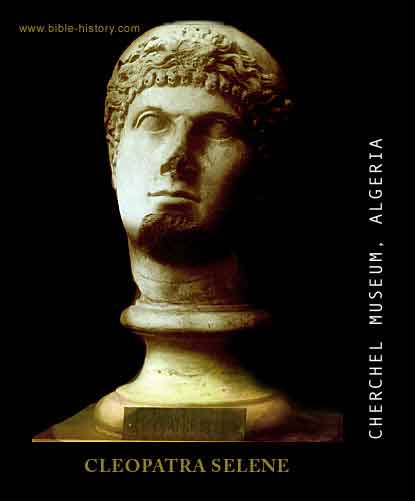
Cleopatra Selene II (Greek:η Κλεοπάτρα Σελήνη, 25 December 40 BC-6), also known as Cleopatra VIII of Egypt or Cleopatra VIII was a Ptolemaic Princess and was the only daughter to Greek Ptolemaic Queen Cleopatra VII of Egypt and Roman Triumvir Mark Antony. She was the younger twin to Ptolemaic Prince Alexander Helios. Her second name in ancient Greek means ‘Moon‘; this was the counterpart of her twin brother‘s second name Helios meaning ‘Sun‘. She was of Greek and Roman heritage. Cleopatra was born, raised and educated in Alexandria, Egypt. In late 34 BC, during the Donations of Alexandria, she was made ruler of Cyrenaica and Libya.
Her parents were defeated by Octavian (future Roman Emperor Caesar Augustus), during a naval battle at Actium, Greece in 31 BC. In 30 BC, her parents committed suicide as Octavian and his army invaded Egypt. Octavian took Cleopatra and her brothers from Egypt to Italy. Octavian celebrated his military triumph in Rome by parading the three orphans in heavy golden chains in the streets. The chains were so heavy that they couldn’t walk. Octavian gave the three siblings to Octavia Minor to be raised in her household in Rome. Octavia Minor became their guardian, was Octavian's second eldest sister and was their father's former wife.
Between 26 BC-20 BC, Augustus arranged for Cleopatra to marry African King Juba II of Numidia in Rome. As a wedding present the emperor gave her a huge dowry and appointed her Queen of Numidia. In return, Cleopatra became an ally to Rome. By then her brothers, Alexander Helios and Ptolemy Philadelphus had died, probably from illness or through murder. When Cleopatra married Juba, she was the only surviving member of the Ptolemaic dynasty.
Juba and Cleopatra returned to Numidia but did not rule there for long. The local Numidians disapproved of Juba becoming too Romanized, which caused civil unrest. The couple were forced to leave Numidia and move to Mauretania. They renamed their new capital Caesaria (modern Cherchell, Algeria), in honor of the Emperor.
Cleopatra is said to have exercised great influence on policies that Juba created. Through her influence, the Mauretanian Kingdom flourished. Mauretania exported and traded well throughout the Mediterranean. The construction and sculptural projects at Caesaria and at another city Volubilis, were built and display a rich mixture of Ancient Egyptian, Greek and Roman architectural styles. The children of Cleopatra and Juba were Cleopatra of Mauretania a possible daughter, Ptolemy of Mauretania (1 BC-40) and Drusilla of Mauretania (born 5). Queen of Syria, Zenobia of Palmyra, is descended from Cleopatra, through her granddaughter Drusilla of Mauretania, the only child of Ptolemy of Mauretania.
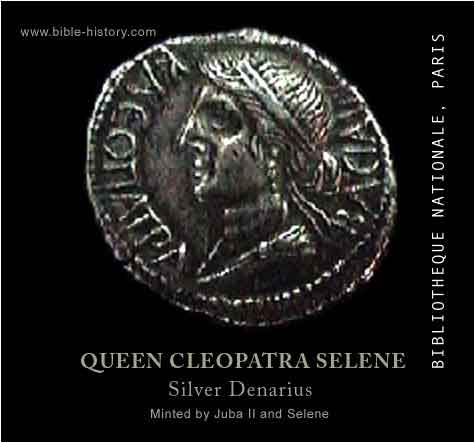
Unfortunately, there are no specific surviving written sources on the life of Cleopatra. Surviving coins and monuments suggest that Cleopatra inherited the iron will and perseverance of the Ptolemaic women. Her various titles on surviving coinage are in Greek: ΒΑΣΙΛΙΣΣΑ ΚΛΕΟΠΑΤΡΑ or ΒΑΣΙΛΙΣΣ ΚΛΕΟΠΑΤΡΑ, which means Queen Cleopatra. These titles were also used on coinage by her late mother. Another title she used on coinage was CΕΛΕNΕ or Selene. Cleopatra seemed to have been religious, patriotic of her Egyptian Greek heritage, though she ignored her Roman heritage. She wanted to retain and continue the Ptolemaic Legacy.
When Cleopatra died, she was placed in the mausoleum that was built by her and Juba. A fragmentary inscription was dedicated to Juba and Cleopatra, as the King and Queen of Mauretania. The following epigram by Greek Epigrammatist Crinagoras of Mytilene is considered to be Cleopatra’s eulogy:
- The moon herself grew dark, rising at sunset,
- Covering her suffering in the night,
- Because she saw her beautiful namesake, Selene,
- Breathless, descending to Hades,
- With her she had had the beauty of her light in common,
- And mingled her own darkness with her death.
Cleopatra is mentioned in the novels by Robert Graves, I, Claudius and Claudius the God. She is the main character of the novel Dear Alexandria written by Mexican author María García Esperón.
[edit] Sources
- Plutarch - Makers of Rome - Mark Antony
- Suetonius - The Lives of the Twelve Caesars - Augustus & Caligula
- Encyclopaedia Britannica - Juba II
- http://www.lunalucifera.com/Mauretania/index.html
- http://www.ancientlibrary.com/smith-bio/1744.html
- http://www.ancientlibrary.com/smith-bio/1745.html
- http://www.geocities.com/christopherjbennett/ptolemies/selene_ii.htm