Cimmerians
From Wikipedia, the free encyclopedia
- See Cimmeria (Conan) or Cimmeria (Poem) for the fiction of Robert E. Howard.
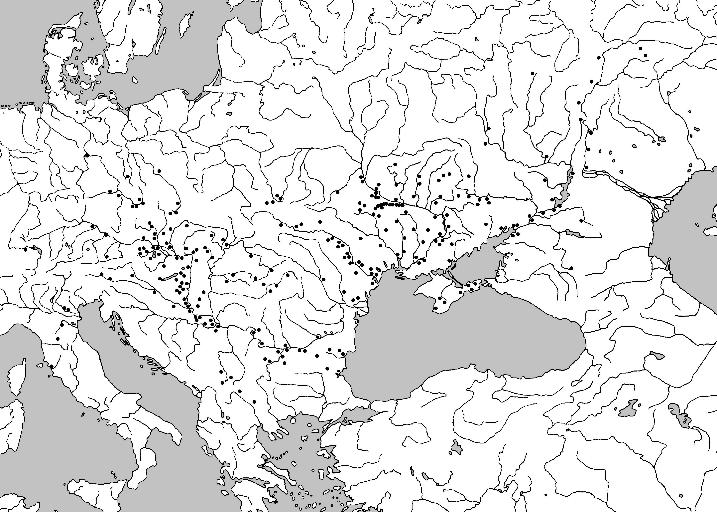
The Cimmerians (Greek: Κιμμέριοι, Kimmerioi) were ancient equestrian nomads who, according to Herodotus, originally inhabited the region north of the Caucasus and the Black Sea, in what is now Ukraine and Russia, in the 8th and 7th century BC.
Contents |
[edit] Origins
Their origins are obscure, but they are believed to have been Indo-European. Their language is regarded as being related to Iranian[1] or Thracian, or they seem at least to have had an Iranian ruling class.[2]
According to Encyclopedia Britannica:They probably did live in the area north of the Black Sea, but attempts to define their original homeland more precisely by archaeological means, or even to fix the date of their expulsion from their country by the Scythians, have not so far been completely successful.[3]
Very little is known archaeologically of the Cimmerians of the Northern Black Sea Coast. They are associated with the Srubna culture, which displaced the earlier catacomb culture (2000-1200 BC).
A few stone stelae found in Ukraine and the northern Caucasus have been connected with the Cimmerians. They are in a style clearly different from both the later Scythian and the earlier Yamna/Kemi-Oba stelae.
[edit] Historical accounts


The first historical record of the Cimmerians appears in Assyrian annals in the year 714 BC. These describe how a people termed the Gimirri helped the forces of Sargon II to defeat the kingdom of Urartu. Their original homeland, called Gamir or Uishdish, seems to have been located within the buffer state of Mannae. The later geographer Ptolemy placed the Cimmerian city of Gomara in this region. After their conquests of Colchis and Iberia in the First Millennium BC, the Cimmerians also came to be known as Gimirri in Georgian. According to Georgian historians,[4] the Cimmerians played an influential role in the development of both the Colchian and Iberian cultures. The modern-day Georgian word for hero which is gmiri, is derived from the word Gimirri, a direct reference to the Cimmerians which settled in the area after the initial conquests.
Some modern authors assert that the Cimmerians included mercenaries, whom the Assyrians knew as Khumri, who had been resettled there by Sargon. However, later Greek accounts describe the Cimmerians as having previously lived on the steppes, between the Tyras (Dniester) and Tanais (Don) rivers. Several kings of the Cimmerians are mentioned in Greek and Mesopotamian sources, including Tugdamme (Lygdamis in Greek; mid-7th century BC), and Sandakhshatra (late-7th century).
A "mythical" people also named Cimmerians are described in Book 11, 14 of Homer's Odyssey as living beyond the Oceanus, in a land of fog and darkness, at the edge of the world and the entrance of Hades; most probably they are unrelated to the Cimmerians of the Black Sea.[5]
According to the Histories of Herodotus (c. 440 BC), the Cimmerians had been expelled from the steppes at some point in the past by the Scythians. To ensure burial in their ancestral homeland, the men of the Cimmerian royal family divided into groups and fought each other to the death. The Cimmerian commoners buried the bodies along the river Tyras and fled from the Scythian advance, across the Caucasus and into Anatolia and the Near East. Their range seems to have extended from Mannae eastward through the Mede settlements of the Zagros Mountains, and south of there as far as Elam.
The migrations of the Cimmerians were recorded by the Assyrians, whose king, Sargon II, died in battle against them in 705 BC. They are subsequently recorded as having conquered Phrygia in 696 BC-695 BC, prompting the Phrygian king Midas to take poison rather than face capture. In 679 BC, during the reign of Esarhaddon of Assyria, they attacked Cilicia and Tabal under their new ruler Teushpa. Esarhaddon defeated them near Hubushna (tentatively identified with modern Cappadocia).
In 654 BC or 652 BC – the exact date is unclear – the Cimmerians attacked the kingdom of Lydia, killing the Lydian king Gyges and causing great destruction to the Lydian capital, Sardis. They returned ten years later during the reign of Gyges' son Ardys II and this time captured the city, with the exception of the citadel. The fall of Sardis was a major shock to the powers of the region; the Greek poets Callinus and Archilochus recorded the fear that it inspired in the Greek colonies of Ionia, some of which were attacked by Cimmerian and Treres raiders.
The Cimmerian occupation of Lydia was brief, however -- possibly due to an outbreak of plague. Between 637 BC and 626 BC they were beaten back by Alyattes II of Lydia. This defeat marked the effective end of Cimmerian power. The term "Gimirri" was used about a century later in the Behistun inscription (ca. 515 BC) as a Babylonian equivalent of Persian Saka (Scythians), but otherwise Cimmerians are not heard of again in Asia, and their ultimate fate is uncertain. It has been speculated that they settled in Cappadocia, known in Armenian as Gamir (the same name as the original Cimmerian homeland in Mannae). However, certain Frankish traditions would locate them at the mouth of the Danube (see Sicambri).
A reference to the Cimmerians is preserved in Gomer גמר of the Hebrew Bible (Standard Hebrew Gómer, Tiberian Hebrew Gōmer, Genesis 10:2, Ezekiel 38:6). As the eldest son of Japheth and the father of Ashkenaz, Riphath and Togarmah, his descendants thus represent one of the major branches of the Japhethic race.
[edit] Timeline
- 721-715 BC – Sargon II mentions a land of Gamirr near to Urartu.
- 714 – suicide of Rusas I of Urartu, after defeat by both the Assyrians and Cimmerians.
- 705 – Sargon II of Assyria dies on an expedition against the Kulummu.
- 679/678 – Gimirri under a ruler called Teushpa invade Assyria from Hubuschna (Cappadocia?). Esarhaddon of Assyria defeats them in battle.
- 676-674 – Cimmerians invade and destroy Phrygia, and reach Paphlagonia.
- 654 or 652 – Gyges of Lydia dies in battle against the Cimmerians. Sack of Sardis; Cimmerians and Treres plunder Ionian colonies.
- 644 – Cimmerians occupy Sardis, but withdraw soon afterwards
- 637-626 – Cimmerians defeated by Alyattes II.
- ca. 515 – Last historical record of Cimmerians, in the Behistun inscription of Darius.
[edit] Language
Of the language of the Cimmerians, only a few personal names have survived in Assyrian inscriptions:
- Te-ush-pa-a; according to Professor J. Harmatta it goes back to Old Iranian Tavis-paya 'swelling with strength'.[1] Mentioned in the annals of Esarhaddon, has been compared to the Hurrian war deity Teshub[citation needed]; others interpret it as Iranian, comparing the Achaemenid name Teispes (Herodotus 7.11.2).
- Dug-dam-mei (Dugdammê) king of the Ummân-Manda (nomads) appears in a prayer of Ashurbanipal to Marduk, on a fragment at the British Museum. According to to Professor J. Harmatta, it goes back to Old Iranian 'Duyda-maya'(giving happiness)[1]. Other spellings include Dugdammi, and Tugdammê. Yamauchi (1982) interprets the name as Iranian, citing Ossetic "tux-domaeg" meaning "ruling with strength." The name appears corrupted to Lygdamis in Strabo 1.3.21.
- Sandaksatru, son of Dugdamme. This is an Iranian reading of the name, and Mayrhofer (1981) points out that the name may also be read as Sandakurru. Mayrhofer likewise rejects the interpretation of "with pure regency" as a mixing of Iranian and Indo-Aryan. Ivancik suggests an association with the Anatolian deity Sanda. According to Professor. J. Harmatta it goes back to Old Iranian Sanda-Kuru 'Splendid Son'[1]. Kur/Kuru is still used as son in Kurdish languages and in Persian it is Korr which is used for the male off-springs of variety of Horses.
Some researchers have attempted to trace various place names to Cimmerian origins. It has been suggested that Crimea is named after the Cimmerians[6] as well as the Armenian city of Gyumri. This, however, seems to be a dubious premise. The name "Crimea" is traceable to the Crimean Tatar word qırım (literally "my steppe" or "my hill"), and the peninsula was known as Taurica ("peninsula of the Tauri") in antiquity (Strabo 7.4.1; Herodotus 4.99.3, Amm. Marc. 22.8.32).
The Cimmerians are generally classified as an Iranian people[1], but based on ancient Greek historical sources, a Thracian[7] or (less commonly) a Celtic[8] association is sometimes assumed. According to C. F. Lehmann-Haupt, the language of the Cimmerians could have been a "missing link" between Thracian and Iranian.
[edit] Possible offshoots
The Cimmerians are thought to have had a number of offshoots. The Thracians have been identified as a possible western branch of the Cimmerians. If Herodotus is to be believed, both peoples originally inhabited the northern shore of the Black Sea, and both were displaced around the same time by invaders from further east. Whereas the Cimmerians would have departed this ancestral homeland by heading east and south across the Caucasus, the Thracians migrated west and south into the Balkans, where they established a successful and long-lived culture. The Tauri, the original inhabitants of Crimea, are sometimes identified as a people related to the Thracians.
Although the Cimmerians of historical record only appear on the stage of world history for a brief time (during the 7th century BC), numerous Celtic and Germanic peoples have traditions of being descended from the Cimmerians or Scythians, and some of their ethnic names might bear out this belief (e.g. Cymru, Cwmry or Cumbria, Cimbri).[citation needed] It is unlikely that either Proto-Celtic or Proto-Germanic entered Europe as late as the 7th century BC, their formation being commonly associated with the Bronze Age Urnfield and Nordic Bronze Age cultures, respectively. It is, however, conceivable that a small-scale (in terms of population) 8th century "Thraco-Cimmerian" migration triggered cultural changes that contributed to the transformation of the Urnfield culture into the Hallstatt C culture, ushering in the European Iron Age. Later Cimmerian remnant groups may have spread as far as to the Nordic Countries. For example the Cimbri tribe, considered to be a Germanic tribe hailing from the Himmerland (Old Dutch Himber sysæl) region in northern Denmark [9].
The etymology of Cymro "Welshman" and Cwmry "Cumbria", connected to the Cimmerians by 17th-century celticists, might instead (according to Phillip Gove) come from Old Welsh combrog "compatriot, Welshman"[10], deriving from an old Brythonic word "combroges" or Proto-British *kom-brogos[11][12], meaning "compatriots", (as a result of the struggle with the Anglo-Saxons) possibly therefore related to its sister language Breton's keñvroad, keñvroiz "compatriot" [13].
In addition, in sources beginning with the Royal Frankish Annals, the Merovingian kings of the Franks traditionally traced their lineage through a pre-Frankish tribe called the Sicambri (or Sugambri), mythologized as a group of "Cimmerians" from the mouth of the Danube river, but who instead came from Gelderland in modern Netherlands and are named for the Sieg river [14].
If the Scythians are assumed to be related to the Cimmerians, as has often been claimed, many other peoples claiming possible Scythian descent could also be added to this list.
The association of the Cimmerians with one of the Lost Tribes of Israel plays a certain role in British Israelism.
Josephus, in his Antiquities, says the descendants of Gomer who were then called Gauls by the Romans, were previously called Gomerites.
[edit] Archaeology
- Koban culture (Northern Caucasus, 12th to 4th centuries BC)
- Cernogorovka culture (9th to 8th centuries)
- Novocerkassk culture (8th to 7th century, between Danube and Volga)
[edit] Notes
- ^ a b c d e J.Harmatta: "Scythians" in UNESCO Collection of History of Humanity - Volume III: From the Seventh Century BC to the Seventh Century AD. Routledge/UNESCO. 1996. pg 182
- ^ Cimmerian. (2006). In Encyclopædia Britannica. Retrieved August 30, 2006, from Encyclopædia Britannica Premium [1]. Actual quote: The origin of the Cimmerians is obscure. Linguistically they are usually regarded as Thracian or as Iranian, or at least to have had an Iranian ruling class.
- ^ Cimmerian. (2006). In Encyclopædia Britannica. Retrieved August 30, 2006, from Encyclopædia Britannica Premium [2].
- ^ Berdzenishvili, N., Dondua V., Dumbadze, M., Melikishvili G., Meskhia, Sh., Ratiani, P., History of Georgia (Vol. 1), Tbilisi, 1958, pp. 34-36
- ^ Entry: Κιμμέριοι at Henry Liddell & Robert Scott.
- ^ Asimov, Isaac. Asimov's Chronology of the World. New York: HarperCollins, 1991. p. 50.
- ^ A.I. Meljukova, Skifija i frakijskij mir, Moscow 1979, 88; Strabo ascribes the Treres to the Thracians at one place (13.1.8) and to the Cimmerians at another (14.1.40)
- ^ Posidonius in Strabo 7.2.2.
- ^ Jones, Gwyn. A History of the Vikings. London: Oxford University Press, 2001.
- ^ Gove, Philip Babcock, ed. Webster's Third New International Dictionary. Springfield, MA: Merriam-Webster, 2002: 321
- ^ Jones, J. Morris. Welsh Grammar: Historical and Comparative. Oxford: Clarendon Press, 1995.
- ^ Russell, Paul. Introduction to the Celtic Languages. London: Longman, 1995.
- ^ Delamarre, Xavier. Dictionnaire de la langue gauloise. Paris: Errance, 2001.
- ^ Geary, Patrick J. Before France and Germany: The Creation and Transformation of the Merovingian World. New York: Oxford University Press, 1988.
[edit] Bibliography
- Ivanchik A.I. "Cimmerians and Scythians", 2001
- Terenozhkin A.I., Cimmerians, Kiev, 1983
- Cimmerian. (2006). In Encyclopædia Britannica. Retrieved August 30, 2006, from Encyclopædia Britannica Premium Service: http://www.britannica.com/eb/article-9082650
- Collection of Slavonic and Foreign Language Manuscripts - St.St Cyril and Methodius - Bulgarian National Library: http://www.nationallibrary.bg/slavezryk_en.html
[edit] See also
- Gog and Magog
- Saka
- Celts
- Amazons
- Cimbri
- Thraco-Cimmerian
- Other Cimmerians: The Cimmerians MILSIM Airsoft Association
- Other Cimmerians: Cimmerian, founder of RantRadio