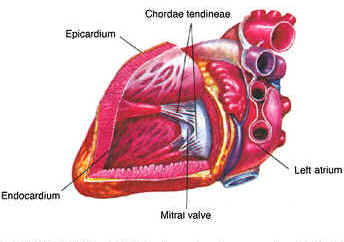
Chordae tendineae
From Wikipedia, the free encyclopedia
 |
This article needs additional citations for verification. Please help improve this article by adding reliable references. Unsourced material may be challenged and removed. (February 2008) |
| Chordae tendineae | |
|---|---|
 |
|
| Interior of right side of heart. | |
 |
|
| The chordae tendineae are the unlabled, white tendons seen connecting the valves to the heart muscle | |
| Latin | chordae tendineae cordis |
| Gray's | subject #138 532 |
| MeSH | Chordae+Tendineae |
| Dorlands/Elsevier | c_31/12236883 |
The chordae tendineae, or heart strings, are cord-like tendons that connect the papillary muscles to the tricuspid valve and the mitral valve in the heart.
When the right ventricle of the heart contracts, the blood pressure pushes the tricuspid valve which closes and prevents a backflow of blood into the right atrium. The chordae tendineae prevents the flaps from being everted into the right atrium. Similarly, these cord-like tendons hold in position other flaps like the bicuspid or mitral valve.
Chordae tendineae are approximately 80% collagen, while the remaining 20% is made up of elastin and endothelial cells.
[edit] External links
- SUNY Labs 20:st-0701 cvfg
- chordae+tendineae+of+heart at eMedicine Dictionary
- false+chordae+tendineae at eMedicine Dictionary
- Organology at UC Davis Circulatory/heart/chambers0/chambers11 - "Mammal heart, chambers (Gross, Low)"
- Bioweb at UWLAX Human heart model (bicuspid valve)
- Illustration at health-pictures.com
|
||||||||||||||||||||
 |
This cardiovascular system article is a stub. You can help Wikipedia by expanding it. |