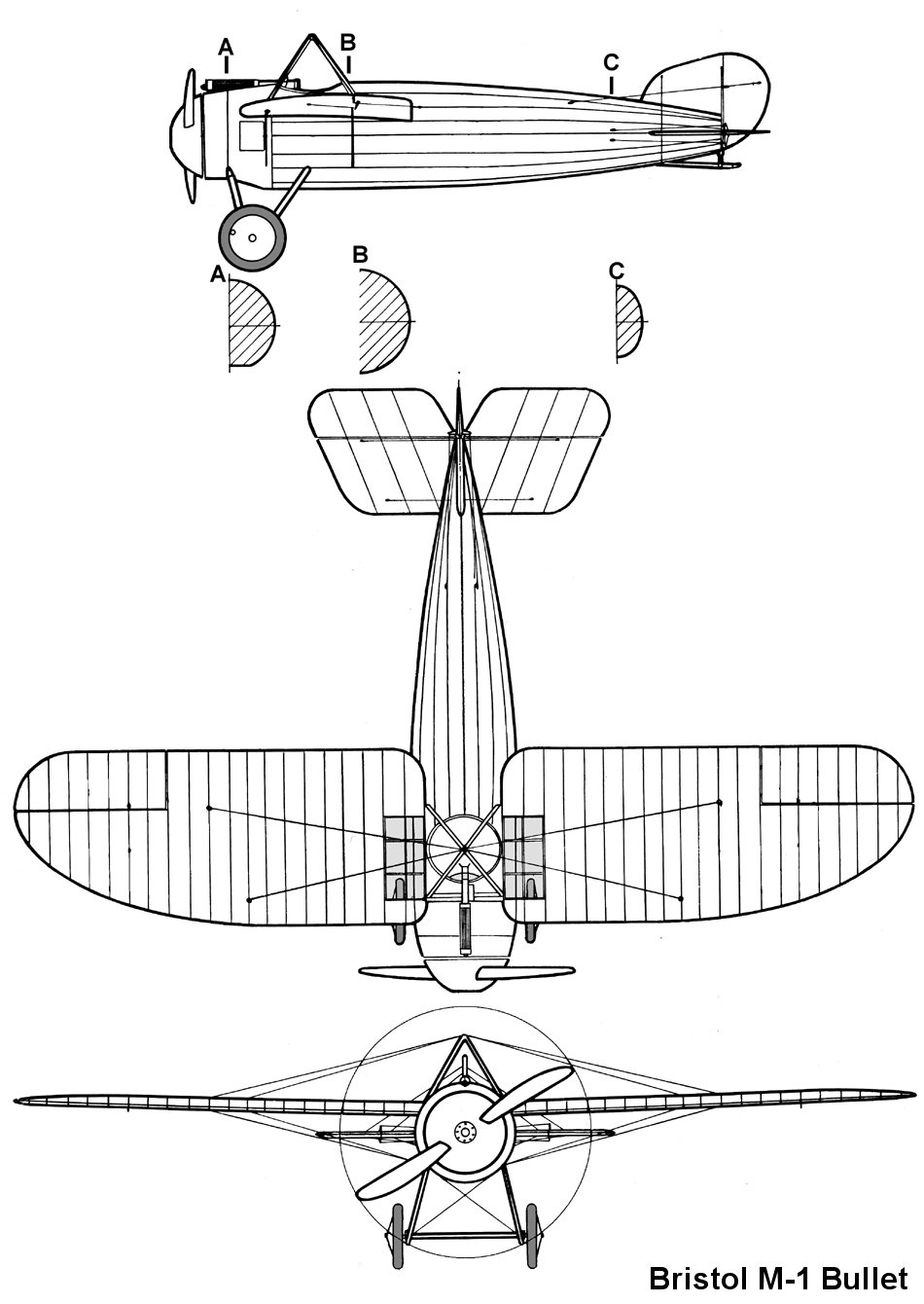
Bristol M.1
From Wikipedia, the free encyclopedia
| M.1 Bullet | |
|---|---|
 |
|
| Type | Fighter |
| Manufacturer | Bristol Aeroplane Company |
| Designed by | Frank Barnwell |
| Maiden flight | 14 July 1916 |
| Introduction | 1917 |
| Primary users | Royal Flying Corps Chile |
| Number built | 130 |
The Bristol M.1 Bullet was a British monoplane fighter aircraft of the First World War.
Contents |
[edit] Development
The M.1A prototype was designed by Frank Barnwell in 1916 and built as a private venture by the Bristol Aeroplane Corporation. The War Office ordered four aircraft for evaluation - designated M.1B - which had a single Vickers machine gun mounted on the port wing and a clear-view cut-out in the starboard wing to give the pilot more downward visibility.
Despite excellent performance (it had a maximum speed 30-50 mph faster than any of the contemporary German Fokker Eindecker monoplanes for example) it was rejected by the Air Ministry for service on the Western Front, ostensibly because its landing speed was considered too high for small French airfields, but more likely because of a widespread belief that monoplane aircraft were inherently unsafe in combat.
Nevertheless, a production order for 125 aircraft was placed on 3 August 1917. Designated M.1C, this version was fitted with a Le Rhône rotary engine and had a Vickers machine gun centrally-mounted in front of the pilot.
A single M.1, registered G-EAVP was rebuilt as a high-speed testbed for the Bristol Lucifer three cylinder radial engine. This aircraft was designated the M.1D.
[edit] Operational history
Thirty-three M.1Cs served in the Middle East and the Balkans in 1917-18, while the rest were used by UK-based training units, where they were popular as personal mounts for senior officers[1].
Six were sent to Chile in part payment for two warships being built for Chile in Britain but commandeered for the Royal Navy before completion. One of these, flown by Lt. Goday, was used to fly from Santiago to Mendoza, Argentina and back on 12 December 1918, the first flight across the Andes mountain chain.[1]
[edit] Variants
- M.1A
- Single prototype with 110 hp (82 kW) Clerget rotary engine.
- M.1B
- Four evaluation models.
- M.1C
- Series production model, 125 built.
- M.1D
- Single M.1C rebuilt as testbed for Bristol Lucifer engine.
[edit] Operators


- Royal Flying Corps / Royal Air Force
- No. 14 Squadron RAF
- No. 47 Squadron RAF
- No. 72 Squadron RAF
- No. 111 Squadron RAF
- No. 150 Squadron RAF
[edit] Specifications (M.1C)
 This aircraft article is missing some (or all) of its specifications. If you have a source, you can help Wikipedia by adding them.
Data from Encyclopedia of Military Aircraft[2]
General characteristics
- Crew: one, pilot
- Length: 20 ft 5 in (6.24 m)
- Wingspan: 30 ft 9 in (9.37 m)
- Height: 7 ft 9 in (2.37 m)
- Wing area: 145 ft² [1] (13.6 m²)
- Empty weight: 900 lb [1] (409 kg)
- Loaded weight: 1,348 lb (611 kg)
- Powerplant: 1× Le Rhône 9J rotary engine, 110 hp (82 kW)
Performance
- Maximum speed: 113 knots (130 mph, 209 km/h) at sea level
- Service ceiling 20,000 ft (6,096 m)
- Endurance: 1 hr 45 mins
Armament
- 1 × fixed-forward .303 in (7.7 mm) Vickers machine gun
[edit] See also
Related lists
[edit] References
[edit] External links
- Original aircraft preserved at Minlaton, South Australia
- RAF Museum
- WWI Aviation
- Duxford legends
- Scale plans of the Bristol M.1 Bullet
|
||||||||
|
||||||||||||||