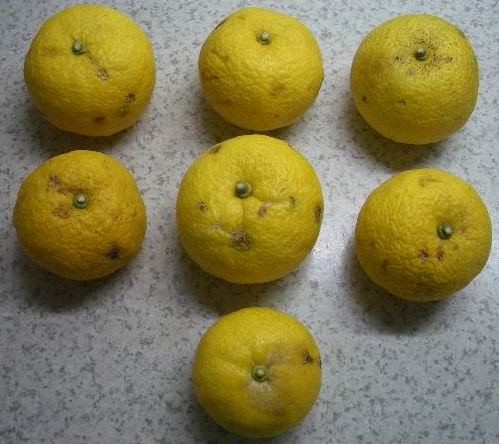
Yuzu
From Wikipedia, the free encyclopedia
| Yuzu | ||||||||||||||||
|---|---|---|---|---|---|---|---|---|---|---|---|---|---|---|---|---|
 Yuzu branch with ripe fruit
|
||||||||||||||||
| Scientific classification | ||||||||||||||||
|
||||||||||||||||
| Binomial name | ||||||||||||||||
| Citrus ichangensis x Citrus reticulata var. austera |
The yuzu (Citrus ichangensis x C. reticulata, formerly C. junos Siebold ex. Tanaka; Japanese ユズ, 柚, 柚子 (yuzu); 유자 (yuja) in Korean; from Chinese 柚子, yòu zi) is a citrus fruit originating in East Asia. It is believed to be a hybrid of sour mandarin and Ichang papeda. The fruit looks a bit like a very small grapefruit with an uneven skin, and can be either yellow or green depending on the degree of ripeness. Yuzu typically range between 5.5 and 7.5 cm in diameter, but can be as large as a grapefruit (up to 10 cm or larger).
The fruit originated in China, and also grows wild in central China and Tibet. It was introduced to Japan and Korea during the Tang Dynasty and it is in these nations that it is cultivated most widely[citation needed]. Confusingly, in modern Chinese, the name 柚子 refers to the pomelo, while the yuzu is known as 香橙.
It is unusual among citrus fruits in being relatively frost-hardy, due to its cold-hardy C. ichangensis ancestry, and can be grown in regions with winters as low as -5°C where more sensitive citrus would not thrive. In Japan, an ornamental version of yuzu called hana yuzu (花ゆず, 花柚子?) "flower yuzu" is also grown for its flowers rather than its fruit.
A variety of yuzu with knobby skin is called shishi yuzu (literally "lion yuzu").photo
Contents |
[edit] Use in Japanese cuisine
The yuzu's flavor is tart, closely resembling that of the grapefruit, with overtones of Mandarin orange. It is rarely eaten as a fruit, though in the Japanese cuisine its aromatic zest (outer rind) is used to garnish some dishes, and its juice is commonly used as a seasoning, somewhat like the way the lemon is used in other cuisines. It is an integral ingredient (along with sudachi, daidai, and other similar fruits) in the citrus-based sauce ponzu. Yuzu may be used to make marmalade or as an ingredient in cakes. It is also used to make liquor (such as yuzukomachi, 柚子小町) and wine.[1][2] Yuzu kosho (also yuzukosho, literally "yuzu and pepper"), is a spicy Japanese sauce made from green or yellow yuzu zest, green or red chile peppers, and salt. Slivered yuzu rind is also used to garnish a savory, salty egg-pudding dish called chawanmushi, as well as miso soup.[3]
Yuzu is also known for its characteristically strong aroma, and the oil from its skin is marketed as a fragrance. In Japan, bathing with yuzu on Toji (the winter solstice) is a popular custom. The whole fruits are floated in the hot water of the bath (sometimes enclosed in a cloth bag), releasing their aroma.
It is often used alongside with sudachi and kabosu.
[edit] Use in Korean cuisine
The fruit is also used, thinly sliced and combined with sugar and honey, to make a thick, marmalade-like syrup containing pieces of the chopped rind and fruit. A tablespoon of this syrup (which can either be made at home or purchased in glass jars) stirred into a cup of hot water makes a beverage called yuja chaphoto (유자차; also spelled yujacha or yuja-cha, cha meaning "tea" in Korean), or, which is used as a herbal remedy for the common cold and similar winter illnesses.
It is also used to make yuja hwachae, a variety of traditional fruit punch.
[edit] Use in Western cuisines
Beginning in the early 21st century, yuzu has been increasingly used by chefs in the United States and other Western nations, achieving notice in a 2003 article in The New York Times.[4] Yuzu has also been used in beer, in the Dutch beer called iKi, brewed in Haarlem, Netherlands.[5]
[edit] Other uses
The body of the taepyeongso, a Korean traditional oboe, is often made from yuzu wood.
[edit] References
- Karp, David. "Secrets Behind Many Chefs' Not-So-Secret Ingredient." The New York Times, December 3, 2003, Dining In, Dining Out/Style Desk, Section F, p. 12.
[edit] External links
- Article about yuzu
- Article from The New York Times
- "Yuzu & Huckleberry: Flavors of the Moment", by Janet Fletcher, from San Francisco Chronicle, Wednesday, May 31, 2006
- Yuzu articles
- Yuja-cha page
- Photo of yuzu
- Photo of a bottle of yuzu juice
- "Food Marketers Put Taro, Yuzu In Recipe For Growth", by Sonia Reyes, from Brandweek, June 26, 2006
[edit] Listening
- "Cooks Look for Answers to Citrus Freeze", from National Public Radio Weekend Edition Sunday, January 28, 2007


![[2]](http://www7.airnet.ne.jp/yamadaya/yuzu.JPG)