Worksop Priory
From Wikipedia, the free encyclopedia

 
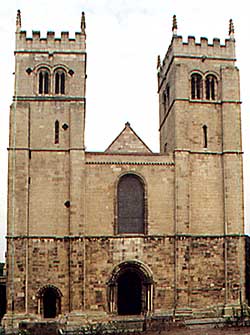
Worksop Priory (formally The Priory Church of Saint Mary and Saint Cuthbert, Worksop) is a Church of England parish church and former priory in the town of Worksop, Nottinghamshire, part of the Diocese of Southwell and Nottingham.
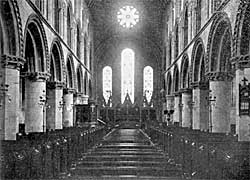
[edit] HistoryThe initial land grant and monies to establish the Augustinian priory were made by William de Lovetot in 1103. In the 14th century the Tickhill Psalter was produced by then prior, John de Tickhill. The priory was dissolved on the orders of Henry VIII on November 15, 1539. Over time most of the former monastic buildings were plundered for their stone, however the nave of the church was saved for use as a parish church, and the early 14th century gatehouse was later used as a school. Extensive restoration and enlargements of the church began in the mid 19th century and continued through the 20th century. [edit] The Organ of Worksop PrioryThe organ case was designed by the builders, Peter Collins, in close co-operation with the architects, Laurence King and Partners, and though painted is constructed in mahogany in its main parts with pine-cored block wood for its panels. The case has a tonal function as well as an architectural one, mixing the sound of the various pipes, then projecting it forwards as a blended whole. The specification was drawn up by David Butterworth and is almost identical to that of St. Mary's, High Pavement in Nottingham. The console, situated at the foot of the central display pipes is constructed of oak; the naturals are of hard ‘blackwood' and the accidentals are white resin topped. The manual compass is of 56 notes; the pedal compass of 30 notes. The style of voicing and the general approach to the construction has its origins in the 17th and 18th centuries, rather than the more familiar instrument to be found in England. The balance of stops is in keeping with classical registration and the ‘Werk-Prinzip' of the case is designed to project the sound into the Priory building. For the mechanism of the key and pedal action, direct connection by trackers of thin wood are used to the control valves, giving the performer control over the attack and decay of each note. The stop action is electric. There are six pistons to each department and six toe levers for the pedal department. There are also eight general pistons. The organ was reconstructed in 1996 by Wood of Huddersfield. It was cleaned and regulated and the soundboards were also reconstructed. The keys were renewed; Swell Octave 2ft replaced with new pipework by Stinkens; Cymbelstern added; entire stop action (slider solenoids excepted) was remade The Great Organ Principal 8 Swell Organ Wood Gedact 8 Pedal Organ Subbass 16 [edit] Pictures[edit] See also[edit] References
[edit] External links
|