William Kentridge
From Wikipedia, the free encyclopedia
William Kentridge is a South African artist who was born in Johannesburg, South Africa in 1955. He took a B.A. in Politics and African Studies at the University of the Witwatersrand and then a diploma in Fine Arts from the Johannesburg Art Foundation. At the beginning of the 1980s he studied mime and theatre at the Ecole Jacques Lecoq in Paris. He had hoped to become an actor however, "I was fortunate to discover at a theatre school that I was so bad an actor... I was reduced to an artist and I made my peace with it."[1]. Between 1975 and 1991 he was acting and directing in Johannesburg’s Junction Avenue Theatre Company. In the 1980s he worked on television films and series as art director.
Kentridge is perhaps best known for his animated films. These films are constructed by filming a drawing, making erasures and changes, then filming it again. He continues this process meticulously giving each change to the drawing 1/4 to 2 seconds of screen time. A single drawing will be altered and filmed this way until the end of that scene. These drawings are later displayed along with the films as finished pieces of art. 4
Contents |
[edit] Career
In 1989 he created his first animation work, Johannesburg, 2nd Greatest City After Paris, in the series Drawings for Projection. In this he used a technique that became a feature of his work: successive charcoal drawings, always on the same sheet of paper, contrary to the traditional animation technique in which each movement is drawn on a separate sheet. In this way Kentridge’s videos and films keep the traces of the previous drawings. His animations deal with political and social issues from a personal and – at times – autobiographical point of view, since the author includes his self-portrait in some of his works.
The political content and the unique techniques of Kentridges' work have propelled him into being one of South Africa’s top artists. Working with what is in essence a very restrictive media, using only charcoal and a touch of blue or red pastel, he has created animations of astounding depth. A theme running through all of his work is his peculiar way of representing South Africa. He does not portray it as the very militant or oppressive place that it was for black people but he doesn’t emphasize the picturesque state of living that white people enjoyed during Apartheid either. Instead he presents a city in which the duality of man is exposed. In his series of nine short films he introduces two characters, namely Soho Eckstein and Felix Teitlebaum. These characters depict an emotional and political struggle that ultimately reflects the life of many South Africans of the time.


In the introductory note to Felix In Exile Kentridge writes: "In the same way that there is a human act of dismembering the past there is a natural process in the terrain through erosion, growth, dilapidation that also seeks to blot out events. In South Africa this process has other dimensions. The very term ‘new South Africa’ has within it the idea of a painting over the old, the natural process of dismembering, the naturalization of things new." Not only in Felix In Exile but in all his animated works the concept of time and change is a major theme that. The way he does this is through his erasure technique which contrasts with conventional cell animation whose seamlessness de-emphasizes the fact that it is actually a succession of hand-drawn images, This is implemented by drawing a key frame, erasing certain areas of it, then re-drawing them and thus creating the next frame. In this way he is able to create as many frames as he wants based on the original key frame by simply erasing small section of it. Traces of what has been erased are still visible to the viewer and as the films unfold a sense of fading memory or the passing of time and the traces it leaves behind are portrayed by William Kentridge’s technique which grapples with what is not said, what remains suppressed or forgotten but can be easily felt.
In the nine films that follow Soho Eckstein’s life, an increasing vehemency is placed on the evanescing health of the individual and of the contemporary society in South Africa. Conflicts between anarchic and bourgeois individualistic beliefs, which is again a reference to the duality of man, indicate the idea of a social revolution in his works by poetically disfiguring surrounding buildings and landscapes. Kentridge states that although his works does not focus on apartheid in a direct manner, but rather on the contemporary state of Johannesburg, his drawings and films are certainly spawned by, and feed off, the brutalized society it left in its wake. As for more direct political issues, Kentridge says his art presents ambiguity, contradictions, uncompleted movements and uncertain endings[1] which all seem like insignificant subtleties but can be attributed to most of the calamity he presents in his work. In his mixed media triptych "The Boating Party" (1985), based on Renoir's painting of the same name, the Havoc caused by seemingly uninterested aristocrats is perhaps his most severe comment on the state of South Africa during Apartheid. The languid diners sit at ease while the surrounding area is ravaged, torn and burned, an interesting contrast that is well reflected in his style and choice of colors.
William Kentridge’s work is heavily context dependent. He is from South Africa, a nation whose native people became second-class citizens under an only recently abolished apartheid set by colonizing Europeans. Kentridge is of European descent but has a unique position as a third party observer. His parents were lawyers, famous for their defense of victims of the apartheid, giving Kentridge the ability to remove himself somewhat from the atrocities committed by his people. The basics of the nation’s socio-political condition and history must be known to fully grasp his work, much the same as the work of artists such as Goya and Kollwitz.1
Kentridge comes from the expressionist lineage, thus form often alludes to content and vise versa. The feeling which is manipulated by the use of palette, composition, media, etc. often plays an equally vital part in the overall meaning as the subject and narrative of a given work. One must use their gut reactions as well as their interpretive skills to find meaning in a work by Kentridge.
Many of Kentridge’s works reveal very little actual content. There is not much of a narrative to be taken from some of his works as there are in many of his other works. However, due to the sparse, rough, and expressive qualities of Kentridge’s handwriting, the viewer will see a somber picture upon first glance. This somber feeling is perpetuated as the image illustrates a vulnerable and uncomfortable situation.2
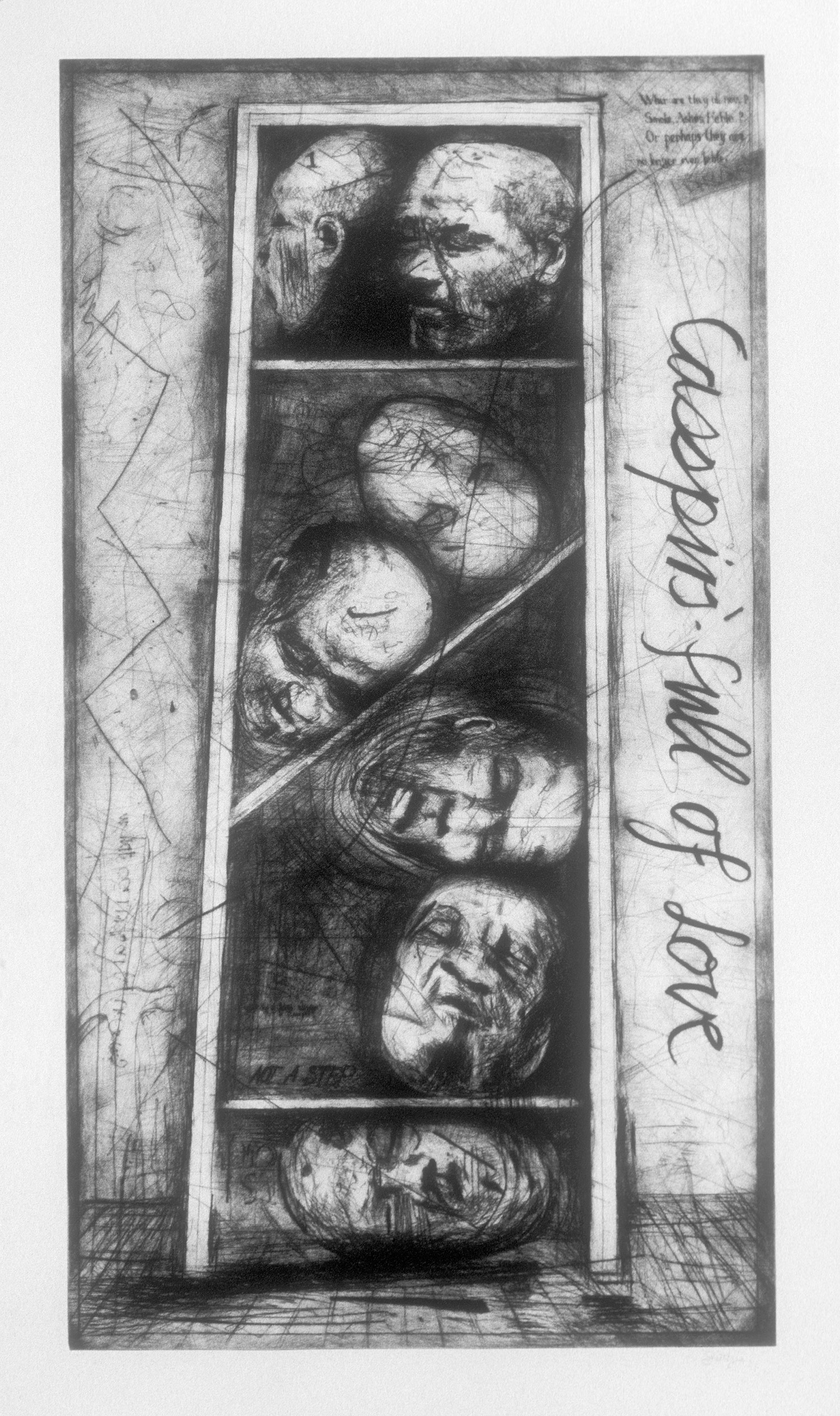
Aspects of social injustices that have transpired over the years in South Africa have often acted as fodder for Kentridge’s pieces. Kentridge’s Casspirs Full of Love, viewable at http://www.metmuseum.org/toah/images/h2/h2_2001.602.jpg, looks like heads in boxes to an average American viewer, but South Africans know: a casspir is a vehicle used to put down riots, sort of a crowd control tank. The box is the casspir and the heads are those of people who have been killed in riots and demonstrations, people that have been “put down”.
The title itself, Casspirs Full of Love, written along the side of the print, is very suggestive and is oxymoronic. A casspir full of love is like a bomb that bursts with happiness, they don’t exist. The purpose of a machine such as this is to instill “peace” by force, yet in this case Kentridge is saying that it was used as a tool to keep the lower class natives from taking the colonial’s power and ultimately, money. 3
"My drawings don't start with a ‘beautiful mark'. It has to be a mark of something out there in the world. It doesn't have to be an accurate drawing, but it has to stand for an observation, not something that is abstract, like an emotion." – William Kentridge He thinks about the activity of print making as being about getting the hand to lead the brain, rather than letting the brain govern the hand.
In 1988, he founded Free Film makers Co-Operative in Johannesburg. In 1999, he was appointed as a film maker by Stereoscope.
Kentridge's artworks are among the most sought-after and expensive works in South Africa, "a major charcoal drawing by world-renowned South African artist William Kentridge could set you back some R250 000" [2].
[edit] Films
- Johannesburg:2nd Greatest City After Paris, 1989
- Monument, 1990
- Mine, 1991
- Sobriety, Obesity & growing old, 1991
- Felix in Exile, 1994
- History of the Main Complaint, 1996
- Weighing and Wanting, 1998
- Stereoscope, 1999
- Medicine Chest, 2001
- Automatic Writing, 2003
His films were shown in the 2004 [3]Cannes Film Festival.
[edit] Exhibitions
- Documenta X, Kassel - 1997
- São Paulo Biennial - 1998
- The Drawing Centre, New York - 1998
- Venice Biennial - 1999
- Bienal de la Habana, Havana - 2000
- Goodman Gallery, Johannesburg - 2003
- Metropolitan Museum, New York - 2004
- Musée d'art Contemporain, Montreal - 2005
- Johannesburg Art Gallery - 2006
- Salzburg Museum - 2006
- Museum of Modern Art, New York
- Museum of Contemporary Art, Chicago
- Barcelona Museum of Contemporary Art
- Chicago Art Institute
- Tate Modern, London
- Smith College Art Museum
- University of Brighton Gallery, UK - 2007
- Williams College Museum of Art
- Bienal do Mercosul, Porto Alegre, Brasil - 2007
- Philadelphia Museum of Art, Philadelphia, Pennsylvania - 2008
[edit] Awards
- Jesse L Rosenberger Medal from the University of Chicago
- Woyzeck on the highveld awards for production, set design & direction, 1982
- Market Theatre Award for New Vision exhibition, 1986
- AA vita Award at Cassirer fine Art, 1986
- Loerie Award memo, 1994
- Carnegie Medal, 2004
- Goslar Kaiserring, 2004
- Honorary Doctor of Literature from the University of the Witwatersrand, 2004
- Standard Bank Young Artist Award
[edit] External links
- Artworks by William Kentridge
- William Kentridge Prints, a book detailing his extensive printmaking oeuvre
- Book launch (photograph of William Kentridge and discussion by Jane Taylor)
- Case study: William Kentridge's Drawings for Projection considering in new media art, particularly in the South African context
- Interview with William Kentridge, by Lilian Tone
- William Kentridge at Who's Who
- Wits honours top artist
- Get ready for Grahamstown
- SA artists in Barcelona
- SA artists at Havana Biennale
[edit] Notes
1 Cameron, Dan, and Christov-Bakargiev, Carolyn, and Coetzee, J.M. William Kentridge. New York: Phaidon Press, 1999.
2 Christov-Bakargiev, Carolyn. William Kentridge. Societé des Expositions du Palais de Beaux-Arts de Bruxelles, 1998.
3 Edmunds, Paul. “William Kentridge’s SANG Retrospective,” Artthrob: Contemporary Art in South Africa 65 (2003).
4 “William Kentridge” Greg Kucera Gallery. 2007 <http://www.gregkucera.com/kentridge.htm>