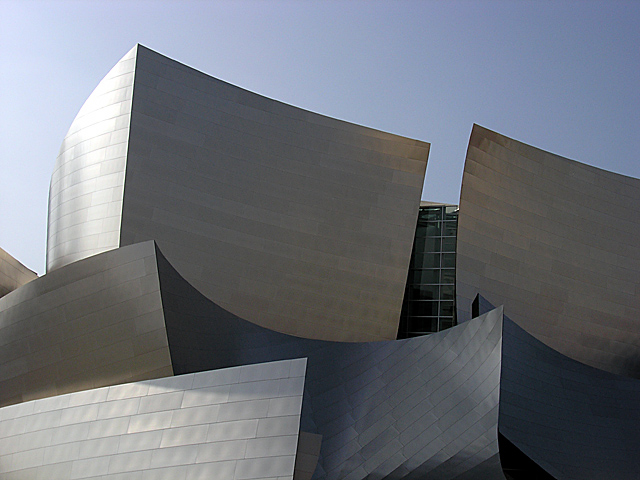
Walt Disney Concert Hall
From Wikipedia, the free encyclopedia
| Walt Disney Concert Hall | |
|---|---|
 |
|
| Location | 111 South Grand Avenue Los Angeles, California United States |
| Coordinates | |
| Type | Concert hall |
| Built | 1999–2003 |
| Opened | October 23, 2003 |
| Construction cost | $274 million |
| Seating type | Reserved |
| Capacity | 2,265 |
| Website | Venue website |
The Walt Disney Concert Hall at 111 South Grand Avenue in Downtown Los Angeles, California is the fourth hall of the Los Angeles Music Center. Bounded by Hope Street, Grand Avenue, 1st and 2nd Streets, it seats 2,265 people and serves (among other purposes) as the home of the Los Angeles Philharmonic Orchestra and the Los Angeles Master Chorale.
The Frank Gehry–designed building opened on October 23, 2003. While the architecture (as with other Gehry works) evoked polarized opinions, the acoustics of the concert hall (designed by Yasuhisa Toyota) were widely praised in contrast to its predecessor, the Dorothy Chandler Pavilion.
Contents |
[edit] Construction
The project was launched in 1987, when Lillian Disney, widow of Walt Disney, donated $50 million. Gehry delivered completed designs in 1991. Construction of the underground parking garage began in 1992 and was completed in 1996. The garage cost had been $110 million, and was paid for by Los Angeles County, which sold bonds to provide the garage under the site of the planned hall [1].


Construction of the concert hall itself stalled from 1994 to 1996 due to lack of fundraising. Additional funds were required since the construction cost of the final project far exceeded the original budget. Plans were revised, and in a cost saving move the originally designed stone exterior was replaced with a less costly metal skin. The needed fundraising restarted in earnest in 1996 — after the real estate depression passed — headed up by Eli Broad and then-mayor Richard Riordan and groundbreaking for the hall was held in December 1999. Delay in the project completion caused many financial problems for the county of LA. The city expected to repay the garage debts by revenue coming from the Disney Hall parking users[1].
Upon completion in 2003, the project had cost an estimated $274 million, including the parking garage which had solely cost $ 110 million [1]. The remainder of the total cost was paid by private donations, of which the Disney family's contribution was estimated to $84.5 million with another $25 million from The Walt Disney Company. By comparison, the three existing halls of the Music Center cost $35 million in the 1960s.
[edit] Reflection problems
After the construction, modifications were made to the Founders Room exterior; while most of the building's exterior was designed with stainless steel given a matte finish, the Founders Room and Children's Amphitheater were designed with highly polished mirror-like panels. The reflective qualities of the surface were amplified by the concave sections of the Founders Room walls. Some residents of the neighboring condominiums suffered glare caused by sunlight that was reflected off these surfaces and concentrated in a manner similar to a parabolic mirror. The resulting heat made some rooms of nearby condominiums unbearably warm, caused the air-conditioning costs of these residents to skyrocket and created hot spots on adjacent sidewalks of as much as 140 degrees Fahrenheit. After complaints from neighboring buildings and residents, the owners asked Gehry Partners to come up with a solution. Their response was a computer analysis of the building's surfaces identifying the offending panels. In 2005 these were dulled by lightly sanding the panels to eliminate unwanted glare. [2]
[edit] Concert organ

The design of the hall included a large concert organ, completed in 2004, which was used in a special concert for the July 2004 National Convention of the American Guild of Organists. The organ had its public debut in a non-subscription recital performed by Frederick Swann on September 30, 2004, and its first public performance with the Philharmonic two days later in a concert featuring Todd Wilson.
The organ's facade was designed by architect Frank Gehry in consultation with organ consultant and sound designer, Manuel Rosales. Gehry wanted a distinctive, unique design for the organ. He would submit design concepts to Rosales, who would then provide feedback. Many of Gehry's early designs were fanciful, but impractical: Rosales said in an interview with Timothy Mangan of the Orange County Reigster, "His [Gehry's] earliest input would have created very bizarre musical results in the organ. Just as a taste, some of them would have had the console at the top and pipes upside down. There was another in which the pipes were in layers of arrays like fans. Very fascinating. Couldn't be built. The pipes would have had to be made out of materials that wouldn't work for pipes. We had our moments where we realized we were not going anywhere. As the design became more practical for me, it also became more boring for him." Then, Gehry came up with the curved wooden pipe concept, "like a logjam kind of thing," says Rosales, "turned sideways." This design turned out to be musically viable.[3]
The organ was built by the German organ builder, Caspar Glatter-Götz, under the tonal direction and voicing of Manuel Rosales. It has an attached console built into the base of the instrument from which the pipes of the Positive, Great and Swell manuals are playable by direct mechanical, or "tracker" key action, with the rest playing by electric key action; this console somewhat resembles North-German Baroque organs, and has a closed-circuit television monitor set into the music desk. It is also equipped with a detached, movable console, which can be moved about as easily as a grand piano, and plugged in at any of four positions on the stage, this console has terraced, curved "amphitheatre"-style stop-jambs resembling those of French Romantic organs, and is built with a low profile, with the music desk entirely above the top of the console, for the sake of clear sight lines to the conductor. From the detached console, all ranks play by electric key and stop action.
In all, there are 72 stops, 109 ranks, and 6125 pipes; pipes range in size from a few inches to the longest being 32 feet (which has a frequency of 16 hertz).[4]
The organ is a gift to the County of Los Angeles from the Toyota Motor Sales, USA, Inc. (the U.S. sales, marketing, service, and distribution arm of Toyota Motor Corporation).[5][6]
[edit] Pop culture
- The Hall was spoofed in The Simpsons episode "The Seven-Beer Snitch"; Frank Gehry voiced himself in the episode where the town of Springfield had him design a new Concert Hall for the town.[1] The Concert Hall was then transformed into a jail by Mr. Burns.
- The first ever movie premiere at the concert hall was in 2003, when The Matrix Revolutions held its world premiere.
- In the opening moments of "Day 6" of 24, a suicide bomber destroyed a bus in the vicinity of the Concert Hall.
- The Concert Hall held Ellen DeGeneres co-hosting for American Idol during the special week of Idol Gives Back. Rascal Flatts, Kelly Clarkson, and Il Divo performed here.
- This building was also used in the Iron Man (film) (2008 release) briefly for a party for Stark Industries.
[edit] Gallery
 Profile view from Grand Avenue; the Dorothy Chandler Pavilion is to the right in the rear |
 Detail near entrance |
 Viewed at night |
 Viewed looking north |
 Viewed at night |
 Main entrance at night |
 Viewed from satellite |
 Looking towards Downtown LA |
 Detail atop main entrance |
 The exterior in winter 2007 |
[edit] See also
- Frank Gehry
- List of concert halls
- Los Angeles Music Center
- Downtown Los Angeles
- The organization of the artist
[edit] References
Gehry, F. Symphony: Frank Gehry's Walt Disney Concert Hall. Harry N. Abrams: 2003.
- ^ a b c People, Parking, and Cities
- ^ Coates, Chris (2005-03-21). Dimming Disney Hall; Gehry's Glare Gets Buffed. Los Angeles Downtown News.
- ^ Timothy Mangan. "Pipe dreams at Disney Hall; The concert venue's fantastical organ is finally ready for unveiling", The Orange County Register (California), September 30, 2004.
- ^ Rosales Organ Builders, Opus 24 (Walt Disney Concert Hall). Retrieved on 2008-01-03.
- ^ Wachtell, Esther (August 1991). "Using all the fund-raising tools: by giving its volunteers all the resources they needed to do the job, The Music Center of Los Angeles increased its campaign goal 15 percent to $ 17.6 million, despite the recession". Fund Raising Management 22 (6): 23. ISSN 0016-268X.
- ^ PAUL KARON. "Toyota ups hall donation", Daily Variety, November 24, 1997.
[edit] External links

- Official website at Los Angeles Music Center
- Walt Disney Concert Hall - web page of the Los Angeles Philharmonic
- Archive of stories from the Los Angeles Times
- Los Angeles Times graphic titled "Inside the Disney Hall Organ"
- Article and images at arcspace.com
- Microclimatic Impact: Glare around the Walt Disney Concert Hall
- Images in B&W of the Disney Concert Hall
- Photographs of exterior and interior of the Disney Concert Hall
- Photograph: Exterior detail of the Disney Concert Hall
- Photographs of Disney Concert Hall exterior and architectural details
|
|||||||||||||


![[1]](http://blog.davidteoh.com/archives/simp15.jpg)