Image:US Air Force U-2 (2139646280).jpg
From Wikipedia, the free encyclopedia
Size of this preview: 750 × 600 pixels
Full resolution (3,000 × 2,400 pixels, file size: 1.47 MB, MIME type: image/jpeg)

| This is a file from the Wikimedia Commons. The description on its description page there is shown below.
|
| Description |
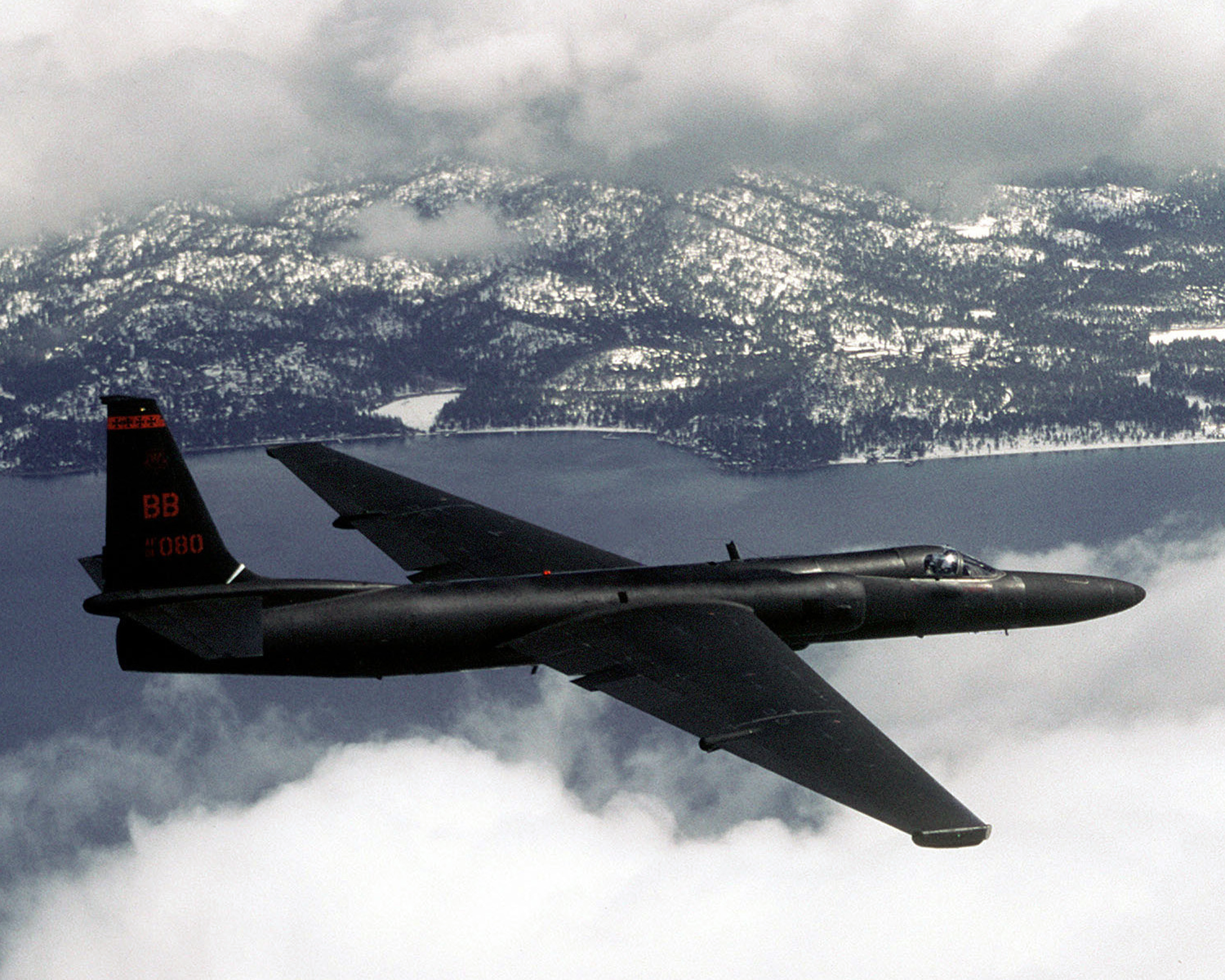
The US Air Force U-2 high-altitude reconnaissance aircraft first flew in 1955 and was developed by Lockheed Martin at the famous Skunk Works site. The aircraft provides continuous surveillance day and night and in all weathers. The aircraft can gather surveillance and signals intelligence data in real time and can be deployed anywhere in the world. Though both the Air Force and the Navy would eventually fly the U-2, it was originally a CIA operation, run through the Office of Scientific Intelligence. Due to the political implications of a military aircraft invading a country's airspace, only CIA U-2s conducted overflights. The pilots had to resign their military commissions before joining the CIA as civilians, a process they referred to as "sheep dipping." Pilot training in the U-2 was significantly aided by the construction of a pair of two-seat trainer aircraft, modified from the single-seater and designated the CT-2, with the second (trainee) cockpit mounted behind and above the cockpit of the (training) pilot in command. As often happens with new aircraft designs there were several operational accidents, some fatal. The first fatal accident was on 15 May 1956 when the pilot stalled the aircraft during a post-takeoff maneuver which was intended to drop off the wingtip outrigger wheels. The second occurred three months later, on August 31, when the pilot stalled the aircraft immediately after takeoff. Two weeks later a third aircraft disintegrated during ascent, also killing the pilot. There were a number of other non-fatal incidents, including at least one which resulted in the loss of the aircraft. The U-2 came to public attention when pilot Francis Gary Powers was shot down over Soviet territory on 1 May 1960, causing an event known as the U-2 Crisis. On 14 October 1962, a U-2 from the 4080th Strategic Reconnaissance Wing, based at Laughlin Air Force Base near Del Rio, Texas and piloted by Major Richard S. Heyser, photographed the Soviet military installing nuclear warhead missiles in Cuba, thereby precipitating the Cuban missile crisis. Heyser concluded this flight at McCoy AFB in Orlando, Florida and the 4080th established a U-2 operating location at McCoy for the duration of the crisis. Later during the crisis another U-2 was shot down over Cuba, killing the pilot, Major Rudolph Anderson. Major Anderson was posthumously awarded the first Air Force Cross. From 1963 the CIA experimented with carrier-based U-2 operations as a way to overcome range limitations.[8] After CIA pilots successfully tested takeoffs and landings of U-2s on the USS Ranger and other carriers, U-2s were used to monitor French nuclear tests on Moruroa in 1964. In early 1964 the Strategic Air Command (SAC) sent a detachment of U-2s from the 4080th SRW (Strategic Reconnaissance Wing) to South Vietnam to fly high-altitude reconnaissance missions over North Vietnam. On 5 April 1965 U-2s from the 4028th SRS (Strategic Reconnaissance Squadron) took photos of SAM-2 sites near Hanoi and Haiphong harbor. On 11 February 1966 the Wing was redesignated the 100th SRW and relocated to Davis-Monthan AFB, Arizona. The SRS detached at Bien Hoa AB, South Vietnam, was redesignated the 349th SRS.[9] On 8 October 1966 the only loss of a U-2 during combat operations occurred when USAF pilot major Leo Stewart, flying from the 349th Strategic Reconnaissance Squadron, developed mechanical problems while at high altitude over North Vietnam. The U-2 managed to return to South Vietnam where the pilot was able to eject safely. The U-2 crashed near its base at Bien Hoa, South Vietnam and the pilot survived. In July 1970 the 349th SRS at Bien Hoa Airbase relocated to Thailand and was redesignated the 99th SRS, and remained there until March 1976. In 1969, the larger U-2Rs were successfully flown from the USS America. The U-2 carrier program is believed to have been halted after 1969. In June 1976, the U-2s of the 100th SRW were transferred to the 9th SRW at Beale AFB, California and merged with SR-71 aircraft operations at that location. On the disestablishment of Strategic Air Command in the early 1990s the wing was transferred to the newly-formed Air Combat Command and redesignated the 9th Reconnaissance Wing (9th RQW). In 1984, during a major NATO exercise, Flt Lt Mike Hale intercepted an American U-2 at a height of 66,000 ft which they had previously been considered safe from interception. Records show that Hale climbed to 88,000 ft (26,800 m) in his Lightning F3. The U-2 is still in front line service over 50 years after its first flight despite the advent of surveillance satellites. This is primarily due to the ability to direct flights to objectives at short notice, which satellites cannot do. Production was restarted in the 1980s. The U-2 has outlasted its Mach 3 SR-71 replacement, which was retired in 1998. A classified budget document approved by The Pentagon on 23 December 2005 calls for the termination of the U-2 program no earlier than 2011, with some aircraft being retired by 2007. |
|---|---|
| Source | |
| Date |
December 26, 2007 at 15:07 |
| Author | |
| Permission (Reusing this image) |
see below |
[edit] Licensing
  |
This file is licensed under Creative Commons Attribution 2.0 License |
 |
This image, which was originally posted to Flickr, was reviewed on January 27, 2008 by the administrator or trusted user File Upload Bot (Magnus Manske), who confirmed that it was available on Flickr under the above license on that date. |
File history
Click on a date/time to view the file as it appeared at that time.
| Date/Time | Dimensions | User | Comment | |
|---|---|---|---|---|
| current | 17:08, 27 January 2008 | 3,000×2,400 (1.47 MB) | File Upload Bot (Magnus Manske) | ( {{Information |Description= The US Air Force U-2 high-altitude reconnaissance aircraft first flew in 1955 and was developed by Lockheed Martin at the famous Skunk Works site. The aircraft provides continuous surveillance day and night and in all weathers) |
File links
Metadata
This file contains additional information, probably added from the digital camera or scanner used to create or digitize it. If the file has been modified from its original state, some details may not fully reflect the modified file.
| Orientation | Normal |
|---|---|
| Horizontal resolution | 300 dpi |
| Vertical resolution | 300 dpi |
| Software used | Adobe Photoshop 7.0 |
| File change date and time | 15:07, 26 December 2007 |
| Color space | 65535 |


