Image:The Banksia (John White).jpg

From Wikipedia, the free encyclopedia

Wikimedia Commons logo This is a file from the Wikimedia Commons. The description on its description page there is shown below.
Commons is a freely licensed media file repository. You can help.
Description

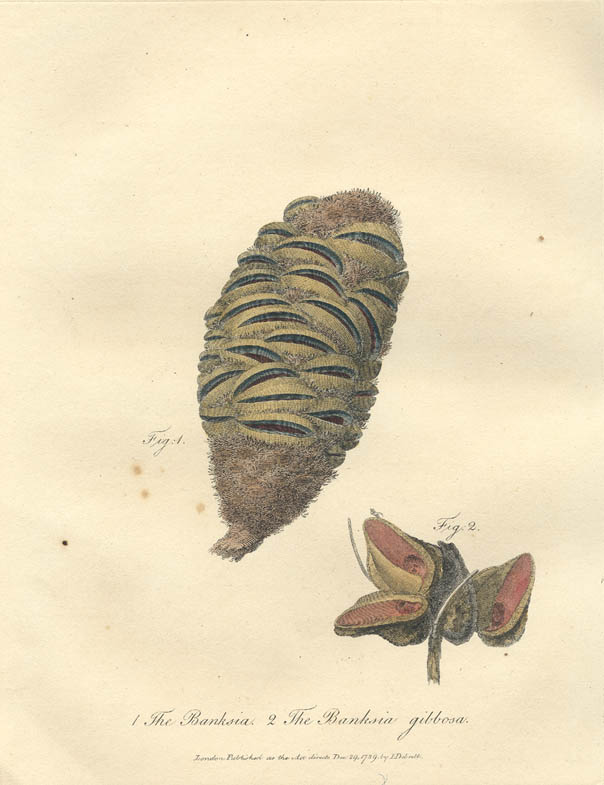
This is an image of a plate that appeared on Page 225 of John White's 1790 Journal of a Voyage to New South Wales.

Figure 1, captioned "The Banksia", shows a Banksia infructescence. The accompanying text states that

"we cannot with certainty determine the species. The capsules are smooth, at least when ripe, and a little shining. We think this is neither the B. serrata, integrifolia, nor dentata of Linnaeus, nor probably his ericifolia; so that it seems to be a species hitherto undescribed. The leaves and flowers we have not seen."

Three years later, in James Edward Smith's A Specimen of the Botany of New Holland, the figured plant was tentatively labelled a Banksia spinulosa (Hairpin Banksia):

"We suspect the fruit figured in Mr. White's Voyage, page 225, fig. I, may belong to this species, but we have no positive authority to assert it."

However, in 1981 Alf Salkin argued that

"The cone illustrated by White (1790) is probably not as suggested from the B. spinulosa described by Smith but, may be from another member of the complex or from one of the forms of B. ericifolia.

Figure 2 is captioned "The Banksia gibbosa", but this plant has long since been transferred into a separate genus as Hakea gibbosa.

Source

The original image appears in Journal of a Voyage to New South Wales. This digital image is taken from the Project Gutenberg transcription of that text, and is available here.

Date

1790

Author

No attribution for the painting is given in White's Journal of a Voyage to New South Wales, and Smith's A Specimen of the Botany of New Holland attributes it to White. Salkin, has suggested that

"these were probably done by the convict artist Thomas Watling"

and this is supported by a set of paintings of the Journal plates by Watling that are held by the Natural History Museum, London. However, Helen Hewson states in Australia: 300 years of botanical illustration that

"it is thought by some that Thomas Watling, a convict artist of some ability, may have done the original artwork, but he did not arrive in the colony until late in 1792.... John Calaby believes that White had Watling copy the plates as published in the Journal for practice, because Watling was trained in landscape painting not natural history painting."
Permission
(Reusing this image)
This is a faithful photographic reproduction of an original two-dimensional work of art. The original image comprising the work of art itself is in the public domain for the following reason:
Public domain This image (or other media file) is in the public domain because its copyright has expired.

This applies to the United States, Canada, the European Union and those countries with a copyright term of life of the author plus 70 years.


Note that a few countries have copyright terms longer than 70 years: Mexico has 100 years, Colombia has 80 years, and Guatemala and Samoa have 75 years. This image may not be in the public domain in these countries, which moreover do not implement the rule of the shorter term. Côte d'Ivoire has a general copyright term of 99 years and Honduras has 75 years, but they do implement that rule of the shorter term.


العربية | Asturianu | Български | Català | Česky | Dansk | Deutsch | English | Ελληνικά | Esperanto | Español | Euskara | فارسی | Français | Gaeilge | Galego | עברית | हिन्दी | Bahasa Indonesia | Italiano | 日本語 | 한국어 | Kurdî / كوردی | Lietuvių | Magyar | Nederlands | ‪Norsk (nynorsk)‬ | Bahasa Melayu | Polski | Português | Română | Русский | Slovenčina | Slovenščina | Shqip | Suomi | Sámegiella | Türkçe | ‪中文(简体)‬ | ‪中文(繁體)‬ | 粵語 | +/-

Under United States copyright law, originality of expression is necessary for copyright protection, and a mere photograph of an out-of-copyright work may not be protected under U.S.copyright law. This photograph was taken in the U.S. or in another country where a similar rule applies (for a list of allowable countries, see Commons:When to use the PD-Art tag#Country-specific rules).
This photographic reproduction is therefore also in the public domain.

العربية | Česky | Deutsch | English | Ελληνικά | Español | فارسی | Français | עברית | Bahasa Indonesia | Italiano | 日本語 | 한국어 | Magyar | Nederlands | Polski | Português | Română | Русский | Slovenščina | Српски / Srpski | Basa Sunda | Türkçe | Українська | ‪中文(繁體)‬ | ‪中文(简体)‬ | +/-


File history

Click on a date/time to view the file as it appeared at that time.

Date/TimeDimensionsUserComment
current04:54, 24 June 2007604×785 (62 KB)Hesperian ({{Information |Description=This is an image of a drawing that appeared on Page 225 of ''John White's 1790 ''[Journal of a Voyage to New South Wales]]''. Figure 1, captioned "The Banksia", shows a ''Banksia'' infructescence. The accompanying text stat)
The following pages on the English Wikipedia link to this file (pages on other projects are not listed):