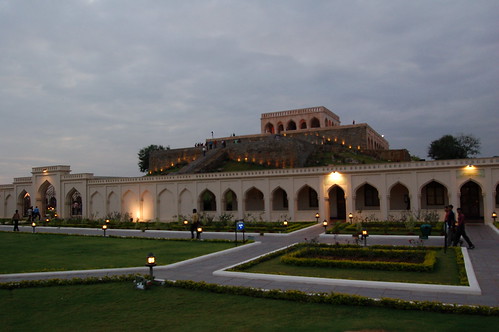
Taramati Baradari
From Wikipedia, the free encyclopedia
| Taramati Baradari | |
| Building | |
|---|---|
| Type | Royal Palace |
| Location | Hyderabad, India |
| Construction | |
| Completed | 1880s |
| Design Team | |
Taramati Baradari is a palace located in Hyderabad, India, that was built under the Seventh Sultan of Golconda, Abdullah Qutb Shah as an ode to his favorite courtesan, Taramati. It is celebrated as an amalgam of the romance and grace of the middle ages.
Taramati was to Abdullah Qutb Shah, what Bhagmati was to his grandfather Muhammad Quli Qutb Shah, the Founder of Hyderabad.
The baradari with 12 doorways were to allow cross ventilation, considered to be the most ingenious technique at the time.
[edit] History
Abdullah Qutb Shah is believed to have enjoyed Taramati’s song even while at Golconda fort. Her melodious voice would be carried by the breeze, reaching the prince’s ear at the fort, because of the acoustics model, in the structure as well as that of the fort.
One tells of two ravishing dancing girls, Taramati and Premamati, sisters who danced on ropes tied between their pavilion and the balcony of the king and patron, Abdulla Qutub Shah.
A legend about the last Qutub Shahi king, Tana Shah, said to eat grains of rice cooked to look like fresh jasmine flowers and to bathe in a fountain filled with rose water.
About half a mile north of the fort itself lies his grave amid a cluster of carved royal tombs. Here lie buried the Qutub Shahi kings and queens in what once their rose gardens.
As a tribute to Taramati and Premamati, they both were buried in the royal cemetery of the Qutub Shahi kings.