Talk:Southern American English/Archive 2
From Wikipedia, the free encyclopedia

Contents |
Glottal/Silent T
I'm curious as to whether any other Southerner's pronounce the "t"s in words like "milton", "fighting", "fulton", and other such words as little more than some sort of glottal stop before the proceeding vowel, and also as to whether this phenomenon occurs elsewhere. I know it's quite common in the Peidmont region of Georgia amongst non-yankee speakers, if anything. Should this be added to the pronunciation section?
- In Gulf Coastal Mississippi, we always pronounce the t's in those words, so they sound like what I assume is normal such as "mill-ton", "fight-ing" or "fuhl-ton".--CJ 07:32, 15 October 2006 (UTC)
- I was born in the South Carolina Piedmont and raised in Georgia Piedmont, and agree with the original assertion. Its quite common among native speakers in these areas (including myself) to pronounce these "t"s very softly, as a glottal stop.
- Ditto to the guy above me; I'm from the North Carolina Piedmont. I barely pronounce the t's in "George S. Patton." They're there, but I don't enunciate them at all and it sounds strange to do so. Also, what's with the "Doesn't cite sources" bit? What sources does one need besides a native speaker?
- I've never EVER heard anyone but non-natives use "Coke," "cola," "soda," "pop," "Pepsi-Cola" or anything but "soft drinks" to describe soft drinks, unless they were specifically referring to "Coke."
- Lol, you haven't been around, have you? Jerr
- To answer your question "what sources does one need besides a native speaker", please read Wikipedia:Reliable sources. "This is so because I'm a native speaker and I say it this way" is not good enough. —Angr 15:57, 17 November 2006 (UTC)
- I don't know exactly where "around" is, but I'm pretty sure I've been there, assuming "around" is in North Carolina.
- I don't think it's a matter of area but of urban v rural. I'm from Mississippi and have also never used any of those words except "soft drinks" unless specifically refering to coke.
- Well where I'm from, in east Tennessee, a coke is any carbonated drink.
- I don't think it's a matter of area but of urban v rural. I'm from Mississippi and have also never used any of those words except "soft drinks" unless specifically refering to coke.
- I don't know exactly where "around" is, but I'm pretty sure I've been there, assuming "around" is in North Carolina.
- To answer your question "what sources does one need besides a native speaker", please read Wikipedia:Reliable sources. "This is so because I'm a native speaker and I say it this way" is not good enough. —Angr 15:57, 17 November 2006 (UTC)
- I use the glottal stop as well. I'm from the Mississippi Coast and distinctly remember pronouncing those words with "t"s growing up, but when I moved to North Mississippi I picked up the slight variation.
According to the book "The Story of English" by Krumm, the Southen Accent was heavily influenced by French via Lousiana. Note how some southerners pronounce "sing" as "sang" Consider how the "i" in the French word "Moulin" is prounounced. It is very similar to English "a" in father!
Reliability of Word Usage Section
I understand that the Word Usage section has a disclaimer stating that many of these phrases aren't sourced, but I think that the exclusion of those items needing citation should seriously be considered until sources are verified. I was born and raised on the Mississippi Coast, have many relatives across the Southeast and in Texas, and currently attend school at the University of Mississippi, which has a notable variety of SAE dialects from across the SAE spoken region. Those being my only credentials, I couldn't swallow this section. The phrases mentioned in this section are NOT in widespread usage among all dialects of SAE, and many of them could/should be considered part of Older SAE, associated by many my age with rural dialects and more importantly with the elderly.
I can imagine that some of these phrases and word usages may have survived in different regions, but it has to be at varying degrees. For example- I have never used the words "yonder," "reckon" or "young'un"; used the words "carry" or "tote" in the manner suggested in the article; the phrases "to tump over" or "to chuck"; the "wasn't"/"doesn't" forms "wudn't"/"dudn't"; or the use of singular nouns as if they were plural. These are associated with older generations and rural speech patterns. But I have used the word "buggy" for "push-cart," which is something that many speakers of SAE do not say anymore, especially in urban areas. The word "mash" is also not used, as far as I am aware, simply as a substitute for "press" or "push" but as a word of emphasis more likened to "excessive force" as in "I mashed my finger with the hammer."
My proposition is that even if there are cited, reliable sources for these word phrases, that it be considered an objective to research where these are used more frequently as it can be argued their usage as a whole is not characteristic of SAE, but more probable only regional sub-dialects within SAE. And that even such sources as Harvard Dialect Survey do not take into account the differences between Older and Newer SAE but are general questions that relate the answers given to the specific areas where the questions were asked, not the actual dialect spoken which can be diverse depending on where one grew up and where one now resides. (If this is an incorrect analysis, I truly am sorry, but it's what I can gather from the reference site provided.)
I am not an expert in this field, so I can only offer observable data to discuss, and would be very interested to see why an expert would disagree. I was just genuinely shocked that such words considered "Old South" by younger generations would be bundled up with more contemporary SAE usage without distinction.
Also, the usage of "mosquito hawk" and "snake doctor" do not refer to "dragonfly" and "crane fly" interchangeably with anyone I have met, and the article suggests- perhaps because of word placement- that it can be. However, I wouldn't doubt that it does in some areas. I understand that this isn't reliable sourcing but original research, but the common use of "mosquito hawk" only refers to "crane flys" and a "snake doctor" is a "dragonfly" as far as I'm aware.207.68.251.25 21:12, 28 November 2006 (UTC)jlseal
No Original Research, Please
Please do not contibute original research (i.e. one's own thoughts or ideas) to Wikipedia (especially to linguistics articles). Doing so is against Wikipedia policy (WP:NOR).
Aside from that fact, just "living in an area" for a long time does not make one an expert on dialect(s). There are too many variables to consider (including the influence of mass media, popular culture, and the 20th Century advent of easily-accessible rapid transit). Unless you are trained and educated in the subject of linguistics, your unqualified opinions may serve to only add confusion to an already complex subject. "I've never heard..." or "I've always heard..." does not cut it.
If you do have contributions to make, please make sure they are referenced. ++ Arx Fortis 07:27, 30 November 2006 (UTC)
The map
Umm I don't know if any of these map makers have ever been to Western Kentucky it's undoubtibly the most Southern area of the states yet it's not shaded on this map. Also people consider Southern Illinois Southern in Dialect, yet the area below the mason dixon line isn't shaded Southern???? can some one say FLAW
- The map is based on information in The Atlas of North American English by William Labov and his colleagues (ISBN 3-11-016746-8). The map only shows one aspect of Southern speech, however, namely the monophthongization of the vowel of "price" to something like "prahs". If you have more accurate published information from a reliable source, feel free to update the map. —Angr 21:30, 1 December 2006 (UTC)
http://www.geocities.com/yvain.geo/diausa.gif
http://www.uta.fi/FAST/US1/REF/images/dialectsus.gif
http://www.ling.upenn.edu/phono_atlas/NationalMap/NatMap2.GIF
http://www.evolpub.com/Americandialects/AmDialMap.gif
http://www.pbs.org/speak/speech/mapping/map.html
http://www.msu.edu/~preston/LAVIS.pdf
http://www.evolpub.com/Americandialects/AmDialLnx.html
Here's a few maps I think yall should find interesting
Terminology
Do linguists use the term "Southern American English"? I tried doing some google research on this before and I remember that I found that there were only a few linguists who used that term. Even if the term is legit (and I'd like to see some proof that it is), I don't think the article should use the abbreviation "SAE", because isn't that customarily used to stand for "Standard American English"? And what is this older/newer "SAE" distinction? Where does that come from? It seems to be entirely original research. schi talk 00:21, 8 December 2006 (UTC)
- ANAE just calls it "Southern", but of course we can't call the article Southern because it would be too ambiguous. I can't think of anything else to call it but the Southern dialect of American English, which probably doesn't get boatloads of googlehits either. —Angr 06:51, 8 December 2006 (UTC)
Word use
Over the next day or so I will be reasearching the assertions made in the Word Use section. Those for which a reference can be found will be moved above the "unsourcedsect" tag. ++ Arx Fortis 01:28, 15 December 2006 (UTC)
Better Map
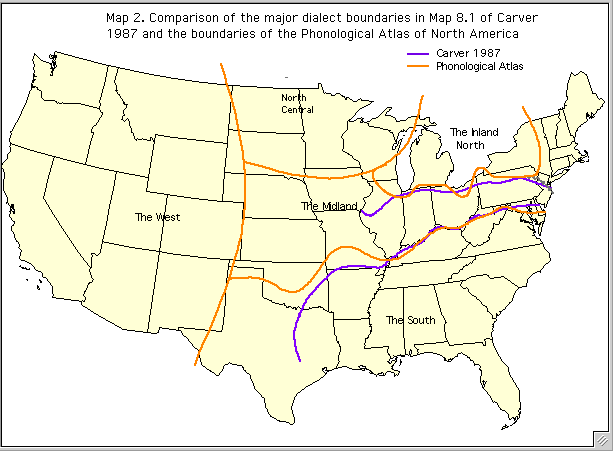
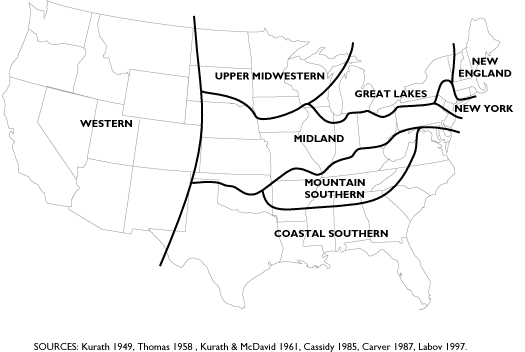
Here is another map that is better than the one that is currently on the site. It too is based on Labov's work. It shows the totality of what he and his team at UPenn consider "Southern English," not just one dialectal trait. It is similiar to the map on the page, but includes a few more areas. I don't know how to make Wiki-maps but I will work on learning how, if anyone wants to try their hand at it instead, here it is. http://www.ling.upenn.edu/phono_atlas/maps/MapsS/Map1S.html Here is the page the map is from http://www.ling.upenn.edu/phono_atlas/home.html Lasersnake 19:20, 29 January 2007 (UTC)
A better map needs to be on this article. The southern dialect is heard all over Oklahoma; not just the bottom sliver as the map suggests. I recommend using the one from PBS. I actually worked with the professors who researched it. —Preceding unsigned comment added by 12.47.197.247 (talk • contribs) 23:17, 30 January 2007 UTC
- One possibility is to include multiple aspects of Southern speech (see the map at Northern cities vowel shift) rather than just one. I believe Angr is the most qualified to make such a map. Ƶ§œš¹ [aɪm ˈfɻɛ̃ⁿdˡi] 21:01, 3 February 2007 (UTC)
- Yes, well, but I'm the one who made the map these people are complaining about... —Angr 23:15, 3 February 2007 (UTC)
- That's right. You got us in this problem and you're getting us out of it. Seriously though, as good an idea as it is, a map including other aspects of southern speech may still not satisfy people since the area covered in the monophthongization map covers pretty much all the other aspects anyway. Ƶ§œš¹ [aɪm ˈfɻɛ̃ⁿdˡi] 23:23, 3 February 2007 (UTC)
- I know. That's why Labov et al. use the monophthongization isogloss alone in their definition of Southern. I should point out that they have no specific information about southern Oklahoma at all; their only data from Oklahoma is from Tulsa and OK City and shows no diphthongization at all. Southern OK is only colored because it's geometrically convenient when Springfield, Little Rock, and Amarillo all have to be included in Southern. I could do what I eventually did with Commons:Image:Cot-caught merger.png, and just show dots to indicate cities where monophthongization is attested rather than implying that large areas have it when actually there's no evidence for them one way or the other. —Angr 23:34, 3 February 2007 (UTC)
- That's right. You got us in this problem and you're getting us out of it. Seriously though, as good an idea as it is, a map including other aspects of southern speech may still not satisfy people since the area covered in the monophthongization map covers pretty much all the other aspects anyway. Ƶ§œš¹ [aɪm ˈfɻɛ̃ⁿdˡi] 23:23, 3 February 2007 (UTC)
- Yes, well, but I'm the one who made the map these people are complaining about... —Angr 23:15, 3 February 2007 (UTC)
- Ehh, the CCM dot format may be accurate but it's not as... expressive. Ƶ§œš¹ [aɪm ˈfɻɛ̃ⁿdˡi] 01:00, 4 February 2007 (UTC)
I have a problem with the Western Kentucky, Southern Indiana, and SOuthern Illinois areas of the current map. A few credible sources have been posted above on this talk page that lables those areas as Southern. From personal experience those are the most Southern areas of the state of Kentucky (this is personal experience). A few of those maps also lable Southern Indiana (across from Louisville) as part of the Southern dialect range too. 74.128.200.135 02:42, 5 February 2007 (UTC)
Angr, I found this map http://www.ling.upenn.edu/phono_atlas/NationalMap/NatMap1.html Is it the one you used to base your Wikimap? I see what you mean that Labov only used the monophthongization of "ay" to define the Southern dialect region. I think that means the map I suggested is the same map that is used to make your wiki-map. I guess my suggestion is that the shaded line on your wikimap be moved a little north to include the parts of Southern Maryland more of W.Va that are included on the Labov map. A wiki-editor found your map and used it as evidence that the Southern dialect was not spoken in MD, when I think we both agree that Labov does include it. Thanks for the clarification and the good work on the maps. Lasersnake 17:35, 5 February 2007 (UTC)
- I based my map on one in the print version of the ANAE. The isogloss on that map is rather further south than in the one you linked to, but the point I was trying to make above is that these isoglosses are not exact. The ANAE (both the print version and the web edition) is based on a telephone survey conducted with urban speakers only. The data collected shows ay-monophthongization in Charleston, Roanoke, Richmond, and Norfolk, but not in Clarksburg, DC, or Baltimore. It provides no information at all about northeastern WV or southern MD! You can't take the isoglosses on either my map or the one you linked to so seriously. —Angr 20:12, 5 February 2007 (UTC)
Ok, I guess it is splitting hairs as to whether the isogloss should be 50 miles further north or south since, as you say, their was no samples from that area anyway. I can live with a little imprecision. Thanks for letting me know how you came to your conclusion. Lasersnake 20:44, 5 February 2007 (UTC)
I personally don't care which map is used as long as we reach a consensus on the map and then agree to stop changing the map every few months. All the Southern articles suffer from this map-change itis. And to be honest, the changes usually aren't that big a deal.--Alabamaboy 20:51, 5 February 2007 (UTC)
- Huh??? This article had one map from April to October and then the current map since October. That doesn't sound like constant map-changing to me. —Angr 22:31, 5 February 2007 (UTC)
I would like to tell you that I am from southern ohio trans-planted Southerner like the majority here. most people from southern ohio has some type of southern dialect & ancestry.Most of the early settlers of southern ohio in the 18th & early19th century came from Virginia,Kentucky. Later in the 1940's to 1980's a huge immigration of Southern appalachian's moved to southern ohio for work making southern ohio's dialect a much stronger southern dialect,southern culture,southern christianity this is even more true out in the rural areas but also in big cities such as North-Dayton,East-Dayton Fairborn,Xenia,Moraine,Middletown,Fairfield,Hamilton. I assure you if you come to the rural areas of southern-ohio try Hillboro rockyfork-lake area & you see southern conservative churches everywhere when you smell constant hickory-smoke in the air and everyone wearing boots & when you approach us you will feel the southern-hospitality you will know that we are not northerners, but southerners by all means. CelticPete March,20,2007
Florida?
Why is Florida not included? Rhythmnation2004 21:02, 25 February 2007 (UTC)
- I'd imagine because Florida speech isn't southern even if Florida itself is. Ƶ§œš¹ [aɪm ˈfɻɛ̃ⁿdˡi] 03:06, 26 February 2007 (UTC)
Florida is not part of the map because not all but most people from Florida are not even southern they are trans-planted northeasterners from NewYork,New Jersey etc, in fact south coastal Florida has no difference in dialect comparred to a Bostonian or New york/Jersey dialect.
Name
The name Southern American English indicated it was English from South America which is wrong, hence the change. Please dont revert to a title as ambiguous as it was, SqueakBox 22:13, 5 March 2007 (UTC)
- No, that would be "South American English". Southern American English is unambiguous, correct, and has consensus as the most common name of the dialect. Please don't move the article to anything else. —Angr 22:47, 5 March 2007 (UTC)
- See /Archive 1#Southern United States English for previous discussion of this issue. —Angr 22:50, 5 March 2007 (UTC)
Well the debate didnt look like there was a consensus and it nmay not be umnambiguous to Americans but it is to everyone else. Your use of admin rollback also seems like a personal attack as if you are treatingm yme like a vandal or someone who doesnt understand how wikipedia works. Such an attitude is unhelpful. I'll stick an NPOV tag on the article till this gets resolved, SqueakBox 23:00, 5 March 2007 (UTC)
- I only used admin rollback on the redirects, to save time. I didn't use it to move the article back to this name. Adding an NPOV tag as if the content of the article were under dispute, rather than the use of the word "American", is disingenuous. While it's clear that Latin Americans object to the use of the word "American" to mean "of the United States", the fact is that in English it's the primary meaning of it. (Hence, while Mexicans and Argentinians may consider themselves americanos, English-speaking Canadians most certainly do not consider themselves "Americans".) Since this is the English-language Wikipedia, the fact that the Spanish word americano means something different (I'd go so far as to say Spanish americano and English American are false friends) is irrelevant. —Angr 23:10, 5 March 2007 (UTC)
Hardly new, though. Rastafarianism had a dispute tag for 6 months before it was changed to Rastafari movement because of the name. It is also clear from the archive that I am not the only person who has trouble with this. We call the US United States not America and its not what Latin Americans think but the fact that the term is highly ambiguous to any Non Northern American English speaker. We've been here before with different words in Brit and American English, and IMO it is important to find a title that is unambiguous. What do other people think? SqueakBox 23:16, 5 March 2007 (UTC)
- I don't see how it is unambiguous. As Angr said, "South American English" would be ambiguous, as would something like "Southern English". But "Southern American" is not the English adjective for things from or dealing with South America; the adjectival form of "South America" is instead "South American". In the term "Southern American", the only possible analysis is that "Southern" is an adjective modifying "American"--i.e., something from or dealing with the southern part of America (and Angr is right when he says that "America" is more or less synonymous with "the United States" in English, as far as I know). My question for you would be, for which native speakers of English is "America" not generally a synonym for "the United States"? I'm not aware of any. --Miskwito 23:23, 5 March 2007 (UTC)
- (Edit conflict) American doesn't mean "from the United States" only within the U.S., though. Canadians, Australians, and Brits all use "American" to mean "from the U.S.". There is no significant ambiguity to the word except when comparing its primary English meaning to its primary Spanish meaning. —Angr 23:27, 5 March 2007 (UTC)
What, exactly, about the article does not confirm to a Neutral Point of View? Dewrad 23:44, 5 March 2007 (UTC)
- The title. Its ambiguous and doesnt make a lot of senmse and thatr needs tagging. As there is a dispute re the title the npov tag seems the best one, SqueakBox 01:42, 6 March 2007 (UTC)
Southern America redirects, correctly IMO, to South America. This article name is thus implying that we are talking about the English found in South America (Falklands, Guyana) and this name is an anomaly, perhaps needing an article Rfc,though I would ahve thought a com promise name would be the best solution, SqueakBox 01:51, 6 March 2007 (UTC)
-
- You'll need to find an outside source that uses "Southern United States English." All the ones I've seen say "American." Changing it, as the mentioned in the previous discussion, would be original research. Ƶ§œš¹ [aɪm ˈfɻɛ̃ⁿdˡi] 03:39, 6 March 2007 (UTC)
- Actually, SqueakBox, this name is a compromise. In the literature, the dialect in question is uniformly called simply "Southern". But since it's obviously out of the question for us to name this article Southern, we compromise by adding American English to it. —Angr 05:12, 6 March 2007 (UTC)
- You'll need to find an outside source that uses "Southern United States English." All the ones I've seen say "American." Changing it, as the mentioned in the previous discussion, would be original research. Ƶ§œš¹ [aɪm ˈfɻɛ̃ⁿdˡi] 03:39, 6 March 2007 (UTC)
I assumed that it was actually called Southern. I got brought here because I speak southern UK English which is alsoo uniformly called a southern accent. How about Southern US English? I honestly feel the title is ambiguouis, the most ambiguous title I have conme across here in wikipedia pretty much. I dont agree that changing an ambiguous title could be considered original research esp given angr has said that what it is actually called is southern English, SqueakBox 14:58, 6 March 2007 (UTC)
It is not unusual in English for a cardinal direction (east, south, north, west) used as a modifer to have a completely different meaning than the adjective (eastern, southern, northern, western) form of the direction used a modifer to the same noun. Examples include
West Virgina (the state) and Western Virginia (a part of the state of Virginia)
South Africa (the country) and Southern Africa (the large geographic region of the continent)
So really there is nothing strange or abhorant about South America (the continent) and Southern America (a cultural region of the US) having different meanings, and thus South American English and Southern American English would mean different things as well. Squeakbox, I understand your concern that non-native speakers may intially be confused about the difference between the two, but that is (for better or worse) the way our language works. All languages have confusing ideosyncracies, but to become a better speaker, they must be learned and understood, not ignored.
Lasersnake 15:56, 6 March 2007 (UTC)
- My concern is not with non-native speakers, it is with non-American but native speakers of English. The fact that Southern America redirects to South America tends to contradict what you say, SqueakBox 16:02, 6 March 2007 (UTC)
-
- Also this relevant article Americas (terminology) doesnt back up what is beinmg said here, SqueakBox 16:06, 6 March 2007 (UTC)
I am a little confused by your argument. Are you saying that in other parts of the world native English speakers refer to the continent as "Southern America," not "South American." If this is what you are saying please provide a quality reference to support this, scholerly, peer-reviewed, etc..
I certainly hope you know that citing another Wikipedia page to support your assertion on this wikipedia page isn't good research. I don't know any more than you do who constructed the redirect pages for this topic. Wikipedia should be consistant in its definitions, but each assertion still must be supported by evidence as being "correct." Otherwise, we will just be copying the same error from that page unto this one. Every encyclopedia, article, etc. I looked at on this topic refers to the continent as "South America." If you so desire I can list several.
Lasersnake 17:08, 6 March 2007 (UTC)
(Edit conflict) To reiterate -- I have met dozens, maybe hundreds, of native English speakers from other countries than the U.S. in my life, and I have never encountered a single one who didn't use the word "American" in the same way I do: to refer to the United States. I wouldn't put too much weight on the redirect from Southern America to South America; the question is, how often is "Southern America" actually used to refer to South America. And the concept "Southern America", whatever it may mean, is irrelevant for this article, since "Southern American English" is to be interpreted as "(Southern (American English))", not "((Southern American) English)". —Angr 17:12, 6 March 2007 (UTC)
America in English unquestionably means the US, I certainly dont dispute that, but Southern America is ambiguous because South America clearly refers to Latin America. If we are talking about sources we also need to attribute that Southern America means the US, I know the sourcing policies here, Lakersnake, and believe that without sources for Southern America referring to America there is a strong case for changing the article name, SqueakBox 17:22, 6 March 2007 (UTC)
How about Southern English? Its currently the disambig but my investigations inmdicate that this is the more common term for the English spoken in the south of the US and southern English doesn't exist as a concept in the UK, SqueakBox 17:25, 6 March 2007 (UTC)
- It doesn't? What's Southern English English about then? In John C. Wells's The Accents of English he divides his discussion of English English up into "RP revisited", "London", "The south", and "The north", so he apparently considers "the south" to be an identifiable dialect region of England. —Angr 18:09, 6 March 2007 (UTC)
As I said before it is actually cvalled a southern accent in the UK, it looks like the naming problem goes further than just this article, SqueakBox 18:14, 6 March 2007 (UTC)
Ok, I think Angr has figured out the confusion. It is not Southern American...English. It is Southern...American English. Can we agree that American English is an unambigous term? If so than Southern American English would clearly refer to the dialect of American English spoken in the South. I don't think changing the name back to Southern English would help anything. In fact I think Southern English was changed to Southern American English to help make the page less ambigious.
Squeakbox, I understand you feel strongly about your claim,but I must disagree when you say that "without sources for Southern America referring to America there is a strong case for changing the article name." Like it or not, the burden of proof here rests with you, and if you can only back up your argument with your own conviction, I am afraid it will fall short.
Lasersnake 17:38, 6 March 2007 (UTC)
-
- I believe that this Wikipedia:Attribution doesnt back up your assertion. All material needs attributiong not merely making changes, SqueakBox 18:07, 6 March 2007 (UTC)
-
-
- I regret that I mentioned the South America vs. Southern America analogy, it was a bad analogy and has lead us astray. What Angr pointed out is real issue here, the page is about a dialect of American English known as Southern American English, it is NOT about a region called Southern America. If the page was about Southern America than your point about citation would be valid, but lets please move past this confusion and address the real issue.
Here is a citation from a public broadcast special that refers to the English of the U.S. as American English http://www.pbs.org/speak/ Notice that this webpage is based on the work of several linguists
Here are some articles that refer to the subdialect in question as Southern American English
http://www.pbs.org/speak/seatosea/americanvarieties/southern/sounds/
http://muse.jhu.edu/login?uri=/journals/american_speech/v079/79.2clopper.html
Brown, Vivian. 1990. The social and linguistic history of a merger: /i/ and /e/ before nasals in Southern American English. Texas A & M University dissertation (sorry not online)
Please review them at your leisure. Hopefully this will suffice to prove that we are not all making this up. I encourage you to provide citations of your own that would indicate a more suitable title for this article.
Lasersnake 18:41, 6 March 2007 (UTC)
- I regret that I mentioned the South America vs. Southern America analogy, it was a bad analogy and has lead us astray. What Angr pointed out is real issue here, the page is about a dialect of American English known as Southern American English, it is NOT about a region called Southern America. If the page was about Southern America than your point about citation would be valid, but lets please move past this confusion and address the real issue.
-
- Yes, and as I mentioned above..."South American" is the correct adjectival form of "South America" in English, not "Southern American", so as you say, Lasersnake, "Southern American English" can really only refer to the English of the South of America [=The U.S.]. Also, if you think "Southern American English" is ambiguous, Squeakbox, surely "Southern English" would be far far more ambiguous? --Miskwito 17:51, 6 March 2007 (UTC)
Name part 2
What do people think about renaming the article Southern (American English)? That makes it clear that we're dealing with a variety of American English called "Southern" and precludes any misinterpretation relating to South America. —Angr 13:49, 8 March 2007 (UTC)
- I want to say no. The problem with proposing any change to this article's name to avoid such an ambiguity is that there is no English-speaking region in South America. Any ambiguity in regards to exactly what it refers to is easily addressed in the first clause of the first sentence: "Southern American English is a group of dialects of the English language spoken throughout the Southern region of the United States..." The problem with trying to avoid people thinking "American" in this context means South American is that American English technically has that same ambiguity but we trust that the reader is either literate enough or knowledgeable enough already to be able to discern pretty quickly that America means North America in this context.
- However, if there were an equivalent Southern (British English) (which may or may not exist already under a different title) then that would make an important distinction between British and American English dialects and, in that case, would be fine by me. Ƶ§œš¹ [aɪm ˈfɻɛ̃ⁿdˡi] 23:17, 8 March 2007 (UTC)
- Well, there are English speakers in Guyana and the Falkland Islands, but they don't have a unified dialect. The equivalent to Southern (British English) exists at Southern English English. —Angr 05:22, 9 March 2007 (UTC)
-
-
- I disagree with renaming the article. I initially thought the idea was ungrounded, but refrained from commenting to allow myself some time to reflect on the issue and not give a knee-jerk reaction. After some thought, I realize that my first impression was correct.
- 1. SqueakBox states he was brought here while searching for "Southern English," which he represents as a dialect of English spoken in southern England. However, the title of this article contains the word "American." No matter which meaning one assigns to that word (nation or continents), it obviously does not fit SqueakBox's original search context. Thus, the original source of confusion in this issue is moot. It was not from someone wanting to learn about the English language spoken on the continent South America.
- 2. Anyone searching for such an article would quickly realize that this article is about the southern region of the United States. As if the map were not clue enough, no one would read through the article and mistake it for an article on anything else. Any erroneous assumption as to the content of this article would instantly dissipate for any reasonable person.
- 3. There is no Wikipedia article on the English language spoken on the continent of South America. The List of dialects of the English language page doesn't even give mention of "South American" English dialects. If there were such an article, a 'disambiguation' or 'distinguish' link could and would be provided to assist users. However...
- 4. One cannot accurately analyze a language in a vacuum. Language is inseparably intertwined with culture, politics and history. Unless a sizable, detectable, sociolinguistic (first-language) culture exists within an established sociopolitical structure, it cannot be considered a dialect nor a candidate for linguistic study or classification. Moreover, a localized population of first-language English speakers on the continent of South America would be considered a unit in and of itself and not collectively grouped with other unrelated, diasporic populations in different areas of the continent. (Think Guyanese English vs. Brazilian English).
- 5. One cannot argue abmiguity between a thing that exists and one that does not. As illustrated above, there is no collective "South American English" ++Arx Fortis 06:41, 9 March 2007 (UTC)
-