Image:Solar sail material.jpg
From Wikipedia, the free encyclopedia
Size of this preview: 800 × 579 pixels
Full resolution (3,000 × 2,171 pixels, file size: 2.03 MB, MIME type: image/jpeg)

| This is a file from the Wikimedia Commons. The description on its description page there is shown below.
|
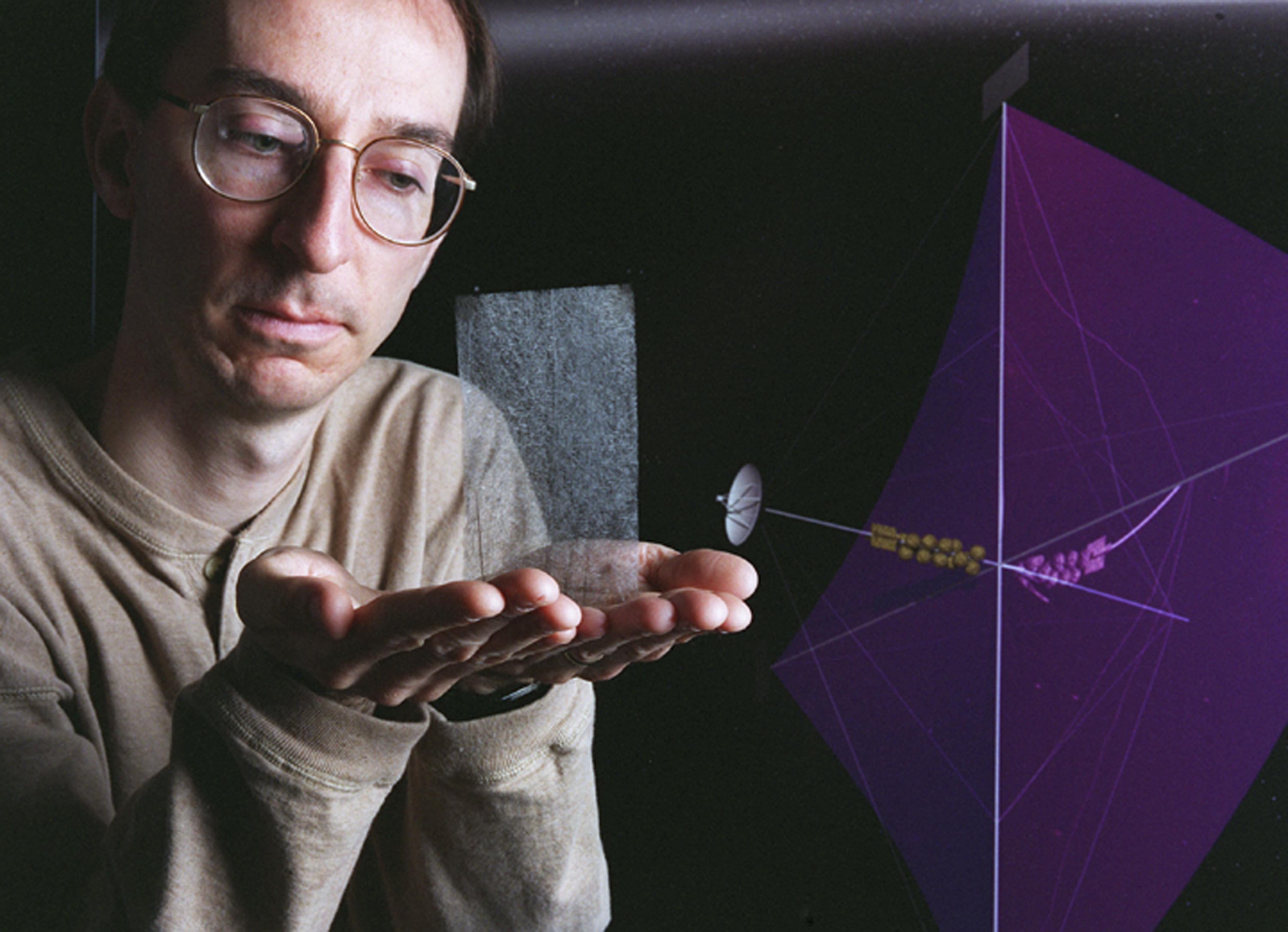
- Les Johnson Views Interstellar Sail Material (NASA)
- original description: Engineers at Marshall Space Flight Center's (MSFC) Interstellar Propulsion Research department are proposing different solutions to combustion propellants for future space travel. One alternative being tested is the solar sail. The idea is, once deployed, the sail will allow solar radiation pressure to propel a spacecraft away from Earth and towards its destination. This would allow a spacecraft to travel indefinitely without the need to refuel during its long journey. Thin reflective sails could be propelled through space by sunlight, microwave beams, or laser beams, just as the wind pushes sailboats on Earth. The sail would be the largest spacecraft ever built, sparning 440 yards, twice the diameter of the Louisiana Super Dome. Construction materials are being tested in a simulated space environment, where they are exposed to harsh conditions to test their performance and durability in extremely hot and cold temperatures. A leading candidate for the construction material is a carbon fiber material whose density is less than 1/10 ounce per square yard, the equivalent of flattening one raisin to the point that it covers a square yard. In space, the material would unfurl like a fan when it is deployed from an expendable rocket. This photo shows Les Johnson, manager of MSFC's Interstellar Propulsion Research Center holding the rigid, lightweight carbon fiber. An artist's concept of the sail is on the right. Mankind's first venture outside of our solar system is proposed for launch in a 2010 timeframe. An interstellar probe, powered by the fastest spacecraft ever flown, will zoom toward the stars at 58 miles per second. It will cover the distance from New York to Los Angeles in less than a minute and will travel over 23 billion miles beyond the edge of the solar system.
 |
This file is in the public domain because it was created by NASA. NASA copyright policy states that "NASA material is not protected by copyright unless noted". (NASA copyright policy page or JPL Image Use Policy).
Deutsch | English | Español | Français | Nederlands | Português | Русский | 中文(简体) | 中文(繁體) | +/- |
 |
 |
Warnings:
|
File history
Click on a date/time to view the file as it appeared at that time.
| Date/Time | Dimensions | User | Comment | |
|---|---|---|---|---|
| current | 11:54, 23 June 2005 | 3,000×2,171 (2.03 MB) | Bricktop |
File links
The following pages on the English Wikipedia link to this file (pages on other projects are not listed):
Metadata
This file contains additional information, probably added from the digital camera or scanner used to create or digitize it. If the file has been modified from its original state, some details may not fully reflect the modified file.
| Image title | A SPACE SAIL, AS DEPICTGED IN AN ARTGISTS CONCEPT AT RIGHT, COULD POWER INTERSTELLAR MISSIONS BEYOND OUR SOLAR SYSTEM. LES JOHNSON, MANAGER OF INTERSTELLAR PROPULSION RESEARCH AT NASA'S MARSHALL SPACE FLIGHT CENTER IN HUNTSVILLE, ALABAMA HOLDS A RIGID, LIGHTWEIGHT CARBON FIBER MATERIAL THAT COULD BE USED TO BUILD A GIANT SPACE SAIL. MARSHALL ENGINEERS ARE CONDUCTIING LABORATORY EXPERIMENTS TO EVALUATGE AND CHARACTERIZE MATERIALS FOR SPACE SAILS. |
|---|---|
| Orientation | Normal |
| Horizontal resolution | 300 dpi |
| Vertical resolution | 300 dpi |
| Software used | Adobe Photoshop 7.0 |
| File change date and time | 08:17, 8 November 2002 |
| Color space | 65535 |


