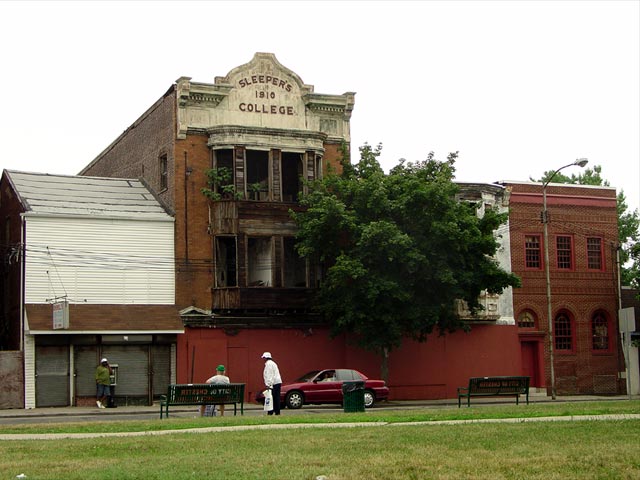
Sleeper's College
From Wikipedia, the free encyclopedia
Sleeper's College (sometimes referred to as Sleeper's Business College) was a college founded by Josiah Sleeper in Chester, Pennsylvania, in 1910.[1] In 1971, the college moved a few miles to 2800 Edgmont Avenue in Parkside, where it operated until 1989.[2]
A 1914 photo, apparently an advertisement, of "Scholars On A Frosty Morning" in front of the original building at 625 Welsh Street describes the college as a "Leading Institution For Office and Commercial Training."[2]
The 1944 "Chester Times" yearbook, p. 94, said:
The Sleeper's Business College, located in its own building at 625 Welsh St, Chester, was planned for educational purposes. The school offers secretarial and accounting courses to young men and women, and the curriculum of the public school is open to both young and old. The method of individual instruction is particularly adapted for the backward pupil.[2]
In the 1950s, the ground floor of 625 Welsh was occupied by the Welsh Restaurant, a diner-style restaurant.[3] The building still stands. (Location: )
[edit] Josiah Sleeper
Sleeper attended grammar or perhaps high school at The Old Academy, located on West 2nd Street between Fulton and Franklin Streets in Chester.[4]
Sleeper became well-known in Delaware County. In the 1890s, he had at least partial control of a baseball team in Marcus Hook, some three miles southwest of Chester. He brought the team to Chester's 12th Street Park, which was bounded by 12th, Upland and Potter Streets. He eventually passed control of the team to local baseball impresario Jesse Frysinger, and it moved in 1900 to Wilmington, Delaware.[5]
In October 1921, Sleeper bought part of the "Brow O' the Hill" estate at 8 Irving Road, Wallingford, Pennsylvania, from D. Edwin Irving for $4,250. He acquired the rest on March 18, 1930, from Samuel Lloyd Irving and his wife and Jeanette Irving Stull and her husband.[6]
Sleeper died August 20, 1946. His will allowed his sister, Lottie Sleeper Hill, to live in "Brow O’ the Hill" until her death. But she had, in fact, already died and so the property was sold for $43,000 to James H. Gorbey, who would go on to be mayor of Chester (1964 to 1967) and U.S. District Court judge from 1970 until his death in 1977.[6]