Silver Bridge
From Wikipedia, the free encyclopedia


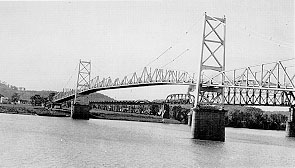
The Silver Bridge was an eyebar chain suspension bridge built in 1928 and was named for the color of its aluminum paint. The bridge connected Point Pleasant, West Virginia and Gallipolis,Ohio over the Ohio River.
On December 15, 1967, the Silver Bridge collapsed while it was choked with rush hour traffic, resulting in the deaths of 46 people. Investigation of the wreckage pointed to the cause of the collapse being the failure of a single eye-bar in a suspension chain, due to a small defect only 0.1 inch (2.5 mm) deep. It was also noted that the bridge was carrying much heavier loads than it was originally designed for and was poorly maintained.

Contents |
[edit] Bridge type history
At the time of its construction, bridges of this type had been constructed for about a hundred years. Such bridges had usually been constructed from redundant bar links, using rows of four to six bars, sometimes using several such chains in parallel. These can be seen in the Clifton Suspension Bridge, designed by Isambard Kingdom Brunel. The chain eyebars are redundant in two dimensions. This is a very early suspension bridge still in service. Other bridges of similar design include the earlier road bridge over the Menai Straits built by Thomas Telford in 1826; the Széchenyi Chain Bridge in Budapest, built in 1839-1849, destroyed by retreating Germans in 1945, rebuilt identically by 1949, with redundant chains and hangers; and the Three Sisters, similar suspension bridges of non-redundant design in Pittsburgh.
[edit] Silver Bridge structure
[edit] Low redundancy, high strength
The eyebars in the Silver Bridge were not redundant, as links were composed of only two bars each, of high strength steel (more than twice as strong as common mild steel), rather than a thick stack of thinner bars of modest material strength "combed" together as is usual for redundancy. With only two bars, the failure of one could impose excessive loading on the second, causing total failure—unlikely if more bars are used. While a low-redundancy chain can be engineered to the design requirements, the safety is completely dependent upon correct, high quality manufacturing and assembly.
In comparison, the Brooklyn Bridge, with wire cable suspension, was designed with an excess strength factor of six, which proved fortunate owing to a contractor's substitution of wire weaker than that specified. (This was discovered before completion and additional strands were placed in the bundles.)
[edit] Rocker towers
The towers were "rocker" towers. These allow the bridge to respond to various live loads by a slight tipping of the supporting towers which were parted at the deck level, rather than passing the suspension chain over a lubricated or tipping saddle or by stressing the towers in bending. Thus the towers required the cable on both sides for their support, so failure of any one link on either side, in any of the three chain spans would result in the complete failure of the entire bridge.
[edit] Design loads
At the time of its construction, a typical family automobile would be the Ford Model T, with a weight of about 1,500 lb (680 kg). The maximum permitted truck gross weight was about 20,000 lb (9,072 kg). At the time of the collapse, a typical family automobile weighed about 4,000 lb (1,814 kg) and the large truck limit was 60,000 lb (27,216 kg) or more. Bumper-to-bumper traffic jams were also much more common - occurring several times a day, five days each week.
[edit] Wreckage analysis
The bridge failure was found to be due to a defect in a single link, eyebar 330, on the north of the Ohio subsidiary chain, the first link below the top of the Ohio tower. A small crack was formed through fretting wear at the bearing, and grew through internal corrosion, a problem known as stress corrosion cracking. The crack was only about 0.1 inch deep when it went critical, and it broke in a brittle fashion. Growth of the crack was probably exacerbated by residual stress in the eyebar created during manufacture. When the lower side of the eyebar failed, all the load was transferred to the other side of the eyebar, which then failed by ductile overload. The joint was now only held together by three eyebars, and another slipped off the pin at the centre of the bearing, so the chain was completely severed. Collapse of the entire structure was inevitable since all parts of a suspension bridge are in equilibrium with one another. Witnesses afterward estimated that it took only about a minute for the whole bridge to disappear.
[edit] Inspection difficulties
"Inspection prior to construction would not have been able to notice the miniature crack. ...the only way to detect the fracture would have been to disassemble the eye-bar. The technology used for inspection at the time was not capable of detecting such cracks."[1]
[edit] Aftermath
The collapse focused much needed attention on the condition of older bridges, leading to intensified inspection protocols and numerous eventual replacements. There were only two other bridges built to a similar design, one upstream at St. Marys, West Virginia and a longer bridge at Florianópolis, Brazil. They were both closed immediately, and the St. Marys bridge was demolished in 1971. Explosive charges were placed on the main chains, and fired to remove the structure, although a small truss bridge was kept to allow access to an island in the river. The Brazilian bridge remains, but is closed to traffic. It was built to a higher safety factor. Modern non-destructive testing methods allow some of the older bridges to remain in service where they are located on lightly traveled roads, while most heavily used bridges of this type have been replaced with modern bridges of various types, and as an extra benefit containing additional lanes.
The new bridge that replaced the Silver Bridge was named the Silver Memorial Bridge.
A scale model of the original Silver Bridge can be seen at the Point Pleasant Museum, and there is an archive of literature kept there for public inspection. The museum also has an eyebar assembly from the original bridge on display on the lower ground floor.
[edit] Urban legends
Odd events were purported in the area over several months before the collapse, including appearances of a "Mothman." Originally, the story of Mothman was connected to the disturbance of the grave of Chief Cornstalk when the county courthouse was expanded. Later, a 1975 book The Mothman Prophecies by John A. Keel would connect the Mothman to aliens. The 2002 "based on a true story" movie of the same name is not set in the 1960s, but in the present day. Point Pleasant has a Mothman Museum and holds an annual Mothman Festival.
[edit] See also
[edit] External links
- "The Collapse of the Silver Bridge," by Chris LeRose in West Virginia Historical Society Quarterly (vol. xv, no. 4, Oct. 2001)
- "The Point Pleasant/Silver Bridge Disaster"
- Image of Silver Bridge
- Point Pleasant Silver Bridge Museum
- Silver Bridge in the Structurae database
- West Virginia Division of Culture and History "On This Day", section-- provides a link to the official WVa state's disaster video the next day, archive 1.6 mb wmv file having good quality, no sound http://www.wvculture.org/history/av/silverbridge256.wmv
- Mothman Museum, Books, Festival and other information and links
- Bridge collapse video to show sequence of events
- Case study of bridge collapse
[edit] References
- Mothman and Other Curious Encounters by Loren Coleman (Paraview Press, 2002, ISBN 1-931044-34-1)
- Seim, Charles (May 2008). "Why Bridge Have Failed Throughout History". Civil Engineering 78 (5): 64-71, 84-87.
|
||||||||