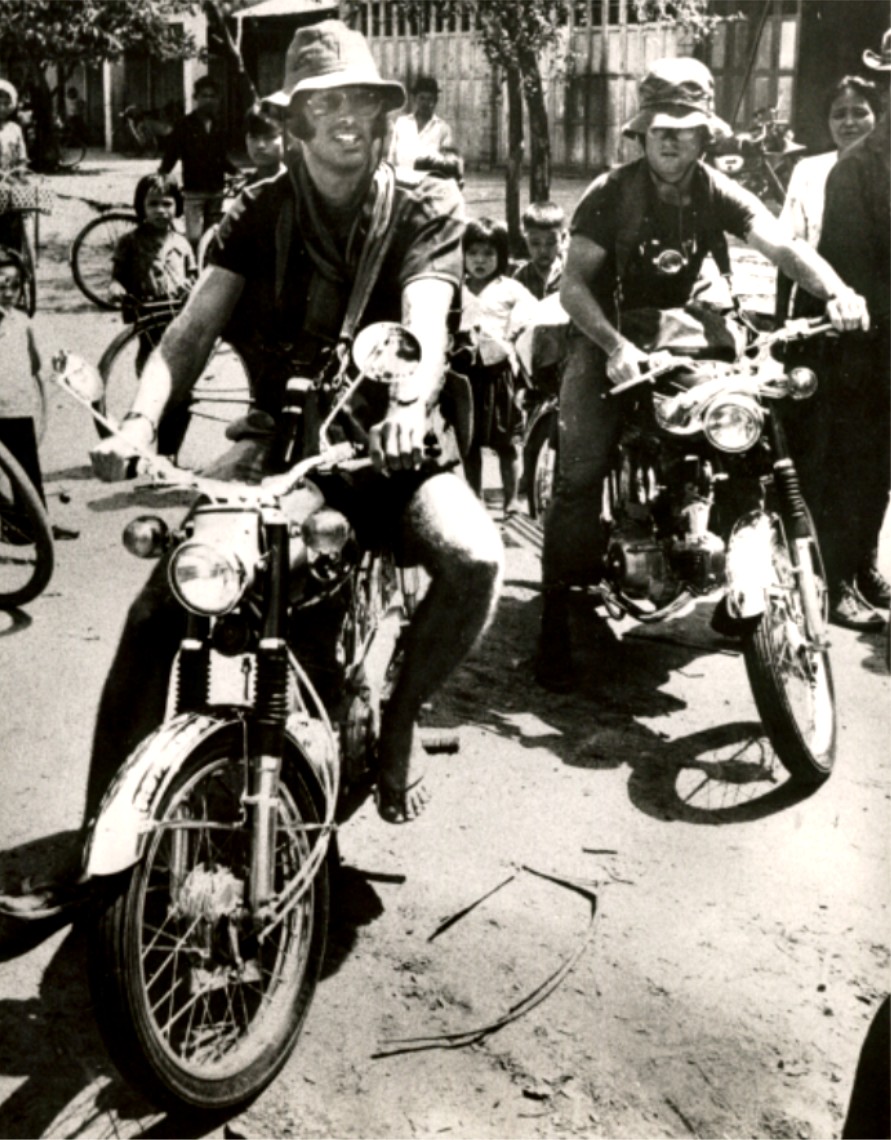
Sean Flynn
From Wikipedia, the free encyclopedia
| Sean Flynn | |
|---|---|
| Born | Sean Leslie Flynn May 31, 1941 Los Angeles, California |
| Died | June, 1971 (aged 30) Chi Pou, Cambodia |
Sean Leslie Flynn (born May 31, 1941, disappeared April 6, 1970, believed captured by factions of Viet Cong and/or Khmer Rouge; believed killed 1971, Bei Met, Cambodia) was an American actor and freelance photojournalist best known for his coverage of the Vietnam War. He started a news service in Saigon with John Steinbeck IV, son of the American author.
Flynn was the only child from the marriage of actors Errol Flynn and Lili Damita, and after a brief enrollment at Duke University and brief stint as an actor, he became a freelance photo journalist under contract to Time Magazine. In the search for exceptional images, he teamed up with elite Special Forces units and irregulars operating in the remotest areas. His taste for adventure was to have tragic consequences, however. On April 6, 1970, he and fellow journalist Dana Stone (working for CBS) left Phnom Penh on rented Honda motorbikes to find the front lines of fighting in Cambodia. Traveling southeast on Route One near a eucalyptus plantation in eastern Cambodia, the two men were stopped at a check point at grid coordinates XT171209 in Svay Rieng Province, Cambodia, and led away by elements of the Viet Cong Tay Ninh Armed Forces and elements of the combined North Vietnamese-Viet Cong Ningh Division based in Cambodia.
Information obtained from indigenous sources indicated that Stone and Flynn were executed in mid-1971 in Kampong Cham Province, Cambodia. Various sources, including an intercepted radio message from COSUN, the Viet Cong high command, indicated that Flynn and Stone survived. One source reported that he had seen a group of very long haired, bearded, tall prisoners near Memot, Cambodia who were identified as 'imperialist journalists'.
In the years that followed, occasional reports emerged from isolated Cambodian villages of a "movie star" who was being held prisoner by the Khmer Rouge. Although his mother Lili Damita spent an enormous amount of money searching for him, he was never found. In the 1980s, a vagrant claimed to have been recently in Mexico having been drinking buddies with a man who claimed to be the son of Errol Flynn. This was never verified or substantiated. In 1984 he was declared legally dead, and one of 22 international journalists missing in Southeast Asia, most known to have been captured.
Important evidence concerning Flynn's fate was uncovered in 1991 by his former photojournalist colleague Tim Page. According to a report published in the UK Sunday Times on 24 March 1991, Page returned to Cambodia in November 1990, determined to resolve the mystery. He began his search at Sangke Kaong, the first village where Flynn and Stone were known to have been held captive for several months according to documents released by the CIA. Page tracked down one former villager who identified Flynn from a contemporary photograph, and recalled that the American had told her that both his parents were movie actors.
According to the report, Flynn and Stone were moved north in early 1971 by their captors to Rokar Knor and then Peus, following the advance of US forces into Cambodia. Following a hunger strike, they were moved again, and eventually handed over to the Khmer Rouge. Investigations by Page and a TV documentary maker led them to a village known as Bei Met, and to an empty grave that had allegedly been the final resting place of two foreigners. Forensic examination of the few remains left in the grave suggested they belonged to a tall man and a short man, and that both had met a violent end.
More recent information has been provided by author Jeffrey Meyers in his 2002 dual biography, "Inherited Risk: Errol and Sean Flynn in Hollywood and Viet Nam". His research now provides a different ending to the mystery of "Whatever Happened to Sean Flynn?" According to Meyer, his research shows that in June of 1971, after more than a year in captivity Flynn had contracted a "severe case of malaria". Due to the poor medical facilities in Cambodia at the time, the medical treatment given to him by his captors "went horribly wrong". When nothing else could be done for him; he was given a lethal injection. (He may also have been buried alive, before the effects of the injection took its final toll.) His remains were then buried in an unknown spot never to be found again. Meyer even mentions that Tim Page after completing his own documentary acknowledges that he had heard that this was how his good friend had met his end.
[edit] Acting career


U.S. Release
Flynn first appeared in front of the cameras at the age of 15, when he appeared in an episode of his father's television show "The Errol Flynn Theatre". The episode titled "The Strange Auction" filmed in 1956. (The show was produced and broadcast in the U.K. in 1956 and was broadcast in syndication in the U.S.A. in 1957.) In 1960 at the suggestion of his friend, the actor George Hamilton, Flynn filmed a scene in Hamilton's picture "Where The Boys Are", but his scene ended up on the cutting room floor. In 1961, at the age of 20 (and after his father's death in 1959), Flynn accepted a contract to appear in a sequel to his father's hit film Captain Blood, "The Son of Captain Blood"(1964--year of U.S. release) also known as "Il Figlio del Capitano Blood" (1962--year of initial European release), being a European production. He made a few more films in Europe also including, "Il Segno di Zorro"(1963--year of initial European release) (aka "Duel at the Rio Grande"(1964--year of release of English version). He also starred in "Stop Train 349"(1964) with Jose Ferrer (aka "Verpastung in Marienborn"--1963--year of initial European release); "Mission to Venice"(1964) (aka "Agent Special a Venise--Voir Venise et...Crever"(1964) & "Sandok, Il Maciste della Jungla"(also 1964)(aka "Temple of the White Elephant"--1966--year of release of English version). He became bored with acting and then went to Africa in late 1964/early 1965 to try his hand at safari guide and big game-hunting. [Also during his time in Africa he tried his hand at being a game warden in Kenya.] In the latter part of 1965 in need of money he made two Spaghetti westerns back-to-back in Spain and Italy. ("Sette Magnifiche Pistole" and "Dos Pistolas Gemelas", both receiving initial European release in 1966.) Soon after, he began his career in journalism making his way to Vietnam; arriving in January of 1966. In the summer of 1966, in need of money again, he made a brief return to acting to star in the French-Italian action film, "Cinq Gars Pour Singapour"(1967--year of initial European release) (aka "Five Ashore in Singapore"(1968--year of release of English version) filmed in that city), his eighth and final starring film. After its completion, he gave up acting for good. He would eventually return to Vietnam and his new-found career of photojournalist which would lead to his disappearance in Cambodia in 1970.
[edit] Trivia
 |
Trivia sections are discouraged under Wikipedia guidelines. The article could be improved by integrating relevant items and removing inappropriate ones. |
- The story of Sean Flynn was immortalized by The Clash in the song "Sean Flynn" from the album Combat Rock.
- Sean Flynn is a major character in Michael Herr's Dispatches, one of the most acclaimed American literary treatments of the Vietnam War. Herr's friendship with Flynn during his years in Vietnam is vividly described. Dennis Hopper's photojournalist character in Apocalypse Now is modeled in part on Flynn and in part on the harlequin character ("The man's enlarged my mind.") in Heart of Darkness.
- Portrayed by Kevin Dillon in 1992 mini-series Frankie's House.
- Examples of Sean Flynn's photography are included in "Requiem: By the Photographers Who Died in Vietnam and Indochina", a collection edited by fellow Vietnam War veteran journalists and friends Horst Faas and Tim Page
[edit] External links
- Brief memoire about Flynn, with an example of his Vietnam images
- Photo of Flynn (left) and Stone taken two hours before their disappearance in 1970
- 1963 photo-report of Flynn filming Son of Captain Blood in Stars and Stripes.
- Peter's E.F. Club - An internet scrapbook dedicated to Errol Flynn with extensive archival articles, books, photographs, filmography, biography, and much more including Sean Flynn.
- Sean Flynn at the Internet Movie Database