Talk:Salvador Allende/archive 2
From Wikipedia, the free encyclopedia

Can we settle once and for all the question of how Allende Died?
Per your request I am here providing excellent sources to do just this...
- There is no doubt that he died because of the military coup. I don't think it is necessary to discuss this. We should discuss about Allende's political and social effects on the nation and on the world. With respect, the son of the death heroes of the Battle of Kosovo, Deliogul 21:30, 15 June 2006 (UTC)
Many people have the impression that his last speach ended with "estos son mis ultimas palabras" (these are my last words) this is a LIE, in truth his speach did not end here. His speach was later modified to support the idea that he commited suicide. The REAL last part to hisd speach is,(english translation)"I have the certainty that the sacrifice will not be in vain. I have the certainty that, atleast, there will be a moral sense that will punish the felony, the cowardness, nad the traitory."
These are his real last words, true supporters of Allende recorded this last part when during september 11, 1973. —Preceding unsigned comment added by Gzuniga (talk • contribs) 22:56, 21 December 2006
All authoritative sources say Salvador Allende's death was by suicide
There is no doubt whatsoever Salvador Allende was not killed by the forces of Augusto Pinochet, but by his own hand on a trigger of a gun on 9/11/73 as Gen. Pinochet launched a military coup, because:
- Allende announced his imminent suicide to the Chilean people in a final farewell radio broadcast "these are my last words" etc. (and you can hear him say it himself, see audio clip links and/or translations below), (this is a LIE, the his last speech did not end here, It was later altered to exlude his words after this.) Allende was probably offered a passage, but probably to be tortured. Nixon vowed to crush Allende and to make him a coward, so they lied about him committing suicide.
- Pinochet's military coup radio communications of 9/11/73, which were intercepted, recorded and preserved by the media (see links below), reveal intentions of granting Allende safe passage, and later as the coup progressed, of communicating internally that Allende was rejecting those offers, and finally of his death (they do also reveal a possible plot by Pinochet to bring Allende's plane down if he had accepted safe passage, but with Allende's death in La Moneda palace, that opportunity never presented itself),
- Several witnesses personally and politically loyal to Allende and present with him at the time of his death including two physicians (see below) have in the years subsequent to Allende's death testified to his manner of death by suicide. (this is another lie, See the got the people who examined Allende ended up dead, see Pinochet told them to lie in exchange to not being killed.)
- His family always outspoken, has never disputed Allende's death as a suicide,
- But perhaps next to live audio tapes, the most authoritative source of the truth of this matter is the official Chilean Government historical websitewhich confirms Allende's death was a suicide:
"Ante el violento quiebre de la institucionalidad democrática, el Presidente Allende se suicida en el Salón Independencia del Palacio de Gobierno. Ese día la democracia chilena quedó suspendida, instalándose la dictadura.
TRANSLATION: "In view of the violent break with institutional democracy, President Allende committed suicide in the Hall of Independence of the Palace of Government. On that day Chilean democracy was suspended, with the installation of the dictatorship."
While many automatically discount that source assuming Pinochet somehow still controls it's content, the fact is that Pinochet and his people have been out of power for 16 years, and were succeeded by 3 mostly Pinochet-unfriendly administrations including the current one of the same political party as Allende.
Ricardo Lagos, Socialist, the current President of Chile (whose staff personnel would control the official Government website), was an ally of Allende and bitter enemy of Pinochet. Indeed Lagos spent many years in exile in the U.S.
Therefore, certainly key historical representations under the Chilean government's control would certainly be expected to be sanitized of all Pinochet-era inaccuracy.
Comments / summary. The evidence shows:
- In conducting the military coup, Pinochet publicly offered Allende safe passage if he surrendered, and was conducting negotiations with Allende through subordinates for that.
- Allende was committed to his cause, felt betrayed, saw no way out, and rejected a deal. He saw his death as a way to undermine the "traitors" (see below).
- He then made a last "farewell" speech to Chileans on live radio. He said to Chileans, "these are my last words" (implying it was his decision to die, since he and his family had been offered safe passage out of Chile).
- In his speech, Allende refused the offer of safe passage and vowed to fight to the end, even "at the cost of my own life."
- In his speech, Allende specifically said his death would further his cause and "history" and help expose "those with strength but no righteousness."
- However, unknown to Allende, Pinochet apparently confided to fellow General Carvajal [on audio tape, see below for link] that he intended to have Allende's plane downed later if Allende accepted the safe passage.
- As Pinochet's forces were about to enter La Moneda, Allende appears to have killed himself. Two doctors (see below) and political advisors with him later testified about this.
The main sources here are first-hand recordings of the principals themselves on the very day in question (live audio recordings of Pinochet and Allende) on September 11, 1973.
It is very interesting that Pinochet is on tape saying he would down Allende's plane, a topic that has received little if any coverage (as far as I know), and hopefully somebody else can research and write an article about it.
La Tercera, Chile's second largest newspaper
See La Tercera's audio archives of 9/11/73, for an extensive list of 9/11/73 multimedia files. These include actual military radio communications to/from Pinochet:
Pinochet tells subordinates to attack at 11 because Allende will not surrender
Audio Pinochet: "A las 11 en punto hay que atacar La Moneda, porque este gallo no se va a entregar".
Translation: "At 11 AM sharp La Moneda has to be attacked, because this man is not going to turn himself in."
As coup unfolds Pinochet warns subordinates Allende is a liar and so to beware of trickery
Audio Pinochet: "Ten cuidado con el señor Presidente, que es muy re chueco, no dice nunca la verdad, así que hay que tener mucho cuidado con él".
Translation: Audio, Pinochet: "Be careful with the Mr. President who is very crooked and never tells the truth, so you have to be very careful with him."
Pinochet frankly discusses Allende's fate with field commanders - rejects a trial
audio Pinochet: "Si los juzgamos les damos tiempo (...) se pueden levantar hasta las pobladas pa' salvarlos (...) la opinión mía es que estos caballeros se toman y se mandan a dejar a cualquier parte. Por último, en el camino los van tirando abajo".
Translation: Pinochet: “If we put them on trial we give them time… Even the outskirts may rebel to ["pa' is slang for "para:] save them… my opinion is these gentlemen are taken and sent to any place [unprecise slang sentence]. As a last resort, on the journey you go throwing them down.”
Gen Carvajal radio's Pinochet to say Allende has machine gun and threatens suicide, Pinochet scoffs
Audio Carvajal comunica a Pinochet que Allende sigue en La Moneda, que porta un fusil ametralladora y que habría dicho que el último tiro se lo dispararía en la cabeza. Pinochet responde: "Esas son novelas no más, ese huevón no se dispara ni una pastilla de goma...".
Translation: Carvajal [a field general] communicates to Pinochet that Allende remains in The Moneda [the Presidential Palace] carries a machine gun and has said the last shot he would fire would be into his head. Pinochet responds: “Those are just fables, that [literally: big balls, but connotating "stupid"] couldn’t even fire a rubber bullet into himself…”
Pinochet gets impatient, demands unconditional surrender from Allende
Audio Pinochet: "Rendición incondicional, ¡nada de parlamentar!" "Se mantiene el ofrecimiento de sacarlo del país, pero el avión se cae, viejo, cuando vaya volando".
Translation: Pinochet: “Unconditional surrender, and no negotiation!” “The offer of taking him out of the country remains open, but the plane falls, old man, when it’s flying.”
The Last Words of Allende
Las últimas palabras de Allende (the last words of Allende)
audio Primera intervención de Allende por radio: confirma el alzamiento militar.
Translation: First radio broadcast by Allende that confirms military coup has begun.
Audio Respuesta de Allende a exigencia de dimisión: "No renunciaré"
Translation: Response by Allende to insistence to step aside: "I won't resign"
Audio El último discurso de Salvador Allende: "...pagare con mi vida la lealtad del pueblo (...) más temprano que tarde se abrirán las grandes alamedas por donde pase el hombre libre para construir una sociedad mejor."
Translation: The final messagre from Salvador Allende: "...I will pay with my life for the loyalty of the people (...) sooner rather than later, will large avenues open through which may men of freedom pass to build a better society."
Gen Carvajal tells Pinochet Allende is dead:
Audio Carvajal comunica a Pinochet y a Leigh que "Allende se suicido, esta muerto". Pinochet ordena que "lo echen en un cajón y lo embarquen en un avión, viejo, junto con la familia, que el entierro lo hagan en otra parte, en Cuba. Si no vamos a tener una pelota pa'l entierro. Si este gallo hasta pa' morir tuvo problemas".
translation of above text: "Carvajal [a field general and referred to as viejo, or "old man" by Pinochet] communicates to Pinochet and Leigh [Air Force Commandant] that "Allende committed suicide, he's dead." Pinochet orders "throw him in a box and ship him on a plane, old man, together with his family, so that he gets buried somewhere else, in Cuba. If not we're going to have a circus for the funeral. Why this man even in dying had problems."
La Tercera print article archive from 9/11/73
Article Headline: Allende responde a exigencia de renuncia: "No lo haré"
Translation: “Allende responds to the insistence he resign: “I won’t do it.”
El Presidente condenó la "actitud increíble de soldados que faltan a su palabra y a su compromiso".
Translation: “The President condemns the “incredible attitude of soldiers who fail to honor their oath and commitment.”
El Primer Mandatario se dirigió al país nuevamente a través de la radio para rechazar la proclama de los militares golpistas que exigen su renuncia. Salvador Allende manifestó su voluntad "de resistir con lo que sea, a costa de mi vida, para que quede la lección que coloque ante la ignominia y la historia a los que tienen la fuerza y no la razón".
Translation: “The President addressed the nation again to reject the proclamation of the military coup leaders that insist on his resignation. Salvador Allende manifested his will to “resist with whatever I can, at the cost of my life, to leave behind the lesson that puts before infamy and history those that have strength but not righteousness. [reference to Chile's national motto: in terms with reason, or otherwise in terms with strength]”
Another Source: Absolute Astronomy Encyclopedia
According to Absolute Astronomy Encyclopedia two physicians in La Moneda were witnesses to Allende's suicide:
-
-
- Dr. Patricio Guijón (who made a statement at the time).
- Dr. José Quiroga (who confirmed it many years later).
-
"…During this coup, Allende died. After being debated by several years, the official version, that he committed suicide with a machine gun (generally presumed to be the machine gun given to him by Fidel Castro), and an autopsy labelled his death as suicide, has been widely accepted, even by members of his own party and family. This general acceptance is based on statements given by two doctors from the La Moneda Palace infirmary: Patricio Guijón, who made a statement at the time, and José Quiroga who confirmed it many years later. (Some sources misattribute these statements to "Allende's personal doctor"; that would be Enrique Paris Roa, who does not appear to have made such a statement.) However some still insist he was murdered by Pinochet's military forces while defending the palace."
nfgii | Talk 03:32, 25 October 2005 (UTC)
Needing at least an improved citation
From the current state of the article:
After Pinochet assumed power, U.S. Secretary of State Henry Kissinger told U.S. President Richard Nixon that the U.S. "didn't do it" (referring to the coup itself) but had "created the conditions as great as possible" [1], including leading economic sanctions.
The quoted phrase is not on the referenced web page (though the reference is clearly relevant to the article in general), and the quoted phrase is not good English, which makes it unlikely that it is an accurate quote of Kissinger, whose use of English is generally correct, if not always inspired. Does anyone have an accurate quotation and a citation? -- Jmabel | Talk 05:30, Jun 22, 2005 (UTC)
on this Kissinger quote
"didn't do it" and "created the conditions..."
I've read a lot about this whole coup before during and after, and the quote appears consistent with what Kissinger would say on this topic, at least it is historically accurate; but I agree the wording is not right at all, and I think that is probably something that was translated from English to another language and back to English by someone not totally fluent in English.
Even so I agree as it is it is not useful, though it would be nice if the original text could be found as it seems to convey important content.
Nfgii 05:04, 28 October 2005 (UTC)
- Found it. It's Box 22, File 3, Telcon, 9-16-73 11,50 Mr. Kissinger-The Pres (PDF). Not sure how standardized that notation is. The transcription in our article is not quite right, but it looks like the bad English was Kissinger's:
P: Well we didn't - as you know - our hand doesn't show on this one.
K: We didn't do it. I mean we helped them. ______ created the conditions as great as possible (??)
I'm new here and it is cool how this works
Nfgii 13:37, 4 November 2005 (UTC)
Comment on archive
Given that this unaddressed issue (Needing...improved citation) was archived, it won't surprise me if the same happened to other unresolved matters. Someone may want to look through the archive and see if other things should be retrieved. -- Jmabel | Talk 22:57, September 11, 2005 (UTC)
Incoherent passages
I've done my best to edit the recently added passage on the KGB. Some of this was too confused for me to edit; I've taken the liberty of inserting HTML comments on what is confusing, clarification would be welcome. Also:
- "We are not mental colons" , about his relationship to Cuba, and "I do not receive subsides from them". "Reality in Cuba is really different from Chile. Cuba came from a dictature, I came to be president after being senator for 25 years". (in an unreleased 1971 interview with Saul Landau, published by La Nacion on September 24th, 2005)
"We are not mental colons" has to be wrong. I'm guessing either "We are not mentally colonized" or "We are not mental colonists" or some such. "We are not mental colons" would be "No somos anos mentales," clearly not what he said. If someone will provide the Spanish-language original, I will gladly render it into better English. Similarly, "dictature" is not an English word. Perhaps "dictatorship" ("dictadura")? Again, if someone will provide the Spanish-language original, I will gladly render it into better English.
If no one responds within 48 hours, I will probably cut that paragraph, because in its current state it is an embarrassment. -- Jmabel | Talk 06:28, 29 September 2005 (UTC)
I am still leaving the KGB passage in the article, but no one has responded to my questions in HTML comments, so I am going to raise the matter more explicitly here. My questions are bracketed, in red.
The KGB's archives report [report? In what sense? Perhaps record?] that Svyatoslav Kuznetsov, KGB case officer in Chile, was instructed by the centre [what "centre"?] to "exert a favourable influence on Chilean government policy". The Times extract from the Mitrokhin Archive volume II from historian Christopher Andrew and KGB defector Vasili Mitrokhin says that "In the KGB's view, Allende's fundamental error was his unwillingness to use force against his opponents. Without establishing complete control over all the machinery of the State, his hold on power could not be secure." [2] In other words, his respect for democracy and legal actions made him insecure in the eyes of Moscow. According to Allende's KGB file, he "was made to understand the necessity of reorganising Chile's army and intelligence services, and of setting up a relationship between Chile's and the USSR's intelligence services", and he was said to react positively (keeping in mind that KGB had a policy of handing up good news to the center). [Is "center" here the same thing as "centre" a few sentences earlier?] In June 1972, it seems [seems to whom?] that Kuznetsov's close relationship to Allende was disturbed by the arrival in Santiago of a new Soviet ambassador, Aleksandr Vasilyevich Basov, member of the Central Committee. [Meaning Central Committee of the Soviet Communist Party? or what?] In 1972, Moscow downgraded its assessment of the prospects of the Allende regime. The "truckers' strike", backed by CIA funding, virtually paralysed the economy for three weeks, which Moscow saw as evidence of the weakness of the Popular Unity government.
Jmabel | Talk 05:35, 13 October 2005 (UTC)
Personal doctor
Once again, the claim has come into the article—again unsourced—that Allende's "personal doctor" testified that he was a suicide. I [Talk:Salvador_Allende/archive#Did_he_shoot_himself_.28revisited.29 thought we had dismissed that]. Mel Romero provided a citation that has this testimony from a doctor present at the scene, Dr. Patricio Guijón, but not by Allende's personal doctor, Enrique Paris Roa, who died shortly afterwards at the hands of the Pinochet regime. Unless either a new citation is forthcoming (which would surprise me, but not astound me), or if someone can show that Patricio Guijón was in some meaningful sense Allende's "personal doctor" (which would astound me), then the text should be amended accordingly and Mel's citation restored:
- Camus, Ignacio Gonzalez , El dia en que murio Allende ("The day that Allende Died"). Instituto Chileno de Estudios Humanísticos (ICHEH) and Centro de Estudios Sociales (CESOC), 1988. p. 282 and following.
I'll give at least 24 hours for someone to respond before I act on this. -- Jmabel | Talk 02:59, 25 October 2005 (UTC)
- [copied from User talk:Jmabel:
- At first I thought your question was only, as it is for a lot of people, whether Allende committed suicide or was killed, and answered this at length in the "talk" page of Allende, but now it dawns on me you may have just questioned whether this info source was from a "personal doctor'.
- If so, you raise a good point, as I believe the two doctors in question were not personal doctors but doctors there in another capacity. You are right that probably got into my head from many secondary sources that just repeat this from some inaccurate original report from a long time ago.
Nfgii 10:51, 25 October 2005 (UTC)
- [end copied material]
Allende a marxist?
As I understand it, Allende was center-left but took a turn towards the hard left after being elected (as the article here points out, partly due to pressure in his coalition). However he might have been a marxist and I just didn't know about it. How about a source on that? --MateoP 02:07, 8 December 2005 (UTC)
- He was a founder in the 1930s of the Chilean Socialist Party, which was always overtly Marxist. I'm not sure what sort of citation exactly you want, but I suspect that if you do a Google search on Allende Marxist you will easily find every type of useful online citation imaginable. -- Jmabel | Talk 23:30, 9 December 2005 (UTC)
-
- One from a historian, preferrably. Thanks. --MateoP 00:49, 10 December 2005 (UTC)
My understanding is that the term "Marxist" encompassed both communism and the social democratic left during this period of Chilean history. Perhaps if this point is clarified in the article, the current dispute can be set to rest. CJCurrie 01:14, 11 December 2005 (UTC)
- This would better fit with my understanding. It's well known that he took a hard dive towards the left after he was elected. How does someone who's already on the hard left go further to the left (enough that everyone signals that he moved to the left)? Allende might have been a Marxist, but that doesn't really say a whole lot. In the context of the article it seems to indicate that he is a soviet-aligned marxist. However, I want an actual source from a historian that has studied primary documents either way. --MateoP 16:13, 11 December 2005 (UTC)
- He was not a Leninist, if that is the point. But he was a Marxist. -- Jmabel | Talk 07:48, 11 December 2005 (UTC)
- Source? --MateoP 16:13, 11 December 2005 (UTC)
-
-
- I don't have a lot handy at the moment, and something really solid will take library research. An interesting thing I found online is this page from Socialist Outlook has excerpts from an article by Tariq Ali, which gives a citation to Regis Debray (Conversations p118) for the following quotation from Allende:
-
We consciously entered into a coalition in order to be the left wing of the system – the capitalist system, that is. By contrast, today, as our program shows, we are struggling to change the system … Our objective is total, scientific, Marxist socialism.
-
-
- The Debray book should not be hard to find, and may have more. The quotation, though, is consistent with either view about Allende's politics prior to election.
-
-
-
- The following all unqualifiedly call Allende Marxist, but I'm not sure I'd call any of them definitive: Encyclopedia Britannica, CNN, Spartacus School Net New York Times reporting at the time of the coup, Isabel Allende's publisher calling him a "Marxist-Leninist" (which I disagree with, and which none of the others say). So, yes, this could use some library research in search of a "killer" citation, but it seems to me like a preponderance. Do you have something citable on the other side that makes you doubt this? Have you done research on this yourself that raises a question about what seems to be the common view? -- Jmabel | Talk 02:05, 12 December 2005 (UTC)
-
My professor of Latin American Politics gave the impression that he was center-left prior to the election and then took a turn towards the left after elected. This makes sense in regards to the coalition. The Socialist Party was in a coalition with the Christian Democrat Party at the time of Allende's election. After he turned more towards the left the coalition broke down (the center-right members of the CDP couldn't get anything done with him) and the political system essentially went into deadlock. This is a common reason stated for why democracy collapsed in Chile. This doesn't make as much sense if Allende was hard left to begin with. This is my problem with this. I don't doubt it, if encyclopedias and such make the claim, but I still want a source. I also am fearful of the tendancy to oversimply ("member of the Socialist Party, therefore a soviet-aligned communist"). Either way I would like a source, and think the article should be changed to reflect his soft-socialist stance, as people might confuse him with being Castro-like due to his place in Cold War history. --MateoP 02:37, 12 December 2005 (UTC)
As I noted above, I believe that both Socialists and Communists were considered "Marxist" in this period of Chilean history. The term referred to a broad range of thought, not simply to armed revolution and the like. If this is clarified, I don't think there's much controversy in using the term. CJCurrie 02:52, 12 December 2005 (UTC)
Agreed, but I think it's also important to know what Allende's beliefs were, aside from the vaguest definition of marxist. --MateoP 03:06, 12 December 2005 (UTC)
Sounds fair. A one-sentence clarification would probably do the trick. CJCurrie 03:09, 12 December 2005 (UTC)
- The UP were not in coalition with the Christian Democrats at the time of the election; they were briefly in a slowly collapsing, informal coalition in the first year or so of the Allende regime. -- Jmabel | Talk 07:51, 12 December 2005 (UTC)
Víctor Farías, again
These edits by Rune X2 revive the largely refuted accusations of Víctor Farías, and present them out of all proportion to the Allende Foundation's refutation, even adding to the quotations section material ("The Hebrews are well-known committers of certain types of crimes…" taken wildly out of context). We've been over this all before (see [[Talk:Salvador Allende/archive#.22Antisemitism and Euthanasia.22]). Much to my frustration, the site of the Allende Foundation, which had all of the relevant archival materials (including the text of the thesis) seems to be largely down while they move their facility, and the links http://www.elclarin.cl/hemeroteca.html, http://www.elclarin.cl/temas/18.html, and http://www.elclarin.cl/zip/p_270505.zip have gone dead.
These should all eventually show up on the Internet Archive, but these links are from June 2005, and their archive of www.elclarin.cl is currently only up to November 2004.
In any event I am reverting at least part of these changes; I suggest that if anyone disagrees they should at least read [[Talk:Salvador Allende/archive#.22Antisemitism and Euthanasia.22] before editing. -- Jmabel | Talk 20:09, 20 December 2005 (UTC)
- I am being moderate in my reversion: however, Rune X2 has not provided very good citations for Farías's claims (no page numbers, for example). I would not object if others revert more of his material. -- Jmabel | Talk 20:20, 20 December 2005 (UTC)
- It looks like the El Clarín material is still available, just moved; I'll get things back in there. -- Jmabel | Talk 20:33, 20 December 2005 (UTC)
-
- I was merely putting in more information and a more NPOV on the part of the article with the racism and anti-Semitism (some other parts of the Allende article also reads a bit one sided), since I felt the previous version gave the impression that the allegation by Farías had been fully and completely rebutted and the case closed - which is not the case, since Farías strongly maintains his reading of the subject is correct and has described the Allende Foundation's claims that the cites are mere copies of other people’s work as “completely nonsense”. And that further Allende’s theories could not be dismissed as youthful mistakes since he was 24-25 at the time. Also that the views might have been common in the 1930s wouldn’t alter the fact that Allende held them too – if he did.
-
- Perhaps it’s also worth nothing that the Allende Foundation is not a neutral observer, but besides trying to maintain Allende’s reputation, is a Marxist organisation from Catalonia. The same goes for Allende’s family naturally – not being neutral observers.
-
- Also I see no reason not to include quotes from the controversial sections of Allende’s dissertion. Readers of the Wikipedia article wants to know what in particular the controversy is about, and not just vague allegation of racism and anti-Semitism – so put them up and let reader themselves decide. Rune X2 09:24, 21 December 2005 (UTC)
-
- Also I'm afraid your links 12 & 13 are still not working Rune X2 09:55, 21 December 2005 (UTC)
-
-
- I don't know what to say about the links "not working" for you; they're working perfectly for me. Weird. Can you access http://www.elclarin.cl at all?
-
-
-
- Quoting Allende paraphrasing Lombroso is a bit of a stretch, but I'll agree to it if we do it in a balanced way. We should not quote only negative remarks about Jews and Arabs and omit positive ones, nor should we mistranslate the passages we quote. You wrote, “The Hebrews are well-known committers of certain types of crimes including: fraud, deceit, defamation, but most notably usury”, and about Arabs “most are adventurers, thoughtless and lazy with a tendency to theft”.
-
-
-
- On race, the relevant passages—clearly cited in Allende's thesis as paraphrases of Lombroso—are "Los ebreos se caracterizan por determinadas formas de deleito: estafa, falsedad, calumnia y, sobre todo, la usuria. Por el contrario, los asesinatos y los delitos pasionales son la excepción." (p. 115 in the PDF I linked to, [3] and "Entre los árabes hay algunos tribus honradas y laboriosas, y otras aventureras, imprevisoras, ociosas y con tendencia al hurto." (op.cit. p.114.).
-
-
-
- Translating the passage about Jews: "The Hebrews are characterized by certain forms of crime: fraud, deceit, defamation and, above all, usury. On the other hand, murders and crimes of passion are the exception." Your version quotes the first sentence without the second; also, "well-known committers" is not there at all in what Allende wrote. Translating the passage about Arabs: "Among the Arabs there are some honored and hardworking tribes, and other who are adventurers, thoughtless and lazy with a tendency to theft.") The "honored and hardworking" Arabs are missing from your quotation; "most" in your quotation comes from nowhere in Allende's writing.
-
-
-
- By 21st century standards, the racializing is not pretty, but it is not nearly as ugly as the mistranslations and omissions make it sound. Allende gives Lombroso's ideas on race/tribe/nation more credence than much anyone would today, but he does not embrace them: "Estos datos hacen sospechar que la raza influye in la delincuencia. No obstante, carecemos de datos precisos para demostrar este influjo en el mundo civilizado." (op.cit. p.114: "These data lead one to suspect that race influences crime. Nonetheless, we lack precise data to demonstrate this influence in the civilized world.")
-
-
-
- Four paragraphs later Allende remarks, "La civilización… ha traído… un mayor incremento de los delitos…": a similar quoting out of context could make Allende appear to be raging against civilization itself. (op.cit. p.115)
-
-
-
- On homosexuality, what he has writes is clearly homophobic, though not atypical of the time. He entertains (but, again, does not clearly embrace) ideas about what strike us now as weird medical operations to try to "cure" homosexuality. I'm not sure how exceptional that was for 1933, but I agree it's worth a sentence.
-
-
-
- As for the allegations that do not relate to the thesis, I don't know my way around these. I could do some research, but before I do, is there someone else working on this article who has already looked into what others besides Farías and those using Farías as their sole source have written about this?
-
-
-
- Rune, I think I've demonstrated pretty clearly above Allende's thesis was quoted misleadingly in the translations you originally gave; I assume that you gave these mistranslations in good faith, and that they are not your own. Do they come from the English translation of Farías's book, or a reviewer, or what? -- Jmabel | Talk 00:04, 22 December 2005 (UTC)
-
-
-
-
- Re. the quotes. I took them from the news sources which broke the story. They are much the same throughout the web, so I suspect they come from the same source. E.g. The Telegraph – which I believe is usually a fairly respectable and dependable source and I think is the one which was first out with the story:
-
-
-
-
-
- Quoted:
- Jews: "The Hebrews are characterised by certain types of crime: fraud, deceit, slander and above all usury. These facts permits the supposition that race plays a role in crime."
-
-
-
-
-
- Arabs: "most are adventurers, thoughtless and lazy with a tendency to theft". – not quoting the first part with the "honored and hardworking" is of course a mistake, but I only took what was presented as a direct quotation, hoping to avoid someones coloured (Farías or the journalist) presentation.
-
-
-
-
-
- Italians: "The southern Italians - in contrast to the north Italians - and the Spanish have a tendency to barbaric and primitive crimes of passion and are emotionally unpredictable."
-
-
-
-
-
- The printed version of The Telegraph also includes this quote:
-
-
-
-
-
- "[...]there was a theory which he praised, that homosexuality being a crime, it could be corrected with surgery - small holes would be made in the stomach, into which small pieces of testicle would be inserted. This would make the person heterosexual[...]"
-
-
-
-
-
- A search on Google on "allende antisemitism" alone gives around 40,000 hits. These theories of his (or of Farías’ imagination) have produced a great deal of debate, and I should expect many readers of an article on Salvador Allende would find the article lacking without a throughout and neutral presentation of them.
-
-
-
-
-
- The links work now. Don’t know why they didn’t work for me yesterday. Rune X2 11:24, 22 December 2005 (UTC)
-
-
-
-
-
- The "well-known" comes from the Spiegel article on Allende: Was Salvador Allende a Racist?: http://service.spiegel.de/cache/international/spiegel/0,1518,356461,00.html Rune X2 12:20, 22 December 2005 (UTC)
-
-
-
-
-
-
- I suspect that, on top of giving this a paragraph or two here, the Farías/Allende controversy deserves an article of its own, laying out in detail what Farías claims and what others have responded (or, where primary documents exist, citing them). And possibly the "food chain" if there was a "game of telephone" going on, with quotes being "improved" as they went along.
-
-
-
-
-
-
-
- The Telegraph is not a bad newspaper, and is certainly citable, but I hope you will concede that it is certainly a conservative paper (to the point where it is nicknamed the Torygraph). Spiegel misquoting is more surprising; I can only guess that they worked from Farías claimed and did not go back to the original thesis. I hope you will agree that where primary sources are clearly misrepresented by secondary and tertiary sources, we need to give the primary sources.
-
-
-
-
-
-
-
- You have no user profile, so I don't know whether you read Spanish, but I believe that on the Jews and Arabs matter it is absolutely clear that these were mistranslations and taken out of context. Are my translations of those passages acceptable to you? If not, do you have a specific issue with them, or need someone else bilingual to weigh in? -- Jmabel | Talk 22:59, 22 December 2005 (UTC)
-
-
-
-
-
-
-
-
- Since I haven't heard from you, I will at least carry the fuller quotations on the Arabs and Jews into the article.
-
-
-
-
Allende and the KGB
I have just finished Mitrokhin II, and it would appear the the excerpts in the article from the Times and various sources, dont even scratch the surface. If the book is to be beleived, and I think that is a safe bet, it would appear that Allende (knowingly) was up to his eyeballs with the KGB since 1961 when the Soviets opened a trade mission there. Considering the length of this new information, and the implications it has over several dozen articles, how best would this be incorporated? DTC 01:14, 21 January 2006 (UTC)
- The key is to give clear citations for whatever you intend to add to articles. Be clear about exactly what work you are citing (title, publisher, date, ISBN), because Mitrokhin II may be a good shorthand to someone already familiar with the work, but is almost useless to someone who is not; when you cite, give page numbers; and be clear what comes from Mitrokhin as against any other source. I agree that what Mitrokhin says should be taken seriously. -- Jmabel | Talk 06:14, 23 January 2006 (UTC)
There do need to be citations added for many of the other parts on the KGB anyway. Saying that the KGB funded a major part of Allende's campagin "unbeknownst to him" is an important point, but I see no more support for Allende not knowing than the writer's own speculation. There is a degree of questionable motives involved here. Grenye | Talk 01:14, 23 April 2006 (UTC)
While Mitrokhin II is certainly very fascinating, it is far from a confirmed source. Parts of it have proved accurate, other parts not so much. If WP is to have academic pretensions at all, it shouldn't rely on material that has not been accepted by academia as a sole source for article sections. There is no corroborating evidence that Allende was a "KGB agent". It is particularly interesting that at this time just after his death, there is a major effort underway by U.S. right wing extremists to rehabilitate Pinochet's image by tarnishing the reputation of Allende and others. Please be careful that this article is not used as a tool to further the aims of the radical right.216.175.105.74 09:16, 26 December 2006 (UTC)
"very factories"?
"The network transmitted data from very factories". I have no idea what "very factories" could mean. -- Jmabel | Talk 06:03, 25 January 2006 (UTC)
The Chamber of Deputies Resolution of August 22, 1973
I'm astounded that this Wiki entry has, apparently for years, been completely sans reference to this rather important avalanche rampaging down the hill of Chilean history. I've reworded the beginning of the entry to include it:
- Dr. Salvador Isabelino Allende Gossens (June 26, 1908 – September 11, 1973) was a Chilean politician whose career in government spanned nearly 40 years, as a senator, deputy, and cabinet minister. Allende was elected President of Chile in the election of 1970 after three unsuccessful runs for the office in 1952, 1958, and 1964.
- President Allende was killed during his military ouster from power on September 11, 1973 by Chile's armed forces (Commander in Chief Augusto Pinochet) weeks after the Chamber of Deputies of Chile's Resolution of August 22, 1973 authorized his forcible removal for, it held, Allende's violations of the Constitution and "goal of replacing legitimately elected authority and establishing the foundation of a totalitarian dictatorship." (Pinochet did not relenquish martial law back to the civilian government after the deposement, and Chile became a military junta under Pinochet at that point.) The manner of Allende's death is still contested (many supporters claim he was assassinated; a larger consensus finds he committed suicide rather than face arrest).
--Mike18xx 07:02, 27 January 2006 (UTC)
Following exchange cut-n-pasted from the Pinochet talk-pages:
- This "authorization," as the POV-filled page you link to plainly states, has no force of law behind it, and authorized nothing. The paragraph as written before was accurate. The resolution should of course be discussed in the article, but this tortured first paragraph is nothing but an attempt to push POV. Please, let's stick to the facts. More pre-September 11th information can and should be added to the article, although Chilean coup of 1973 is the main article for the events leading up to the coup. I've reworked the first paragraph into a compromise version, I hope you find it acceptable. Eliot 18:06, 27 January 2006 (UTC)
-
- Chile, as you may be aware, did not have any US-style "articles of impeachment" for the Chamber of Deputies to follow as de facto "force of law"; it's only recourse of action is the one it chose: imploring the nation's military to oust the President.
-
- An analogy: It is about the same time in alternate history United States, where President Richard Nixon steadfastly refuses to resign in the face of growing demands he do so over gross misconduct in office. The US Congress, lacking a Constitutional means to impeach him, passes a resolution exhaustively detailing his various treasons and implores the US Army to address the grave national crisis; the resolution passes on a near 2:1 vote. Three weeks later, the US Army does so, and Nixon airs out his own head in preference to being arrested (and also to make a martyre of himself to his fervent supporters). General Westmoreland, rather than then going back to the barracks, uses the opportunity to establish a military junta ruled by him, and busies himself rooting out Nixon's supporters. Three decades later, Spanish-language historybooks and internet encylopedias still routinely present the Nixon's apologists' version of events in which the fact that an overwhelming majority of the Congress demanded he be militarily punted in the first place are buried way far down in the fine print if not swept under the rug entirely. Attempts to re-position the primary roll of the Congress in initiating the whole affair are ridiculed as "POV" and "misleading"; meanwhile, the apologists do not consider it "POV" to, variously, obsess over the "democratically-elected" "doctor" (actually a politician for thirty years) Nixon's "service" and "ambituous social reform projects", the contingency planning of his foreign adversaries, and especially, the "violent" details of the "coup" (which -- as opposed to the Congressionally-sanctioned removal of Nixon -- was actually bloodless, since it essentially consisted of Westmoreland just saying "No, I think I'll keep this brass-ring!" to Congress before dissolving it.)
-
- RV'd with changes in the interest of pragmatic compromise. Also an alternate source for the Resolution is now linked (it goes to a page sans any site-owner's editorializing).--Mike18xx 19:30, 27 January 2006 (UTC)
-
-
- You are approaching this article in bad faith, Mike18xx, by calling the long-standing consensus version of the article 'Rebrane's POV' and your own, ideologically driven edit the 'neutral version' even as it contains external links to political sites. Perhaps you should work on adding information to the encyclopedia (such as an article about the August 22 resolution) instead of tearing up parts that have already gone through rigorous consensus edits. Eliot 21:13, 27 January 2006 (UTC)
-
-
-
- I'm reverting again to the consensus version of the first paragraph. This is not "my POV version." I'm all in favor of you expanding the article, just to make it clear, but not in favor of you editing the first paragraph to reflect your personal biases. Thanks. Eliot 21:28, 27 January 2006 (UTC)
-
Please address the analogy above, Rebrane and Eliot -- because that's what's been going on here. The mere fact that a manifest whitewash has a "long" pedigree does not entitle it to last forever.
Regards your accusation of "ideologically driven" -- I loathe the smell of hypocrisy in the afternoon.
Regards "consensus", the vote was 81 over 47.--Mike18xx 21:34, 27 January 2006 (UTC)
- The analogy is not an issue. Fictitious analogies are not a valid basis for adding to Wikipedia. Please see Wikipedia:Verifiability.
- The consensus I was referring to was the consensus of Wikipedia editors that the first paragraph was balanced and accurate. The first paragraph is not 'my POV', it is a consensus version which has stood for many months.
- My problem with your modification to the first paragraph is that it suggests that the August 22 resolution was the most important event leading up to the coup, and that the coup was somenow 'authorized' or 'sanctioned' by the resolution. I don't think this is supported by any reliable secondary sources, at least none that you have attempted to present.
- Just to make it crystal clear, I am not trying to bury any information or continue the pedigree of a long whitewash. I invite you to add as much verifiable facts and information about the Chamber of Deputies Resolution to the article and to Wikipedia as you want to. The verifiable facts and information contained in this article are the basis for the first paragraphs. Eliot 14:13, 28 January 2006 (UTC)
- 1. You're avoiding the POV issues raised by the analogy; it is those I wished to see some response to.
- 2. Regards consensus: You're the only one arguing against it in Talk.
- 3. info regarding the Resolution is not difficult to find on Google (although much of it is in Spanish).
- 4. You don't think the Chilean Congress' implorement of military intervention less than a month before actual military intervention is the "most important event" leading up to military intervention?
- 5. Regards "supported by secondary sources": Military intervention is supported by the very wording of the Resolution -- I could certainly include the relevant phrasing...or would that be jumped all over as "POV" (despite being the POV of the Chilean congress rather than a Wiki editor)? I would argue that it is incumbant upon critics to demonstrate how the Resolution wasn't a call for military intervention.
- 6. You're conflating the military removal of Allende (implored by the Resolution) with a "coup" (Pinochet's power-grab after-the-fact).--Mike18xx 20:05, 29 January 2006 (UTC)
I'm afraid we're never going to get anywhere if you continue to treat me as an ideological adversary to do battle with, instead of someone who's simply trying to maintain basic standards in the wiki.
Now, as to your point 5, it seems that you need to review the Wikipedia policy on verifiability. You really ought to read the whole article, but here's the nut of it: Facts, viewpoints, theories and claims in articles must only be included if they have already been published by reliable and reputable sources. The fact that there was a resolution, and the text of the resolution, are plainly verifiable. Good. But your interpretation of the significance of the resolution has not been backed up by a secondary source. It must be in order to merit inclusion in the article.
But again, I invite you to write a more thorough treatment of the resolution in the article, or write your own article on the resolution. If it merits inclusion in the first paragraph, then it definitely merits a fuller explanation on the article. And cite those sources. Eliot 06:29, 31 January 2006 (UTC)
Significance of the resolution
Eliot: Your interpretation of the significance of the resolution has not been backed up by a secondary source.
- - See the first and the third External Links. (The hilarious thing about this gripe is that were I to actually quote some of the "secondary source" commentary, the have-their-cake-and-eat-it-too guys would howl "POV!" loud enough to give werewolves earaches.) --Mike18xx 09:32, 31 January 2006 (UTC)
Those are, respectively, primary sources and a secondary source from a non-objective publication. And I should emphasize that the main reason I object to including the Resolution so prominently in the first paragraph is because it's not supported, or even referred to, by the rest of the article.
If your only secondary sources are so POV-filled that you admit they are not suitable for Wikipedia, then that should tell you something, shouldn't it? If, on the other hand, there are credible, neutral secondary sources which back up your assertion that the Resolution was important to the coup in a way that the strikes, the sanctions, and everything else were not, then you should have no problem citing them.
As to the last edits: I don't believe the word 'reform' implies a point of view, but I'd like to hear your explanation. He tried to change the way the government operated -- how is that not 'reform?' And as to 'Soviet-aligned,' I don't deny that it's supported, but I don't think the prominence is warranted. I think opening paragraphs should be concise and generic, whereas more complex issues like the circumstances leading up to the coup or alignment with the Soviet Union should go in the appropriate part of the article, where the facts can be explored thoroughly without totally spoiling the readability of the article. Eliot 01:55, 2 February 2006 (UTC)
- (cut/paste)
- "Appropriate" and "credible" are in the eye of the beholder, as Wikipedia itself observes via "...Although it may be advisable to follow it, it is not however policy. Feel free to update the page as needed..." right at the top of Reliable Sources. I.e., the Appeal to 'authority logical-fallacy is not codified here (and for an immense bellylaugh, this piece further down details: "Publications with teams of fact-checkers, reporters, editors, lawyers, and managers — like the New York Times... — are likely to be reliable, and are regarded as reputable sources, when anyone whose been seriously paying attention to the Grey Drunk Lady since it collected the lying Stalinist shitheel Walter Duranty's Pulitzer Prize recognizes it as arguably the least credible large media organ -- it's stubborn denial of reality over a great number of issues is legendary).
- As indicated in the summary field of the last revert, I am attempting to acertain a repository for the original Resolution. I have so far learned that the Chamber of Deputies does NOT have its output converted into electronic form at present (although it is working on it, having finished 19th century up to early 20th century archives).
- As far as I am aware, no one (particularly no one in Chile) disputes the accuracy of either the Spanish or the English renderings that are available on either of Chilean politician Jose Pinera's sites and/or mirrors.
- In any event, for simple reasons of being closer to the source, I would rather "err" toward the assumption that documentation provided by Chileans is more "reliable" than than "err" toward the assertions of North American academics and journalists.
- For that reason, until I see a dispute involving more than "technicalities", I'm going to keep the Resolution in there as relevant.--Mike18xx 01:28, 2 February 2006 (UTC)
- The accuracy of the translation of the resolution is not in dispute. The relevance is what is in dispute, and this is why primary sources are problematic. You can assert that Pinochet was motivated by the Resolution, but from the sources cited in the article, we don't even know that he read it. This is exactly what reliable secondary sources are all about, and it is not a technicality. Eliot 01:59, 2 February 2006 (UTC)
-
-
- 'One the hand you stipulate "The accuracy of the translation of the resolution is not in dispute," yet on the other you accuse me of "...assert(ing) that Pinochet was motivated by the Resolution," -- But the obvious purpose of the Resolution, in its own unambiguous terms, is the removal of Allende by non-legislative and non-judicial means. Whether Pinochet was "motivated" by the Resolution, or merely found it convenient to pre-existing schemes, is something I do not comment upon.
- The Resolution belongs in the article, top-front-and-center, because it represents the majority opinion of the Chilean legislature regards the forcible removal of Allende, and it is therefore considerably more relevant to the subject than, say, "strikes", or external opinions.
-
/paste
- And BTW, exactly how many other psuedonyms do you post under, "Rebrane|Eliot"?--Mike18xx 03:25, 2 February 2006 (UTC)
-
- This hostility is totally unwarranted, and is hindering the compromises which are necessary to make this a good article. I have never made any edits under another username and I seriously resent the accusation.
-
- I wish you had read the "primary sources" tag before removing it. It clearly says that web pages affiliated with the subject of the article, such as the ones you are relying on, are NOT present and are being requested. I've replaced it, and I expect you not to remove it again. Eliot 23:03, 2 February 2006 (UTC)
-
-
- Compromise may aid in making a good article or a bad one, depending upon whether it is revelation or obfuscation which is doing the compromising. Certainly you would not expect Holocaust deniers and Jews to create a usable Wiki entry concerning German concentration camps as the product of "compromise". As far as usernames go, I see "Rebrane" and I see "Eliot", and it wasn't immediately apparent that they're the same person (even if one is just a redirect). Regards the "primary sources" tag, economiaysociedad is manifestly a web page affiliated with the subject of the article.--Mike18xx 23:59, 2 February 2006 (UTC)
-
-
-
-
- I don't know how I can say this any more plainly, but the fact that you are only citing web pages affiliated with the subject of the article is the reason for the tag. Please do not remove it again, it is pretty clear-cut abuse. Eliot 00:36, 4 February 2006 (UTC)
-
-
-
-
-
-
- I confess to misreading the banner previously; however, upon re-examining it, I find that it does not help your case -- there is significant difference between "affiliated with the subject" (e.g., a paid lobbyist or lawyer is "affiliated with" the entity paying him, and is therefore obviously POV'd) and "has covered the subject" (e.g., josepinera.com retaining a copy of the Resolution, a newspaper, a website, etc). IOW, while I misread the banner, you misinterpreted what the word "affiliated" meant.--Mike18xx 07:33, 4 February 2006 (UTC)
-
-
-
-
-
-
-
-
- It does. Josepinera's site fetures a clear pro-capitalist, anti-socialist ideology (at the time of this writting, the first paragraph of the site sports a rather random comparison between Lenin's policies in the revolutionary russia and the policies of Augusto Pinochet in Chile, and miscites Lenin as the source for the motto Workers of the World, Unite!). Sites such as these, although they may contain factual information, are too biased to be acceptable for a neutral reader. Suppose that we quoted the Marxists Internet Archive to refute your claim. Would it be acceptable?
-
-
-
-
-
-
-
-
-
- Furthermore -- and going beyond the mere fact of the biased sources you present -- we could as well argue that the resolution in debate was a pre-emptive moevement of the pro-coupists to back themselves and institute some sort of legality in their actions. That resolution is questionable because of the irregular state of democracy at that point. With the same degree of credibility, the fact that Salvador Allende is currently, in Chile, vindicated as a democratic president, and that his staute stands in front of the Casa de la Moneda with the quote I have faith in Chile and its destiny, could be used to argument the opposite.
-
-
-
-
-
-
-
-
-
- You use that sole resolution to claim that the coup against Salvador Allende was legitimate. However, the sixteen years of democracy since the dictatorship finished have been seen, both in Chile and abroad, as a restoration of democracy.
-
-
-
-
-
-
-
-
-
- All the above paragraphs would not belong to the article, but they do in this talk page. I merely expose them as an example on how other people may disagree with you, with similarily solid arguments. Eliot's demand, which I will make mine as well, is not that you remove your facts from the article, but that these facts be arranged in a more neutral manner. A correct and neutral opening paragraph for Salvador Allende should merely state that he was deposed after a period of social and political turmoil that led some to question his legitimacy.
-
-
-
-
-
-
-
-
-
- I am thus reverting the first paragraph to its proper form, and encourage you to write the facts about that resolution (including context, the affiliation of the people signing it, and its legality -- which is an objective term, unlike legitimacy) in the Legacy and debate section within the body of the article.--Gatonegro 11:20, 6 February 2006 (UTC)
-
-
-
-
- The attitudes of Pinera do not constitute proof of "affiliation" in the Wiki sense of the term as pertains to the flag.
- Again, I'm not seeing any attempt by a respondant to distinguish the military removal of Allende (implored by the Resolution) with the refusal of Pinochet to return power to civilian authority after-the-fact. The distinction is extremely important.
- Claiming that "affiliations" of Resolution signatories are inadequately explored is insufficient (and illogical) rationale to justify non-inclusion (suffice to say that those who voted Yay wanted Allende out by any means necessary -- that much is obvious from the text of Resolution, and no further elaboration is necessary).--Mike18xx 00:00, 9 February 2006 (UTC)
Can we blame the failing of the Chilean economy on Allende?
It is clearly stated at several points in the article that extensive sanctions were placed on Chile by the majority of Western countries. Due to the excessive economic damage that would undertandably be caused by this, is it factually correct to lay the blame at Allende's feet? No doubt even a free market system would collapse when there are such high sanctions against it. Therefore it is unfair to accuse Allende's 'marxist' policies as resulting in this economic failure.
- But Allende's mismanagement was the major cause of the economic failure. Only die-hard Allende supporters would dispute this. 200.119.237.115 16:31, 12 February 2006 (UTC)
- actually, any student of history could dispute this. For starters, rich people never suported Allende, after he won (they werent specting that, in fact most of them spected the US to make a harsher intervention rather than just track 1) most of them took all of their savings from the bank after he won, and by the time it was 1972, most of them fully suported the oposition and/or were on it. Most of Allende's meassures were actual rather brilliant at the time, such as the nationalization of the copper (none of it went to Chile, and today is the main source of our economy), then the agricultural reform, as Chile was spending millions in exportations that could had been grown here (many landowners just wouldnt plant anything in their vast lands), then theres the nationalization of many corporations that were also in the hands of outside capitals, of wich none went to Chile. Truly, back then, Chile was a banana country. Some of them, most of them were actually really great, in a simple way, they took what it belonged to the country, what it was being stolen, in the case of copper for example. To say that the mismanagement was the mayor cause of the economic failure is a huge mistake, for starters thats a completely polarized view, not seeing first that Chile had a huge oposition, all of them suported by the US (i believe it was 10 million dollars to support the oposition). The embargo was just the tip of a huge economical attack directed at chile, as economy has proved very efficient in disrupting any country (america wouldnt have gotten their independence so soon if it wasnt because of the raise of tax by england, wich all in all, was what triggered the war).
-
- It wasn't the tax which caused the war, it was the tax without representation in the British parliament. Anyway, usually "nationalisation" of industry is another word for theft really - if a country has not got the resources and expertise to set up an industry and sells the rights to exploiting the resource to a multinational who then spends 10s of millions setting it up, you don't just say "oh sorry you don't own that any more". If you want a cut of their action you tax their profits.
-
- As of 1999 70% of copper reserves were owned by Codelco the state owned copper company, but 63% of production was from the private companies owning 30% of the reserves. Usual state run efficiency. As for investment in the mining sector, Canadian companies are the largest single investors. Does it really require nationalisation for an industry to benefit a country greatly - absolutely not and in many cases quite the opposite.
-
-
- Chile's economic collapse during the Allende administration was the direct cause of U.S. imposed sactions. The U.S. goverment interpreted Allende's socialist leanings as a communist tactic. President Nixon told CIA Director Richard Helms to "make the [Chilean] economy scream" immediately after Allende's Septemeber electoral victory in 1970. U.S. economic aid to Chile was reduced during all three years of Allende term in office.
- (See, Beneath the United States: A History of U.S. Policy Toward Latin Americ by Lars Schoultz).
- —This unsigned comment was added by 137.165.209.92 (talk • contribs) 5 March 2006.
-
On the trucker strike
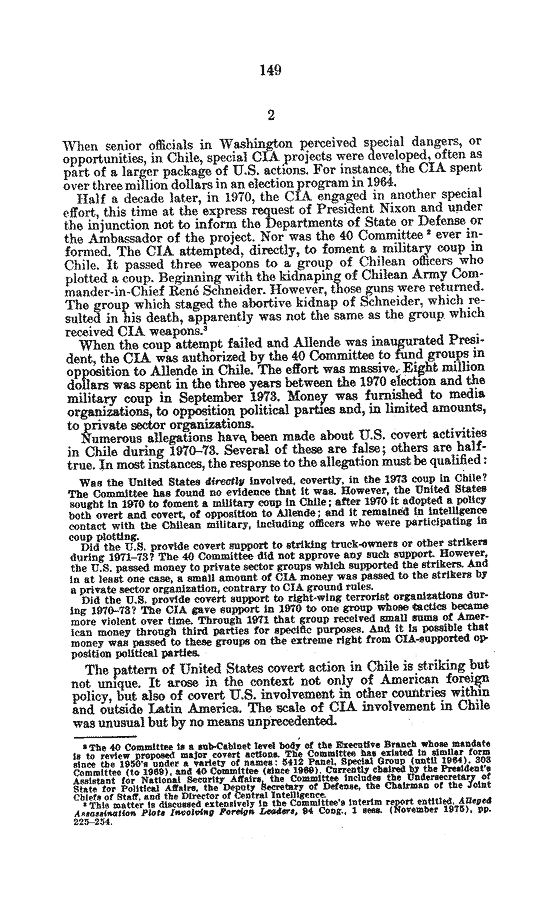
"A CIA report released in 2000 admitted that the CIA financed the trucker's strike." This is incorrect. See
"the Church Report explains that while no CIA money was sent directly to fund an economically devastating truckers strike, 'It is clear that anti-government strikers were actively supported by several of the private sector groups which received CIA funds.'"
From: http://auto_sol.tao.ca/node/view/746?PHPSESSID=35c465f696916fe6510b4d257acaf59f
Actually I found the Church report online, the specific page is here: http://www.aarclibrary.org/publib/church/reports/vol7/pages/ChurchV7_0077a.gif
Relevant quotation: "Eight million dollars was spent in the three years between the 1970 election and the military coup in September 1973. Money was furnished to media organizations, to opposition political parties and, in limited anounts, to private secotr organisations. ... Did the U.S. provide covert support to striking truck-owners or other strikers during 1971-73? The 40 Committee did not approve any such support. However, the U.S. passed money to private sector groups which supported the strikers by a private sector organization, contrary to CIA group rules."
To say that "A CIA report released in 2000 admitted that the CIA financed the trucker's strike" is therefore completely misleading. It implies that the strike was a result of CIA manipulations when in actual fact the strength of the "financing" was that some CIA backed groups may have made some smallish donations to the strikers (how much "financing" is necessary to support a 3-week strike anyway ?).
I think the text in the article should either be removed or heavily qualified, it's overtly political and very misleading as it stands.
Plan Z
Plan Z is still under question. Only left wing moonbats that believe Allende was no Commie say its false with such conviction. The CIA only speculated it could've been disinformation from the junta.The left wing courts surely believed everything in Pinochet's White Paper document except the last page containing info on Plan Z. Even the Retting Commision Report on Human Rights abuses by Pinochet call Plan Z a "fascimile".
I am not appologizing for Pinochet at all but I certainly am sick of reading about how much of a golden boy Allende was and that he was not planning a Marxist coup. - Jude84
- Well, until we have more definite data we will have to leave that information as it currently is.--FVZA_Colonel 13:28, 27 October 2006 (UTC)
Smells way too Pro-Allende
On a smaller note. Where are the sources for the "CIA backed" strikes? Apparently Allendes economic policy was such a success that it drove entire sections of the working class to the streets. If fact it was so popular it even drove thousandsstay at home moms to march while banging on pots and pans; considered one the biggest protests in Chilean history.
So I guess the CIA has big pockets to pay for all of these strikes, block aid (while other left wing governments showered Allende), and round up the working middle class against Allende. Give me a break. The left wing conspiracy tales are too much. Just admit that Allende did HIMSELF in and was a commited Marxist.
- Chile's economic collapse during the Allende administration was the direct cause of U.S. imposed sactions. The U.S. goverment interpreted Allende's socialist leanings as a communist tactic. President Nixon told CIA Director Richard Helms to "make the [Chilean] economy scream" immediately after Allende's Septemeber electoral victory in 1970. U.S. economic aid to Chile was reduced during all three years of Allende term in office. (See, Beneath the United States: A History of U.S. Policy Toward Latin Americ by Lars Schoultz).
- —This unsigned comment was added by 137.165.209.92 (talk • contribs) 5 March 2006.
Even Paul Sigmund, a marxist historian, doesnt believe that the CIA had any big role in the toppling of Allende. While money from the US diminished, other nations doubled their aid to Chile. Nixon could've said all he wanted he still couldnt do much. Four other Marxist Historians like Ian Roxbourough also attributed Allendes economic collapse as his own doing and negating the Chilean constitution. He collectivized dozens of farms against the will of many campesinos.
You kool-aid Marxists are seriously ahistorical and conspiracy ridden if you believe the CIA had everything do with Allendes downfall. The Chilean people wanted him out. There were dozens of protests (not funded by the CIA) against Allende. Instead you guys like reading second hand sources from kool aid drinking historians or hack progressive authors with a bent that narrowly depict quotes from Nixon or a CIA document as the "real" reason for Allendes demise. You cannot accept the fact that Allende was not who he was so it had to have been the USA's fault.
I am not a right winger. I can accept that Pinochet was bad and needs to be tried for war crimes but I am not at former Allendes heel totally demolishing a Wikipedia site with pro-allende, pro-marxist garbage. - Jude84
I don't know how much of you live in Chile or are related to, but there's a lot ofinformation deficit from your comments.
- http://foia.state.gov/documents/PCIA3/00009242.pdf Read the first sentence of it.
- http://www.gwu.edu/~nsarchiv/news/20001113/700917.pdf
- http://www.gwu.edu/~nsarchiv/NSAEBB/NSAEBB8/ch05-01.htm
- http://www.gwu.edu/~nsarchiv/NSAEBB/NSAEBB110/index.htm
- http://www.gwu.edu/~nsarchiv/NSAEBB/NSAEBB8/ch26-01.htm (Some parts: worth spending; not concerned; no involvement of embassy; $10,000,000 -{CIA has big pockets}- available, more if necessary; full-time job--best men we have; game plan; make the economy scream; 48 hours for plan of action.)
If you want to keep reading those documents just search. It's so obvious that US was involved all the time.--200.111.34.164 00:47, 7 March 2006 (UTC)
U.S. could supported groups against Allende (CODE, Christian Democrats,etc.) like URRRS and Cuba supported his government but neither were really decisive. U.P. governemt hasn't a 50%+1 population support. Allende's administration made bad decissions and tried to impose a socialist regime ("la vía chilena al socialismo") with borderly legal measures (resquicios constitucionales): he statized industries and banks, the agrarian reform became more violent and tried a huge educational reform (Escuela Unificada). Allende also had little leadership on his own coalition: despite he was an democratically elected President, his own party (Socialist Party) supported the armed way and there were other groups with the same agenda (MAPU,MIR).
On the other side, there were no records about U.S. officials during the coup itself. The coup was planned and executed by Chilean. In fact there were many groups that finally converged to make the coup of September 11th (there was a previois attempt). Some sources said that it was first planned by Navy officials that lately contacted their counterparts on the Army, Air Force and Carabineros.
Allende's government had a strong opposition, including the spontaneous "cacerolazos" in many Chilean cities (houseviwes making noise with their casseroles every evening).
In conclusion, both Cold War powers supported their interests but the UP didn't need help to make their own mistakes and neither did the opposition to depose the first ones. baloo_rch 00:40, 9 March 2006 (UTC)
I am not negating the fact that the CIA didnt do anything but that thier covert ops actually managed to bring about the fall of Allende. This is far from true. Allende violated the Chilean constitution at almost every level and was hounded by the center-left coalitions and the Supreme Court of Chile. The CIA had no role in that. That was all Allende. The US did thier part to push thier interests away from Chile. But that did not stop nations like Sweden, Cuba, USSR and other social democracies from pumping aid to Allende's administration. The US withdrawl of aid and embargo was a blip on the radar. The Coup was all Chilean. - Jude84
The coup was not all Chilean. In fact, the CIA admitted to having funded the coup about three years ago. Just because it's true doesn't mean it's pro-Communist. Don't be so shallow.
And thank you Baloo for clarifying what the other poster did not understand. - Jude84
-
- The CIA "admitted" no such thing. Documents released show that some individuals/groups which received funding from the CIA backed the truckers strike financially (despite rules to the contrary) - see the section above regarding the truckers strike. Other documents released show that in fact the Chilean coup was a complete surprise to US intelligence agencies although they had previously provided some clean weapons to a group which they thought at one stage may attempt a coup. —This unsigned comment was added by 83.88.98.11 (talk • contribs) 28 March 28 2006.
Wich part of the constitution was violated by Allende?. The "center-left" coalitions was simply the Christian Democratic Party, that is better called a center party at the time. As a matter of fact they call themselves "the way between the left and the right". The URSS never provided considerable help because they considerated that the "chilean way" was unreachable. Cuba give his best, but they couldn't do much with US's noses in their shoulders. And Sweden and the others social democracies never do much more than a speak in favor. So, you are gonna put that in front of economic aid to political parties of oposition, economic embargos, technical support for any chance of a coup... man.
If you understand spanish, please read es:Salvador_Allende. baloo_rch 23:58, 10 March 2006 (UTC)
Thank You Balloo. These people are ahistorical getting into things they know barely anything about. The entire point of the rumble in Santiago was because Allende was violating the constitution. The turmoil in Chile was not due because of America or the CIA. Stop believing in those hyped marxist conspiracies. - Jude84
baloo, wich part of the constitution was violated by Allende?. I read the article in spanish, and I sure understand it as i'm chilean, so for that kind of squire of Jude84 don't told me that I don't know what happen in my country.
- The Cola Wars: The story of the global battle between the Coca-Cola Company and PepsiCo, Inc. by J.C. Louis and Harvey Z. Yazijian (Everest House, 1980, ISBN 0896960528) had some remarkable material Pepsi's Chilean bottling company participating in the coup by putting all of its vehicles at the service of the plotters. I read this about 25 years ago, so I don't remember details; someone might want to track down a copy and look it up, -- Jmabel | Talk 06:27, 27 March 2006 (UTC)
I have to disagree with the statement that the coup came about because Allende violated the constitution. The fundamental problem with his administration was that he was trying for revolution while keeping within the bounds of legality (something you'll find many historians say). I don't think that the United States or CIA caused the coup, they played a minor role in 1973. I'd attribute what happened more to the absolute failure that was Allende's economic policy and the structural inconsistencies within Chile itself (class conflict, political stratification, export-economy system, etc). -Srilina
Name
surely "Dr. Salvador Allende Gossens" is quite enough. Is there even any use of "Salvador Isabelino del Sagrado Corazón de Jesús Allende Gossens" outside of this article? --Oburo 01:36, 13 March 2006 (UTC)
- It's his full name, so it "quite" doesn't matter whether it is widely used. —Sesel 00:04, 14 March 2006 (UTC)
NPOV Tag
Anibody think that this article is not neutral? It seems like the discussion about the pro-allende POV was settled.—This unsigned comment was added by Bauta (talk • contribs) 28 March 2006.
A flat-out LIE
Watch carefully:
- ....the Chamber of Deputies of Chile's Resolution of August 22, 1973 sanctioned the end of democratic rule with a simple majority vote.
Whomever altered this sentence to read that way wasn't merely making a mistake, or smuggling in a "point of view" -- he was LYING through his shit-stained teeth. And it's been sitting their like a pus-dripping wart at the end of a witch's nose for God knows how long now? (I submit this is a prima-facia example of why Wikipedia is doomed to utter failure as an in any way remotely credible regards any obliquely partisan issue.) —This unsigned comment was added by Mike18xx (talk • contribs) 2 April 2006.
- Actually, I think your style of addressing other editors is more of a threat to the project than much anything in this article. I have added a signature to your comment, because you are particularly out of line to make such a remark and not sign it.
- For what it's worth, I agree that the sentence you complained about was not an accurate representation of what the Chamber of Deputies voted for, but the version that you subsequently added is no prize either. -- Jmabel | Talk 03:39, 3 April 2006 (UTC)
-
- I edited it to be correct, not popular.--Mike18xx 09:37, 4 April 2006 (UTC)
- The resolution was never approved, because it failed to get two-thirds majority in the Chamber of Deputies, right? See Chilean_coup_of_1973#Allende_responds Vints 13:28, 3 April 2006 (UTC)
- See Jose Pinera's dissection of Allende's rejoinder here: http://www.lyd.com/english/weekly/never.html --Mike18xx 09:37, 4 April 2006 (UTC)
-
"Questions of coup justification"
- The lead of a biographical article is not the place to get into the questions of whether the coup was somehow justified or even "authorized" (edit comments, 21:59, 10 April 2006 Jmabel)
The text you reverted away from not only did not "justify" the coup, it differentiated the removal of Allende from the "coup" proper (i.e., Pinochet's assumption of dictatorial power ex post facto). This issue has been discussed before (see above). Merely mentioning the Resolution of Aug 22, 1973 does not constitute endorsing Pinochet's dictatorship. I can certainly fathom why Allende's hoary hold-outs prefer continually airbrushing the Resolution out of history, over thirty years now after the fact, in order to maintain their adopted illusion (originally Soviet propaganda) of Allende as a ruthlessly usurped champion of the people. One of these days, I'll get around to including referenced accounts of Allende's importation of Cuban enforcers into Chile, at which point the torch-bearers will wish they'd never poked the ant-hill.--Mike18xx 01:34, 11 April 2006 (UTC)
Here, and at History of Chile, and doubtless elsewhere, someone seems to be editing with a strong anti-Allende agenda. I don't have time to do more than note this and hope someone else will follow up, but besides the continual return of the mention of the Resolution of Aug 22, 1973, with no mention that the legislature could not muster the two-thirds majority that could have legally removed Allende. Also, the addition of "Soviet-aligned". Chile under Allende was certainly somewhat friendly toward the Soviets (and very friendly toward Cuba) but aligned? I don't remember any Soviet bases in Chile, nor any military treaties. - Jmabel | Talk 05:12, 19 April 2006 (UTC)
- I agree with you and when I added a sentence in the Salvador Allende article about the two-thirds majority my edit was quickly removed by Mike18xx. Vints 06:06, 20 April 2006 (UTC)
-
- I'm really busy now, and don't have time to fight over this, but I think there have been several very contentious recent edits. We do not usually describe elected leaders of having "imposed" on their countries the very policies on which they ran and won office. - Jmabel | Talk 06:07, 1 May 2006 (UTC)
What's with the legacy section?
Someone needs to look over the Legacy and Debate section with a fine-toothed comb. Yes indeed, Mr. Allende was a cotnroversial figure. Yes indeed, there are many little sectrets he may have been involved in. However, many of the items here are conspiracy theories largely lacking credence. There are legitimate points against Allende that go unmentioned. There needs to be clearer support for some of these allegations. Grenye | Talk 01:15, 23 April 2006 (UTC)
Internal opposition to Allende
- Allende’s transparent lust for power was well recognized in Chile by the time of the 1973 coup. On August 23, 1973 the Chamber of Deputies, the equivalent of our House of Representatives, adopted a resolution charging: "It is a fact that the present Government of the Republic [the Allende administration], from its inception, has been bent on conquering total power, with the evident purpose of submitting all individuals to the strictest economic and political control by the State, thus achieving the establishment of a totalitarian system, absolutely contrary to the representative democratic system prescribed by the Constitution." [4]
It seems it was not only Pinochet who opposed Allende, but the Chilean Congress as well. It seems he disregarded written promise he had made in exchange for Congressing appointing him president in 1970. --Uncle Ed 01:58, 7 May 2006 (UTC)
- Do we have a credible source for the text of this resolution? A google search for [allende "has been bent on conquering total power"] turns up only three websites, all highly polemical, none of which refer to any other source for the text. Cadr 15:25, 7 May 2006 (UTC)
- (I'm not suggesting that these websites have made the resolution up, I just think it would be good to have a better source.) Cadr 15:29, 7 May 2006 (UTC)
-
- Do not confuse one house of Congress with the entirety of Congress. There was both a Chamber of Deputies and a Senate.
- This was basically (maybe entirely?) a party-line vote. The Christian Democrats had turned against him.
- It had no legal force. There was a constitutional process to remove a president; it would have required a 2/3 vote, which this did not achieve
- Yes, the majority of the Chamber did basically claim that Allende had violated the constitution and called for his overthrow by force, if necessary. Clearly a constitutional crisis, in that part of the apparatus of government was invoking violence against another part, but (lacking a 2/3 vote) they had no more constitutional right to remove him than he them.
- In any event, Pinochet's coup was clearly not an attempt to "restore" constitutional rule. It was an opportunistic exploitation of the split between constitutional forces.
- - Jmabel | Talk 22:43, 25 June 2006 (UTC)
- Here's the text of the August 22 resolution in English (I don't know where someone got August 23), with several other languages, including the original Spanish, linked. Whatever one thinks of the politics of the person who maintains the site, I see no reason to doubt the authenticity of the text. - Jmabel | Talk 22:48, 25 June 2006 (UTC)
Allende's early political career
- 1934, Allende became a minister [not of Health?] in one of the three Popular Front governments of Chile led by Pedro Aguirre Cerda.
- Though I may well be wrong, I have been unable to track down any other source information suggesting that Allende became a minister at any stage before 1938, and Cerda did not have a government prior to 1938 either. Does anyone else have any feelings about this?
Kissinger quote
Google "communist due to the irresponsibility of its own people", including the quotation marks. There are hundreds of results and many in Google Books as well. —Sesel 00:20, 29 May 2006 (UTC)
- This article is a biography of Allende. Quotes about his government (which I do not doubt the Kissinger quote is one) do not belong here- you may wish to incorporate them into the Chile under Allende article. There is already one Kissinger quote which directly addresses Allende in the article, there's not need for this one. Isarig 17:00, 4 June 2006 (UTC)
- There is no quote section in Chile under Allende so let's keep the citation here. And this article deals with both Allende and his government and the coup.Vints 09:04, 6 June 2006 (UTC)
- There doesn't need to be a "quotes" section there. Find a section where this quote is appropriate and add it in, either in Chile under Allende or United States intervention in Chile. This article is a biography of Allende, and There is already one Kissinger quote which directly addresses Allende. Isarig 14:38, 6 June 2006 (UTC)
- Why don't you add the quote where it belongs, since you removed it. Vints 15:34, 6 June 2006 (UTC)
- I don't think the quote is that notable. but if you feel differently - by all means go for itIsarig 19:52, 6 June 2006 (UTC)
- Why don't you add the quote where it belongs, since you removed it. Vints 15:34, 6 June 2006 (UTC)
- There doesn't need to be a "quotes" section there. Find a section where this quote is appropriate and add it in, either in Chile under Allende or United States intervention in Chile. This article is a biography of Allende, and There is already one Kissinger quote which directly addresses Allende. Isarig 14:38, 6 June 2006 (UTC)
- There is no quote section in Chile under Allende so let's keep the citation here. And this article deals with both Allende and his government and the coup.Vints 09:04, 6 June 2006 (UTC)
- I don't mind the quote, it shows how people are ready to violate democracy in the name of democracy. But, but, Wikiquote is where quotes belong, there's no need for a "quotes" section on WikiPEDIA when there's a WikiQUOTE made exactly for this. --A Sunshade Lust 22:08, 10 June 2006 (UTC)
I moved the quotes to Chilean Coup of 1973. Vints 07:04, 12 June 2006 (UTC)
Causes of civil unrest
Mingus ah um, with whom I am currently in an edit war with, seems to feel that the following phrasing: "Domestic opposition and intervention from the United States led to a state of civil unrest amid strikes, lockouts, American economic sanctions, and calls by some opposition members for the military to restore order." is more factually accurate than "Allende is generally considered to have imposed a controversial...agenda.../snip/... which led to civil unrest, strikes and lockouts, American sanctions, and calls by some opposition members for the military to restore order." I maintain that his preferred wording is historically innacurate propaganda seeking to blame Allende's domestic opposition and the United States for creating Chile's problems under Allende -- rather than being a response to them). The Chilean Chamber of Deputies (whose Resolution Mingus is desperately attempting to remove from the Pinochet entry foreward) certainly and emphatically disagreed with that interpretation.--Mike18xx 01:14, 20 July 2006 (UTC)
- Mike, you and I both know that it is a stretch to state that Allende's "agenda" was the only factor which led to civil unrest, which is what your edit blatantly implies. If it were not for your simultaneous edits on the Pinochet page, I would have given you the benefit of the doubt, but it is very clear that you are trying to pin everything negative on Allende. Until you are willing to actually acknowledge the fact that you are not the sole possessor of "the truth," your actions (and your notorious wiki reputation) will amount to nothing more than POV pushing. Are you willing to engage the language contructively, sans elipses? --(Mingus ah um 07:49, 20 July 2006 (UTC))
- I will revert again in the interests of accuracy over placating you, and leave it to you to formulate a reasonable edit which does not "try to pin everything negative" (your phrase) on everyone but Allende (which is the propaganda version I will continue to nuke my alotted three times per day).--Mike18xx 09:23, 20 July 2006 (UTC)
- It appears that another user agrees with me; your edits have already been reverted by him or her. --(Mingus ah um 19:47, 20 July 2006 (UTC))
- I have no doubt that you'll find an endless number of persons to agree with you (and nearly all of them will be American or European leftists) who nevertheless won't put forward any kind of credible case here in talk, should they appear here at all. Meanwhile, the occasional editor from Chile will troop through Wiki and not see any occasion to revert my submissions (eg, Melromero over in the Pinochet entry).--Mike18xx 20:30, 20 July 2006 (UTC)
- So... I take it that the answer to my question ("are you willing to engage the language contructively, sans elipses?") is a no. Why should anyone take an editor seriously who is not willing to discuss or consider altering the language of his edits? --(Mingus ah um 20:40, 20 July 2006 (UTC))
- Why should anyone take an editor seriously who is not in command of the subject matter, and whose "trump card" is to issue threats of moderation of other editors? Cut-n-paste: I will revert again in the interests of accuracy over placating you, and leave it to you to formulate a reasonable edit which does not "try to pin everything negative" (your phrase) on everyone but Allende (which is the propaganda version I will continue to nuke my alotted three times per day).--Mike18xx 21:07, 20 July 2006 (UTC)
- So... I take it that the answer to my question ("are you willing to engage the language contructively, sans elipses?") is a no. Why should anyone take an editor seriously who is not willing to discuss or consider altering the language of his edits? --(Mingus ah um 20:40, 20 July 2006 (UTC))
- I have no doubt that you'll find an endless number of persons to agree with you (and nearly all of them will be American or European leftists) who nevertheless won't put forward any kind of credible case here in talk, should they appear here at all. Meanwhile, the occasional editor from Chile will troop through Wiki and not see any occasion to revert my submissions (eg, Melromero over in the Pinochet entry).--Mike18xx 20:30, 20 July 2006 (UTC)
- It appears that another user agrees with me; your edits have already been reverted by him or her. --(Mingus ah um 19:47, 20 July 2006 (UTC))
- I will revert again in the interests of accuracy over placating you, and leave it to you to formulate a reasonable edit which does not "try to pin everything negative" (your phrase) on everyone but Allende (which is the propaganda version I will continue to nuke my alotted three times per day).--Mike18xx 09:23, 20 July 2006 (UTC)
US intervention began already in September 1970 when Allende had won the popular election, and before he had "imposed" any agenda. So they weren't "a response" to Chile's problems, as Mike says.Vints 21:58, 20 July 2006 (UTC)
Vints is entirely correct.
- Both Vints and You are tossing up, and confirming, a wholly arbitrary statement. More below.--Mike18xx 06:45, 21 July 2006 (UTC)
As for your previous response to me: Why do you say I am not in command of the subject matter? Simply because I do not agree with your POV edit, and have suggested you either submit to a discussion of your edit or accept moderation (an activity which is not unusual on wiki, and generally offends only those who have trouble working with others)? I'm not the one who tries to defend his arguments by labeling the individual in question with a term which bears no relationship to the man's ideology, polemics or implemented policy (that term, if you have already forgotten, was Leninist)?
- A descriptive I will stand by.--Mike18xx 06:45, 21 July 2006 (UTC)
The original statement: "Domestic opposition and intervention from the United States led to a state of civil unrest amid strikes, lockouts, American economic sanctions and calls by some opposition members for the military to restore order."
Your statement: "Allende's term as president was market by civil unrest, strikes and lockouts, American sanctions, Allende's refusal to enforce numerous Chilean Supreme Court rulings, and calls by some opposition members in the legislature for the military to restore order."
Our differences are very clear:
First, you refuse to accept the fact that we should highlight the fact that domestic opposition and US intervention dramatically increased the state of civil unrest. You just want to cut "domestic opposition" from the article and replace it with a reference to Allende's administration. That's POV pushing if I've ever seen it, but, if you are actually willing to discuss the language we may be able to come to a conclusion.
Second, you believe that Allende's relationship with the Supreme Court should be highlighted (even though his disagreements/opposition to the court are only vaguely mentioned and are not referenced in this article). Most individuals would believe that a reference to a particularly troubling relationship with the court should not be made more prominent in the introduction of a biography than within the body of the article itself.
Third, if you weren't so interested in POV pushing (that is, if you were really trying to clean up the article), you would have probably been interested in highlighting something as important as, say, the fall of the price of copper on international markets or the fact leftist civil unrest was the result of socialists and anarchists advancing land reforms (which began not under Allende by under Christian Democrat who preceeded him) ahead of Allende's (and the Marxist's) shedule. But these are factors which you clearly have no interest in.
Finally, Allende did not have a pro-Soviet agenda (a statement which is still in the introduction, and which you initially attempted to add your new statement too); he had repeatedly opposed Soviet activities and encouraged a detente with China, the Soviet Union's arch-rival at that time. I intend to remove the statement, although I'm sure you will revert my edit.
I don't know what more to say. I'm willing to produce a compromise draft if you are willing to put down in print that you are willing to consider a draft that I present. If you are not, we may have hit a brick wall. I think we both know what the next step would be if that is the case. --(Mingus ah um 22:18, 20 July 2006 (UTC))
- (1) Allende unquestionably had a pro-Cuban agenda, which is close enough to my tastes; I otherwise have no objection to removing the pro-Soviet....although I am 99% certain it won't take too much digging to buttress it. China was an annoyance to the SU, not an "arch-rival" (the US was its "arch-rival").
- (2) Nixon and Kissinger dusting off contingency plans and exploring how to plant some articles in newspapers and spread a little money around doesn't really constitute on-the-ground "intervention" in the manner that legions of Marxists hacks who've been butchering this story for three decades would desperately like you to believe. It certainly doesn't represent "intervention" in the way of, say, Allende green-lighting his buddy Fidel Castro to send down 5,000 "embassy personnel" to run riot as his own personal brownshirt squad, and greenlighting the MIR to murder & loot the countryside. I'm going to guess that didn't know either of these.
- (3) The fact that falling copper prices could cripple an entire country is evidence of that fact that Allende's socialist gutting of the rest of Chile's economic infrastructure had left it so utterly dependant upon that one thing left.
- (4) Regards the Supreme Court: Would you prefer I replaced the word "numerous" with "7,000"? Allende's near-complete and deliberate intention of marginalizing the entire judicial branch of the Chilean government was a primary impetus for the Resolution which led to his demise. Pinochet didn't just mount up his horse and charge like Don Quixote in a one man army, you know; the rest of the military forces followed him for good reasons.
- (5) Regards the unnamed "civil opposition" which you are so certain shares responsibility for "unrest" -- when you can dig up something that isn't sourced to a Marxist screed, I'll be more than happy to entertain it. Prior to then, it's simply an unsourced statement regardless of its merits. In any event, if the "unrest" is a response to Allende, then its difficult for you to maintain that Allende isn't responsible for it. I maintain that the "unrest" (in the form of a socialism-destroyed economy) resulted in opposition to Allende. But then Marxist accounts are all about inversion (i.e., to accuse one's enemy of doing exactly that which oneself is doing).--Mike18xx 06:45, 21 July 2006 (UTC)
-
- Surely "pro-Cuban" is not necessarily "Leninist". Are you also going to say that (for example) Hugo Chavez and Evo Morales are Leninists?
- I hope you will acknowledge that the reason for much of Pinochet's initial support was under the mistaken impression that he would restore the status quo ante.
- As for sources: the issue should be their intellectual honesty and factual accuracy, not their politics. Th author being a Marxist (and I suspect you use that term very broadly) no more disqualifies a source than being (for example) a capitalist, a Muslim, or a lawyer, though in each case there would be people who would be made as uncomfortable by that as you are by a Marxist. -- Jmabel | Talk 22:06, 25 July 2006 (UTC)
- So you say. I disagree, as there are certain modes of illogic involved in falling into certain ideologies -- and anyone throwin' down with dialectics, let alone religious fanaticism, is just, plain out. I expect as much accuracy from Marxist dialectitions appraising so-called "peoples revolutions" (orchestrated from the Kremlin) as I expect from Islamists attempting to obfusicate the Wiki entries for dhimmi and honor killing. Which is to say: None save clever "consessions" designed to milk "compromise" abandonments of truth elsewhere via "consensus". Which is fine, of course, if your idea of a well-written encyclopedia entry is one which consists of fifty-percent truth and fifty-percent distortion, weaseling, and censorship-by-ommission.--Mike18xx 22:54, 25 July 2006 (UTC)
Rene Schneider
This:
-
-
- Allende assumed the presidency on November 3, 1970. Twelve days before, General René Schneider, Commander in Chief of the Chilean Army, was wounded during a kidnap attempt by a group lead by Roberto Viaux. Viaux's kidnapping plan had been supported by the CIA, although it seems Kissinger ordered the plans turned off.[5] Schneider was a known defender of the "Constitutionalism", a doctrine according to which the Army's role is exclusively professional, its mission being to protect the country's sovereignty and not being allowed to interfere in politics. General Schneider's resistance while being kidnapped terminated in his death in a hospital, three days later, not being able to recover from gunshot wounds. + Allende assumed the presidency on November 3, 1970.
- René Schneider's murder was disapproved by a lot of people, and helped citizens and military support Allende,[6] whom the Parliament finally chose on October 24. On October 26, President Eduardo Frei named General Carlos Prats as commander in chief of the army in replacement of René Schneider.
-
...is just appalling grammar through and through; and chock full of other problems: The word "seems", for instance, has no place in an authoritative encyclopedia entry. The FrontPage linked piece doesn't claim that Schneider's assassination translated into civilian support for Allende. (In fact, his murder was exploited by the promulgators of the "Plan Z" theory.) There's also the incongruity of indulging the purported "Constitutionalism" of Schneider when Wiki-editing professed lovers of constitutions are mostly AWOL when it comes to dealing with Allende's own peeing all over the Chilean Constitution to the extent that a Resolution imploring the military to overthrow him for violating the Constitution handily passed the Chamber of Deputies. (I had to fight tooth-and-nail to get that pivotal document, the passage of which was trumpeted on the front pages of Chilean newspapers the next day, referenced at all in the Wikipedia entries.) Essentially, it's an unseemly excercise in hypocrisy.--Mike18xx 23:55, 25 July 2006 (UTC)
- Grammar is also not a reason to delete entire paragraphs. I didn't revert your edits because you can't spell "customary" ("customery") or "obfuscation" ("obfusication" ).
- Nor you the word "paid" (below).
- I copied the part about of the text about popular and military support from Chilean presidential election, 1970.
- The fact that one Wiki entry is badly sourced is not legitimate grounds for propogating the error.
- The Chamber of Deputies' resolution was written by Allende's adversaries and is by no means a neutral source.
- You could say that about anything. Moral-equivalence logical-fallacy.
- Also it failed to get enough support in the Senate.
- Because senators had longer terms, and Allende's supporters there hadn't been thrown out in elections yet.
- I used the word "seems" because it should be short and the matter is explained in the FrontPage Magazine article. Kissinger said he had turned off the coup. But since Viaux went on with the plan it's possible Kissinger never did in fact turn it off, thus "seems". According to the René Schneider article, CIA afterwards payed the kidnappers $35.000.
- You're completely ignoring the main objection that your claim that "citizens" were influenced by the Schneider assassination is sourced is in fact not sourced. Why are you assuming that I'm not going to catch you hopscotching right on by that?
- Also, why do you write "pro-Cuban and pro-Soviet agenda" for Allende and delete "pro-US agenda" for Pinochet? Vints 06:16, 26 July 2006 (UTC)
- Because that's accurate. As I told you before, kicking communists out of your country's government does not ipso facto equate to a "US agenda". Pinochet, for instance, had little interest in implementing any of the ideology behind, say, the Declaration of Independence. He certainly didn't have any qualms about keeping the copper mines under government control as a source of revenue, so you really can't even call him a capitalist nominally respectful of property-rights.--Mike18xx 18:18, 26 July 2006 (UTC)
- Pinochet imposed a vast privatization of most sectors, although not every part of the economy was privatized, but the US didn't have an entirely privatized economy either.
- Regretably, no it does not.
- To say that Allende was pro-Soviet is not more correct than saying that Pinochet was pro-US.
- Opposing Soviet-style command-collectivization of your country does not make you pro-US.
- Allende had no intention to turn Chile into a one-party state.
- I didn't claim that he did...although one could reasonably infer that all of the Soviet and Cuban personnel crawling around Chile weren't there just to enjoy scenic vacations in the Andes.
- The lead in particular should be objective so I'd rather have both pro-US and pro-Soviet removed.
- Objectivity does not consist of giving fact and error equal-time.
- Probably the article doesn't mention that in addition to the support from the military, the citizens' support for Allende also increased, because it's obvious that the opposition killing Schneider had this effect. I will remove it though until a source supports it. Vints 06:29, 27 July 2006 (UTC)
- Cause and effect fallacy. Given that Allende has already been elected, but had yet to do anything prior to being sworn in; it's unlikely civilian opinion about HIM changed merely because a military commander was mysteriously assassinated. At least, you've yet to indicate so in any cite. "Probably" is just your conjecture. In fact, you have no evidence whatsoever of how citizen opinion of Allende changed one way or the other after the murder of Schneider. Suffice to say that 36.2 percent of the voters, itself a subset of the entire population approved of Allende in the election. Hardly a ringing endorsement; Hell, the Nazis got 44% in Germany's 1933 plurality.--Mike18xx 07:31, 31 July 2006 (UTC)
- Pinochet imposed a vast privatization of most sectors, although not every part of the economy was privatized, but the US didn't have an entirely privatized economy either.
- Because that's accurate. As I told you before, kicking communists out of your country's government does not ipso facto equate to a "US agenda". Pinochet, for instance, had little interest in implementing any of the ideology behind, say, the Declaration of Independence. He certainly didn't have any qualms about keeping the copper mines under government control as a source of revenue, so you really can't even call him a capitalist nominally respectful of property-rights.--Mike18xx 18:18, 26 July 2006 (UTC)
-
-
- Mike, given your objection above to a wide swath of sources on the left (apparently, you believe that no Marxist can be an acceptable source, and clearly your definition of Marxist is wide enough to embrace people who don't even call themselves such), it is remarkable that you think David Horowitz's FrontPageMag.com magazine is not equally disqualified by being so far to the right. Oh, but I forgot: according to your remarks above, intellectual honesty is beside the point. And if you want to file an RFC on me for that last sentence, I welcome it; indeed, I would welcome a close review of the discussion on this page in general. - Jmabel | Talk 22:10, 30 July 2006 (UTC)
-
- Jmabel? Most US Republicans are Marxist without knowing it (because they're idiots); and all you have to do to nail the fact down is ask them what their plan is for eliminating coercion-funded government welfare (AKA "vote-buying programs") and economy-collectivizing federal bureaucracies (and draw a vacant stare). (Yes, yes; I am quite well aware of the fact that eventually the State is supposed to whither away in the final stage, even though it just never gets around to that phase.) Furthermore, I dislike all "left" and "right" descriptions as they are completely arbitrary, generally obfusicationist as the point of their being uttered, and are totally neglectful of the only meaningful political scale: that of liberty versus subjugation. As far as Marxists who self-describe themselves as such (or by various, evasionary euphemisms), their "credibility" and "intellectual honesty" goes exactly as far as their dialectical method, which is to say not very far at all. Beyond that (which is quite enough already), I have zero regard for anyone whose philosophy consists of their assuming they have the right to dispose of my property as they see fit.--Mike18xx 07:31, 31 July 2006 (UTC)
-
- I take it that you define a "Marxist" as anyone who disagrees with your political views.
- You take it wrongly, and you wouldn't have the slightest clue what my political views are (although I can guess with reasonable certainty what you erroneously assume them to be).
- I also take it that you would do well to re-read wikipedia's NPOV policy. And the credibility of a source does not rest on the degree to which the author approves of your beliefs. -- Nikodemos 08:15, 31 July 2006 (UTC)
- You shouldn't play with double-edged swords, because they're sharp on both sides. Now then, this isn't about me; and you should get over your dialectic games right now.--Mike18xx 09:27, 1 August 2006 (UTC)
- I take it that you define a "Marxist" as anyone who disagrees with your political views.
Mike, why do you not use the edit summary field? Without giving a motivation you deleted this sentence: The "truckers' strike", backed by CIA funding, virtually paralysed the economy for three weeks, which Moscow saw as evidence of the weakness of the Popular Unity government. [7] The deleted statement is verified in the article that you copy text from. (I inserted it again.)Vints 14:16, 1 August 2006 (UTC)
POV wording in lead
The third paragraph of the article currently begins "As President, Allende imposed a controversial Marxist program…" For starters, the word "imposed" is very POV. Do we say that Ronald Reagan "imposed" conservatism on America? But, also, do call his administration's program "Marxist" is a stretch, especially with the connotations of that term. Allende personally was a Marxist, and the lead section should apply that adjective to him, which it does not. But his administration was a "broad left" administration. Its program attempted to move in the direction of socialism, and I wouldn't object to calling it a "socialist" program, but "Marxist" in this context is almost as POV as "imposed". - Jmabel | Talk 23:51, 13 August 2006 (UTC)
- I changed to "carried out". Vints 03:17, 15 August 2006 (UTC)
"Early life"
Has anyone noticed that the "early life" section isn't particularly about his early life? It includes material ranging right into his presidency. I believe that much of the latter portion of this section should be refactored elsewhere in the article. - Jmabel | Talk 23:59, 13 August 2006 (UTC)
Soviet aid to Allende
This in the Election section was not correct: "The KGB spent $420,000 in the campaign unbeknownst to Allende". I changed to "an undetermined amout" which the Church Report says. According to this article, $420,000 was the total actual and proposed payments to Allende by KGB both before and after the election: "The KGB documents record actual and proposed payments to Chile's Salvador Allende totaling $420,000 both before and after his election as president in 1970." Vints 14:09, 27 August 2006 (UTC)
machine gun or assault rifle?
Does anyone have a source backing that supposed machine gun claim? If the weapon in question (I'm not convinced of suicide, the speech definitelly does not back that theory up (I've heard good (neutral) translations in two languages), but thta's not my point here anyhow) was indeed the one gifted by Fidel Castro it would be an AK-47 Kalashnikov which is a rifle (automatic rifle or assault rifle) and by no means a machine gun. This is just the kind of mistake people commonly make, describing any large automatic weapon as a machine gun. So unless there actually is some document that names a specific machine gun I propose this entry in both this article and in the coup of 1973 article be corrected to automatic rifle, assault rifle or AK-47... Or of course a combination.--Caranorn 14:43, 11 September 2006 (UTC)
R: In Chile all automatic weapons are call "Metralletas" ( mored used ) o "Ametralladoras" (Machine Guns) like a general automatic weapons and in 1973 the term "Asault Rifle" (Fusil de Asalto) are not used yet So the term "Ametralladora" and "metralleta" are refed to a Full Automatic Rifle The correct term in the English ver. must be "AK-47" or Kalashnikov Rifle in spanish chile de term must be "metralleta" : All full automatic wueapon of high caliber, this included Machine Gun, Sub Machineg Gun, Assault Rifles etc "Subamatralladora" Sub Machine Gun "Ametralladora": Machine Gun ( bad used to call any automatic... "Fusil de Asalto" Assault Rifle "Fusil Ametrallador" This term is used by military to refed a AK-47 ( in the Assault to LA MONEDAI) when the term Assault Rifle are not popular... Fusil Ametrallador are a Automatic Rifle
AK-47 must refered by KAlashnikov Rifle o AK-47 to respect the historical context —The preceding unsigned comment was added by 201.223.9.112 (talk • contribs) 9 October 2006.
"Cuban's Socialist principles"
"The CIA claim that Allende's campaign also received $350,000 from Cuba though the claim is usually dismissed because it would be against Cuban's Socialist principles": huh? Besides this presumably either intending to say "Cuba's socialist principles" or "Cubans' socialist principles", dismissed by whom? And on what basis? That Communist countries have a principled aversion to involving themselves in other countries' internal affairs? I hate to disillusion you (well, actually I don't) but this is not something about which Communist countries have shown themselves to be particularly scrupulous.
Of course, I will remove this. But I figured it was worth a comment, in case there is something substantive and citable that should be restored in its stead. - Jmabel | Talk 19:50, 21 September 2006 (UTC)
Democratic socialism
This is the name of what he advocated. It doesn't matter what "libertarians" think. Democratic socialism is a neutral political science term. —Sesel 23:17, 4 November 2006 (UTC)
Absolutely not true. That is just your opinion. And the fact that you put democratic next to socialism put a positive bias onn it. Once again, Allende received money from the KGB, he was a good friend of Fidel Castro, the Supreme Court complanied time and time again of him using the executive branch not to carry out judicial sentences, and the parliament called the armed forces to seize power because of the way he was conducting the government. Many people in Chile had their property taken, their factories. Allende wanted to institute an education program that was denounced by the catholic church because it was clear indoctrination.
Therefore, after all that, I think it is reasonable to say that many people would agreee that saying Allende was a democratic socialist is a biased view. I'm not saying you have to label it authoritarian socialism or anything like that. Just label it socialism, which is exactly what I try to do when I delete democratic. Let people make up their own minds and figure out for themselves if they believe Allende was a democratic figure.
---
One more thing, exactly who says this non-sense about democratic socialism. I read the link and its not very good. It looks more like left-wing people who love their ideology. At the top you can clearly read that it has no citacion, or sources. It looks more like b-s if you ask me.
Oh yeah, another thing. "It doesn't matter what libertarians think". How democratic of you!
- Actually, most left wingers don't like the term "democratic socialism". The reason is quite simple, any form of socialism is per definition democratic. It's also too easily confused with social-democracy. Otherwise, at least in US political sciences the term democratic-socialism is commonly used, whether it's applicable to Allende is another issue, what's certain is that he favoured democratic means. Collaboration with Castro certainly does not disqualify one in this respect, as Fidel certainly was and still is more democratic then any of his predecessors ever were. Lastly, I cannot see any ties between democracy and private property (or should I say exploitation of the masses), expropriations regularly take place all over the world as commonly in so called democracies as in any other type of state.--Caranorn 22:49, 8 November 2006 (UTC)
Yeah but we are not here to promote what right wingers or left wingers believe. Most right wingers think it is not democrtic as socialism does not allow for private property. So my question is, if left wingers don't like it because socialism per se is democratic, and right wingers think socialism per se is not democratic, then why put it in Allende's bio? How about just calling it "socialism".
I truly don't understand why you people insist on this. It is so obviously biased. The article on "democratic socialism" does not have any citations and its pretty close to a joke. Once again I'm deleting it and putting just socialism. It suits both right and left.
- The fact that Supreme Court complained shows that Chile was a democracy. In a dictatorship it wouldn't be allowed to complain. In addition, there was a Congressional election in early 1973.Vints 07:52, 9 November 2006 (UTC)
-
- Socialist love to attach their very biased ideology to anything to strengthen their position. There is no such thing as democratic socialism, as they are two opposites. Socialism generally does not accept the notion of free will, the right of the individual to determine their own future. For democracy to work, people must have free will, must be free to vote without threat of duress or violence, and must own some degree of property, such as the clothes on their backs and the shoes on their feet, to go and vote. It also must be sustainable in that the democracy is not itself voted away, so some resitrictions must exist ... like not being able to vote into existence an ideology contrary to anything needed to keep democracy going ... otherwise it ceases to remain a democracy. Just because democracy can be used as a tool to advance socialism does not make democracy in itself compatible with socialism. As history has proven time and time again, once a socialist state is established, true democracy vanishes. Allende was a socialist, period, and the deletions of democratic are perfectly valid. Jcchat66 06:00, 27 November 2006 (UTC)
-
-
- Balderdash. "Socialism generally does not accept the notion of free will": as far as I can tell, even the most economically determinist Marxist does not reject free will at the individual level, they just believe (as do many right-Hegelians, such as Francis Fukuyama) that the forces of history are so large that no individual dramatically effects its course. "Free to vote without threat of duress or violence": Chile had a parliamentary election early in 1973. I'm not aware of any reports that it was less than "free and fair", but if you have these, then they would be a useful addition to the article Chile under Allende. "Own some degree of property, such as the clothes on their backs and the shoes on their feet": a straw man argument. I don't think even Maoism denies personal property at that level. Certainly, democratic socialism does not. Collective ownership of the means of production (often meaning only the larger industries) should not be confused with collective ownership of your toothbrush. To say that under socialism the government owns your clothes is exactly as much of a straw man as to say that under capitalism there can be no public streets. As for the vanishing of democracy: the Scandinavian countries are usually seen as social democratic. They are all also model democracies. - Jmabel | Talk 18:47, 29 November 2006 (UTC)
-
-
-
-
- Perhaps there remains some misunderstanding of what socialism represents. Allow me to enlighten you. Socialism remains defined as: various, social, economic and political theories advocating collective or state ownership and management and distribution of the means of production. Also, a system in which there is no private property. And, let us not forget, Marxist theory. This is a textbook definition of socialism. Your argument is quite regular and un-inventive, as this idea has been limping along for thousands of years now without success with those very same arguments.
-
-
-
-
-
- With absolute certainty socialism does not acknowledge free will in practice, no matter how often it is sophistically argued otherwise. It is painfully simply why. If anyone decides that they do not want to live in a socialist society as a matter of their will ... that are promptly shot in the back of the head "for the greater good." There's the free will, splattered all over the place. Of course there are various degrees of socialism, democracy, capitalism, and all the other beliefs that exist. America has many socialist institutions, such as Marx's progressive income tax and Social Security. As, as you might have noticed, democracy in America has suffered in equal proportion to socialistic implementations ... thus Bush came to power. And taxation is staggering in all socialists countries, as much as 80% or more, which is essential for social programs to work. Do citizens have the free will not to support these social programs? Of course not. Good luck with your theory of social democracy. Social feudalism (since feudalism puts all means of production and distribution in the state anyway) is far more feasible, and essentially no different, yet such a phrase would never be accepted. Balderdash indeed! —The preceding unsigned comment was added by Jcchat66 (talk • contribs) 02:27, 6 December 2006 (UTC).
-
-
Racism section bloated
The strength of the evidence for Allende's alleged racism is not enough to justify the length of the section, especially when compared to other, more substantial, sections. Xiner 00:48, 27 November 2006 (UTC)
- The section is, correctly, mostly about the why these charges don't stand up. I think we need this somewhere, perhaps an article of its own, because the charges are out there circulating. - Jmabel | Talk 18:56, 29 November 2006 (UTC)
If Allende has been mentioned to be a racist then it should be there.
His name
I haven't checked further down the article if it's mentioned already but if anyone's interested his name I think means:
Saviour Isabelino (1) of the Holy Heart of Jesus Allende (2) Gossens (3)
- Just a name, I think. However it is a form of the masculine form of 'Isabel - Elizabeth.
- Just a name.
- Just a name.
POV issue, Legacy and debate -> Opponents' View
The last sentence in this section seems a bit biased:
- Nevertheless, Allende's own refusal to obey and/or enforce more than 7,000 Chilean Supreme Court and other legistlative rulings (as detailed in the Resolution of August 22, 1973) indicate he had already begun ruling in a dictatorial style in defiance of Chile's democratic government institutions.
The link to Wikisource results in an empty article, so it seems the statement is unsourced (it would appear it was deleted, but there is no talk page to read; there are however some redirects to that page on wikisource, so it is possible it existed). One should also be careful using a source written by Allende's own political enemies (surely relevant, but also unavoidably biased) to state facts about Allende. —The preceding unsigned comment was added by 84.48.60.238 (talk • contribs) 16:36, 3 December 2006 (UTC).
The argument "A common and more severe criticism is that because of his closeness with Fidel Castro and Eastern bloc countries, he was planning to convert Chile into a Cuban-style dictatorship." seems like a fallacy. That is a big claim (planning to convert Chile into a Cuban-style dictatorship) for such a small amount of evidence (his closeness with Fidel Castro and Eastern bloc countries). (72.181.194.88 22:03, 5 December 2006 (UTC))
High school
Recent anon edit changed where he went to high school. Does someone have a citation for this? - Jmabel | Talk 07:39, 6 December 2006 (UTC)
- The same source used for the year and place of birth: Biography of Allende. Notice that the birthdate given on the official website of the Presidency of Chile differs from the birthdate given in Wikipedia. I don't know what is the correct date. Jespinos 04:18, 28 December 2006 (UTC)
OAS and diplomatic relations with Cuba
The article mentions the OAS convention that restricted the signatory's diplomatic relations with Cuba. It should be noted that Canada, which is mentioned, was not a member of the OAS at the time of the signing of the convention, nor in 1971. The article could be read to imply that it was. Fishhead64 22:33, 10 December 2006 (UTC)
Socialist / Communist
The lead recently said, I think accurately, "He was the first democratically elected Marxist president in the world." It now, instead, makes the odd claim "He was the second democratically elected Socialist revolutionary president in the world (the first was Guyana's Cheddi Jagan in 1953)." I have no idea what is the basis for claiming that Allende (or Jagan) was a "revolutionary" in a sense that, say, Manuel Azaña of Spain was not. All arrived in power entirely through electoral means; all could have been seen as "revolutionary" in the loose sense of a dramatic break from earlier regimes. I think we have gone from something clear (and accurate) to something muddy. - Jmabel | Talk 08:27, 12 December 2006 (UTC)
- Socialist works, but indeed not revolutionary socialist (which is usually used for Trotskyists).--Caranorn 17:08, 12 December 2006 (UTC)
-
- What? What are you talking about? "Trotskyist," "Bolshevik" or "Marxist-Leninist" is usually used for Trotskyists, not "revolutionary socialists." To be clear, Allende was ac communist. He told Debray "The answer is the proletariat. If it wasn't so I wouldn't be here [...] As for the bourgeois state, at the present moment, we are seeking to overcome it. To overthrow it. [...] Our objective is total, scientific, Marxist socialism." Marxist socialism is the first step in the transition to communism. All communists have socialism as their immediate objective. Redflagflying 06:21, 15 December 2006 (UTC)
-
-
- Which is why I've never understood why some people term themselves socialists. But you are preaching to the converted you know. For the rest, I know of a number of Trotskyst parties and organisations calling themselves revolutionary socialists (or communists), radical socialists (or communists). On the other hand I can't think of a socialist (lets call it democratic socialism to avert confusion) organisation using the term revolutionary. That is to say that inclusion of the term revolutionary makes an organisation distinct from the socialist international. That is not the case for Allende.
- Your quotes are interesting though as they indeed show a more radical Allende (but that does not change his allignement with the socialist party and socialist international), but it was not without reasons that both local communists and international communists supported him. Of course this might seem bad for anyone who has never seen inside the movement and doesn't know how democratic (chaotic) it actually is.--Caranorn 13:52, 15 December 2006 (UTC)
-
neutrality tags
Shouldn't we remove the neutrality tags from the legacy sections? They seem redundant, since the sections are marked to indicate that they reflect POVs anyway. Debivort 22:12, 12 December 2006 (UTC)
- Seems like no one objects to this - I'm going to remove them. Debivort 01:54, 14 December 2006 (UTC)
Took nonsense about racist piece out of "Early Life"
There was a sentence thrown in by an obvious critic of Allende (NPOV anyone?) about Salvador's supposed anti-semitic writing. This is covered later in the article, with a more balanced view. It was also contradictory, as this very article goes on to say "Farías allegations have been challenged by the Spanish President Allende Foundation, which published various relevant materials on the Internet in PDF form, including the dissertation itself[13] and a letter of protest sent by the Chilean Congress (and signed among others by Allende) to Adolf Hitler after Kristallnacht.[14] The Foundation claims[15] that in his thesis Allende was merely quoting Italian-Jewish scientist Cesare Lombroso, whereas he himself was critical of these theories. Farías maintains the affirmations that appear in his book. The President Allende Foundation replied publishing the entire original text of Lombroso[16] and in April 2006 filed an anti-libel claim against Farías and his publisher in the Court of Justice of Madrid (Spain)." Redflagflying 06:19, 15 December 2006 (UTC)