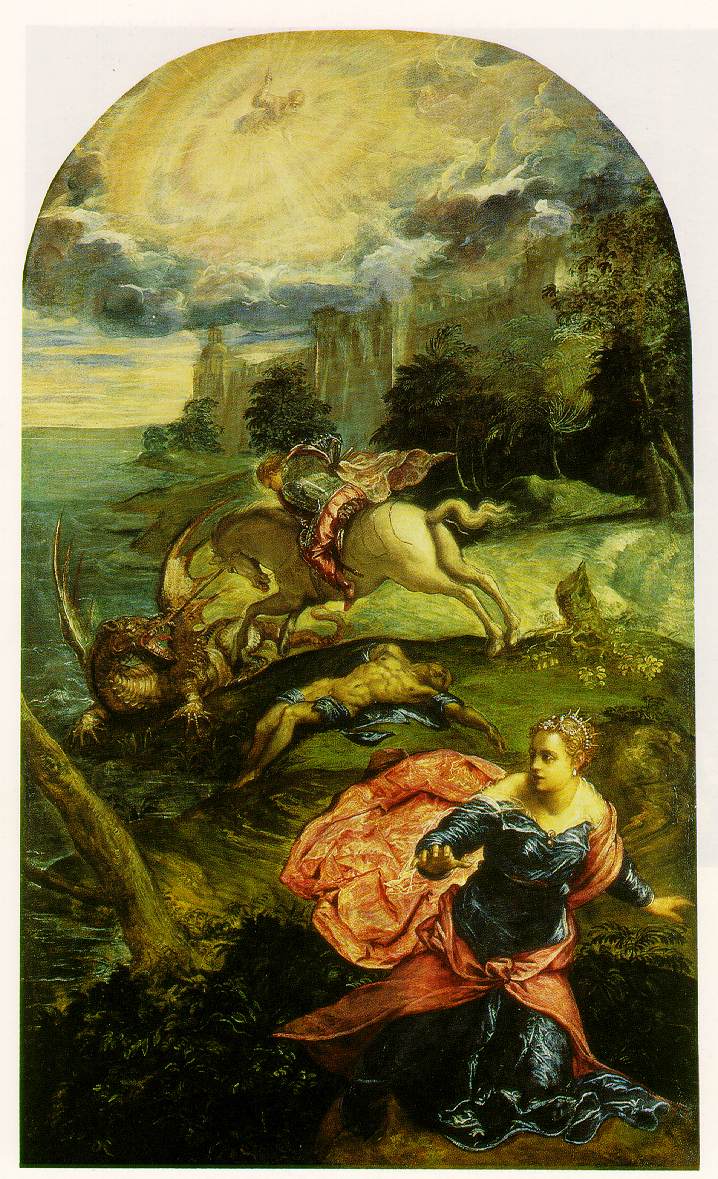
Saint George and the Dragon
From Wikipedia, the free encyclopedia


.jpg/180px-Stockholm-Storkyrkan_(St.Georg).jpg)


The episode of Saint George and the Dragon appended to the hagiography of Saint George was Eastern in origin,[1] brought back with the Crusaders and retold with the courtly appurtenances belonging to the genre of Romance. The earliest known depiction of the motif is from early eleventh-century Cappadocia;[2] the earliest known surviving narrative is an eleventh-century Georgian text.
The dragon motif was first combined with the standardized Passio Georgii in Vincent of Beauvais' encyclopedic Speculum historale and then in Jacobus de Voragine's Golden Legend, which guaranteed its popularity in the later Middle Ages as a literary and pictorial subject.
Contents |
[edit] The legend
According to the Golden Legend the narrative episode of Saint George and the Dragon took place in a place he called "Silene," in Libya. There was no such place, the name being perhaps a corruption of Cyrene. The Golden Legend is the first to place this legend in Libya, as a sufficiently exotic locale, where a dragon might be imagined.
This town had a pond large as a lake where a plague-bearing dragon dwelled that envenomed all the countryside. To appease the dragon, the people of Silene used to feed it a sheep every day, and when the sheep failed, they fed it their children, chosen by lottery.
It happened that the lot fell on the king's daughter. The king, distraught with grief, told the people they could have all his gold and silver and half of his kingdom if his daughter were spared; the people refused. The daughter was sent out to the lake, decked out as a bride, to be fed to the dragon.
Saint George by chance rode past the lake. The princess, trembling, sought to send him away, but George vowed to remain.
The dragon reared out of the lake while they were conversing. Saint George fortified himself with the Sign of the Cross,[3] charged it on horseback with his lance and gave it a grievous wound. Then he called to the princess to throw him her girdle and put it around the dragon's neck. When she did so, the dragon followed the girl like a meek beast on a leash. She and Saint George led the dragon back to the city of Silene, where it terrified the people at its approach. But Saint George called out to them, saying that if they consented to become Christians and be baptised, he would slay the dragon before them.
The king and the people of Silene converted to Christianity, George slew the dragon, and the body was carted out of the city on four ox-carts. "Fifteen thousand men baptized, without women and children." On the site where the dragon died, the king built a church to the Blessed Virgin Mary and Saint George, and from its altar a spring arose whose waters cured all disease.[4]
Traditionally, the lance with which St. George slew the dragon was called Ascalon, a name recalling the city of Ashkelon, Israel. From this tradition, the name Ascalon was used by Winston Churchill for his personal aircraft during World War II (records at Bletchley Park), since St. George is the Patron Saint of England.
[edit] Origins
Many historians consider the roots of this story to be older than Christianity itself. They note that the origin of the saint is said to be partly from Cappadocia in Asia Minor, and that Asia Minor was among the earliest regions to adopt the popular veneration of the saint. The region had long venerated other religious figures. These historians deem it likely that certain elements of their ancient worship could have passed to their Christian successors. Notable among these ancient deities was Sabazios, the Sky Father of the Phrygians and known as Sabazius to the Romans. This god was traditionally depicted riding on horseback. The iconic image of St. George on horseback trampling the serpent-dragon beneath him is considered to be similar to these pre-Christian representations of Sabazios. It is also possible that the "George and the Dragon" myth is derived from the myth of Perseus and Andromeda. This myth in turn may derive from an earlier Hittite myth concerning the battle between the Storm God Tarhun and the dragon Illuyankas. The story also has counterparts in other Indo-European mythologies: The slaying of the serpent Vritra by Indra in Vedic religion, the battle between Thor and Jörmungandr in the Norse story of Ragnarok, the Greek account of the defeat of the Titan Typhon by Zeus.[5] Parallels also exist outside of Indo-European mythology, for example the Babylonian myths of Marduk slaying the dragon Tiamat..
In iconography, some Catholic saints are depicted in the act of killing a dragon. This is one of the common aspects of Saint George in Egyptian Coptic iconography,[6] on the coat of arms of Moscow, and in English and Catalan legend. In Italy, Saint Mercurialis, first bishop of the city of Forlì, is also depicted slaying a dragon.[7] Saint Julian of Le Mans, Saint Veran, Saint Bienheuré, Saint Crescentinus, Saint Margaret of Antioch, Saint Clement of Metz, Saint Martha, Saint Quirinus of Malmedy, and Saint Leonard of Noblac were also venerated as dragon-slayers.[8]
[edit] Treatment by artists
- Paolo Uccello, Saint George and the Dragon, National Gallery, London
- Edward Elgar, The Banner of St George: a ballad for chorus and orchestra, words by Shapcott Wensley, 1879
- Raphael (Raffaello Santi), St. George Fighting the Dragon, 1504. Oil on panel. Louvre, Paris, France
- Edward Burne-Jones, St. George and the Dragon, 1866.
- Tintoretto (Jacopo Robusti), St. George and the Dragon, 1555.
- Gustave Moreau, St. George and the Dragon, c. 1870. Oil on canvas. The National Gallery, London.
- Giovanni Bellini, Saint George Fighting the Dragon, c. 1471. Pesaro alterpiece.
- Peter Paul Rubens. Saint George and the Dragon, 1620
[edit] Contemporary retelling
- The Dragon Knight, a series of books by Gordon R. Dickson, adopted this story as a past event into its canon, significant in that dragons had since referred to humans as 'georges.' The story of St. George and the Dragon is referred to on occasion, but never told. The first book in the series, The Dragon and the George, is a retelling of a previous short story by the same author, "St. Dragon and the George".
- In the 1950s, Stan Freberg and Daws Butler wrote and performed St. George and the Dragon-Net (a spoof of the tale and of Dragnet) for Freberg's radio show. The story's recording became the first comedy album to sell over 1 million copies.
[edit] See also
[edit] Notes
- ^ Robertson, The Medieval Saints' Lives (pp 51-52) suggested that the dragon motif was transferred to the George legend from that of his father fellow soldier saint, Saint Theodore Tiro. The Roman Catholic writer Alban Butler (Lives of the Saints) was at pains to credit the motif as a late addition: "It should be noted, however, that the story of the dragon, though given so much prominence, was a later accretion, of which we have no sure traces before the twelfth century. This puts out of court the attempts made by many folklorists to present St. George as no more than a christianized survival of pagan mythology."
- ^ In the iconography of Eastern Orthodoxy, George had been depicted as a soldier since at least the seventh century.
- ^ In the earliest version, where the dragon is more clearly a representation of paganism, or at least infernal power, the sign of the Cross itself was sufficient to defeat the dragon.
- ^ Thus Jacobus de Voragine, in William Caxton's translation (On-line text).
- ^ Mallory, J. P. (1989). In Search of the Indo-Europeans. Thames and Hudson. ISBN 0-500-27616-1.
- ^ Orcutt, Larry (2002). Slaying the Dragon. Retrieved on 2007-03-17.
- ^ Catholic Encyclopedia: Forli
- ^ Sauroctones
[edit] References
- Loomis, C. Grant, 1948. White Magic, An Introduction to the Folklore of Christian Legend (Cambridge: Medieval Society of America)
- Whatley, E. Gordon, editor, with Anne B. Thompson and Robert K. Upchurch, 2004. St. George and the Dragon in the South English Legendary (East Midland Revision, c. 1400) Originally published in Saints' Lives in Middle English Collections
- Catholic Encyclopedia, "Saint George"
- (Kalamazoo, Michigan: Medieval Institute Publications) (On-line Introduction)
[edit] External links
- Saint George church in Dolinka (Hungarian: Inám)
- St George and the Dragon Events and Ideas - Official Website for Tourism in England
- St George Unofficial Bank Holiday: St. George and the Dragon, free illustrated book based on 'The Seven Champions' by Richard Johnson (1596)