Poughkeepsie Bridge
From Wikipedia, the free encyclopedia
| Poughkeepsie Bridge | |
|---|---|
 |
|
| Official name | Poughkeepsie Bridge |
| Carries | Poughkeepsie Bridge Company (railroad), and many successors including CNE, NH and PC, out of service since May 8, 1974 |
| Crosses | Hudson River |
| Locale | Poughkeepsie, New York, Highland, New York |
| Maintained by | Poughkeepsie-Highland Railroad Bridge Company |
| Design | Cantilever bridge |
| Longest span | 6 x 525 ft (160 m) |
| Total length | 6,771.52 ft (2063.96 m) |
| Width | Single standard gauge (4 ft 8.5 in) track |
| Vertical clearance | Deck truss, unlimited clearance |
| Opening date | 1889 |
| Maps and aerial photos | |
The Poughkeepsie Bridge (sometimes known as the "Poughkeepsie Railroad Bridge", the "Poughkeepsie-Highland Railroad Bridge" or the "High Bridge") is a steel cantilever single track railway bridge spanning the Hudson River between Poughkeepsie, New York on the east bank and Highland, New York on the west. It was completed in 1889 and went out of service in 1974. It is expected to reopen in 2009 as a pedestrian bridge.
Contents |
[edit] History
[edit] Construction
Planning for a Hudson crossing bridge began before the Civil War. Over the years, many plans had been made for a fixed span across the Hudson River south of Albany to replace the numerous car float operations. One of the most persistent was originally chartered in 1868 as the Hudson Highland Suspension Bridge Company, and would have crossed from Anthony's Nose to Fort Clinton, now roughly the site of the Bear Mountain Bridge. This proposed bridge was never built.
The Poughkeepsie Bridge Company was chartered in June 1871 to build the bridge, and J. Edgar Thomson of the Pennsylvania Railroad was persuaded to support the effort. Contracts were let to a firm called the American Bridge Company (not the company of the same name founded later), but the Panic of 1873 intervened and the scheme collapsed.
In 1886, the Manhattan Bridge Building Company was organized to finance the construction. Among the prominent backers was Henry Clay Frick, the coal tycoon and associate of Andrew Carnegie. The Union Bridge Company of Athens, Pennsylvania, which had completed the Michigan Central cantilever bridge at Niagara (see Niagara Cantilever Bridge), was subcontracted to build the Poughkeepsie structure. Dawson, Symmes and Usher were the foundation engineers, while John F. O'Rourke, P. P. Dickinson and Arthur B. Paine were the structural engineers. The bridge was designed by Charles Macdonald and A.B. Paine. As is typical for cantilever bridges, construction was carried out by constructing cribwork, masonry piers, towers, fixed sections on falsework, and finally cantilever sections, with the final cantilever interconnection spans (if used) floated out or raised with falsework.
The first train crossed the bridge on December 29, 1888.
The bridge was considered an engineering marvel of the day and has six main spans. The total length is 6,767 feet, including approaches, and the deck is 212 feet above water. It is a multispan cantilever bridge, having three river-crossing cantilever spans of 525 feet, two anchor spans of 525 feet, 2,200 foot shore spans and a 2,654 approach span on the eastern bank, as the eastern bank is lower than the western side, which has bluffs in that area. It formed part of the most direct rail route between the industrial northeastern states and the midwestern and western states.
[edit] Operation
The bridge remained as the main Hudson River crossing south of Albany until the construction of the Bear Mountain Bridge in 1924, and was advertised as a way to avoid New York City congestion (see the Poughkeepsie Bridge Route article for more information). Due to the changes in ownership of railways, the bridge was nominally owned by many different lines, including Central New England Railway (CNE), New York, New Haven and Hartford Railroad (NH), and Penn Central (PC) among others.


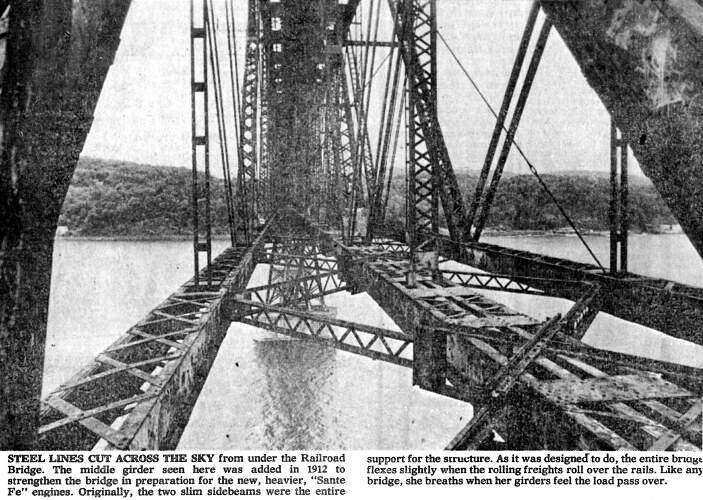
The bridge was strengthened in either 1906 or 1912 (sources vary), possibly by Ralph Modjeski, by adding a third line of trusses down the middle and by adding a central girder and additional interleaved columns, to safely handle the increase in weight of trains, as can be seen in this illustration from the Poughkeepsie Journal story archive.
[edit] Decline and closing
The bridge's importance was severely reduced in 1960 when the Erie Lackawanna system was created; the larger railroad consolidated most freight routes on its own trackage. When the Penn Central System was created by merger in 1968, it also preferred a different route using its Selkirk Yard and the West Shore Line.[1] Factors such as the decrease in manufacturing in the Northeast, the construction of the Interstate Highway System, and increased maintenance costs may also have made the bridge increasingly uneconomical in the 1960s and 1970s.[citation needed]
With the 1970 bankruptcy of Penn Central, the Lehigh & Hudson River Railway similarly entered receivership, and on May 8, 1974 the Poughkeepside Bridge suffered an alleged arson fire that damaged the bridge decking. The L&HR was unable to afford repairs, leading to its closure. The Penn Central's successor Conrail absorbed the L&HR, but also saw repairs as cost-prohibitive. In 1986 the railroad was permitted to abandon the line.[1]
Today, the span is blocked off, and used only to carry electric power lines and a small amount of telephone cable.
[edit] Restoration
In 1998, a nonprofit organization called Walkway Over the Hudson acquired the bridge, hoping to turn it into pedestrian walkway. The conversion is currently in progress. Walkway, as its known, has received support from local residents, city, and state officials totaling about $1,000,000, plus forgiveness of $550,000 in taxes inherited from the previous owners.[2] This is a far cry from the estimated $10-15 million required for the project, but Walkway leaders are hopeful.[3]
The project has been separated into four phases: [4]
- Phase 1 - attain ownership of the bridge. This phase is complete.
- Phase 2 - do a structural analysis of the bridge and to use it to generate a comprehensive plan, including budget and timeline for completion. The group also has to find funding for the project and secure funding for the start of construction.
- Phase 3 - construct and open the first 1,800 feet of the walkway on the Ulster side. The Dutchess side will get an elevator and 900 feet of walkway.
- Phase 4 - construct the remaining 4,000 feet of the walkway and a connection to the Hudson Valley Rail Trail in Highland and the Dutchess Rail Trail in Poughkeepsie.
Currently in the second phase, Walkway hopes to open the bridge by 2009[5]. The piers have been inspected and given a clean bill of health. Walkway hopes to solicit funding from both state and federal government for historic preservation, and private philanthropic organizations[6]. Funding sources include:
- The Dyson Foundation, which has donated $1.5M[7].
- New York State Office of Parks, Recreation and Historic Preservation, which has donated $500,000[8].
- New York State budget item of $8M[9].
- Special legislative resolution of $1.25M [10][9].
[edit] References
- ^ a b Lorett Treese (2006). Railroads of New Jersey: Fragments of the Past in the Garden State Landscape. Stackpole Books. ISBN 0811732606.
- ^ Malone, Michael. "Rusty Bridge, Great Views and Soon, a Walkway?", The New York Times, 2007-1-21.
- ^ Merchant, Robert. "History buff plugs for bridge: Yorktown man joins fight for railroad span", The Journal News, 2006-11-27.
- ^ Phases. Retrieved on 2007-06-06.
- ^ VARUGHESE. "New vision for old Hudson span", Times Union, 2008-2-17.
- ^ "Walkway group takes wraps off Poughkeepsie Railroad Bridge plans", Mid-Hudson News, 2007-6-5.
- ^ "Walkway project gets $1.5M", Daily Freeman, 2007-22-8.
- ^ "Poughkeepsie railroad bridge gets state grant", Record Online, 2007-19-12.
- ^ a b "Walkway Over the Hudson to get underway with budget funding", Mid-Hudson News Network, 2008-10-4.
- ^ "Saland Secures $1.25 Million for Walkway", Hudson Valley Press, 2008-15-4.
[edit] External links
[edit] Background information
- Poughkeepsie Bridge in the Structurae database
- Bridging the Hudson at Poughkeepsie 1871 Bridge Prospectus
- CatskillArchive.com copy of Scientific American article of February 5, 1887 (written during construction) has data on steel strength and testing
[edit] Illustrations and images
- Marist College site (article may not be the best source but it has an excellent picture of (non cantilever) span falsework during construction)
- Library of Congress HAER images
- CatskillArchive.com Construction etchings and description includes etching of cantilever cranes (steam donkey powered) constructing cantilevers
- Walkway.org History section, has pictures of falsework and cantilever cranes.
- CatskillArchive.com illustration of bridge (side view) with bent, floor, viaduct details
[edit] Preservation efforts and historic register information
- Walkway.org An organization devoted to saving and repurposing the bridge. Holds title, as far as is known, as of 2005.
- Bridgeweb.com article on historic cantilevers and preservation efforts
- CatskillArchive.com Poughkeepsie Journal 1974 fire article
- CatskillArchive.com POK Journal other articles of interest
- National Register of Historic Places nomination 1978 Announcement
|
||||||||


|
||||||||||