Talk:Polywell/Archive 1
From Wikipedia, the free encyclopedia

| Archive 1 | Archive 2 → |
Contents |
Todd Rider
It should be noted that the controversial paper(s) referenced in main article where written over 12 years ago. The entire section should be considered for removal. --Nbritton 19:28, 12 May 2007 (UTC)
- That's not the way the Wikipedia works. Papers don't get removed because they are 12 years old. Only if you can find a paper that contains maths and so forth that proves the paper wrong, and which is generally accepted. And even then, linking to the original paper saying that it has been superseded is probably the way to go. WP:NPOV WolfKeeper 19:53, 12 May 2007 (UTC)
-
- That's what I'm saying! We have 12 years of new research with new designs, someone needs to check if the papers by Todd Rider are still applicable... and have it be noted in the main article. --Nbritton 09:15, 13 May 2007 (UTC)
The paper stays in the article. It doesn't matter how old it is if it's applicable. If you have evidence from other peer-reviewed work that the concerns raised in the paper don't apply to Polywell, present it. — Omegatron 14:09, 13 May 2007 (UTC)
Definitely. Until Bussard releases a paper explaining how Rider's thesis isn't applicable to the Polywell design (which could be very likely, given the dynamic nature of the plasma balance in the system), the paper should stay, and should be referenced even if it is proven to be inapplicable. — Blane Dabney 18:02, 14 May 2007 (UTC)
There is actually a rebuttal to Rider's paper from Tom Ligon buried in this gigantic thread: http://forum.nasaspaceflight.com/forums/thread-view.asp?tid=5367&mid=136500#M136500 Ligon essentially seems to say the maxwellianization only happens at the low-energy "top" of the well, which actually reduces the bremmstrahlung losses becauses all the electrons have the same energy when they arrive at the "bottom" of the well where fusion occurs. I agree Rider's paper should stay though as it's the standard critique. TallDave 205.234.189.1 18:56, 25 May 2007 (UTC)
- Not quite what I said. Bussard describes the "annealing" process (maxwellianization of the ions at low kinetic energy at the "top" of the well) as a means of removing any kinetic energy distribution induced by collisions elsewhere (addressing Rider's assertion that the plasma will maxwellianize and that this will result in some ions upscattering and being lost). Bremsstrahlung is not affected by this. Below, I give a link to a repository of DTIC reports, which includes at least two by Bussard and King regarding bremsstrahlung and how to minimize it. Different mechanism. Tom Ligon Tomligon 23:41, 14 June 2007 (UTC)
Oops! Thanks for clarifying. Don't know how I get brem mixed in with that. TallDave 205.234.189.1 20:29, 4 September 2007 (UTC)
Key to the design / merge
If I understand correctly, the key to this design is the relative weights, charges, and sizes of the different particles involved. The electrons weigh much less than the ions, and so are carried around in circulation by the magnetic field in a way that forms a quasi-spherical shell inside the device. The ions are much heavier and have more inertia, so they rarely collide with the tiny electrons and aren't affected by the magnetic field, but are attracted to the electrons en masse and crash together after passing through the shell and going towards the center. — Omegatron 22:02, 27 November 2006 (UTC)
- Correct.
- As for the proposed merger, I would disagree. The Farnsworth fusor has its own article (it's a specific type of inertial electrostatic confinement). Why shouldn't this one? -- Rei 06:16, 28 November 2006 (UTC)
-
- Fusor should be merged, too. If not, all three have redundant content which needs to be split. — Omegatron 13:15, 28 November 2006 (UTC)
-
-
- Every type of fusor already has their own articles. Why shouldn't this be the case? Why should we jam all of this technical detail, history, etc, for each into a single article? That would be like insisting that mice, rats, gerbils, etc all get grouped into the "Rodent" article.
-
-
-
- Polywell is a very different beast than a Farnsworth-Hirsch fusor, even though they're both IEC fusion devices. The physics behind it is very different. It's wrong to shove them together as though they're minor variants on the same design. In short, I stridently object. -- Rei 20:10, 28 November 2006 (UTC)
-
I have a problem, I read the article, and I still don't understand how it works. I think this could use another section before design of "Theory". I just want to see something in there about how it confines the fuel like we're talking about here. Even after reading the entire article, reading all seemingly related articles, and reading your posts, I still don't understand what the deal is. How do they confine the electrons to the center with a magnetic field? I read one thing that says it's kind of similar to a Penning Trap, but if I'm not mistaken, that's only for one charge of particle. Plus, I see nothing in this polywell design that looks like a large electric field being generated. It's all done with a magnetic field right? wrong? If it is, how can this design confine them in a sphere when the Tokomak has to spin them in a toroidal design? Is that because this design is only confining negative charges as opposed to positive charges? That would make sense to me, but I am seriously lacking an authoritative explanation on this. But even so, how does it confine the electrons with just a magnetic field in a sphere. That is what I would like to see from an added section to this article.
Also, there is talk about a "grid", but I would like to see a more direct description of what other designs it is used in. Most people reading I think are going to have no clue what you mean by a grid.theanphibian 18:26, 16 February 2007 (UTC)
Sorry for being so annoying, I have another question! The first line of the article states that this is "a gridless inertial electrostatic confinement fusion process". Now, the last 2 paragraphs I wrote were in reference to the magnetic mirror (wanting more information), but I also want to pick about the "inertial electrostatic confinement" part. Is this really inertial? For that to be the case, shouldn't you be throwing fuel into the reactor as it fusions to have it accelerated by the electric field created by the negative charges? My impressions up to this point was that this is not the case. Take a Tokomak for instance, there is much more fuel present than what is fissioning at any given time. It just bounces around until two particles "hit". Is that not the case with the polywell? If you say "inertial", you are suggesting the opposite, that fuel ions are accelerated and fissioned in a continuous stream injected into the core. To tell you the truth, I just don't know which way it is. And YES I watched the google video of this.theanphibian 18:58, 16 February 2007 (UTC)
Bussard's polywell and lecture
Bussard says a lot, and he says it fast. I'm just an engineer, so I don't know what a lot of these terms mean, but here's my summary of notes from watching the Google lecture. We should cover a lot of this stuff:
Research timeline
- Has been working on fusors for the past 11 years with his company EMC2
- Team of 5-10 people for 12 years
- Funded by DOD/DARPA, so results have been classified. "Embargo" on publishing papers for 11 years.
- Claims only reason for lack of money is because DOE has charter to research fusion with tokomaks and won't fund other fusion research
- First test September 1994
- Now that contract is over? he plans to write papers about the results.
- First summary paper should be online soon, was published in October in proceedings submitted to the 57th International Astronautical Conference in Valencia, Spain
- Bussard is a fellow of International Academy of Astronautics
- Can't go to Valencia to present it because of medical limitations
- Then hopes to write a 120 page or so paper to explain everything for a bigger journal like Fusion Technology
- First summary paper should be online soon, was published in October in proceedings submitted to the 57th International Astronautical Conference in Valencia, Spain
- Funding ran out in 2005, "saved" by "Admiral Cohen" to get through 2006 just long enough to get these results
-
- Was funding cut? Mentioned being under "Advanced Energy Development" "line item" in Navy's budget, which was killed to make room for Iraq? Or was the budgeted money all used up? Or contract expired?
-
- Closed the lab down on 1st November 2005?
- SpaceDev (SpaceShipOne, James Benson) is interested in fusors for space engines
- Moved one million dollars of Navy equipment to SpaceDev
- SpaceDev hired the three best lab people to continue research
- "Or maybe Google" could fund it, says that he ended up giving the speech there 'by accident', but they do happen to have a lot of money...
- SpaceDev (SpaceShipOne, James Benson) is interested in fusors for space engines
Research results
- Says tokomaks will never work, Bussard was one of the people who got them started
- "Stars aren't toroidal", "billions of dollars to discover that it's not any damn good", and other choice quotes
- Better to simulate center-pointing force like gravity in stars; uses electric fields to push towards the center instead of a toroid
- Says "like marbles in a well", so my wanting to mention an analogy to "marbles in a bowl" is not a half bad idea, is it?
- Mentions burning nuclear waste from fission reactors with a D-T system while simultaneously producing power, to drop nuclear waste storage time from 4000-9000 years to 40-90 years
- Older designs are IXL or EXL
- IXL (ion acceleration) energy's lost and grid melts. 90-95% transparency is the best they can get, but no grid is transparent enough.
- EXL (electron acceleration, two guns) inversion of IXL. Gets rid of electron interception but replaces it with ion interception
- Hirsch has on his desk the prototype that reached 10^10 fusion reactions (per second?) on D-T
- Ion guns facing each other
- Drive voltage probably in excess of -150 kV --Tom Ligon162.84.67.130 23:30, 11 January 2007 (UTC)
- 10^-6 total energy gain, due to grid loss problem and collision with walls
- quasi-spherical magnetic fields
- trap injected energetic electrons to form spherical negative potential well
- There are no magnetic monopoles. Bussard patented a device in which the magnetic fields are on the edges of a polyhedron with an even number of faces around every vertex so alternate faces are north-south
- Electrons are trapped by polyhedral magnetic field in a spherical configuration, ions are dropped into electron shell and trapped by electrons. Has to do with weight difference of electrons and ions?
- fusion ions trapped in this spherical well
- focussed through central region (1/r^2)
- oscillate across core until reacted
- Previous designs like two magnets facing each other had line cusps around the edge, with two magnets facing each other there's an equator of loss
- Alternating polyhedra design has lots of point cusps instead of line cusps, which have lower losses. "Polywell" magnetic polyhedral grid
- System acts like a spherical colliding-beam device
- Fuel gas is input at potential well edge
- Fusion products escape to system walls
- Maxwellian distribution problem
- His fusors do not use a Maxwellian distribution. Not maxwellian equilibrium plasmas like Tokomak
- Non-local thermodynamic equilibrium
- Boron with a charge of +5 falling into a 100 kV well will reach 500 kV; doesn't need a 500 kV well
- Needs to be slightly ion-rich to create a virtual anode instead of a neutral core
- There's significant wiggle room between ion-rich enough to create fusion and too ion-rich that it 'blows the well'
- The major problem they were facing is electrons striking the apparatus without a magnetic shield. they solved this a year ago.
- Another problem is arcing
- Neutrals can be ionized with microwaves and "gauss lines"? (used a modified consumer microwave oven) to allow them to be controlled
-
- Ha! Yes! I pulled apart an old microwave and found the magnetron could be rigged to seal a vacuum if we adapted it to a modified CF plate. We mounted it on PXL-1, and demonstrated it would light off copious ionization in that device. This is Electron Cylotron Resonance (ECR), the same thing that makes the magnetron work. Microwaves at 2.45 GHz cause electrons in a 875 G magnetic field to resonate, and any neutral hitting that zone gets zapped fast. PXL-1 had an 875 G topology not too far from its walls, and a pretty blue glow showed up there. When that magnetron burned out, we found an identical oven at one our favorite science supply houses (a plumbing supply store) and swapped them a new oven for it.
- But for stronger magnets, higher frequencies are needed to place ECR near the walls. And that's not a $100 problem. Tom Ligon 162.84.67.130 01:11, 12 January 2007 (UTC)
-
- Without big enough power supplies, used capacitor bank to run wb4 for a few milliseconds
- in 2005
- 12 kV drive, 10 kv well depth, D-D fusion 10 kv
- Achieved 10^9 fusions/second for a quarter of a millisecond, based on count of three neutrons
- 100,000 times higher than farnsworth or hirsch (though Hirsch apparently reached 2×10¹⁰ neutrons/s in the 1960s)
- Things they know it needs:
- No metal surfaces open to the electrons
- Needs to be recirculating
- All coil containers need to be conformal to magnetic field shape, so electrons are not striking the magnets, need gaps between magnets
Future research
- SpaceDev
- Also considering easier to build neutron-emitting systems to retrofit existing fossil fuel plants
- Navy is interested in p-11B for electric submarines
- Proposed project is estimated at 150 (D-D) to 200 million (pB11), five years to complete a working reactor
- Size would be 1.5-2 m for D-T, 2-2.5 m for p-B11, no larger needed
- Physics problems are gone, engineering problems and money are the only things left to deal with, though engineering is 10 times as expensive as physics
- "2 megavolt output"
- "200 kV standoffs"
- Future devices will not be circular coils, but will be optimized for the shape of the magnetic field?
- Would first spend $2M?:
- creating two more small machines like the last one created (WB6?)
- First a truncated cube
- Then a truncated dodecahedron
- Then run those results by a review panel before proceeding to the rest of the $200M?
- creating two more small machines like the last one created (WB6?)
Others working on fusors:
- George Miley of the University of Illinois, working with grid-based fusors
- Gerry Kulcinski and John Santarius of University of Wisconsin-Madison also working with grids, trying to improve Farnsworth's design
- (I notice they claim 1.1x10^8 neutrons/sec with D-D)
- That reference cites operation at 130 kV. The WB-6 tests were at 12.5 kV drive, 10 kV well depth, conditions under which conventional IEC machines make so few neutrons as to be difficult to detect. Tom Ligon 162.84.67.130 19:57, 23 January 2007 (UTC)
- (I notice they claim 1.1x10^8 neutrons/sec with D-D)
There are also letters online ostensibly written by him: [1] [2] — Omegatron 20:31, 29 November 2006 (UTC)
- Thank you for the summary. I am listening to the lecture now. Two things jump out. First, Achieved 10^9 fusions/second for a quarter of a millisecond, based on count of three neutrons. Isn't this a bit of an extrapolation? Second, if they really have something, why don't they have a website? None of the charts in the video are legible. Paul Studier 23:14, 29 November 2006 (UTC)
-
- Websites concerning products are for trying to sell them. Bussard is trying to raise funders, which isn't quite the same thing. A quick google search looking for scientific review of Polywell shows what little is out there so far as being favorable.[3]. As for the neutron count, I'd have to listen to the talk again. That doesn't sound right -- 10e9 fusions/second for a quarter millisecond would mean the release of 2.5 million neutrons. Surely their detection rate couldn't be that low, could it? -- Rei 00:15, 30 November 2006 (UTC)
-
-
- Well, seeking funders is the same as advertising. I would like to just see the charts he put up in the video. As for 3 neutrons, Bussard mentioned that the detectors were several feet away, the fusion event was short and it generally takes several cm of solid material to stop a neutron. If I recall correctly, neutron detectors have a couple cm of area and contain gaseous boron trifluoride, which is not very dense. So the conversion factor is plausible. However, 3 neutrons from one event is not enough to convince me. Still this justifies an article because I believe that even hoaxes should be documented. Paul Studier 04:46, 30 November 2006 (UTC)
-
First, Achieved 10^9 fusions/second for a quarter of a millisecond, based on count of three neutrons. Isn't this a bit of an extrapolation? As for the neutron count, I'd have to listen to the talk again. That doesn't sound right -- 10e9 fusions/second for a quarter millisecond would mean the release of 2.5 million neutrons. Surely their detection rate couldn't be that low, could it?
- Sounds like a very ballpark estimate to me. He said the detector was on the other side of the room, so it's only going to intercept a portion of the neutrons produced, but a count of 3 seems like not enough data points to accurately measure anything. Could neutrons prefer to shoot off in certain directions if the plasma is not perfectly spherical, or are they completely unimpeded by everything?
- Also, he says his fusors had 100,000 times as many fusions as Farnsworth or Hirsch, yet it doesn't seem to be that high, and even if it is, others have reached higher numbers since.
- '“Just plugging it into the wall, I think I produced 105 neutrons per second,” Hirsch recalls. (His more carefully controlled trials in 1967 yielded more than 1010 neutrons per second, a benchmark that has yet to be beaten by the modern versions of this device.)'
- "New fusors based on Hirsch's design were first constructed in the later 1960s. Even the first test models demonstrated that the design was a "winner", and soon they were producing production rates of up to a billion per second, and has been reported to have observed rates of up to a trillion per second."
- Here's some info on measurements and calculations.
-
- I've had to mention this many times already, but I guess that I have to mention it again. Bussard claimed 100,000 times the neutron production rate under the same well depth and driving conditions as Farnsworth. Sure, one can build a bigger fusor or put more current into it to get a higher neutron production rate, but that's not an apples to apples comparison.
-
- As for a count of 3, yes, you'll have a very wide confidence interval, but it is statistically meaningful. If I interviewed a a million people and three reported that that they had Condition X, I could conclude with a good degree of confidence that Condition X was not a one-in-a-billion event. -- Rei 16:41, 30 November 2006 (UTC)
-
-
- Aha! — Omegatron 21:23, 30 November 2006 (UTC)
-
-
-
- I think that's a pretty decent layman's description there. I'm not a fusion expert, but I do have a background in radiation detection. The 3 neutrons seemed odd to me as well, but then I reconsidered the type of experiment they were doing. I think fusion only actually happened over a very small time interval. Now, if you know anything about detectors, you should know that this isn't going to be easy to detect. They have 'dead time' on the order of milliseconds, so the best a detector could do is find one neutron over this short time period. It might have gotten 5 million, but you can only count one. Furthermore, I expect that they did have multiple detectors and all at a considerable distance. Let's say they had 3 detectors that could detect one neutron each, this indicates a fusion rate of some certain value or above. The exact reverse calculations of figuring how many neutrons were ejected for those 3 detected neutrons would be a nightmare, but I imagine they did it.
-
None of the charts in the video are legible. I would like to just see the charts he put up in the video.
- I already wrote to the address listed on fusor.net and asked for copies of the slides or images. No response.
- I guess we have to wait for the papers to be published, though he said he already published a summary for the International Astronautical Conference proceedings. Why can't I find it?
- The abstract is available at http://www.iac-paper.org/user/download.php?id=4338&type=abstract§ion=congressbrowser Chandon 06:09, 4 December 2006 (UTC)
Still this justifies an article because I believe that even hoaxes should be documented.
- It's our duty to report neutrally on anything notable, regardless of whether it really works, is a hoax, or is a good idea that fails to produce good results. — Omegatron 13:51, 30 November 2006 (UTC)
If I were going do a hoax, I wouldn't say I got four tests each with just a few neutron counts over less than a millisecond each. I'd say I ran ten seconds, and got enough counts to be scarry. And I wouldn't stick hard-to-read scanned paper plots in my report, I'd dummy-up some nice looking plots with Excel. Bussard has laid out the truth, in admitedly hard-to-read-form, as to just what data those runs produced. And the man was born in 1923 ... he's not trying to get rich, he just wants to be sure this thing is on track to get built while he is still around. He would be happy to turn the thing over to someone both qualified and committed to it. I worked on the project for over 5 years. Tom Ligon 162.84.67.130 21:20, 11 January 2007 (UTC)
From [4] Neutrons produced from the D-T reaction are emitted isotropicly (uniformly in all directions) from the target. Neutron emission from the D-D reaction is slightly peaked in the forward (along the axis of the ion beam) direction. The source described here is a commercial neutron source that accelerates ions which hit a solid target. Since the ions in the fusor are pretty much going in all directions then the distribution should be isotropic even if the plasma itself is not symmetrical. Paul Studier 20:47, 30 November 2006 (UTC)
As for 3 neutrons being significant, I would have to know the details of the detector. Did they detect the neutrons only during the quarter millisecond that the plasma was operating, or over a much longer time period? What is the background rate from cosmic rays, etc. for the time period? As I recall, neutron detection was controversial with both cold fusion and bubble fusion. This thing is smelling like a hoax to me. I would be very interested in seeing the slides. Paul Studier 20:56, 30 November 2006 (UTC)
The few neutrons in each of the four tests were all detected during the sub-millisecond period when the remaining instruments show a deep potential well exists. As the background count of the counters was down to a few counts per minute, consistently getting several counts per test on four tests in a row, is highly significant. The counters would have been over a meter from "the action" due to chamber diameter. If he used the counters I set up, I went to exceptional lengths to shield them against stray counts due to electrical discharges. -- Tom Ligon
changing from a cubic construction to a polyhedral one.
- A cube is a polyhedron... — Omegatron 10:39, 3 December 2006 (UTC)
More references:
Bussard, R. (1991). Some Physics Considerations of Magnetic Inertial-Electrostatic Confinement: A New Concept for Spherical Converging-Flow Fusion. Fusion Technology, 19(2), 273-293.
KRALL, N. (1992). The polywell™: a spherically convergent ion focus concept. Fusion technology, 22(1), 42-49.
Robert W. Bussard's Legislative Proposal to Congress
Images from the paper
These are covered under fair use.
(Images placed in article.)
The diagrams in the paper, are, unfortunately, completely illegible. I'm not sure what I think about that... — Omegatron 20:26, 14 December 2006 (UTC)
Dr. Bussard no longer has an office staff to help him make pretty reports. He still tends to be an overhead-projector/photocopier kind of guy, and may not tend to use the latest and greatest computer graphics. But the data presented are shots of fairly raw material. If he were faking this, he'd have claimed 10-second runs with 10 billion fusions detected, and we would be wondering why nobody was killed. -- Tom Ligon
- Here's an image of WB-1, made with permanent magnets. (Taken from [5]) You can see the electron burns where the magnetic field cusp intersects the surface: WB-1 71.41.210.146 03:28, 8 May 2007 (UTC)
Losses
For the fusor: "Without the motion of electrons and magnetic fields, there are no synchrotron losses and low levels of bremsstrahlung radiation."
But... the polywell uses magnetic fields to redirect electrons. So wouldn't it suffer from these losses? — Omegatron 15:23, 18 December 2006 (UTC)
-
- There are few that doubts that these devices do fusion, resulting in production of a lot of neutrons, but we have had that on some level for many years. What miss are the principles and math (rather than just the pictures, remember Lord Kelvin on numbers....) to show how they plan to meet the Lawson criterion and represent a leap change in sustainable net energy output. If not it is just a better "steam engine". The polywell seems to have some potiential in the area of recirculation. But unless they have some novel underlying theory; bremsstrahlung will still drain the energy of the fuel and ash ions. Somewhat simplified bremsstrahlung happens as moving charged particles form dipoles that change orientation and length which results in the emission of electromagnetic radiation. Unfortunately it does not matter what particles move as long as there are relative speeds. At fusor energy levels, heavy ions are not a problem in themselves, but electrons are a real pain. As an p-11B enthusiast myself it would interrest me immensely e.g. to see some novel electron draining or shielding principles, rather than the plumbing equipment and the conspiration that is hinted here.Haade 15:41, 26 December 2006 (UTC)
-
-
- I believe that the key to the low bremsstrahlung levels is the somewhat anisotropic distribution of the plasma in the device. The ions and the electrons are being contained by two different methods: electrostatically for the ions, magnetically for the electrons. The electron density increases as you approach the core, and should be fairly stable, given enough re-injection to account for the inevitable electron losses, and a stable magnetic field. The ion density should be almost inverse, though the net charge in the core should be slightly positive to maintain a virtual anode once the fuel ions are injected. The ions will spend a great deal of their time approaching a zero kinetic energy state as the approach the grid and decelerate. This counterbalance of ion vs. electron motion should anneal out any lost ion energy to bremsstrahlung, though it may effect electron lifetimes in the core. As far as the fusion products go, in D-D the neutrons shouldn't be affected significantly by bremsstahlung, but remains to be seen if the alphas generated by p-B11 fusion will be greatly affected. As the alphas should be strongly attracted to the walls of the device, the decrease in electron density as you approach the grid and the hopefully neutral-free zone outside the device should reduce any alpha energy lost to bremsstrahlung to manageable levels. But wether or not this is the case hasn't been published by Bussard as of yet. That's just my best guess. — Blane Dabney 19:02, 15 May 2007 (UTC)
-
-
-
-
- A number of what are apparently internal reports pertaining to the HEPS device have turned up available at DTIC (http://stinet.dtic.mil/). Search for "Bussard" and scan the titles for available .pdf files of interest. Among them are a pair from 1991 on the subject of bremsstrahlung and syncrotron radiation. Brem is a problem when you get fast electrons at high density, particularly in the presence of high Z nuclei. The brem objections apparently come from the p-B11 case on the presumption that the electrons at the core of the device are at high energy, and B qualifies as high-Z. In fact, to produce a potential well, the electrons must give up kinetic energy (due to coulomb repulsion from the high density of electrons there). If you have the well at the full depth allowed by space-charge limitation, the electrons will have nearly zero kinetic energy there. For the p-B11 case, Bussard and King show the calculations and demonstrate that it is important to keep the virtual anode height (due to convergence of the ions) below 0.15 of the potential well depth (i.e. control ion production to achieve lower ion density in the convergence region), and also run considerably hydrogen-rich. Both of these measures reduce the fusion power output, and this is compensated for by increasing the machine size, probably the reason Bussard says the p-B11 machine must be larger than a DD machine. Tom Ligon Tomligon 23:43, 14 June 2007 (UTC)
-
-
Magnet arrangement?
The article notes "Later designs began spacing electromagnets, reducing the metal surface area, and most critically, changing from a cubic construction to a polyhedral one.". When I look at the images of the devices, even the modern ones, they all seem to have a cubical arrangement. What's the story here? Maury 13:32, 5 January 2007 (UTC)
- Having built and run a couple of them for Bussard, I can tell you why they are cubes: Cheap, compact, and good enough. He would like to build WB-8 as a higher order, which I believe is a dodecahedron, or more specifically a truncated dodecahedron. All of the magnets face the same pole in in all forms of the Polywell (r). That essentially means the field direction on all faces are in, and all corners are out, and this constrains the valid configurations. I have corrected this and a few other points in the main WIKI.Tom Ligon
Ok, well if they are all cubes, which I think is what you're saying, why does the quote state they aren't? Is there another version of the device that was built that is not referenced in the article? If so, we should add it! Maury 20:26, 11 January 2007 (UTC)
-
- Why did he say it needed an even number of faces? — Omegatron 18:43, 11 January 2007 (UTC)
-
-
- Must be a mis-quote. I can guarantee you that ever single Polywell (r) built so far is a cube, from HEPS to WB6, there are photos of most of these in the Google talk and his October paper, and I've never seen anything to the contrary. When I first read the Polywell Wiki, it definitely had the error, plus a few other minor glitches, which I've corrected. The reason he wants to build WB7 and WB8 is to compare two comparably-sized machines, one a cube, one a dodecahedron, to determine if the higher order (and presumably more spherical) machine works enough better to mess with it. He did discuss possibly making a MPG machine as a dodecahedron, and I built a paper model to look at the idea, but I see no evidence it was ever built.
-
-
-
- As for the geometry, think of these donut magnets ... each a copper coil, with a particular direction of magnetic field thru the hole in the middle. Assemble all of these into a regular polyhedron, each with the field in the hole pointed the same direction, let's say all with N in. The fields encircle these toroids, so around the periphery of the magnets, N points OUT. The working geometries are all forms in which the central holes are IN, the truncated corners are OUT. So if you inject electrons on one face hole, they'll circulate to go IN face holes, OUT corners. I have not personally worked out all the geometries that will do this, but the truncated form of the equilateral pyramid, the cube, and the dodecahedron definitely do it neatly. --Tom Ligon 162.84.67.130 00:01, 12 January 2007 (UTC)
-
-
-
-
- Assuming that all the solenoids are the same size / strength, then the truncated forms of the platonic solids are the complete set of possible geometries - though actually it is the quasiregular polyhedra, and the solenoids circumscribe their respective polygons. All magnetic fields can be represented as bipartite graphs, some vertices colored as N and some as S, the edges being like bar magnets. For a spherical arrangement you need all bipartite graphs with euler characteristic 2. To avoid the field puckering out, and for ease of manufature, you want all these mythical bar magnets to be the same size and strength; this pares it down to the three edge-transitive zonohedra. Bussard quickly found out that you can't make the machine out of bar magnets, because the electrons will run into them, and you get horrible losses. So you replace the vertex shaped magnetic pole with the polygon shaped solenoid, which means the machine is the dual polyhedron of the field, that is, the three quasiregular polyhedra. At least that's how I figure it. Eassin 16:40, 21 May 2007 (UTC)
-
-
Seventh power?
Has Bussard rigorously establshed that  holds valid all the way to power outputs 10^7 times greater than are seen in the polywell models tested so far?--207.245.10.222 23:41, 7 January 2007 (UTC)
- The actual model is B^4R^3 for rate of fusion, and B^4R for power gain. (and if someone wants to clean up my math coding, be my guest). He presumes, based on his design experience, that B will also increase with R. In fact, once he gets up to magnets of 1.5 meter radius or so, liquid helium superconductors become a viable option, and at that point the scaling may get a LOT better. Tom Ligon 162.84.67.130 00:01, 12 January 2007 (UTC)
I assume that when density is high you can do a lot in a small volume, is this part of what drives the high ratio as well?
- This is getting a little out of my depth. I watched him do the calculations a few times, but the only way I could honestly say I could totally follow them is if I videotaped these sessions and then studied them for hours or days. There are a few references associated with this Wiki to papers before the publication blackout was imposed that may shed some light. I've not gone into the math-heavy ones myself because I really don't have the skills in that area, but papers on the subject by Nick Krall, one of the best plasma physicists who ever walked or breathed, may be enlightening. If, in fact, Dr. Bussard does finish that big paper someone discussed, 150 pages or so, it will be intended for peer review and should pretty rigorously detail the scaling issue, and answer other questions.
- I can say with high confidence that none of the math involved is some kind of wierd physics. Its all straightforward stuff, most of it found in the NRL Plasma Formulary, a favorite reference of plasma physicists. I could recognize all the formulae, but I doubt I could reconstruct the system on my own. A good plasma physicist, taking a perhaps skeptical but honest look at the problem, could likely reconstruct the models, in time. This might take years of work to get all the details, though, and I hope the detailed work is presented before then. Tom Ligon 71.114.3.132 17:04, 13 January 2007 (UTC)
- Years? If the physics is truly that complicated, how can anyone be certain that unforeseen complications do not occur somewhere between the existing models and energy break-even? --216.13.72.151 23:07, 15 January 2007 (UTC)
- The only way to know for sure is to build it. Tom Ligon Tomligon 23:00, 16 January 2007 (UTC)
- Years? If the physics is truly that complicated, how can anyone be certain that unforeseen complications do not occur somewhere between the existing models and energy break-even? --216.13.72.151 23:07, 15 January 2007 (UTC)
Award
Looks like Bussard has won an award for the Polywell from the International Academy of Science! I have added the reference to the article.JulesVerne 13:30, 5 March 2007 (GMT)
- There are several organizations with the same name, and the consensus around here seems to be that this award is not very important. See Talk:Robert W. Bussard#Outstanding Technology of the Year Award - 2006. — Omegatron 19:24, 6 April 2007 (UTC)
What gives?
It sounds like he has given a talk at Google, and also says, "We are probably the only people on the planet who know how to make a real net power clean fusion system, and we are out of support!" [6] So why is this not being funded? Perhaps this discrepancy should be noted in the article. --Remi0o 12:33, 7 April 2007 (UTC)
- Because it is basically a Magnetic mirror machine. The concept was eventually abandoned because it proved to be impractical to maintain the necessary non-Maxwellian velocity distribution. I am tempted to add the category Pseudophysics. Paul Studier 22:21, 7 April 2007 (UTC)
-
- Saying that the polywell, whose configuration and principle of operation is very different from a magnetic mirror, is a magnetic mirror, and then saying that, because you said they are the same, it's fringe science, even though magnetic mirrors aren't fringe science, is, at best, original research. Removing category. Kevin Baastalk 22:49, 7 April 2007 (UTC)
-
-
- How about the quote from the article "We are probably the only people on the planet who know how to make a real net power clean fusion system, and we are out of support!" So he knows more than all of the people at the big fusion experiments including the folks building ITER. Certainly sounds like someone out of the mainstream of science to me. Personally I think it deserves a pseudophysics category, but I will only put back the Fringe science category. Paul Studier 23:23, 7 April 2007 (UTC)
-
-
- "Fringe science is a phrase used to describe scientific inquiry in an established field that departs significantly from mainstream or orthodox theories." -The Polywell, besides not being science (it's engineering), is based off of mainstream scientific theories. The polywell is engineering, not science. And that's what he's talking about when he says they know how to do it.
-
- Regarding Maxwellianization, this is how i see it: the well establishes a relationship between the ions distance from the center and it's radial velocity. It's velocity perpendicular to it's radial velocity is essentially an angular velocity. So let's split this up into radial and angular velocities:
-
-
- angular velocity: Assuming for a moment that the angular veocity for each ion is mantained (inertial), as the ion gets closer to the center the angular velocity's contribution to the kinetic energy decreases, such that when it's in the center it is exactly zero. (because a ball traveling in a circle of radius r at angular velocity 2pi is traveling with linear velocity 2pi*r.) So as ions approach the center, their angular velocity components become non-maxwellian, such that at the center they are all exactly the same: 0.
-
-
-
- Now, dropping that assumption, the rule still applies, because it's a law of geometry (translation of coordinate systems). However, we add in maxwellianization of the angular velocity, which will make their angular velocities approach an average, with a normal distribution. That average, since as many will be going clockwise as counterclockwise, is zero. It is only a matter of what the standard deviation of the normal distribution is. Or, more precisely, how fast the standard deviation increases or decreases with respect to the distance from the center. (This is really a crude model, because they do not actually linear velocity perpendicular to their radial velocity as they go away from the center. their angular velocity decreases. the trajectory (in two dimensions) would look more like a polar rose or trefoil knot.) in any case, it seems to me that maxwellianization will tend to reduce the standard deviation of their angular velocities, leading to better focus.
-
-
-
- radial velocity: Again, starting with the simpler non-maxwellian case: because of the radial electrostatic gradient, the radial velocity of an ion will be a function of its initial radial velocity and distance from the center. To simplify this, one can combine initial distance from center and radial velocity by finding the distance from the center in which the radial velocity is zero. Thus, if they all start from the same distance from the center at wich the radial velocity is zero (disregarding that this is quasi-spherical rather than spherical), they will all have the same radial velocity at any given distance from the center.
-
-
-
- Ideally, they all have zero radial velocity at the very outer edge of the sphere, thus giving them maximum kinetic energy at the center. this is what the polywell attempts to do by using microwaves to ionize the gas. according to mainstream scientific theory, the ionization rate will depend largely on how well matched the magnetic field strength at the point of ionization is to the frequency of the microwave radiation. Thus, since the magnetic field strength decreases as one goes towards the center, one can set the microwave frequency such that it ionizes the most at the very edge of the sphere.
-
-
-
- So now lets take into account maxwellianization of the radial velocity component. And here is the key: potential energy does not maxwellianize. Sure, they will maxwellianize on the outside, all to the same low average velocity (and thus low standard deviation (i.e. "temperature"). But, since their initial distance from the center of the ions is all about the same (the very edge, where the gas is ionized), and their velocities (KE) are relatively low in comparison to their potential energy (the huge voltage gradient between the center and the outside), as they go toward the center they will be accelerated at the same rate, and thus their radial velocities relative to each other will stay the same. since maxwellianization is a function of velocities relative to each other, and not absolute velocities(throwing ice in space won't make it melt), maxwellianization will occur at the same rate, and their standard deviation ("temperature") will not increase as they go towards the center, even though their average KE gets much higher.
-
-
-
- Now this doesn't take into account the fact that as ions are going towards the center, the same number of ions are going away from the center, at the same average radial velocity. So you have two sets of ions whose relative radial velocities are higher and higher as you approach the center. That is a possible source of additional maxwellianization. As I understand it, if they are flying past each other very fast, the ions going in opposite directions spend so little time at any distance from each other where inter-atomic forces would be significant that tehy don't really affect each other. So maxwellianization between inbound and outbound ions would occur at a higher rate as you get further from the center. - a maxwellianization that leads to zero average radial velocity. This causes the ions' "distance from the center at which their radial velocity is zero" to approach "far from the center" quicker than it approaches "close to the center". Leading towards the ideal condition mentioned earlier.
-
-
-
- That's all very rough. Forgive me: I don't really know what I'm talking about. 69.131.30.74 00:59, 8 April 2007 (UTC)
-
-
- I don't quite follow all of this but I will think about it. Whether it is true or not, and whether this is how Polywell is really supposed to work, it is science that is quite a bit different than the mainstream science that led to the abandonment of mirrors and the move to tokamaks. That alone should qualify it as fringe science, whether or not the thing works. Paul Studier 01:54, 8 April 2007 (UTC)
-
-
-
- This is not a magnetic mirror.
- Bussard was Assistant Director under Director Robert Hirsch at the Controlled Thermonuclear Reaction Division of what was then known as the Atomic Energy Commission.
- They founded the mainline fusion program for the United States: the Tokamak. Bussard later abandoned this approach in favor of the Polywell approach.
- And was funded by the Department of Defense.
- And later granted an award for it by the National Academy of Science. [7]
- They abandoned ICF as a road to fusion power as well, but the HiPER isn't considered fringe science.
- Kevin Baastalk 02:28, 8 April 2007 (UTC)
-
-
-
-
-
- How is this not a mirror? One could travel through the exact center of the face of the truncated cube and ones motion would be parallel to the magnetic field lines. See page 16 of [8]. Any electron that starts in the center and goes towards the center of the face will escape. If there is something that prevents this, then this is new science not generally accepted by the plasma physics community. Paul Studier 04:36, 8 April 2007 (UTC)
-
-
-
-
-
-
-
- Hopefully this intrusion here will help: Both traditional magnetic mirrors and the Bussard/Polywell have unavoidable 'cusps' in the magnetic field through which it's a practical impossibility to stop substantial plasma particle transits. Now, ignore the IEC/fusion claims for a moment and consider only the innovations in the magnetics. In the case of the Polywell, it's clear from the Google lecture and the paper that Bussard claims he's found, after many frustrating attempts, a geometry and construction method that allows recirculation of electrons along the mag. field lines outside of the immediate physical confines of the device thus defeating the long known cusp problem. Per Bussard, in the Polywell electrons transiting cusps are not immediately lost; he estimates 10^5 transits before a complete exit of the device. One reported goal of the several evolutionary 'WB' design-geometries was ever more unobstructed field lines. Although poorly documented (so far), in this specific regard his magnetic recirculation design appears plausible based on well understood physics and, AFAICT from the literature, novel. None the less the usefulness of this design for net power fusion appears fundamentally flawed as it remains in essence a beam-beam configuration and thus subject to resolution of the usual issues (thermalization, Bremsstrahlung) as chronicled nearby.. 192.160.51.70 01:59, 17 April 2007 (UTC)
-
-
-
-
-
-
-
-
- i don't understand what you are saying. Yes, if a particle is traveling in a straight line through the center of a toroid, it will continue to travel i a straight line end escape. But particles don't travel in straight lines through exact centers. And this is not a phenomena peculiar to polywells, it is a law of physics. There are electron loses, yes. Mostly at the vertexes though, not at the center of the tori. That's why there are electron guns refueling the electrons. You have to keep refueling the electrons that escape through the cusps, and that's a power loss. Bussard mentions this in the google video. What's your point? And how does electron losses make this a magnetic mirror? By that definition, just about everything is an magnetic mirror.
-
-
-
-
-
-
-
- Okay, I see. you should have linked "magnetic mirror". I get where you get the idea that this is a magnetic mirror. As I understand it, the polywell creates a virtual cathode in the center via electrons, and it's the coloumb force of this cathode, not the magnetic force (not the lorentz force), that draws ions towards the center. So the Polywell is not a magnetic mirror in regards ions, at least. As far as ions are concerned, it's a Fusor without an inner metal grid to run into. Though i'm sure electrons are largerly governed by the lorentz force, I think the columnb force (them repelling eachother) plays a significant role in the formation of the electron well (i.e. virtual cathode). Kevin Baastalk 17:23, 9 April 2007 (UTC)
-
-
-
-
-
-
-
-
- Sorry if I'm speaking out of place here (I haven't contributed to this article yet), but I have read Bussard's paper and it clears up some of these issues after much chewing. The electrons are held by the magnetic mirror and the heavy ions are held mostly by the negative charge of the electrons. If an ion escapes far enough, however, it will turn back around due to the fact that the magnetic mirror reflects both charges. This is not to say that the device would work with a neutrally charged core, since a reflected ion has been slowed by the potential well created by the electrons. Particles are harder to contain by a magnetic mirror proportionally to:
- How heavy they are
- How fast they are moving
- And there are obviously limitations to the magnitude of a magnetic field that we are able to create, so we may not be able to confine electrons to the MeV scale energy needed to create fusion (and of COURSE not ions) but we may be able to confine the electrons of a negatively charged plasma which can be used to accelerate ions to the required fusion energies by the potential well created by the electrons. I personally find it hard to believe that the fusion material could be confined in this way, but not impossible. theanphibian 21:05, 9 April 2007 (UTC)
- Actually, the magnetic field shouldn't effect the ions at all. It simply isn't strong enough. And it isn't intended to either. The ions are contained solely by the electrostatic effect of the strongly negative charge of the potential well created by the electrons contained within the magnetic trap. Also, according to the fusion cross-section of the p-B11 reaction, the electrons only need to be at the 100KeV level, not the MeV level. The p-B11 fusion cross-section is ~660KeV. B11 has a net charge of +5, so accelerating it to 130KeV should be all that is necessary. This is 10x greater than what they have done with any of the polywell devices, but well within the realm of possibility. — Blane Dabney 22:11, 9 May 2007 (UTC)
- Sorry, I wasn't trying to say the electrons need to be at MeV energies, the entire polywell concept is built so that you don't need a thermal equilibrium at tremendous energies to create the collisions necessary for fusion. I do, however, fairly well remember the paper mentioning that the ions may get magnetically reflected as well. It can't reflect the high energy ions, yes, but an ion will loose almost all it's energy if it ever gets near the edge of the electrostatic potential well. Of course, you probably wouldn't track individual particles when analyzing the system, I'm sure that both effects are working in conjunction. Granted, the magnetic mirror effect on the ions should be a very small contribution. theanphibian 20:06, 13 May 2007 (UTC)
- Actually, the magnetic field shouldn't effect the ions at all. It simply isn't strong enough. And it isn't intended to either. The ions are contained solely by the electrostatic effect of the strongly negative charge of the potential well created by the electrons contained within the magnetic trap. Also, according to the fusion cross-section of the p-B11 reaction, the electrons only need to be at the 100KeV level, not the MeV level. The p-B11 fusion cross-section is ~660KeV. B11 has a net charge of +5, so accelerating it to 130KeV should be all that is necessary. This is 10x greater than what they have done with any of the polywell devices, but well within the realm of possibility. — Blane Dabney 22:11, 9 May 2007 (UTC)
- Sorry if I'm speaking out of place here (I haven't contributed to this article yet), but I have read Bussard's paper and it clears up some of these issues after much chewing. The electrons are held by the magnetic mirror and the heavy ions are held mostly by the negative charge of the electrons. If an ion escapes far enough, however, it will turn back around due to the fact that the magnetic mirror reflects both charges. This is not to say that the device would work with a neutrally charged core, since a reflected ion has been slowed by the potential well created by the electrons. Particles are harder to contain by a magnetic mirror proportionally to:
-
-
-
-
And later granted an award for it by the National Academy of Science. [9]
- That appears to be an inconsequential organization. Otherwise good, though.
- Lots of non-Tokamak fusion devices have been proposed, built, and abandoned, but that doesn't make them pseudoscience. Be skeptical, but not pathologically skeptical. — Omegatron 21:15, 8 April 2007 (UTC)
Fringe science
The category Fringe science has been removed from this article twice in the last day. Rather than edit war, is a poll appropriate? My arguments in support of the category Fringe science are above and need not be repeated.
Does this article deserve the category Fringe science? Paul Studier 01:41, 4 May 2007 (UTC)
- Yes Paul Studier 01:41, 4 May 2007 (UTC)
- No. Kevin Baastalk 15:20, 5 May 2007 (UTC) My arguments are listed above.
- Question. Do we have any reliable source that states that Polywell or Bussard are Fringe? A categorization based on an editor's analysis, however valid, smacks of original research. --Wfaxon 06:53, 6 May 2007 (UTC)
- Strongest Possible No: This isn't something remotely "odd" like majoran-mediated double beta decay, and yet I've never heard anyone refer to that as being on the fringe. The polywell is nothing more than another arrangement of plasma confinement device, and by no means the oddest (I could provide a list on demand). Your arguments above are based mostly on an inaccurate comparison to other machines, machines no one would call fringe. Both issues seem like excellent arguments against your claim, as others have noted. On other occasions you've used non-technical arguments like funding difficulties to indicate fringiness. As I noted, Frank Whittle faced considerably worse funding problems, yet I have never seen anyone claim the jet engine is a fringe topic. Frankly, the arguments above strike me as specious. Enough already. Maury 14:41, 6 May 2007 (UTC)
- No. htom 14:48, 6 May 2007 (UTC) I suspect he's unfunded because he's not built an empire to support.
- Let's build one and then decide! Seriously, this appears to be mainstream science, cutting-edge engineering, fringe only in the sense it would have wide ramifications if the ful-size model worked. Daveprice74 01:05, 7 May 2007 (UTC)
- No The guy is generating neutrons, and has multiple devices. We've got guys like Tom Rider providing some credibility, he's published a fair amount of his work, and in theory is writing it all up in great detail right now. I would say that if a year passes with no further significant publications about polywell devices, we should reconsider how to label this article. I for one hope that he gets his initial funding to build WB7 and WB8, to give him a year or two to prove his ideas, and labeling his work as 'fringe science' seems premature and could hurt his efforts to prove the idea. Smilindog2000 12:54, 7 May 2007 (UTC)
- No - Man, Wikipedia has a serious pseudoskepticism problem lately. How many peer-reviewed papers do you have to write before you're considered "mainstream" these days? Yeah, maybe Polywell won't work, but lots of other things didn't, either. That doesn't make them "fringe science". — Omegatron 22:55, 7 May 2007 (UTC)
- No - The science behind this is mainstream plasma physics, but in a novel containment configuration. It may not work, but the science isn't fringe. — Blane Dabney 22:03, 9 May 2007 (UTC)
- No - Fringe science involves entirely new principles of science. This is ordinary physics (actually arguably it's engineering, not physics). -- WolfKeeper 17:54, 13 May 2007 (UTC)
Protoscience?
May I suggest discussion on weather this article fits the Category:Protoscience category instead? theanphibian 06:57, 15 May 2007 (UTC)
- None of the science involved in the Polywell is new. It's the engineering that's new, and its actually not revolutionary. It's an evolution of the Hirsch/Farnsworth Fusor (or the Elmore/Tuck/Watson device), which, while being proven as a dead-end as far a power production is concerned, is proven science. — Blane Dabney 15:13, 15 May 2007 (UTC)
- I fail :( theanphibian 00:12, 18 May 2007 (UTC)
- I don't think so. It is accepted by the fusion communities in many countries. There are many peer reviewed papers. They have a lot of numbers, for example, these TFTR parameters. On the other hand the polywell article does not mention either energy, ion or electron confinement time or density. No comparison with the Lawson criteria. No information on the distribution of the plasma, not even a photo of the glowing plasma that would give a density distribution. Paul Studier 23:01, 17 May 2007 (UTC)
- There is also no mention of the energy gain. From the neutron yield I calculate 1.5 watts for the sub-millisecond run. Don't know the power input. Paul Studier 23:03, 17 May 2007 (UTC)
-
- How did you get that high for WB6? I got less than a milliwatt, and I'm probably this thing's biggest fan. Tom Ligon
-
-
- From the video Achieved 10^9 fusions/second for a quarter of a millisecond. That is 4*10^12 neutrons per second. For D-D, each neutron represents two fusion events, one giving n + He-3 and one giving p + H-3. So for each neutron we get 7.3 mev of energy. Each Mev is 1.6021773e-13 joule. So (4*10^12 neutrons per second)*(7.3 mev/neutron)*(1.6021773e-13 joule/mev)=4.7 joules/sec = 4.7 watts. My previous calculation seems to be in error. Does this look right? Paul Studier 21:27, 14 June 2007 (UTC)
- How are you getting that many neutrons (4e12) for a fusion rate of 1e9 per second? For a DD reaction, there are 2 fusions per neutron (half of the reactions produce tritium and a proton, the other half make He3 and a neutron). We are not getting a whole string of reactions resulting from the fusion product. The actual measurements on WB6 were neutrons detected, with about 1.3e4 neutrons produced per neutron detected, and it should work out to less than 1e9 per second by any means you look at it. I wish it had been more, and longer. Tomligon 19:10, 19 June 2007 (UTC)
- My mistake. I read it as 10^9 neutron during a quarter of a millisecond, so I multiplied by 4000 quarter milliseconds per second. The power would be about a milliwatt. How much input power is there? What is the electron current input and voltage? Paul Studier 20:04, 19 June 2007 (UTC)
- If you squint really hard at the yellowed data plots in the Valencia report, you may be able to make out 14 amps of electron injection current at the time of the fusion events, and that would have been at a drive voltage of 12.5 kV. Establishing the potential well that fast in pulsed mode took a big surge of current prior to the fusion condition, and there was a huge surge in the following Paschen discharge. I don't know the magnet power, but it was also huge. WB6 didn't even make a scratch at net power, and will need more help even than R^7 to get there. There's a big gain from higher drive voltage available, and WB6 probably had a fuel dilution problem from background hydrogen and other trash gas, as well. I believe the magnetic field was also remarkably low compared to the other WB series machines. And it had essentially no mechanism to regulate ion production. The amazing thing is, it made fusion at all, yet it did so on all four attempts. It was grossly under-optimized. Tomligon 16:24, 20 June 2007 (UTC)
- My mistake. I read it as 10^9 neutron during a quarter of a millisecond, so I multiplied by 4000 quarter milliseconds per second. The power would be about a milliwatt. How much input power is there? What is the electron current input and voltage? Paul Studier 20:04, 19 June 2007 (UTC)
- How are you getting that many neutrons (4e12) for a fusion rate of 1e9 per second? For a DD reaction, there are 2 fusions per neutron (half of the reactions produce tritium and a proton, the other half make He3 and a neutron). We are not getting a whole string of reactions resulting from the fusion product. The actual measurements on WB6 were neutrons detected, with about 1.3e4 neutrons produced per neutron detected, and it should work out to less than 1e9 per second by any means you look at it. I wish it had been more, and longer. Tomligon 19:10, 19 June 2007 (UTC)
- From the video Achieved 10^9 fusions/second for a quarter of a millisecond. That is 4*10^12 neutrons per second. For D-D, each neutron represents two fusion events, one giving n + He-3 and one giving p + H-3. So for each neutron we get 7.3 mev of energy. Each Mev is 1.6021773e-13 joule. So (4*10^12 neutrons per second)*(7.3 mev/neutron)*(1.6021773e-13 joule/mev)=4.7 joules/sec = 4.7 watts. My previous calculation seems to be in error. Does this look right? Paul Studier 21:27, 14 June 2007 (UTC)
-
International Academy of Science
What is the relevance of this organization or their award? — Omegatron 15:44, 20 May 2007 (UTC)
- The organization is relevant because they give out awards for science-related progress. Their award is relevant to the polywell because it was given to Dr. Bussard, for the polywell. Kevin Baastalk 16:26, 20 May 2007 (UTC)
- relevant:
Function: adjective 1 a : having significant and demonstrable bearing on the matter at hand b : affording evidence tending to prove or disprove the matter at issue or under discussion <relevant testimony> c : having social relevance 2 : PROPORTIONAL, RELATIVE - rel·e·vant·ly adverb synonyms RELEVANT, GERMANE, MATERIAL, PERTINENT, APPOSITE, APPLICABLE, APROPOS mean relating to or bearing upon the matter in hand. RELEVANT implies a traceable, significant, logical connection <found material relevant to her case>. GERMANE may additionally imply a fitness for or appropriateness to the situation or occasion <a point not germane to the discussion>. MATERIAL implies so close a relationship that it cannot be dispensed with without serious alteration of the case <facts material to the investigation>. PERTINENT stresses a clear and decisive relevance <a pertinent observation>. APPOSITE suggests a felicitous relevance <add an apposite quotation to the definition>. APPLICABLE suggests the fitness of bringing a general rule or principle to bear upon a particular case <the rule is not applicable in this case>. APROPOS suggests being both relevant and opportune <the quip was apropos>. [10]
- relevance:
Function: noun 1 a : relation to the matter at hand b : practical and especially social applicability : PERTINENCE <giving relevance to college courses> 2 : the ability (as of an information retrieval system) to retrieve material that satisfies the needs of the user [11]
Kevin Baastalk 16:26, 20 May 2007 (UTC)
- Obviously Polywell is relevant to the award. I'm asking why the award is relevant to this article. How significant is this organization? — Omegatron 17:23, 20 May 2007 (UTC)
-
-
- Definitely misleading, and probably non-notable. Bussard cites it on his new web page, though... — Omegatron 22:50, 17 June 2007 (UTC)
-
Why is the link in this section now going to the real IAS, instead of the Missouri one?
- Agreed. I removed this info. Wikipedia's job is not to advertise for some obscure cave-based organization linked to polygamy that doesn't even have its own article. MotherHubbard (talk) 03:40, 10 January 2008 (UTC)
Field nulls
I'm chewing the fat with Eassin over to my place, and he asks "won't the magnetic field curve at the vertices leaving them unshielded, and a source of electron losses?" That gets me to thinking. Is it at all possible to set up a magnetic field in a volume using only external coils in such a way that there are neither line cusps nor field nulls? Even if such a far-reaching mathematical result is not provable in general, won't the vertices of a polywell at least tend to be regions of low field and therefore critical areas for both electron loss rates and coil survival times? Applied to Bussard's design, that would be the points where the circular coils kiss. The currents in the two coils are opposed, so there is not much net current around to make any fields, and simple symmetry arguments rule out everything except a radial field there. Has anybody seen more than hand-waving from Bussard on exactly what his 3-D magnetic fields are? What is the mathematical definition of these "line cusps" he wants very much to avoid? --Art Carlson 12:08, 22 May 2007 (UTC)
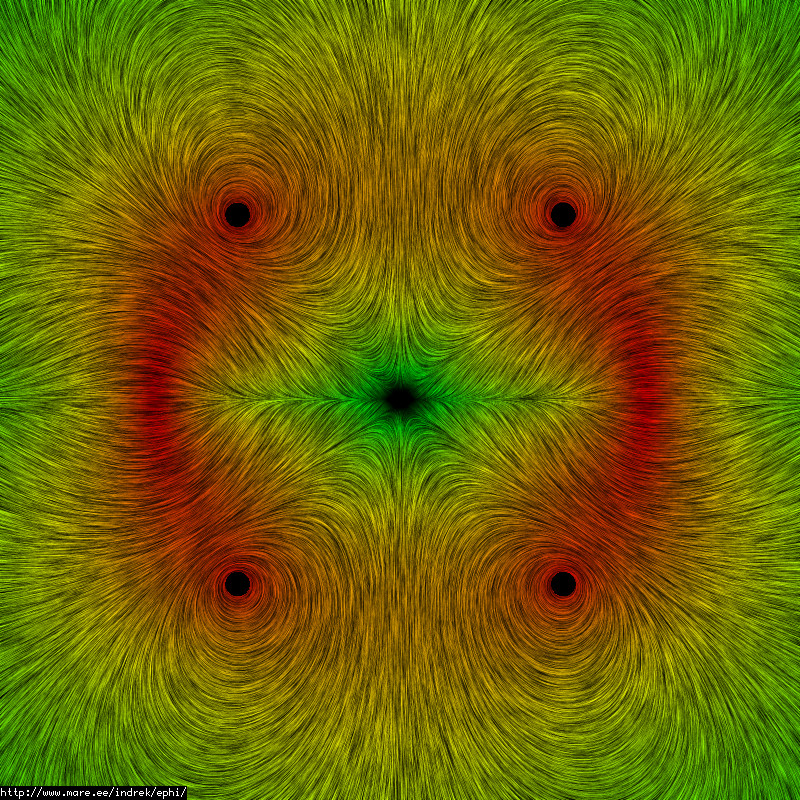
- Indrek Mandre has been doing some computer modeling of the magnetic field lines in the Polywell, as well as some particle simulation. You can see some of his results here: http://www.mare.ee/indrek/ephi/. For an example of what the field lines look like at the corner cusps, look at this image: http://www.mare.ee/indrek/ephi/pcp_lic.jpg. This is a corner cross section of the Polywell, so the field lines on the left and right are between two of the solenoids. Where those fields approach the solenoid cross sections at the top and bottom demonstrates the field geometry at the corner cusps. — Blane Dabney 15:46, 25 May 2007 (UTC)
- These are interesting pictures. A real important question is what is the plasma density at various locations. It is contained in the center where there is almost no field, or does it stick on the magnetic field lines? If it is the second case, then this thing will perform worse than the Levitated Dipole. This question could be answered simply by taking a photo. Don't know if hydrogen would glow, but neon and argon would. Paul Studier 21:33, 14 June 2007 (UTC)
- Some fairly good photos of WB2 and WB4 in operation can be found in the Google talk summary posted at http://www.askmar.com/Fusion.html. Once these machines hit the Paschen arc (glow discharge) condition that typically ends runs if background gas is allowed to get out of control, you can see the plasma pretty well. I'm not sure it is visible in fusion operation (there should be virtually no recombination of ions and electrons to produce light in correct operation). In the Paschen discharges, you can see the plasma follow electron paths. Fainter traces exit the cusps and follow the magnetic field lines. The glow inside the magrid is much brighter, illustrating the "wiffleball" confinement. The wiffleball effect is explained as a behavior of the trapped electrons in the center of the machine: once the density is sufficiently high, the electrons behave diamagnetically, that is they tend to exclude the magnetic field. This results in them pushing the field back and opening up that low-field zone in the center. This has the byproduct of partly closing down the cusp holes. In the Paschen discharge modes, you may actually be able to see this effect. Look for a photo of WB2 operating with a very intense blue glow inside. The wiffleball effect is supposed to result in densities inside the device being several thousand time higher than outside. Tom Ligon Tomligon 00:08, 15 June 2007 (UTC)
- These are interesting pictures. A real important question is what is the plasma density at various locations. It is contained in the center where there is almost no field, or does it stick on the magnetic field lines? If it is the second case, then this thing will perform worse than the Levitated Dipole. This question could be answered simply by taking a photo. Don't know if hydrogen would glow, but neon and argon would. Paul Studier 21:33, 14 June 2007 (UTC)
-
-
-
- I don't see what you describe in the picture "WB2 Operating, November 1994. The light appears to be room lighting. For example, there is a moon shaped light in front of the coil on the right side. Looks like glare from the glass. There is a perfect circle of light in the center. If that was plasma, it would be cusp shaped with points up, down, right and left. Paul Studier 03:22, 18 June 2007 (UTC)
-
-
-
-
-
- About that whiffleball ... I understand that the electrons would be diamagnetic (though there could be some exceptions to this rule), which, I figure, would improve the confinement by making a higher mirror ratio even if the field near the coils is not changed. Is that the whole story? Bussard draws pictures of big holes becoming little holes. Is that supposed to be a geometrical statement or just an analogy between hole size in a ball and mirror ratio in a plasma device? Concerning the pretty pictures ... I have to keep reminding myself that this is a 3-D configuration, so lines close together in the drawing does not imply a high field. I still believe the magnitude of the field where the rings touch will be small and radial. --Art Carlson 10:35, 15 June 2007 (UTC)
-
-
Is this paper new? It seems to address some of this? — Omegatron 22:52, 17 June 2007 (UTC)
- Thanks. At least I hadn't seen this paper before. It verifies my suspicion that field nulls at the vertices would be a problem. The proposed solution is to not let the coils touch, but this (at a minimum) introduces the line cusps that Bussard earlier said were so important to avoid. This paper claims that the additional losses through the line cusps can be held small. It also claims that electrons must be recirculated, so that some electron density - but not too much - must exist exterior to the coils. The question of how much of that recirculating plasma is intersected by the feeds (electrical and cryogenic) to the coils is not addressed. It is also interesting to remember the argument about good confinement in the machine due to the inherent stability of plasmas in concave magnetic fields. This argument applies to the plasma in the interior, but not to the recirculating electrons, where transport-producing instabilities must be feared, or at least considered. In short, this paper makes clearer what the current thinking of the proponents is, but it doesn't make me any less pessimistic. --Art Carlson 11:45, 18 June 2007 (UTC)
California Funding
The link California likely to fund further Polywell work. has been debunked at [13]. I quote from Joe Strout, the administrator of the blog and obviously pro-Polywell: I got a call back from Bill Maile in the Governor's office. He spoke with the Governor's policy advisors, and in brief, the story is false. This is the first anyone in the Governor's office has even heard of the idea. ... Meanwhile, remember, you got the truth here first — disappointing truth though it is. Paul Studier 21:28, 29 July 2007 (UTC)
Thanks. I'll go back and edit my own blog then. Tom Perkins