Talk:Political corruption
From Wikipedia, the free encyclopedia
[edit] Senseless map
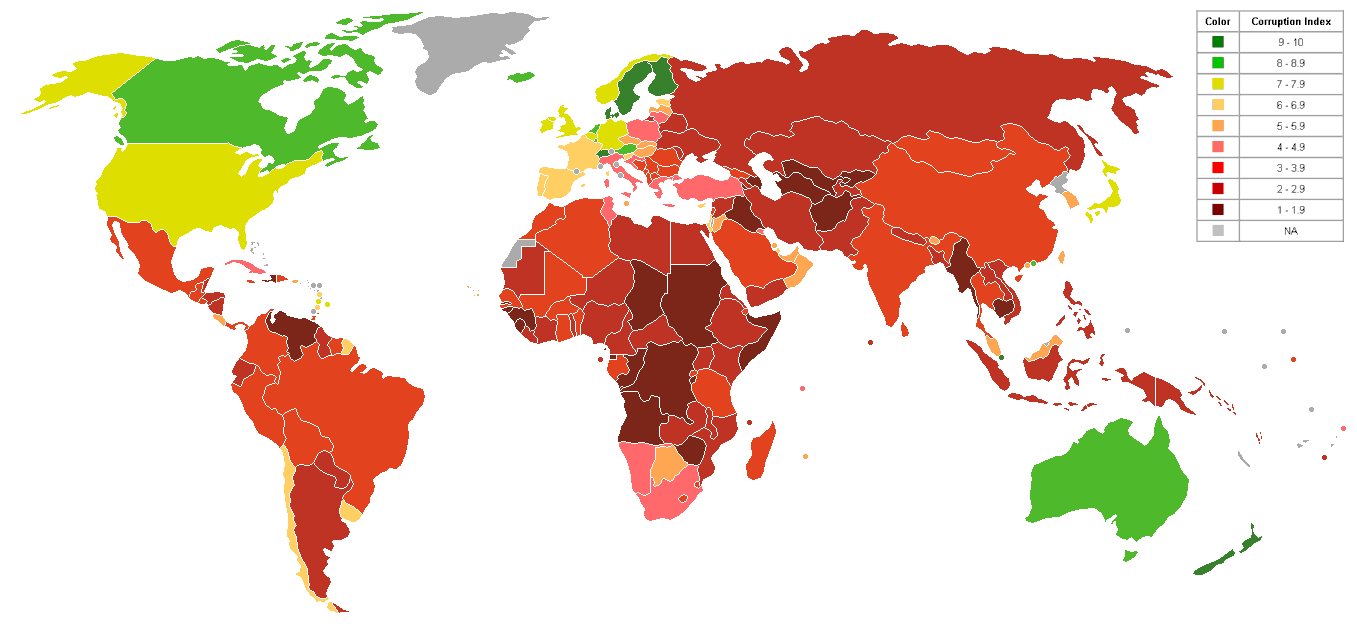
Something is awfully wrong with the map shown, on one hand it quantifies corruption in a way one is left unsure whether the greater the number the more corruption there is or viceversa. On the other hand I find it quite ignorant of facts if it supposes that either Peru or the United States are one much more corrupt than the other. As both are respectively as corrupted as their respective power may let them be. The map is out of date now. It needs to be changed. —Preceding unsigned comment added by 195.172.14.80 (talk) 14:43, 28 September 2007 (UTC)
[edit] Inaccurate
Either way, the map is completely wrong or someone bribed the inspectors.
[edit] Not sure what title shall this have

I'm assuming that reporting the top and bottom 12 lists is fair use, or the reporting of facts, or both. Please remove or re-edit if you disagree -- Anon.
Mar 21, 2006 - updated link address from public domain resource at
http://www.usaid.gov/our_work/democracy_and_governance/technical_areas/anti-corruption/index.html "USAID" is the lead foreign aid department for the US State Dept. They have strategies and programs to fight corruption and provide financial support for well known anti-corruption programs like Transparency International and others focused on specific regions. However, many anti-corruption foreign aid programs focus on external projects, and they need to expand efforts to fixing internal government management control systems that are weak and allow corruption opportunities to flourish. Vjochim 13:27, 21 March 2006 (UTC)
An entry is deserved on the UN Oil For Food program don't you think? It is likely the largest corruption scandal in history. - Response - yes, it is huge - do a Google search on Paul Volcker to find websites with details. Vjochim 13:27, 21 March 2006 (UTC)
Prof. Jon S.T. Quah (National University of Singapore) has excellent articles on Corruption and Corruption in Asia, as well as excellent books on corruption. Makes a good link in your reference or research sections. http://adb.org/Documents/Periodicals/GB/GovernanceBrief11.pdf http://www.currenthistory.com/currentissue.html Jack, April 18, 2006
"Charges of corruption as a political tool Oftentimes, politicians may seek to taint their opponents with charges of corruption. In the People's Republic of China, this phenomenon was used by Zhu Rongji, and most recently, by Hu Jintao to weaken their political opponents."
Please, can someone explain and/or expand this? It sounds like a very subjective claim. - Reply - this is fairly correct: A review of online articles of public corruption would show many times when one aspiring politician is claiming the incumbent has allowed corruption - especially after a big public case. In some cases, entire political parties lose power like Canada, in 2005 when the liberals were caught siphoning money out of government accounts to pay for political campaigns. The liberals lost control of the government after that scandal. Vjochim 13:27, 21 March 2006 (UTC)
[edit] proving corruption
It is easy to prove corruption, ... ...
This text in the article is not true, corruption is probably the most difficult crime to detect, investigate, and prosecute. Vsion 08:22, 17 May 2005 (UTC)
But with the right leads and the ability to read in between the lines corruption can show it self at its approoriate time. Unfortunately the people that have the ability to do this line of work have been bought and fall in the hands of corruption them selves.. 1:11 AM 20 December 2005 (MSC)
Disagree, many countries are forming anti-corruption commissions due to pressure from rankings in Transparency International's corruption indexes. The best are based upon the succesful Hong Kong anti-corruption commission. One indicator is how many court cases result in convictions, and is there publicity about it. For instance, a similar commission exists in poorly ranked Indonesia but they are growing in credibility and a track record of convictions. In contrast, another new commission in Iraq is preparing many cases, but the separate court system isn't yet strong enough to process the cases and issue convictions. But progress comes, based upon the "political will" of the incumbent political parties. Vjochim 13:27, 21 March 2006 (UTC)
[edit] Maricopa County
- Even in countries where national politics is relatively honest, political corruption is often found in regional politics. An example is in Maricopa County, Arizona.
What's the deal there? There's no explanation for the example, either on this page or the link to Maricopa County. Maccoinnich 10:28, May 20, 2005 (UTC)
- I removed this. The original author may have been referring to a scandal involving alternative-fuel vehicles that happened in 2000-2002 during Governor Jane Hull's administration, but to my knowledge this affected the entire state and not just Maricopa County. Moreover, the scandal may not have involved corruption in the first place; it could be argued that the legislation was well-meaning but greedy citizens took advantage of loopholes. Anyway, I don't think it's a good example even if that was the intended reference, so let's leave all of this out for now. Jeeves 02:45, 24 May 2005 (UTC)
Actually, we might want to put it back in. I'm in contact with some members of government, and they emphatically affirmed said corruption, mentioning AZSCAM, a major case of corruption in Maricopa County a few years ago where members of the state legislature were basically caught on film accepting bribes. More research pending, but it's definitely corruption. There was also a case about 20 years ago somewhere in Ohio, I'll look it up.
- I still have no idea what this is all about. If it's going to go back it, it definitely needs some explanation. Maccoinnich 17:15, August 13, 2005 (UTC)
I have to agree with the gentleman or woman that wrote and presented facts because if there is proof of bribery there is no reason for that not to be considered any type of corruption.
[edit] List of conditions favorable to corruption
Section 1 is a list of conditions favorable to corruption. The presence of a rambling, sloppy list at the beginning of the article could cause readers to ignore the high-quality material later on. This list appears to be a collection of personal gripes and theories of the editors. While some items are universally accepted and well worded (lack of transparency) others are poorly worded and indicate the political agenda of the editor (Apathetic, uninterested, or gullible populace that fails to give adequate attention to political processes.).
All in all, I think the items on this list need to be referenced, and then they need to be written in a consistant manner (currently, some are general and some are specific). AdamRetchless 14:34, 7 September 2005 (UTC)
- I've structured the list, grouping related items together. Some improvement in phrasing may be needed. Criticforaday 21:35, 8 September 2005 (UTC)
~~I swear, this world is coming to an end.
[edit] List of Conditions
As far as a "rambling, sloppy list" is concerned, I'd have to disagree. In an article "A Policy-Oriented Theory of Corruption" by Tevfik Nas, Albert Price, and Charles Weber of the University of Michigan at Flint (published in American Political Science Review in 1986), the exact same contributing factors are listed (though not in a list form).
Nas, et al, divide the causes of corruption into "personal characteristics" and "structural influences". The personal characteristics are reduced to either greed or desire for social status (which, in my opinion, is probably the same thing). The structural influences are sub-divided into organizational, quality of citizen involvement, and effects of the legal system. I believe pretty much everything listed in the article can be placed into those divisions.
TL Hart
[edit] Christopher Largen's novel JUNK (2005)
This doesn't seem to be a major work of literature, but rather an advert for a vanity publication. Suggest we get rid of it.
While we're at it, the section on corruption in fiction is a bit light. Pretty much all the Conspiracy thrillers of the 1970s alluded to corruption and Watergate, etc. I'll add some more when I have time.
[edit] Why just "political"?
Who's never heard of the "I'll scratch your back if you scratch my back" principle in the workplace?
Are businesses somehow magically immune from corruption?
Isn't it handy to know the person in charge of purchacing?
I know countless examples of workplace corruption.
- Right, but workplace corruption is inherently a different animal from political corruption and is usually regulated under a different set of laws. Also, the term corruption could be used to refer to corruption of information (especially during transmission). So I think that is why the qualifier "political" is necessary here.--Coolcaesar 03:21, 5 November 2005 (UTC)
-
- We do have Police corruption and Corporate crime.--Commander Keane 13:39, 2 December 2005 (UTC)
I suggest that the article be split off so that we have:
- Official corruption, the misuse of an offical position for private advantage
- Political corruption, corruption of the polical system through bribery, intimidation, extortion, vote buying, destabilization, or influence peddling
Josh Parris#: 03:59, 5 December 2005 (UTC) \
some ideas;
The term "official corruption" could be referred to as "acting out of office" - an even broader concrete concept (i.e. so they opened the office door, walked outside, and started acting out there?). Or simply the act of exploiting others. (Borderline Personality)
Suggest it as:
CORRUPTION - an individual's inability to differentiate right from wrong is compromised ~ rendering them unable to follow, obey, or conform to laws, policies, procedures, protocols, or recognize jurisdictional limitations. So whose decisions ultimately cause mental, physical, or emotional harm to others under their control.
Note - a position of authority would be the logical point of origin for this behavior. Obviously, regarding an object of little consequence as "corrupt" seems an oxymoron. An individual's status could be compromised for different reasons i.e. if physical in origin due to dementia, mental-psychotic disorders, or emotional-personality disorders.
Therefore, someone could be corrupt, because they are incompetent. But if someone is incompetent, can they be corrupt?
btk; 17/1
[edit] Political corruption in China
Can anyone do an article on political corruption in China? I searched for it on Wikipedia but there doesn't seem to be an article on it, also I don't know how to request an article.
[edit] USA
I don't see why there's an article about the USA in here, in my opinion, the intire country is corrupt.
- And lets give a quadrupple and a half cheer to the person, whomever it might've been, who wrote that, truly one of the most intelligent and cynical persons there is here on wiki! Huzzah! (x4½)81.228.148.164 08:41, 23 July 2007 (UTC)
[edit] Corruption and Indian Corruption
In India Government gives food grains at subsidised rate through rationing shop on ration card. It appers that all most all the industrialist are having ration card means they are poor and nothing else but poor. Will any reader on this discussion will give opinion about difference in corruption and Indian corruption. vkvora 17:06, 22 August 2006 (UTC)
Don't Forget the Organ Trading Black Market in India and Countries in that area That People have investigated Tirelessly.
[edit] Kashmir is by product of Defence Corruption in India and Pakistan
-
- Red Tape, Bureaucracy, Corruption, Political corruption, Bribery, Extortion, Graft, Money Laundering all are part and parcel of Religon. vkvora 05:24, 2 September 2006 (UTC)
[edit] Map
Map is bullcrap, USA should be in black color on this map.—Preceding unsigned comment added by 88.226.107.91 (talk) 06:28, 15 November 2006
- Good to hear from an expert. About the map, it's hard to follow. A similar map with better colours is here: http://upload.wikimedia.org/wikipedia/commons/0/04/World_Map_Index_of_perception_of_corruption.png (if link doesn't work, qv the article on Switzerland and scroll down) -Jackmont, Jan 11, 2007.
- That map is outdated.Ultramarine 13:29, 13 January 2007 (UTC)
- There is far more corruption in the USA than anyone would want, but in relative terms the map is not far wrong. I say this based on ten years of experience in international consulting in the areas of corruption, organized crime, and poverty. Citizens of almost any country will tell you that the corruption in their country is terrible, far worse than anyone outside can ever understand, yet there are strikingly clear differences. I think Transparency International's index is reasonably close to objective truth, and improving every year. —Aetheling 03:27, 5 June 2007 (UTC)
[edit] The USA's government
To be totally honest, the US's political state is extremely corrupt as is the country. -Anonymous —Preceding unsigned comment added by 207.203.165.11 (talk) 23:34, 4 December 2006
[edit] Type of Abuse
It is simple to list monetary. How about abuse that doesn't involve money? For example, abuse for position gain, political power gains,etc. It make me grief to think about it.
--Sltan 13:58, 19 January 2007 (UTC)
[edit] External links
The external links section is full of unnecessary pointers, and is likely to attract more. I've removed the most obvious: columns from private newspapers, private blogs, ads, confusing corruption with other types of crime and misbehavior. I also commented out the examples section, because it can never represent a neutral point of view; anyone can "blacklist" anyone, without discussion or consensus. --Vuo 19:31, 22 March 2007 (UTC)
-
- Vuo has a sharp eye. good edit. Rjensen 21:32, 22 March 2007 (UTC)
[edit] Merge with Kleptocracy
Keep separate. Allow me to be the first to object to this proposal. Kleptocracy is a type of government. Political corruption is a mode of behavior (usually criminal), and a disease of political systems. Kleptocratic tendencies are a suitable subject for political science, whereas political corruption is primarily a concern of criminal justice. I really think that each of these two topics deserves its own article, so that each article can focus on what is important to it. To merge them would be to create an even more unwieldy article — and I think that the topic of political corruption is already immense enough as it is. My vote is to keep them separate. —Aetheling 03:17, 5 June 2007 (UTC) Keep separate.Ultramarine 11:24, 5 June 2007 (UTC)
- Kleptocracy is a buzzword first used for the Jelzin administration for a gouvernement with so much corruption in it that corruption has become the core of the gouvernement. It is a political neologism that is PRODded. Everything there is to say about "Kleptocracy" can be said in Political Corruption, and a redirect is fully sufficient for "Kleptocracy". --85.181.63.14 12:04, 17 June 2007 (UTC)
I agree with Ultramarine. Corruption may lead to kleptocracy but they are different. Keep separate.
- LC
I believe that although kleptocracy may be a form of political corruption, it is in itself too idiosyncratic to wash into political corruption as merely another subdivision. Keep separate.
- Kyp —Preceding unsigned comment added by 24.32.84.229 (talk) 20:05, 21 October 2007 (UTC)
It looks like kleptocracy is a type of political corruption. So there should just be a link on that page to get to this page. But don't merge them--they aren't the same thing. —Preceding unsigned comment added by 67.41.234.69 (talk) 23:42, 22 October 2007 (UTC)
[edit] Wikipedia - conditions favorable for corruption
- Information deficits
- Lack of government transparency.
- -> ArbCom ruled Tobias Conradi is not allowed to compile lists of admin right abuses
- Contempt for or negligence of exercising freedom of speech and freedom of the press.
- -> admins and users often censor other user's opinion or representation of verifiable facts, labeling the opinion or verifiable facts trolling/vandalism/personal attack
- Lack of government transparency.
- Lacking control over and accountability of the government.
- Lacking civic society and non-governmental organizations which monitor the government.
- -> creation of Wikiproject to monitor admin right abuses was surpressed by admins
- Contempt for or negligence of exercising freedom of speech and freedom of the press.
- -> freedom of speech surpressed by admins
- Weak rule of law.
- -> admins do sometimes not apply the written policies, but their own interpretations of them, sometimes openly admintting that certain written rules exist, but should not be followed "in that special case"
- Weak judicial independence.
- -> NONE in WP
- Lacking civic society and non-governmental organizations which monitor the government.
- Social conditions
- Self-interested closed cliques and "old boy networks".
- -> on WP:AN in a discussion with Conrad Dunkerson regarding Tobias Conradi that can be found. Admins attack Conrad, because he did not side with them
- In societies where personal integrity is rated as less important than other characteristics (by contrast, in societies such as 18th and 19th Century England, 20th Century Japan and post-war western Germany, where society showed almost obsessive regard for "honor" and personal integrity, corruption was less frequently seen)
- -> E.g. Tobias Conradi is from post-war Germany - while most of the admins he saw engaging in corrution or supporting it come from the US/UK/AU. Some admins even offered to make deals with Tobias, which Tobias rejected ("You cannot buy me").
- Lacking literacy and education among the population.
- -> some admins, or users that think about becoming admins, lack basic logical thinking or ability to understand written policies. Sometimes they even may not have read the existing policies at all.
- Self-interested closed cliques and "old boy networks".
84.190.47.116 10:44, 30 July 2007 (UTC)
- FYI, the above user has had his log-on name banned from editing wikipedia for his own failure to abide by rules and regulations, regularly insulting and harrassing others, and clearly, his own lack of basic logical thinking, which was what led to his being banned in the first place. John Carter 16:42, 30 July 2007 (UTC)
[edit] Combating Corruption: A Policy Tool Kit
This section was copied verbatim from the CIPE website, at <http://www.cipe.org/programs/corruption/index.php>. The page in question does not have a copyright marker, but neither does it have an explicit permission to copy notice. Even if it did have such a notice, it is very poor form simply to copy someone's article into Wikipedia. Not only is it not encyclopedic in style — a Wikipedia requirement — but it contains no references at all, and is thus technically original research. At best we should summarize the policy toolkit, with a reference and perhaps quote one or two of its specific recommendations. As it is now, it is unacceptable. I hesitate to delete it entirely, because there is good material here. — Aetheling 05:40, 5 October 2007 (UTC)
[edit] Effects
The text of the section "Effects" was also quoted nearly verbatim from "A Handbook on Fighting Corruption" (http://pdf.dec.org/pdf_docs/Pnace070.pdf), p. 5. I haven't read the entire Wikipedia article, but I suspect there is more of the same elsewhere. I'm not quite sure what to do in this situation; for now I'll just flag the article with a template. modify 18:18, 11 December 2007 (UTC)
The addition was made here, with a note that says it's from a public domain source. Can someone who knows about these things verify that it's OK to copy and paste from a US government publication like this? If so, perhaps the {{copypaste}} should be removed. modify 18:44, 11 December 2007 (UTC)
[edit] "Unholy Alliance"
You can't debate this without reading it. Here it is.
-
-
- (begin)
-
An unholy alliance is a coalition among seemingly antagonistic groups, especially if one is religious, for ad hoc or hidden gain. Like patronage, unholy alliances are not necessarily illegal, but unlike patronage, by its deceptive nature and often great financial resources, an unholy alliance can be much more dangerous to the public interest. An early, well-known use of the term was by Theodore Roosevelt (TR):
- "To destroy this invisible Government, to dissolve the unholy alliance between corrupt business and corrupt politics is the first task of the statesmanship of the day." - 1912 Progressive Party Platform, attributed to TR[1] and quoted again in his autobiography[2] where he connects Trusts and monopolies (sugar interests, Standard Oil, etc.) to Woodrow Wilson, Howard Taft, and consequently both major political parties.
After the breakup of Standard Oil, TR lost the election, and the unholy alliance he had identified, oligopolies of a few big commodities corporations and their political allies, continued otherwise undeterred by the mutually beneficial indifference of both major political parties. In 1935, retired Marine Major General Smedley Butler described how this unholy alliance influenced U.S. foreign policy and how his job abroad had been to be a "muscle man for big business." In 1944, conservative journalist John T. Flynn described how this unholy alliance uses religion to sell its agenda abroad to the American public:
- "The enemy aggressor is always pursuing a course of larceny, murder, rapine and barbarism. We are always moving forward with high mission, a destiny imposed by the Deity to regenerate our victims while incidentally capturing their markets, to civilise savage and senile and paranoid peoples while blundering accidentally into their oil wells."[3]
A reference to this unholy alliance today is:
- Unholy Alliance, a review by PBS journalist, Rev. Dr. Allen Dwight Callahan of
- Phillips, Kevin (2006) American Theocracy: The Peril and Politics of Radical Religion, Oil, and Borrowed Money in the 21st Century, Viking Press.
Other unholy alliances are the subjects of other books:
- Unholy Alliance: Radical Islam and the American Left, by David Horowitz
- Unholy Alliance, by David Yallop, about the international drug trade and resultant political corruption
- Unholy alliance: religion and atrocity in our time, by Marc H. Ellis
- Unholy Alliance: A History of Nazi Involvement With the Occult, by Peter Levenda
Still other unholy alliances are found in "Bootleggers and Baptists"[4] and Dixie Mafia.
- ^ O'Toole, Patricia, "The War of 1912," TIME in Partneship with CNN, Jun. 25, 2006.
- ^ Roosevelt, Theodore. An Autobiography: XV. The Peace of Righteousness, Appendix B, NEW YORK: MACMILLAN, 1913.
- ^ Flynn, John T. (1944) As We Go Marching. p. 240
- ^ Bruce Yandle, "Bootleggers and Baptists: The Education of a Regulatory Economist." Regulation 7, no. 3 (1983): 12.
-
-
- (end)
-
Is a term for an alliance between theoretically opposed groups. However, this is not a term specifically used for corruption. There may be an "unholy alliance" between nations in a war, for example.Ultramarine (talk) 17:51, 12 December 2007 (UTC)
- Correct, but it is also a form of political corruption. Its public face hides its method of operation. "Bootleggers and Baptists" is one classic example. The deliberately hidden relationships between government officials and a wealthy few is what TR thought so dangerous, because it enabled extensive corruption of other sorts. Deceiving the public is dishonest, therefore corrupt if any personal benefit derives from doing so. —Preceding unsigned comment added by 63.98.135.196 (talk) 18:09, 12 December 2007 (UTC)
- Most of the soures do not state that this a term commonly used with regards to political corruption, they mention other forms of "unholy alliances". Regarding the usual far left wing capitalist conspiracy theories, they are opinions, not facts. Regarding campaign finance, this is already discussed, although this is not corruption, since it is not illegal or secret.Ultramarine (talk) 18:16, 12 December 2007 (UTC)
- "Most of the soures" don't have to. TR didn't have to. Merely using it to identify a form of corruption establishes it, especially if the author is the POTUS viewing the corruption from the inside. The word "conspiracy" is not used here. Converging interests of a powerful few suffices to produce the same effect. Nothing is said here about campaign finance, although that is understood. There must be much about campaign finance that is illegal or secret, otherwise people wouldn't keep going to prison, but "illegal or secret" isn't the requirement for corruption. Merely self-serving and dishonest will do, all the more if on a massive scale. —Preceding unsigned comment added by 63.98.135.196 (talk) 20:15, 12 December 2007 (UTC)
- There already a section on "Campaign contributions". If there is something more that should be added on this, like undue influence by businesses, then this is the place. The references to "unholy alliances" like the one between Nazis and Occultism, or the radical left and islamist terrorists, have no place in this article.Ultramarine (talk) 20:26, 12 December 2007 (UTC)
- You removed without all the tags without explanation: [1] Please add explanations for this or the irrelevant material will be removed. Again, why should we mention things like unholy alliances between Nazis and Occultism, or the radical left and islamist terrorists? Ultramarine (talk) 20:32, 12 December 2007 (UTC)
- "Most of the soures" don't have to. TR didn't have to. Merely using it to identify a form of corruption establishes it, especially if the author is the POTUS viewing the corruption from the inside. The word "conspiracy" is not used here. Converging interests of a powerful few suffices to produce the same effect. Nothing is said here about campaign finance, although that is understood. There must be much about campaign finance that is illegal or secret, otherwise people wouldn't keep going to prison, but "illegal or secret" isn't the requirement for corruption. Merely self-serving and dishonest will do, all the more if on a massive scale. —Preceding unsigned comment added by 63.98.135.196 (talk) 20:15, 12 December 2007 (UTC)
There is vastly more to an unholy alliance than campaign contributions. The fake opposition of the "opposing" parties usually involves one taking a high moral tone, crusading preachers or government officials who are going "stamp out X" or "regulate Y" or bring a "newer, deeper understanding of Z" if folks will just have faith. It is this last example that relates to Nazi occultism, a sort of hocus-pocus preast-craft to distract the lumpen proletariat from the enormity of Nazi intentions. Likewise, some on the Left stand accused of a double standard w.r.t. Islamist terrorism, again, adopting a high moral tone that masks their acceptance of it. When done to confuse the public, for personal gain, and it works, it's corrupt, politically, i.e., results in policies that do not accomplish their stated purpose, but rather benefit only a few, inside the alliance. This is what TR, Smedley Butler, John Flynn, and many others saw.
- If Flynn and Smeadly etc it talking about Nazis and Occultism, or the radical left and islamist terrorist, then you should give a quote stating this. You have taken many unconnected uses of the word "unholy alliance" and mixed them together to fit your own theory which is not allowed, see WP:OR. You could maybe use them in an article about the word "unholy alliance", discussing what the word means in general, but no in an article about political corruption. The only one of sources that connects "unholy alliances" and poltical corruption is the Theodore Roosevel one and the book Unholy Alliance about the international drug trade and resultant political corruption.
- Your more general theory that a few wealthy people secretly controls and corrupts everthing, is not an established fact, as your text clams, but simply the opinions of a some people, like the not uncommon opinion that the US have a secret "unholy alliance" with aliens who have given the US all new technology, or the theory that the Freemasons or the Illuminati controls everthing. Maybe we could have a section about your view, but then is should be called something like "Conspiracy theories" to cover these aspects.Ultramarine (talk) 11:43, 13 December 2007 (UTC)
- Both the facts and the synthesis (such as it is, which isn't much) seem well documented. -68.221.118.230 (talk) 23:48, 11 January 2008 (UTC)
- Please respond to the arguments given.Ultramarine (talk) 15:55, 24 January 2008 (UTC)
[edit] Cleanup?
User:Perspicacite added a cleanup tag, could he please enumerate what to clean up? The article isn't a major mess, just some citation formatting would be in order. --Vuo (talk) 14:17, 31 January 2008 (UTC)
[edit] Hello?..
Why on earth is the world banks statistics put on a page about government corruption. If this isn't irony then what is, how can you make the world bank somehow be above corruption and able to give legitimate statistics, when any educated person knows the source of corruption in the world today is the world bank. The americans government is literally, and sourced as the most corrupt in the world, and it is ovbious that the denial of this corruption creates alot of bias on wikipedia in general. —Preceding unsigned comment added by 216.8.131.33 (talk) 05:11, 25 February 2008 (UTC)
[edit] Wallah koran!
HAHAHA
how is it possible that an article over a topic as broad and important as this is so poorly written with so few references? is this an encyclopedia or not? —Preceding unsigned comment added by 216.143.219.16 (talk) 02:40, 31 March 2008 (UTC)