Image:PIA07763 Rhea full globe5.jpg
From Wikipedia, the free encyclopedia
Size of this preview: 620 × 599 pixels
Full resolution (2,400 × 2,320 pixels, file size: 1.42 MB, MIME type: image/jpeg)

| This is a file from the Wikimedia Commons. The description on its description page there is shown below.
|
[edit] Summary
| Description |
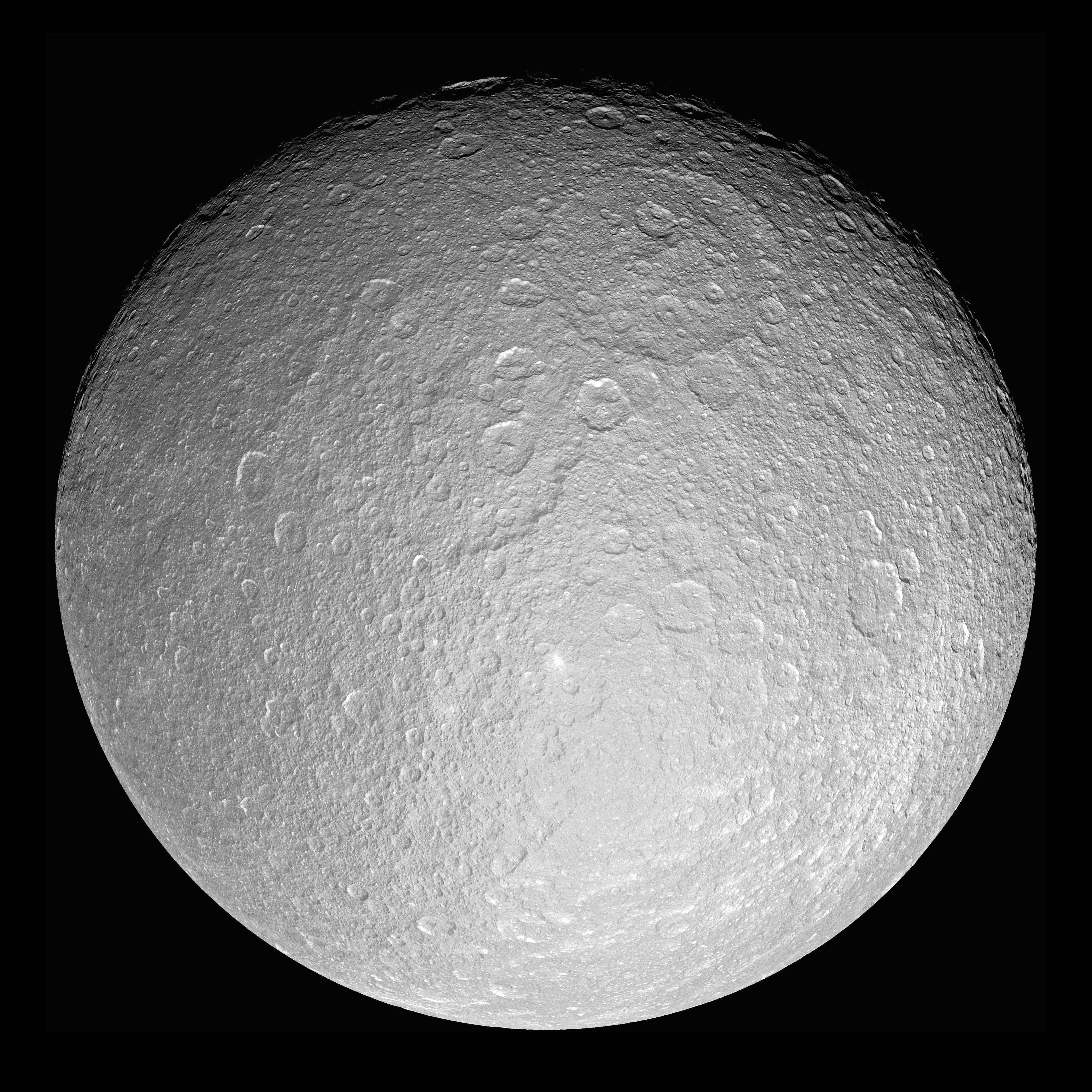
This giant mosaic reveals Saturn's icy moon Rhea in her full, crater-scarred glory. This view consists of 21 clear-filter images and is centered at 0.4 degrees south latitude, 171 degrees west longitude. The giant Tirawa impact basin is seen above and to the right of center. Tirawa, and another basin to its southwest, are both covered in impact craters, indicating they are quite ancient. The bright, approximately 40-kilometer-wide (25-mile) ray crater seen in many Cassini views of Rhea is located on the right side of this mosaic (at 12 degrees south latitude, 111 degrees west longitude). See PIA07764 for a close-up view of the eastern portion of the bright, ray crater. There are few signs of tectonic activity in this view. However, the wispy streaks on Rhea that were seen at lower resolution by NASA's Voyager and Cassini spacecraft, were beyond the western (left) limb from this perspective. In high-resolution Cassini flyby images of Dione, similar features were identified as fractures caused by extensive tectonism. Rhea is Saturn's second-largest moon, at 1,528 kilometers (949 miles) across. The images in this mosaic were taken with the Cassini spacecraft narrow-angle camera during a close flyby on Nov. 26, 2005. The images were acquired as Cassini approached the moon at distances ranging from 79,190 to 58,686 kilometers (49,206 to 36,466 miles) from Rhea and at a Sun-Rhea-spacecraft, or phase, angle of about 19 degrees. Image scale in the mosaic is 354 meters (1,161 feet) per pixel. The Cassini-Huygens mission is a cooperative project of NASA, the European Space Agency and the Italian Space Agency. The Jet Propulsion Laboratory, a division of the California Institute of Technology in Pasadena, manages the mission for NASA's Science Mission Directorate, Washington, D.C. The Cassini orbiter and its two onboard cameras were designed, developed and assembled at JPL. The imaging operations center is based at the Space Science Institute in Boulder, Colo. For more information about the Cassini-Huygens mission visit http://saturn.jpl.nasa.gov. The Cassini imaging team homepage is at http://ciclops.org. The NASA image has been processed to enhance contrast, reduced in size, and had black panels added to its borders. |
|---|---|
| Source | |
| Date |
2005-11-26 |
| Author |
NASA/JPL/Space Science Institute |
| Permission (Reusing this image) |
see below |
| Other versions | Image:Rhea hi-res PIA07763.jpg |
 |
This image or video was catalogued by Jet Propulsion Lab of the United States National Aeronautics and Space Administration (NASA) under Photo ID: PIA07763. This tag does not indicate the copyright status of the attached work. A normal copyright tag is still required. See Commons:Licensing for more information. |
[edit] Licensing
 |
This file is in the public domain because it was created by NASA. NASA copyright policy states that "NASA material is not protected by copyright unless noted". (NASA copyright policy page or JPL Image Use Policy).
Deutsch | English | Español | Français | Nederlands | Português | Русский | 中文(简体) | 中文(繁體) | +/- |
|
 |
Warnings:
|
File history
Click on a date/time to view the file as it appeared at that time.
| Date/Time | Dimensions | User | Comment | |
|---|---|---|---|---|
| current | 00:43, 23 December 2007 | 2,400×2,320 (1.42 MB) | WolfmanSF | ({{Information |Description=This giant mosaic reveals Saturn's icy moon Rhea in her full, crater-scarred glory. This view consists of 21 clear-filter images and is centered at 0.4 degrees south latitude, 171 degrees west longitude. The giant Tirawa impac) |
File links
Metadata
This file contains additional information, probably added from the digital camera or scanner used to create or digitize it. If the file has been modified from its original state, some details may not fully reflect the modified file.
| Orientation | Normal |
|---|---|
| Horizontal resolution | 72 dpi |
| Vertical resolution | 72 dpi |
| Software used | Adobe Photoshop Elements 3.0 Macintosh |
| File change date and time | 16:30, 22 December 2007 |
| Color space | 65535 |


