Image:PIA07712 - F ring animation.gif
From Wikipedia, the free encyclopedia
No higher resolution available.
PIA07712_-_F_ring_animation.gif (450 × 450 pixels, file size: 3.43 MB, MIME type: image/gif)

| This is a file from the Wikimedia Commons. The description on its description page there is shown below.
|
[edit] Summary
| Description |
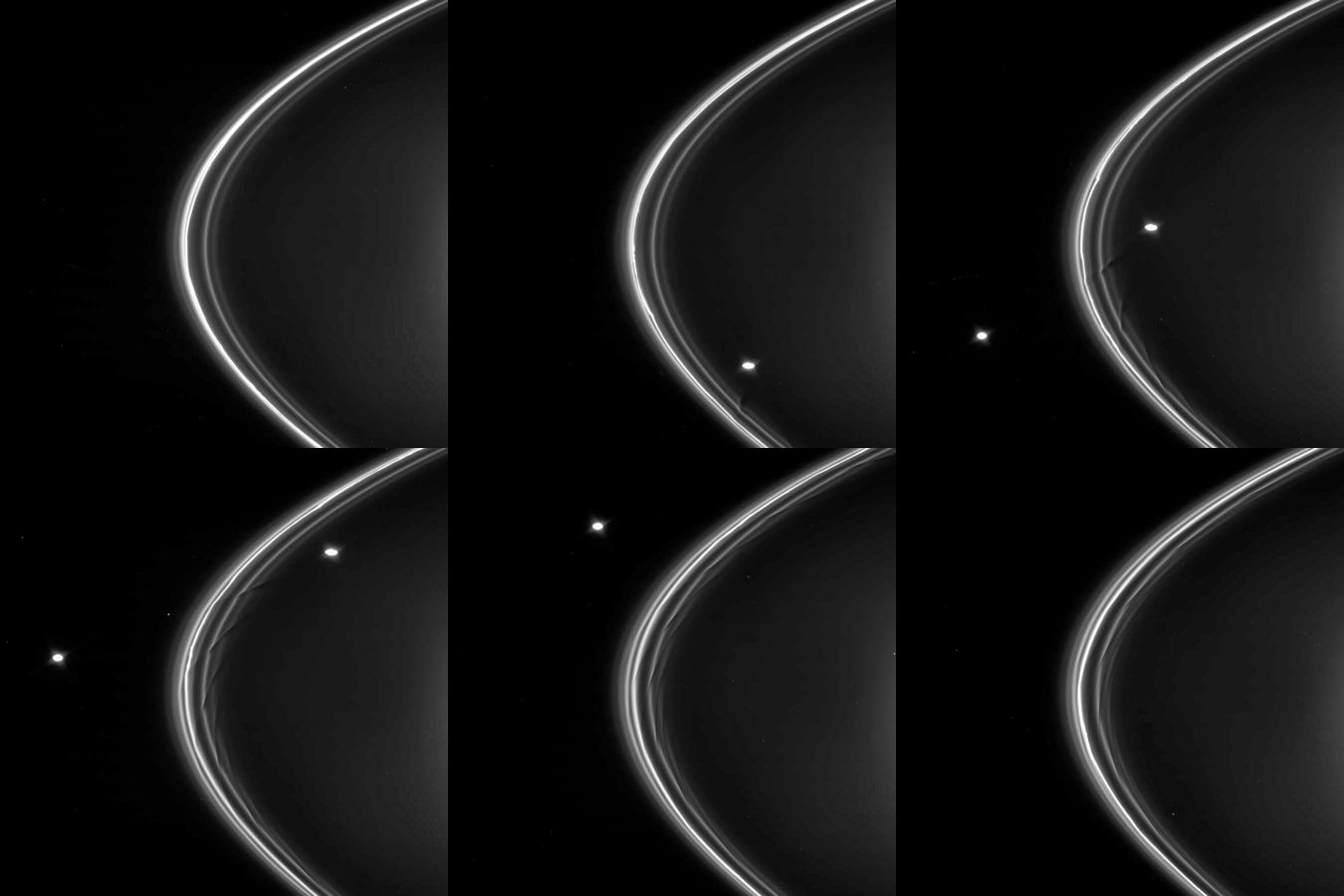
This movie sequence from Cassini shows dark drapes in the inner strands of the F ring caused by the gravitational influence of the shepherd moon Prometheus (102 kilometers, 63 miles across). Prometheus appears first in the sequence, interior to the F ring, and Pandora (84 kilometers, 52 miles across) follows along outside of the ring. Radial structure in the bright core of the ring is visible throughout the movie. Prometheus orbits closer to Saturn, and thus faster, than the icy particles that make up the F ring. The moon passes comes closest to the ring at “apoapse”, when it is farthest from Saturn. It is during these apoapse passages that Prometheus has its greatest influence on the fine ring material. With time, the ring material previously affected falls behind so that on the next apoapse passage of Prometheus, a new gore in the inner ring material is made. The material closer to Prometheus orbits the planet faster than the material closer to the bright F ring core. The gores, together with the sheared-out material due to differential orbital motion, create the dark, diagonal drapes. Several background stars are seen moving across the field during the movie. The visible light images in this sequence were acquired using the narrow angle camera on April 13, 2005 from a distance of approximately 1.2 million kilometers (700,000 miles) from Saturn. The Cassini-Huygens mission is a cooperative project of NASA, the European Space Agency and the Italian Space Agency. The Jet Propulsion Laboratory, a division of the California Institute of Technology in Pasadena, manages the Cassini-Huygens mission for NASA's Science Mission Directorate, Washington, D.C. The imaging team consists of scientists from the US, England, France, and Germany. The imaging operations center and team lead (Dr. C. Porco) are based at the Space Science Institute in Boulder, Colo. For more information about the Cassini-Huygens mission, visit http://saturn.jpl.nasa.gov and the Cassini imaging team home page, http://ciclops.org. This is a truncation of NASA's half-size animated gif version of the sequence. The full size image sequence is also available at http://photojournal.jpl.nasa.gov/animation/PIA07712. |
|---|---|
| Source | |
| Date |
April 13, 2005 |
| Author |
NASA/JPL/Space Science Institute |
| Permission (Reusing this image) |
see below |
 |
This image or video was catalogued by Jet Propulsion Lab of the United States National Aeronautics and Space Administration (NASA) under Photo ID: PIA07712. This tag does not indicate the copyright status of the attached work. A normal copyright tag is still required. See Commons:Licensing for more information. |
[edit] Licensing
 |
This file is in the public domain because it was created by NASA. NASA copyright policy states that "NASA material is not protected by copyright unless noted". (NASA copyright policy page or JPL Image Use Policy).
Deutsch | English | Español | Français | Nederlands | Português | Русский | 中文(简体) | 中文(繁體) | +/- |
|
 |
Warnings:
|
File history
Click on a date/time to view the file as it appeared at that time.
| Date/Time | Dimensions | User | Comment | |
|---|---|---|---|---|
| current | 19:51, 24 November 2007 | 450×450 (3.43 MB) | WolfmanSF | (Reduce file size by deleting alternate frames. Double delay setting to maintain speed of animation.) |
| 09:48, 23 November 2007 | 450×450 (6.44 MB) | WolfmanSF | (truncate down to 122 frames) | |
| 02:00, 23 November 2007 | 450×450 (6.91 MB) | WolfmanSF | (further truncation down to 131 frames) | |
| 09:02, 22 November 2007 | 450×450 (7.12 MB) | WolfmanSF | ||
| 10:01, 21 November 2007 | 450×450 (9.01 MB) | WolfmanSF | ({{Information |Description=This movie sequence from Cassini shows dark drapes in the inner strands of the F ring caused by the gravitational influence of the shepherd moon Prometheus (102 kilometers, 63 miles across). Prometheus appears first in the sequ) |


