Talk:Palace of Justice siege
From Wikipedia, the free encyclopedia


[edit] change of picture
when colombians think of the seige, the image of the old palace of justice comes in mind. Do you think it would be better to change the main image on top to be the old palace of justice or the palace of justice during the attack instead of the new one? (since it already features at the end of the article) thank you Minako-Chan* (talk) 19:24, 31 May 2008 (UTC)
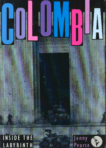
[edit] Looking for picture on the cover of Colombia: Inside the Labyrinth
There is an breath-taking picture on the cover of the book Colombia: Inside the Labyrinth, by Jenny Pearce showing tanks going into the Palace of justice. It was taken by a photographer, Julien Frydman who was working for a defunct photo organization, Sygma which was swallowed by Corbis.
A really poor, small, nearly indecipherable picture of the book is here.
Any ideas where I can find the picture? Travb 06:40, 21 February 2006 (UTC)
-
- I contacted Corbis, this is what they said:
-
- Thank you for contacting Corbis Account Services. Do you have the image ID number? Unfortunately, we are not able to find it by title of magazine. There may be a chance that the photographer is not a part of the Corbis family any longer as well. Personal Wall Decor ranges in price from $390.00 to $455.00 per image. This license allows you to have access to the high res digital file only.
-
- I found Jenny Pearce's school homepage:
- http://www.bradford.ac.uk/acad/peace/tmp/staff/pearce_j/
-
-
- I got the picture from the back cover and the front cover, and sliced it together, it is now on my flickr.com account, which is now in the external links section.Travb 02:38, 4 April 2006 (UTC)
-
[edit] Can't beleive everything you hear on television?
I just watched (2002) World History of Organized Crime - Disc 2 [DVD]. History Channel. Volume two contains "China," "India," and "Colombia."
The tape, an incredibly simplistic handling of a very complex situation in Colombia says:
"Just before noon on November 6th, 1985 at the Colombia Palace of Justice in downtown Bogata, guerillas hired by the [Medillin] Cartel seized more than 250 hostages."
Is this true? Did the [Medillin] Cartel hire M-19? This sounds dubious. Were there extradition files on M-19 also in this building, or just the Cartel? Travb 00:17, 26 February 2006 (UTC)
-
- Found my answer:
-
- A few analysts have speculated that some druglords, such as Pablo Escobar, may have masterminded the operation in order to get rid of several criminal investigations recorded in the documents lost during the event. Later legal investigations have concluded that this was apparently not the case, and most later observers have tended to undermine the claims of any close operational links between those parties and the M-19.
-
- from the m-19 wikipage.Travb 00:31, 26 February 2006 (UTC)
[edit] The missing
Pearce, Jenny (May 1 1990). in 1st: Colombia:Inside the Labyrinth. London: Latin America Bureu, p. 166. 0906156440.
Fourteen people 'disappeared" including eight members of the cafeteria staff, three casual visitors to the Palace and three guerrillas.
What does this mean? disappeared? Travb 00:40, 26 February 2006 (UTC)
- It means that their bodies have not been found.
- Though it appears that the numbers given by Pearce in 1990 may well be a bit outdated, as the current figure is 11 (or, strictly speaking, 10, after one of several unidentified bodies was identified through DNA testing: [1]).
- Several alternative explanations have been proposed: a) They were burned into unrecognizable remains as a result of their being overly exposed to the fires and are among several unidentified bodies. b) They were undercover guerrilla operatives working in the building and which assumed other identities once they left with the rest of the survivors c) They were somehow taken alive by the military and possibly tortured or otherwise killed at some unspecified moment, either outside or inside the building.
- The most popular assumption is currently "c", though the matter still remains unresolved . Juancarlos2004 16:43, 26 February 2006 (UTC)
corrected spelling and grammarTrelane 05:51, 3 April 2006 (UTC)
-
- Took out confusing reference from Carrigan book:
-
-
- Approximatly five o'clock on November 7th, Colonel Sanchez from the museum command center across the street from the palace told General Samudio, "We've captured a female guerrilla. She's been identified, she's fully identified." General Samudio responds: "Well, you know what to do. If the sleeve disappears, make certain you disappear the jacket too." This means if she is 'disappeared' [to be tortured], make certain you dispose of the body.
-
-
- The author does not have footnotes, only notes about the chapters at the end of the book, so I am not sure were she got this from.Travb 09:53, 6 March 2006 (UTC)
Although you have to remember the truth is very hard to find and there are are least more disappeared people than the ones they mention. This is the case in various countries in South America, the truth right now is very limited to be trusted, maybe in some years a more verifiable truth can be found. --MasK of ThE CARNIVAL 23:53, 21 March 2006 (UTC)
The "missing" poster here (from the missing persons table) is confusing. The two persons at lower left cannot be matched to the list in the article. The lower left corner person is not certainly identifiable to sex (probably female). What can be made out from its name is a short word and a longer one, probably 3 letters in the first and 4 in the last. "Ana Rosa" (as in Ana Rosa Castilblanco) would be a reasonable match, "Irma Franco" (Pineda) seems less likely because of the 3 small dots after the initial capital letter of the second word. This leaves "Lucy Amparo Oviedo de Aria(?)s" on the poster unidentified.
IONO whether this poster is reliable as to names, but it contains more complete versions of some of the missing ones' names which could be put into the list. Dysmorodrepanis 03:49, 20 September 2007 (UTC)
This shows a photo of Castilblanco which very roughly agrees the lower left corner person on the photograph. It also lists "Lucy Amparo Oviedo" but does not list Pineda. Having just stumbled upon this event (which I can barely if at all remember hearing of in the news back then), my first guess is that there are actually 12 (now 11 - after Castilblanco's remains were ID'd) disappeared. Dysmorodrepanis 03:55, 20 September 2007 (UTC)
[edit] Is this in Carrigan's book?
Travb, I'm not 100% sure but...these two paragraphs are supposed to be from Carrigan's book, aren't they?
-
-
- Supreme Court chief justice Alfonso Reyes is burned alive in the assault. Someone pours gasoline on his body and incinerates it. Twenty eight other bodies are dumped into a mass grave and soaked with acid so identification will be difficult. Five days later a volcano erupts outside of Bogota, killing 40,000 people. Hundreds of those bodies are dumped into the mass grave atop the bodies from the Palace of Justice, sealing the forensic secrets forever.[5]
-
-
-
- Despite numerous investigations and lawsuits, no one has ever been punished for the carnage at the Palace of Justice, and no responsibility fixed. "Nothing happens here," says a character in Garcia Marquez's novel One Hundred Years of Solitude, an ironic reference to the army's slaughter of the striking banana workers in 1928 and Colombia's warped propensity for denying that such events happen. "Colombia has moved on," Ana Carrigan asserts. "Colombia has forgotten the Palace of Justice siege."
-
If so, then it maybe it should be presented as such a bit more clearly, especially the first paragraph (perhaps using " "s, I guess). Reading the article as an encyclopedia entry doesn't make it immediately clear (the [5] aside, there's a lack of " "s there), since the general style of the text does seem like the one employed by the author (Note to self: add some stuff on a couple of recent developments worth pointing out, sometime later in the day/week/month). Juancarlos2004 03:59, 3 April 2006 (UTC)
-
- I was shocked too about the burning of the body. Carrigan intervewed someone who explained what she saw--I don't have the book now (returned to library), so I can't give you the name of the person--she was not annoynmous though--Carrigan names this person's name.
-
- The second paragraph is also adapted from Carrigan. I like it as a good ending. But you can edit it as you wish, delete it even.
-
- I have kind of moved on with the palace of justice. This summer I can check the book out again and go through any questions you may have--right now I am streseed with school though.
-
- Some of the things that Carrigan say are so shocking, that is why I investigated the reviews of the book. All of the reviews of the book were wonderful and strong. One journalist even said he was not surprised by the allegations of Carrigan, living in Colombia for so long.
Thought you may be interested in this, it is facts, graphs I found about world oil production today:
http://bailey83221.livejournal.com/72068.html
thanks for all of your work. Travb 05:36, 3 April 2006 (UTC)
- I see. Well, in any case, I'm going to make a couple of edits. Nothing too major, for now.
- In any case...in November 2005, CROMOS magazine published an article about Carrigan and her book (there was a considerable amount of mainstream media coverage on the subject of the siege and its consequences, the impunity, etc.), in which she apparently defends the bulk of the book's arguments and her overall conclusions, but admitts that, in retrospect, the book may have some mistakes (ie: apparently she now belives that she too easily ruled out any mafia involvement on the side of the M-19):
-
-
- Su libro tiene un profundo valor histórico, aunque ella es la primera en reconocer que tiene sus fallas. "Me arrepiento francamente de no haber buscado más a fondo la participación de la mafia. Creí lo que habían dictaminado los juzgados. Hoy no puedo creer que el M-19 tomara el Palacio sin ayuda financiera. No creo que la mafia le hubiera pagado al M-19 para que matara a los jueces. Pienso que la motivación fue, probablemente, destrozar los expedientes".
-
- Thanks for the info on oil production, btw. Juancarlos2004 01:11, 4 April 2006 (UTC)
-
- Nice edits. When you say nothing major, for now, what do you mean?
-
- Carrigan talked to the morticians who took the bodies of the dead. The military came in and took away several of the bodies (28), using the excuse that they were the bodies of the terrorists, and that they feared that the terrorists would attack the mortorary and try to take the bodies. thanks for the Cromos article, i would never have found it, focusing only on english sources. If carrigan is full of shit, I will not stand by her.Travb 01:44, 4 April 2006 (UTC)
-
-
- Well, I meant that the edits won't provide any shockingly new revelations, for now. Why "for now"? Because I'm mostly working on adding some info on the Truth Comission that was named last year (I'll finish the edits in a few minutes, with some luck). According to the SEMANA newsweekly, the Comission (which is working very silently and prudently) may have found some surprising new information. But until the Comission finishes its work and goes public (ie: here's where the "for now" fits in), supposedly by November this year, there is no way to tell whether it may actually make a difference. Hope that clears some things up Juancarlos2004 02:38, 4 April 2006 (UTC)
-
[edit] babelfish.altavista.com translation of the cromos.com article
http://www.cromos.com.co/historico/2005-11-25/contenido_MI-3152.htm
2005-11-25
The OFFICE OF THE PUBLIC PROSECUTOR WILL CALL TO DECLARE, 20 YEARS LATER, To EX- PRESIDENT BELISARIO BETANCUR BY The FACTS Of The JUSTICE PALACE. THE JOURNALIST ANA CARRIGAN ALREADY HAD TRIED TO JOIN THE PIECES.
its first trip to Colombia Ana Carrigan saw from a window, in street 37, how Bogota crumbled. He was 1948. April of 1948. Then, in the heat of horror of the Bogotazo, knew - with the incredulous eyes of an Earth girl of its mother and was enchanted right away by its familiar past. They spent the years and grew the sleepy illusion to return and to work in the country. And it obtained it in the middle of the 60. "Then I realized reality of Colombia and Latin America. Not it reality of my family, an elite ". Then, also, he fortified theParga-Corte's side of his blood, (Tolima) removed its Colombian roots in Dolores, and Rafael eeted again itself with his uncle.
The twin brother of his mother was a great influence in his life and a great inspiration in his work. An anxious, politically liberal until the marrow, academic and democratic man. In fact in his present literary project he follows the route of Rafael Courteous Parga. To traverse his he gives to an incisive glance to the violence of the 40 and the 50 him, where - according to the author one begins to understand history of Colombia.
Of a mere labor chance, Carrigan was in favor in Colombia in November of 1985. (it had arrived with the idea to roll a documentary one on gamines of Bogota when the headquarters of Colombian justice exploded in flames) That coincidence, years later, it finished turned a book with his documented version of one of the most non-uniform and chilling episodes of the country: the Palace of Justice.
In that occasion it remained 10 days and, with the fright of the very fresh happened thing, it ran to New York to propose history to him to a publisher who knew in the New York Times, for the dominical magazine of the newspaper. Already mentalizada to write a journalistic piece, it returned in May of 1986 to work in his investigation.
And that made with a great rigor to commemorate the first anniversary of the taking. But, when he was all ready one to print, they announced to him that the note would not be published because did not have the version of Belisario Betancur. She tried to explain that the President did not speak of the subject with anybody but was useless. She never published herself.
Then that unpublished writing began to him to weigh and it dedicated itself to look for one editorial to turn it book. After five years and a contract in its salary, returned to continue investigating in the happened thing and in 1993, with very good critics, it presented/displayed the Palace of Justice: a Colombian tragedy. But, for his surprise, never it was translated the Spanish. Its motivation to write on controversial subjects of the region (it also has a book on the conflict in El Salvador) is clear. "it makes sick to see to Me how the official versions of history are as much successful. Of all the problems that Colombia suffers today, for me, most serious - the one than allows and stimulates all evils is impunity, that in the last 20 years has arrived at a grotesca dimension ". S or book has a deep historical value, although it is first in recognizing that she has his faults. "I frankly regret not to have looked for thorough more the participation of the Mafia. I believed what they had considered the courts. Today I cannot think that the M-19 took the Palace without financial aid. I do not believe that the Mafia had paid to the M-19 so that it killed the judges. I think that the motivation was, probably, to destroy the files ".
In Colombia nobody is responsible. Nobody admits its errors, nobody in the power never requests pardon.
In the Spanish practitioner who learned of girl and who still conserves, it speaks from England without it fails the memory to him of the desperate shout of Alfonso Kings EchandÃa. Of the necessity of the Commission of the Truth, the tortured ones in the School of Cavalry, of the Aryan disappear, Jesus Cabrales, Andrés Almarales...
Fundamentally the thesis of my book is simple. Part of which the democracy in Colombia is a false democracy, cradle in lies and masks, behind which the political class and the rich classes manages to manipulate their interests and to cover the truths of a dramatic reality. A reality of poverty, abandonment and indifference by the life. But during the 27 hours of the battle on the inside and by outside the Palace of Justice, those masks fell. The essential character of this society and its leaders came to the light and for the first time was spread by radio and television to the whole country.
For that reason it is that it was necessary - since made minister Noemà SanÃn- telephone cut communications with the Palace to silence the voice of the President of the Court, and to order that that night, while the hostages agonized and burned the Palace, the television transmitted the scenes of the soccers match and the Aid of Beauty from Cartagena.
In my book there is the testimony of a judge, widow of whom was attending of the President of the Court, with who I long spoke six years after the tragedy. She says following it:
' In my opinion the most catastrophic consequence of which happened in the Palace of Justice is that it revealed the true character of the political class of this country. Lamentably Colombia suffers of amnesia and we have arrived at such point of insensibilidad and cruelty that the life no longer has value. The right does not have valor'.
And I ask myself: She will be why to anybody it seemed rare to him that Mrs. SanÃn went Chancellor from Colombia to the six years of these facts? By that amnesia she will be that almost three million Colombians voted by her for the Presidency of the country? And she will be why nowadays, to the great majority of the Colombians, she matters to them I comine the luck of the kidnapped ones of the CRAF?
Ana Carrigan Parga is enthusiastic and forceful when speech of Colombia, the country that takes in its veins and that although wants the editorials have given the back him to their closeer investigation.
Ana Carrigan Speaks
If that night of the 7 of November the President of the Republic had found the force moral to tell to the country the truth, everything would be different. I think that it had done possible to begin to construct, on ashes of deads of the Palace, the bases of a true state of right. In a state thus, the whole society had had the space and the possibilities of demanding responsibilities.
Because in Colombia nobody is responsible. Nobody admits its errors, nobody in the power requests pardon. And never there are consequences. To the 20 years of the Palace, only some of the old M-19 (Gustavo Petro, Navarrese Antonio or Otty Patino) have asked pardon the victims by the errors of their old leaders.
Signed: Travb 02:12, 4 April 2006 (UTC)
All be damn, she thinks the druggies paid the M-19 to destroy the files. This needs to be changed in the article. What about the official report which said that the mafia was not invloved, that she mentions in her book? What made her change her mind?Travb 02:12, 4 April 2006 (UTC)
- That's a good question, especially because she doesn't give any specific reason for the change (though she seems to have few or no doubts about her other conclusions and statements). I don't know, but maybe she has had time to talk to other people she didn't talk to before, read other things, etc. and all that may have made her modify her previous beliefs. Juancarlos2004 03:03, 4 April 2006 (UTC)
[edit] Another Babelfish Translation
-
- What I do know now, after confirming it with a quick Google search, is that at least the sons of two of the magistrates that died in the Palace of Justice (Mauricio Gaona and Carlos Medellín Becerra) do seem to believe that there was an M-19 / mafia link, and apparently have access to some alleged evidence on the subject. See here:
-
-
-
- Documentos que probarían los supuestos vínculos del Movimiento 19 de Abril, M-19, con el fallecido narcotraficante Pablo Escobar en los hechos que terminaron en la toma del Palacio de Justicia fueron entregados por el ex ministro Carlos Medellín Becerra al presidente Álvaro Uribe Vélez. El ex ministro es hijo del magistrado Carlos Medellín Forero, quien murió en el asalto realizado por el grupo guerrillero el 5 de noviembre de 1985.
-
-
-
-
-
- “En uno se habla de que Pablo Escobar pagó cinco millones de dólares por la toma del Palacio de Justicia. Tengo otro documento que demuestra que Escobar, con un líder del M-19, negoció la cabeza del magistrado Alfonso Reyes Echandía (quien ejercía como presidente del alto tribunal en ese momento) en un millón de dólares y otro millón de dólares por la quema de los expedientes de la extradición”, dijo el Ex ministro.
-
-
-
-
-
- Según Medellín, los documentos deben ser evaluados por las autoridades judiciales .“Son indicios que se han venido recogiendo en los últimos 20 años sobre la relación entre el Cartel de Medellín y el M-19”, agregó. Otros testimonios. El abogado Mauricio Gaona, hijo del ex magistrado Manuel Gaona, quien falleció en la toma del Palacio de Justicia, indicó que su padre, un día antes del hecho, los reunió en su hogar y les informó que estaba siendo objeto de amenazas contra su vida, al parecer, por parte del Cartel de Medellín. 95 personas murieron en la toma el Palacio de Justicia el 5 de noviembre de 1985, en el gobierno de Belisario Betancur.
-
-
-
-
-
- “Los magistrados de la Corte que se encontraban ese día estudiando la exequibilidad o no del tratado de extradición y las leyes que los rigen estaban amenazados previamente por el Cartel de Medellín y en el caso de mi padre como magistrado ponente su posición era de constitucionalidad o exequibilidad total”, comentó Gaona.
-
-
-
- http://elpais-cali.terra.com.co/paisonline/notas/Octubre062004/A206N2.html
-
-
- Documents that would prove the supposed bonds del Movement 19 of April, M-19, with the deceased narcotics trafficker Pablo Escobar in the facts which they finished in the taking del Palace of Justice were given by ex- minister Carlos Medellín Yearling calf al president Alvaro Uribe Vélez. The ex- minister is son of the magistrate Carlos Jurisdictional Medellín, who died in the assault made by the guerrilla detachment the 5 of November of 1985.
-
-
-
-
- "In one he is spoken of which Pablo Escobar paid five million dollars by the taking of the Palace of Justice. I have other document that demonstrates that Escobar, with a leader of the M-19, negotiated the head of the magistrate Alfonso Kings Echandía (who exerted as president of the high court then) in a million dollars and another million dollars by burn it of the files of the extradition ", said the Ex- minister.
-
-
-
-
-
- According to Medellín, the documents must be evaluated by the judicial authorities "Son indications that have come gathering in the last 20 years on the relation between the Poster of Medellín and the M-19", added. Other testimonies. Lawyer Mauricio Gaona, son of ex- magistrate Manuel Gaona, who passed away in the taking of the Palace of Justice, indicated that his father, a day before the fact, reunited them in his home and informed to them that was being object of threats against its life, apparently, on the part of the Poster of Medellín. 95 people died in the taking the Palace of Justice the 5 of November of 1985, in the government of Belisario Betancur. "the magistrates of the Court who were that day studying the exequibilidad or not of the treaty of extradition and the laws that governs them were threatened previously by the Poster of Medellín and in the case of my father like ponente magistrate its position era of consitutionality or total exequibilidad", commented Gaona.
-
-
-
- This doesn't mean that they are necessarily right. As sons of two of the victims, they may be grasping at any and all straws in order to find the still non-existant closure their sanity demands, but it does make things far less simple, to say the least. Juancarlos2004 03:15, 4 April 2006 (UTC)
-
-
- Interesting what the latest truth commision will find. Go ahead and add this to the wikipage, if you like. I wish I could contact Ann and ask her why she changed her mind.Travb 03:43, 4 April 2006 (UTC)
-
[edit] Dead link
During several automated bot runs the following external link was found to be unavailable. Please check if the link is in fact down and fix or remove it in that case!
- http://eltiempo.terra.com.co/proy_2005/proy_palacio/home/index.html
- In Palace of Justice siege on Sun Jul 16 21:14:22 2006, 404 Not Found
- In Palace of Justice siege on Mon Jul 17 16:06:23 2006, 404 Not Found
- In Palace of Justice siege on Thu Jul 27 00:53:11 2006, 404 Not Found
maru (talk) contribs 04:53, 27 July 2006 (UTC)
[edit] Dead link
During several automated bot runs the following external link was found to be unavailable. Please check if the link is in fact down and fix or remove it in that case!
- http://eltiempo.terra.com.co/proy_2005/proy_palacio/home/ARTICULO-WEB-INTERNA_SECCION_PROY_2005-2603525.html
- In Palace of Justice siege on Sun Jul 16 21:14:23 2006, 404 Not Found
- In Palace of Justice siege on Mon Jul 17 16:06:25 2006, 404 Not Found
- In Palace of Justice siege on Thu Jul 27 00:53:13 2006, 404 Not Found
maru (talk) contribs 04:53, 27 July 2006 (UTC)
[edit] Dead link
During several automated bot runs the following external link was found to be unavailable. Please check if the link is in fact down and fix or remove it in that case!
- http://semana.terra.com.co/wf_InfoArticuloArchivado.aspx?IdArt=93555
- In Palace of Justice siege on Sun Jul 16 21:14:17 2006, 404 Not Found
- In Palace of Justice siege on Mon Jul 17 16:06:25 2006, 404 Not Found
- In Palace of Justice siege on Thu Jul 27 00:53:13 2006, 404 Not Found
maru (talk) contribs 04:53, 27 July 2006 (UTC)
[edit] Inconsistency
One section of this article claims there are 25 justices, another 24. A quick search on the web suggests 23, but that is a current number and may not be applicable to this time period. This needs to be fixed. Hue White 15:30, 18 September 2007 (UTC)