Noctilucent cloud
From Wikipedia, the free encyclopedia
| Polar mesospheric cloud | |
 Noctilucent clouds over Lake Saimaa. |
|
| Abbreviation | NLC/PMC |
|---|---|
| Altitude | 75,000 ~ 85,000 m (250,000 ~ 280,000 ft) |
| Classification | Other |
| Precipitation Cloud? | No |
Noctilucent clouds, also known as polar mesospheric clouds, are bright cloudlike atmospheric phenomena visible in a deep twilight. The name means roughly "night shining" in Latin. They are most commonly observed in the summer months at latitudes between 50° and 70° north and south of the equator.
They are the highest clouds in the Earth's atmosphere, located in the mesosphere at altitudes of around 75 ~ 85 km, and are visible only when illuminated by sunlight from below the horizon while the ground and lower layers of the atmosphere are in the Earth's shadow; otherwise they are too faint to be seen. Noctilucent clouds are a not fully understood meteorological phenomenon. Clouds generally are not able to reach such high altitudes, especially under such thin air pressures.
As an explanation, it was once proposed that they were composed of volcanic or meteoric dust, but they are now known to be primarily composed of water ice (confirmed by UARS). They appear to be a relatively recent phenomenon—they were first reported in 1885, shortly after the eruption of Krakatoa—and it has been suggested[1] that they may be related to climate change. At least one researcher, Dr. Michael Stevens of the United States Naval Research Laboratory, believes space shuttle exhaust may contribute to the formation of noctilucent clouds. Imaging has also shown that some debris clouds from various space accidents have been mistaken for noctilucent clouds. [1] It has been suggested that a transition to a hydrogen economy could increase the number of noctilucent clouds in the future through increased emissions of free hydrogen.[2]
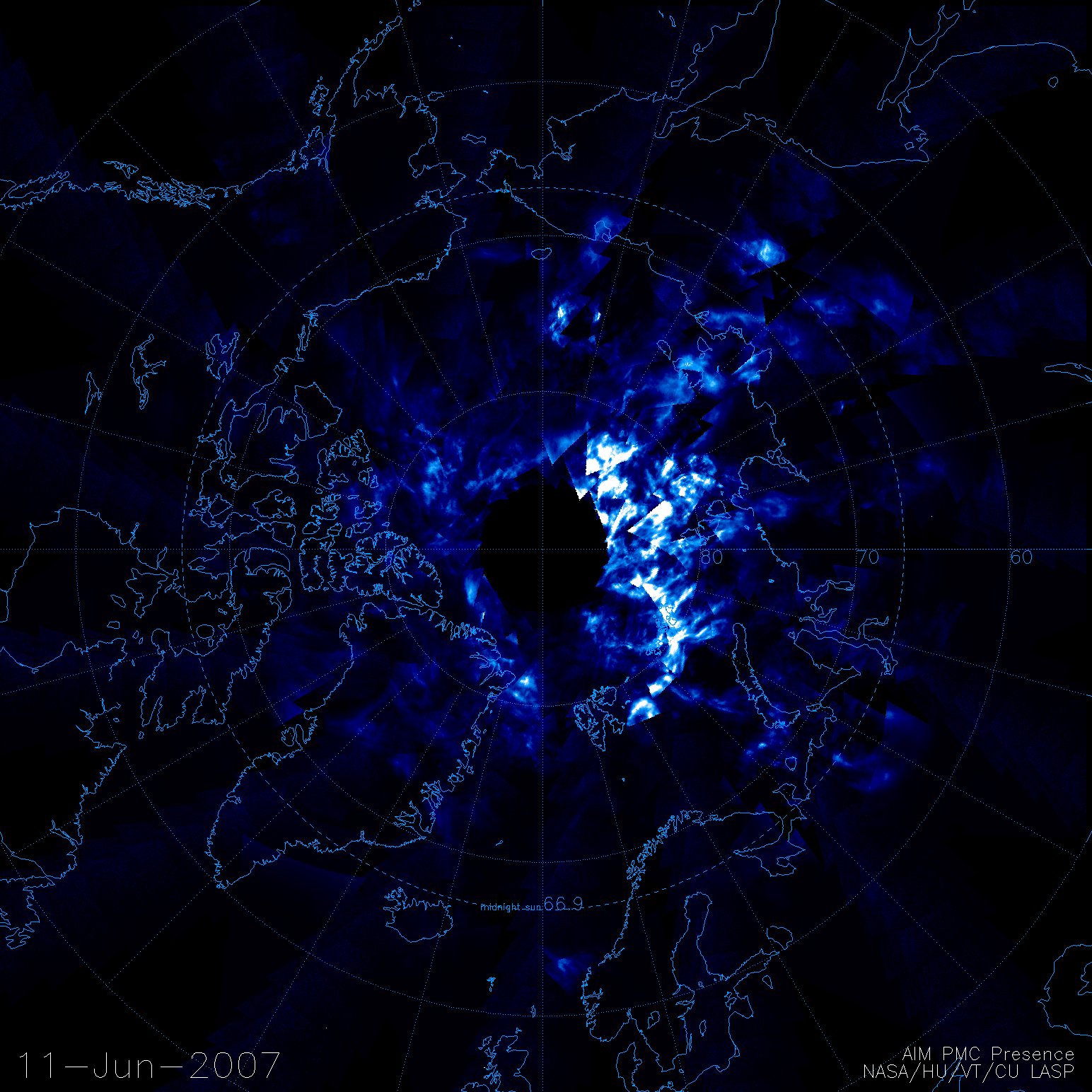
Noctilucent clouds can be studied from the ground, from space, and in situ by sounding rockets; they are too high to be reached by weather balloons. Noctilucent clouds were first detected from space by an instrument on the OGO-6 [2] satellite in 1972. More recently they have been extensively studied by the Swedish satellite Odin [3] launched in 2001. The AIM satellite mission, launched in 2007, is dedicated to research into noctilucent clouds.
On 2006-08-28, scientists with the Mars Express mission announced that they found clouds of carbon dioxide similar to noctilucent clouds over Mars that extended up to 100 km above the surface of the planet. [4]
[edit] See also

[edit] References
- ^ Thomas, GE; Olivero J (2001). "Noctilucent clouds as possible indicators of global change in the mesosphere". Advances in Space Research 28: 939–946.
- ^ Potential Environmental Impact of a Hydrogen Economy on the Stratosphere - Tromp et al. 300 (5626): 1740 - Science
[edit] External links


- NLCs & mesosphere, Images
- NLC time-lapse movies
- AIM satellite mission
- Composite polar view of Noctilucent clouds via AIM Satellite
- BBC News Article on satellite mission
- Noctilucent Cloud Observers' Homepage
- Solar Occultation for Ice Experiment (SOFIE)
- Southern Noctilucent Clouds observed at Punta Arenas, Chile
- Link Between Noctilucent Clounds and the Space Shuttle, US Navy
- Astronomy Picture of the Day: Noctilucent Clouds Over Sweden
- More pictures
- BBC Article-Spacecraft chases highest clouds
|
|||||||||||||||||