Native American mascot controversy
From Wikipedia, the free encyclopedia


The use of Native American mascots in sports has become a contentious issue in the United States and Canada. Americans have had a long history of "playing Indian" that dates back to the 1700s.[1] Many individuals admire the heroism and romanticism evoked by the classic Native American image, but many too view the use of mascots as both offensive and demeaning.
Despite the concerns that have been raised, many Native American mascots are still used in American sports from the elementary to the professional level.
[edit] History
During the 1960s, the National Congress of American Indians created a campaign to eliminate negative stereotyping of Indian people in the media. They focused mainly on cartoons and movies; however their protests of sports organizations garnered the most attention.[2] The National Congress of American Indians has long been opposed to mascots that portray Indians in a negative light. They feel that teams with mascots such as the Braves and the Redskins perpetuate negative stereotypes of Indian people, and demean their native traditions and rituals.[3] Proponents of Native American mascots, however, believe that Native American mascots pay homage to these people and promote a better understanding of their cultures.[2] Despite this issue emanating during the civil rights movement, it still continues today as many teams continues to possess mascots with controversial names and images.[2]
[edit] Varying degrees of offensiveness?

To further complicate this issue, many feel that there are varying levels of offensiveness with team names and mascots. Anil Adyanthaya from the Boston Globe writes on June 5, 2005, "The use of Aztec or Seminole as a nickname by itself would not appear to be racist, as such names refer to a particular civilization rather than an entire race of people. In this way, they are no different from other school nicknames such as Trojans and Spartans (like Aztecs, ancient peoples) or Fighting Irish and Flying Dutchmen (like Seminoles, nationalities). Similarly, Warriors and Braves are no different from the fighting men of other cultures, like Vikings, Minutemen, or Musketeers (all current NCAA mascots, the first of which is also an NFL mascot) so it seems hard to argue that their use is uniquely demeaning in some way."[4]
According to polling results published in Sports Illustrated in February 2002, "Although most Native American activists and tribal leaders consider Indian team names and mascots offensive, neither Native Americans in general nor a cross section of U.S. sports fans agree."[5]. According to the article, "There is a near total disconnect between Indian activists and the Native American population on this issue."[5]
However, despite this varying degree of degradation, the National Collegiate Athletic Association (NCAA), the ruling authority on college athletics, distributed a “self evaluation” in June of 2005, for teams to examine the use of potentially offensive imagery with their mascot choice.[4]
Some college teams, however, are changing their names and mascots without instruction of the NCAA. For example, Marquette University changed their team name from the Warriors to the Golden Eagles in 1994. The school’s president stated “we live in a different era than when the Warriors nickname was selected in 1954. The perspective of time has shown us that our actions, intended or not, can offend others. We must not knowingly act in a way that others will believe, based on their experience, to be an attack on their dignity as fellow human beings.” Stonehill College also changed their mascot from the Chieftain to the Skyhawk “out of respect to Native American culture.”[4]
Additionally, teams that are not directly affected by this controversy have issued their opinions. The University of Wisconsin and the University of Iowa have both refused to schedule non-conference games against schools with Native American mascots.[4] Ironically, the University of Iowa's own nickname, "Hawkeyes", has Native American origins (Iowa is the "Hawkeye State"), although the team uses a hawk as its symbol rather than an Indian.
The University of Oregon, following suit by the Oregonian newspaper, declined to refer to the University of Illinois team as the "Illini" in a basketball game in 2005. Illinois won the game 79-61.
[edit] Argument supporting the use of Native American mascots

Some individuals (typically non-Native Americans)[original research?] who support the use of Native American mascots state that they are meant to be respectful, and to pay homage to Native American people. The argument is made that Native American mascots focus on bravery, courage and fighting skills rather than anything derogatory. Karl Swanson, vice-president of the Washington Redskins professional football team, declared in the magazine Sports Illustrated that his team's name "symbolizes courage, dignity, and leadership," and that the "Redskins symbolize the greatness and strength of a grand people."[6]
Others claim Native American mascots help promote the culture to those who might be unaware of its significance. Chief Illiniwek, the mascot for the University of Illinois, has been another figure who has come under scrutiny. However, in 1990 the Board of Trustees of the University of Illinois called the mascot a “dignified” symbol: “His ceremonial dance is done with grace and beauty. The Chief keeps the memory of the people of a great Native American tribe alive for thousands of Illinoisans who otherwise would know little or nothing of them.”[2] However, the tribal dance and costume was not of the Illini confederacy, but that of the Lakota tribe.[citation needed]
Steven Denson, director of diversity for Southern Methodist University and member of the Chickasaw nation, while not issuing a blanket endorsement, has nevertheless stated that there are acceptable ways to use Native American mascots if it is done in a respectful and tasteful manner. He states, “I believe it is acceptable if used in a way that fosters understanding and increased positive awareness of the Native-American culture. And it must also be done with the support of the Native-American community. There is a way to achieve a partnership that works together to achieve mutually beneficial goals.”[7]
[edit] Argument opposing the use of Native American mascots
Opponents of Native American mascots feel that the mascots breed insensitivity and misunderstanding about native people. Opponents also highlight the seeming double standard for racial mascots where there are no mascots based on African Americans, Mexican Americans, or Asian Americans depicted in sports.[8] The University of Notre Dame’s “Fighting Irish."[9] and the University of Louisiana Lafayette's "Ragin' Cajuns" are notable exceptions to the debate, as those schools selected symbols that represent themselves historically.
A big issue in the Native American mascot debate is the use of Indian mascots by elementary, middle and high school sports teams. Opponents of Native American mascots feel that children should be exposed to realistic and positive portrayals of American Indians during their educational years. Kathy Morning Star, director of the American Indian Cultural Support, states that "It is the responsibility of educators to set the example and teach the youth of today to respect other ethnic or minority peoples - NOT to exploit or disrespect them by using them as 'mascots' or stereotypical 'images' which perpetuates racism."[8]
Many opponents also take offense to proponents of Native American mascots that claim they are simply paying tribute to native people. Considering many Native Americans’ stance on this issue, opponents of Native American mascots feel that the mascots should be deemed offensive by the people being imitated, not by those who are imitating. Barbara Munson of the Oneida nation states "When someone says you are hurting them by your action, if you persist - then the harm becomes intentional."[8]
Opponents also deem it insensitive when unconscious phrases like “Kill the Indians” or “Murder the Redskins” are yelled during sporting events (the latter of which is particularly yelled by Cowboys, Eagles, and Giants fans, due to long-standing NFL rivalries), referring to the team playing, but also creating a negative view of Native Americans.[8]
[edit] Florida State Seminoles

The debate over the mascot and symbol of Florida State University's Florida State Seminoles athletic teams is an interesting case study because of the university's close ties to the Seminole Tribe of Florida.
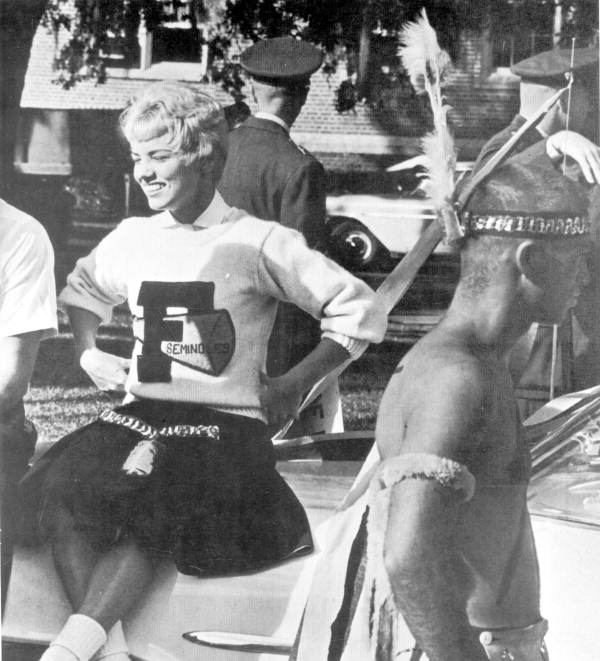
The university's first mascots were Sammy Seminolephoto (1958-1972) and Chief Fullabull.[1][2] Both were portrayed by white undergraduate students who dressed in faux American Indian garb,[3] and the latter mascot would engage in antics such as stabbing a fake pig representing the mascot of an opposing team on the basketball court.[4]
After leaders of the Seminole Tribe of Florida learned of these mascots, they attended a basketball game on the campus in 1972 and subsequently expressed their concern to the university regarding the Chief Fullabull mascot.[5] Both mascots were retired that year,[6] and were replaced in 1978 with Chief Osceola and Renegade, with a white student this time portraying the 19th century Seminole war chief Osceola, Renegade being his appaloosa horse.
In August of 2005, the NCAA granted Florida State University a waiver, which removed FSU from the NCAA’s list of colleges whose sports teams, it said, used “hostile or abusive” imagery towards Native Americans. According to Bernard Franklin, senior vice president of the NCAA, "The staff review committee noted the unique relationship between the university and the Seminole Tribe of Florida as a significant factor. The decision of a namesake sovereign tribe, regarding when and how its name and imagery can be used, must be respected even when others may not agree."[10]
The Seminole Tribe of Florida officially sanctions the use of the Seminole as Florida State University’s nickname and of Chief Osceola as FSU's mascot. Max Osceola, the chief and general council president of the Seminole Tribe of Florida, feels that it is an “honor” to be associated with the university.[10]
Some members of the Seminole Tribe of Oklahoma, among them the activist Michael Haney,[11] opposed FSU's use of the Seminoles mascot and name. In addition, general council member of the Seminole nation of Oklahoma David Narcomey stated, speaking on his own behalf, "I am deeply appalled, incredulously disappointed ... I am nauseated that the NCAA is allowing this 'minstrel show' to carry on this form of racism in the 21st century." In 2005, Jennifer McBee, the Oklahoma Seminole tribe's attorney general, stated that the council had taken no official position on the FSU issue.[10] Despite the individual comments of some members of the Oklahoma Seminoles, Ken Chambers, principal chief of the Seminole Nation of Oklahoma told The Palm Beach (Florida) Post in August 2005 that he had no objection to Florida State University using the Seminoles as a nickname and symbol, reversing the earlier public position of the Oklahoma tribe's spokesperson.[12] In July 2005, the Seminole Nation General Council, the legislative body for the Seminole Nation of Oklahoma, voted 18-2 to not oppose the use of Native American names and mascots by college sports teams.
[edit] Other
Other Indian tribes have also supported the use of their tribal names as a tribute to their heritage. The Ute tribe approved the use of the name "Utes" for the University of Utah and the NCAA granted a waiver to allow the name to remain.
The Sioux tribe, however, refused to approve the use of the name "Fighting Sioux" in the name of the University of North Dakota. UND has appealed several times to the NCAA and is currently under a championship host ban for not removing the moniker.
The University of Illinois at Urbana-Champaign, however, is permitted to use the name "Illini" owing to the NCAA ruling that the name "is closely related to the name of the state and not directly associated with Native Americans."[13] The mascot Chief Illiniwek was ruled "hostile and abusive" and was retired in 2006 to comply with the NCAA's ruling.
[edit] Financial impact of change
Many supporters of Native American mascots feel that the financial cost of changing mascots would far outweigh the benefits. Sales of merchandise with team mascots and nicknames ranging from t-shirts to beer coozies generate millions of dollars in sales each year, and teams contend that a change in team mascots would render this merchandise useless.[6]
Opponents, however, are unconcerned with the cost of changing and view mascots as caricatures of real Indians that do not honor them, but rather trivialize and demean important Indian dances and traditions. Opponents feel that despite the cost of a change in team mascots, it should be done to prevent what they believe is racial stereotyping. Clyde Bellecourt, the director of the American Indian Movement, stated "It's the behavior that accompanies all of this that's offensive. The rubber tomahawks, the chicken feather headdresses, people wearing war paint and making these ridiculous war whoops with a tomahawk in one hand and a beer in the other-all of these have significant meaning for us. And the psychological impact it has, especially on our youth, is devastating."[6]
[edit] Current status
The Native American mascot issue remains fiercely contested because of the many Native American mascots still currently used in sports. According to the American Indian Cultural Support, as of 2006, at least 2,498 kindergarten, elementary, middle and high schools use Native American Indian mascots throughout the country.[8]
Though change has been made on the public school and college level, the professional arena has seen virtually none and still utilizes mascots such as the Chicago Blackhawks, Washington Redskins, Cleveland Indians, Atlanta Braves, Kansas City Chiefs, and many others.[8] During the 2007 post-season, for example, Chief Wahoo was very visible, including being displayed in the stats line on the bottom of network television screens for both TBS and Fox Sports.
[edit] Bibliography
- King, C. Richard, and Charles Fruehling Springwood (2001). Beyond the Cheers: Race as Spectacle in College Sport. SUNY Series on Sport, Culture, and Social Relations. State University of New York Press. ISBN 0791450058.
- King, C. Richard, and Charles Fruehling Springwood, eds. (2001). Team Spirits: The Native American Mascots Controversy. Foreword by Vine Deloria Jr. Lincoln: University of Nebraska Press.
- Spindel, Carol (2002). Dancing at Halftime: Sports and the Controversy Over American Indian Mascots. Updated edition, with a new afterword. New York: New York University Press.
[edit] Films
- In Whose Honor? (1997). Written and produced by Jay Rosenstein. Ho-Ho-Kus, New Jersey: New Day Films.
[edit] See also
- Charlene Teters
- Chief Illiniwek
- Chief Wahoo
- List of sports team names and mascots derived from Indigenous peoples
- List of ethnic sports team and mascot names (all ethnicities)
- Mascot
- National Congress of American Indians
- Seminole
- Vernon Bellecourt
[edit] References
- ^ First Peoples, Colin G. Calloway, 2nd Edition, 2004
- ^ a b c d Fight Hate and Promote Tolerance http://www.tolerance.org/news/article_tol.jsp?id=165 www.tolerance.org
- ^ National Congress of American Indians http://www.ncai.org/ncai/resource/documents/governance/ncainews4.2.99.htm National Congress of American Indians Applauds "Redskins" Trademark Cancellation
- ^ a b c d Boston Globe http://www.boston.com/news/globe/editorial_opinion/oped/articles/2005/06/05/sports_mascots_and_native_americans/ Sports, mascots, and Native Americans
- ^ a b S.L. Price & Andrea Woo, "The Indian Wars", Sports Illustrated, March 4, 2002, pp 66-71
- ^ a b c New Jersey State Bar Foundation http://www.njsbf.org/njsbf/student/respect/winter03-1.cfm Native American Mascots: Racial Slur or Cherished Tradition?
- ^ Red Orbit http://www.redorbit.com/news/science/153383/nativeamerican_nicknamesmascots/index.html Native-American Nicknames/Mascots
- ^ a b c d e f American Indian Cultural Support http://www.aics.org/mascot/mascot.html MASCOTS - Racism in Schools by State
- ^ University of Notre Dame http://und.cstv.com/trads/nd-m-fb-mas.html NOTRE DAME FIGHTING IRISH - Traditions
- ^ a b c USA Today http://www.usatoday.com/sports/college/2005-08-23-fsu-mascot-approved_x.htm NCAA allowing Florida State to use its Seminole mascot
- ^ Tim Giago: The Powerful Medicine of Michael Haney - Living on The Huffington Post
- ^ http://www.usatoday.com/sports/college/2005-08-11-fsu-mascot-support_x.htm Oklahoma Seminoles OK Name
- ^ [http://www.ncaa.org/wps/portal/legacysiteviewer?CONTENT_URL=http://www2.ncaa.org/portal/media_and_events/press_room/2005/november/20051111_illinois_mascot_stmnt.html Statement by NCAA Senior Vice-President] (retrieved 19 April 2008)
[edit] External links

Organizations
Articles
Parody