Mormon folklore
From Wikipedia, the free encyclopedia
Mormon folklore is a body of expressive culture unique to The Church of Jesus Christ of Latter-day Saints (LDS Church) and its members. It includes tales, oral history, popular beliefs, customs, music, jokes, and other traditions.
The purpose of folklore is to promote values and experiences that apply to a culture at large, not just a specific family or small group. Folk history, says folklore specialist William A. Wilson, is "generated by the folk ... constantly re-created ... in response to their current needs and concerns, reflective of what is most important to them" ("Mormon Americana," 440). Relevant values within the Mormon culture can include personal sacrifice, gratitude, missionary work and courage as well as tales that support religious principles and beliefs.
Wilson said Mormon folktales often affirm the group’s beliefs that people doing the Lord's work may receive divine protection. "It's a rhetorical strategy designed to persuade the audience to accept a certain point of view or to follow a certain course of action," [1]
Contents |
[edit] Folklore vs. doctrine
In the LDS Church, folklore is usually distinguished from church doctrine, but there is no universal method of determining where doctrine ends and folklore begins. Most Latter-day Saints consider material in the scriptures of the church and joint statements of the First Presidency and Quorum of the Twelve Apostles to constitute church doctrine and policy.[1] Any other part of the expressive cultural aspects of Mormonism may be legitimately classified as Mormon folklore.[2][3]
[edit] Examples of Mormon folklore
Folklore, including Mormon folklore, is dynamic rather that static, changing emphasis and details over time. Latter-day Saints pass on the group's cultural heritage from person to person and from generation to generation. These elements of heritage may not only be passed through written documents or formal instruction but may be found in stories and customs in both family and church settings. Tales learned at home or in a church function may later be repeated to others. Stories learned at home, in the LDS Family Home Evening or other family gatherings, may later emerge in family activities in the next generation.
In general, Mormon folklore may be presented in three broad categories:
- The spoken and written word: including songs, family stories, humorous tales, and contemporary accounts from missionaries and church leaders.
- Handicrafts and memorial items: including traditional tools and implements, holiday traditions, family keepsakes and scrapbooks, and a family Book of Remembrance kept in association with genealogical records.
- Unique Mormon activities: including Family Home Evening, youth dating practices, family celebrations of birth and baptismal dates, genealogical activities, and church and community celebrations of holidays such as Pioneer Day.
[edit] Tales and popular beliefs
The following are examples of tales and popular concepts from Mormon folklore:
- that Cain, the killer of Abel, is alive and wanders the earth, wearing no clothing but being covered by hair and that apostle David W. Patten encountered him once.[4][5]
- modern encounters and assistance from one or more of "The Three Nephites", three Nephite disciples chosen by Jesus in the Book of Mormon, who were blessed by Jesus to "never taste of death; but ye shall live to behold all the doings of the Father unto the children of men..."[6]
- that on December 7, 1941, Japanese aircraft pilots attempted to bomb or strafe the church's Laie Hawaii Temple just prior to or just after the attack on Pearl Harbor, but were prevented from doing so by mechanical failures or an unseen protective force,[7] and that the Japanese pilot who attempted to bomb or strafe the Laie Hawaii Temple was converted to the LDS Church after he saw a picture of the temple in the possession of Mormon missionaries in Japan;[7]
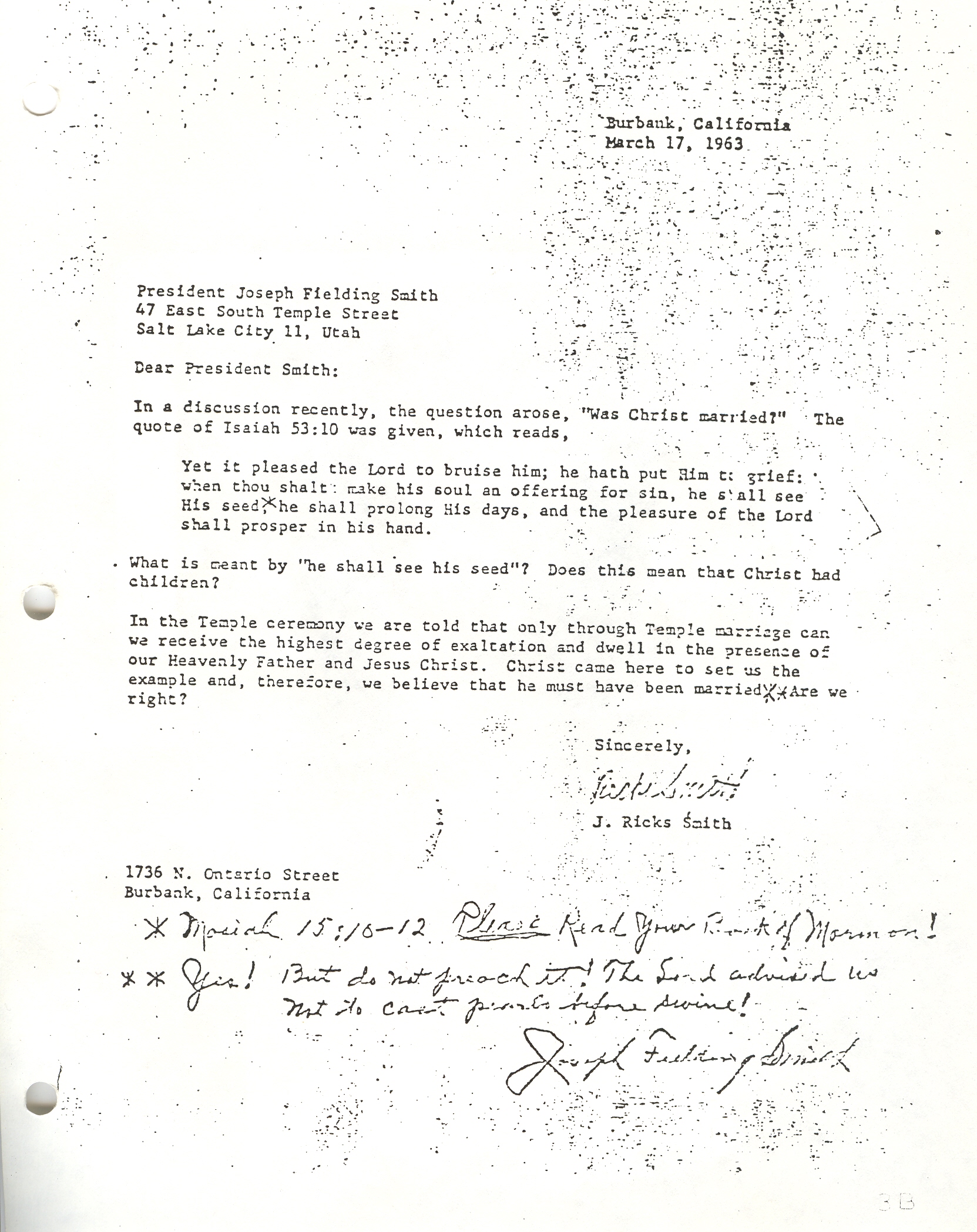
- that Jesus was married, possibly to Mary Magdalene, Mary, sister of Lazarus, or Martha, and that Jesus may have been a polygamist and had children;[8][9][10][11][12]
- the miracle of the gulls, in which the crops of early Mormon settlers in Utah Territory were saved from destruction by a vast flock of seagulls that ate swarms of Mormon crickets that were devouring the crops;[13][14][15]
- that in designing the Salt Lake Temple, Brigham Young had the foresight to make space accommodation for future technological advancements such as elevators, air conditioning, and electrical wiring;[16][17]
- that Māori prophets or chieftains, including Paora Te Potangaroa and Tāwhiao, predicted the coming of Mormon missionaries to New Zealand;[18][19][20]
- that Tāwhiao accurately predicted the site of the 1958 Hamilton New Zealand Temple before his death in 1894;[21]
- that a flash of lightning or other divine manifestation protected the body of Joseph Smith, Jr. from being mutilated by a mob after he had been killed at Carthage Jail;[22]
- that those who persecuted the early Latter Day Saints and killed Joseph Smith, Jr. suffered physically and mentally later in their lives, with some meeting gruesome or particularly painful deaths;[23]
- that in 1739 a Roman Catholic monk predicted that within 100 years an angel would be sent by God to restore the lost gospel to the earth and that the true church would be established in "a valley that lies towards a great lake";[24][25]
- that today's youth were "generals" in the War in Heaven and that when they return to heaven they will be revered;[26]
- that when speaking to the Latter Day Saints after the death of Joseph Smith, Jr., Brigham Young took on the appearance, voice, and mannerisms of Smith and that this was a sign from God that Young was to be Smith's successor;[27][28]
- that the writings of the early Church Fathers conform better with Mormonism than with modern Christianity;[29]
- that the global flood of Noah constituted the baptism of the Earth;[30]
- that Orson Hyde, an early apostle of the church, was of Jewish ancestry and that for this reason it was he in 1841 that dedicated Palestine for the return of the Jews.[31]
[edit] Predictions
The following are examples of predictions or prophecies that are part of Mormon folklore:
- that the church will one day reinstitute the practice of plural marriage;[32]
- that the day will come that the United States Constitution will "hang by a thread" and that members of the church will be central in rescuing it and the United States from destruction.[33][34][35][36][37]
[edit] Research into Mormon folklore
Alta and Austin Fife [2] are generally recognized as the founders of research into Mormon folklore, a discipline that has expanded greatly since the couple’s initial work in the 1930s. Although previous and contemporary scholars had briefly addressed the issue, the Fifes expanded the field, both through their collection [3], now known as the Fife Folklore Archive held at Utah State University in Logan, Utah. Their ground-breaking book on Mormon folklore, “Saints of Sage and Saddle”, was published in 1956 .
[edit] Notes
- ^ However, some Latter-day Saints have a more expansive conception of doctrine. For example, many believe that any statement made by the President of the Church constitutes doctrine. Others may extend this belief to statements made by an apostle or other general authority in a general conference of the church.
- ^ William A. Wilson, "Folklore", Encyclopedia of Mormonism (New York: Macmillan) 2:518–520.
- ^ The designation "folklore" does not imply that the tale or belief is necessarily "untrue".
- ^ Lycurgus A. Wilson (1993 reprint, 1900). The Life of David W. Patten, The First Apostolic Martyr (Salt Lake City, Utah: Eborn Books) pp. 46–47.
- ^ Spencer W. Kimball (1993, 3d ed.). The Miracle of Forgiveness (Salt Lake City, Utah: Bookcraft) ISBN 0884944441, pp. 127–128.
- ^ 3 Nephi 28:7
- ^ a b Kenneth W. Baldridge and Lance D. Chase, "The Purported December 7, 1941, Attack on the Hawai'i Temple", in Grant Underwood (ed.) (2000). Voyages of Faith: Explorations in Mormon Pacific History (Provo, Utah: Brigham Young University Press) ISBN 0842524800, pp. 165–190.
- ^ Hyde 1854, p. 81–82, 210
- ^ Hyde 1858, p. 259-260
- ^ Orson Pratt, The Seer 1:159.
- ^ Wilford Woodruff, Journal Entry 1883-07-22, reporting on a sermon given by Joseph F. Smith.
- ^ Joseph Fielding Smith, Handwritten note responding to letter from J. Ricks Smith, 1963.
- ^ Pratt 1880, p. 276-277
- ^ Smith 1869, p. 83
- ^ William G. Hartley, "Mormons, Crickets, and Gulls, A New Look at an Old Story", in D. Michael Quinn (ed.) (1992). The New Mormon History (Salt Lake City, Utah: Signature Books).
- ^ Paul C. Richards, "The Salt Lake Temple Infrastructure: Studying It Out in Their Minds", BYU Studies (1996–1997).
- ^ BYU NewsNet 100 Hour Board: Submission 10093, 2004-11-12.
- ^ Matthew Cowley, ""Maori Chief Predicts Coming of L.D.S. Missionaries", Improvement Era 53:696–698, 754–756 (Sep. 1950), reprinted in Matthew Cowley (1954, Glen L. Rudd ed.). Matthew Cowley Speaks: Discourses of Elder Matthew Cowley of the Quorum of the Twelve Apostles of the Church of Jesus Christ of Latter-day Saints (Salt Lake City, Utah: Deseret Book) p. 200–205.
- ^ Grant Underwood, "Mormonism and the Shaping of Maori Religious Identity", in Grant Underwood (ed.) (2000). Voyages of Faith: Explorations in Mormon Pacific History (Provo, Utah: Brigham Young University) pp. 107–126.
- ^ R. Lanier Britsch, “Maori Traditions and the Mormon Church,” New Era, June 1981, 38.
- ^ LDS Church (1958). The Mormon Temple (Hamilton, NZ: LDS Church), p. 13.
- ^ N.B. Lundwall (ed.) (1952). The Fate of the Persecutors of the Prophet Joseph Smith (Salt Lake City, Utah: Bookcraft) pp. 226–233.
- ^ N.B. Lundwall (ed.) (1952). The Fate of the Persecutors of the Prophet Joseph Smith (Salt Lake City, Utah: Bookcraft) pp. 292–352.
- ^ Jacob Spori, "True and False Theosophy", Juvenile Instructor, 28:672–674 (1893-11-01).
- ^ Paul B. Pixton, "'Play It Again, Sam': The Remarkable 'Prophesy' of Samuel Lutz, Alias Christophilus Gratianus, Reconsidered", BYU Studies, 25:3 (1985) pp 27–46.
- ^ "Pres. Packer refutes quote", LDS Church News, 2001-04-28.
- ^ Hyde 1877, p. 58
- ^ Lynne Watkins Jorgensen, "The Mantle of the Prophet Joseph Passes to Brother Brigham: One Hundred Twenty-one Testimonies of a Collective Spiritual Witness", in John B. Welch (ed.) (2005). Opening the Heavens: Accounts of Divine Manifestations, 1820–1844 (Provo and Salt Lake City, Utah: BYU Press and Deseret Book) ISBN 0842526072 pp. 373–480.
- ^ Michael T. Griffith (1996). One Lord, One Faith: Writings of the Early Christian Fathers as Evidences of the Restoration (Bountiful, Utah: Horizon) ISBN 0882905759
- ^ Pratt 1880, p. 323
- ^ Hyde did dedicate Palestine for the return of the Jews, but "careful investigation has uncovered no evidence" of Hyde's reported Jewish ancestry: Lynn M. Hilton and Hope A. Hilton, "Orson Hyde", in Allan Kent Powell (ed., 1994). Utah History Encyclopedia (Salt Lake City: University of Utah Press).
- ^ Bruce R. McConkie (1966, 2d ed.). Mormon Doctrine. (Salt Lake CIty, Utah: Bookcraft) p. 578.
- ^ Young 1854, p. 15
- ^ Kimball 1856, p. 216
- ^ Harold B. Lee, Conference Report, April 1942, p. 87.
- ^ Joseph Fielding Smith, Conference Report, April 1950, p. 159.
- ^ Ezra Taft Benson, Conference Report, April 1963, p. 113.
[edit] References
- Allred, David A. Representing Culture: Reflexivity and Mormon Folklore Scholarship. Thesis. Brigham Young University, March 2000.
- Fife, Austin and Alta (1956). Saints of Sage and Saddle: Folklore Among the Mormons (Bloomington, Ind.)
- William A. Wilson (2006). The Marrow of Human Experience: Essays on Folklore (Salt Lake City, Utah: University of Utah Press) ISBN 0874216532
- Wilson, William A. "Folklore, a Mirror for What? Reflections of a Mormon Folklorist." Western Folklore. Vol. 54. January 1995, 13-21.
- Wilson, William A. "Mormon Folklore. Mormon Americana: A Guide to Sources and Collections in the US." BYU Studies. Mormon American. 1995, 437-454.
- ——, "The Study of Mormon Folklore: An Uncertain Mirror for Truth," Dialogue: A Journal of Mormon Thought 22:4 (Winter 1989) pp. 95–110
- Hyde, Orson (October 6, 1854), “The Marriage Relations”, in Watt, G.D., Journal of Discourses Delivered by President Brigham Young, His Two Counsellors, and the Twelve Apostles, and Others, vol. 2, Liverpool: F. D. Richards, pp. 75-87.
- Hyde, Orson (1857), “Man the Head of Woman—Kingdom of God—The Seed of Christ—Polygamy—Society in Utah”, in Watt, G.D., Journal of Discourses Delivered by President Brigham Young, His Two Counsellors, and the Twelve Apostles, and Others, vol. 4, Liverpool: S. W. Richards, pp. 257-263.
- Hyde, Orson (April 5, 1877), “Prayer the Medium for Blessing—Practical Morality Establishes Confidence—The Prophet Joseph Manifest in Brigham—Age Prevents Effort, but when Behind the Vail, Freedom from Obstruction is our Opportunity”, Journal of Discourses Delivered by President Brigham Young, His Two Counsellors, and the Twelve Apostles, and Others, vol. 19, Liverpool: William Budge, pp. 57-60.
- Kimball, Heber C. (September 6, 1856), “Union of the Priesthood—Salvation of the American Nation—Punishment of the Saints’ Enemies, etc.”, Journal of Discourses, Delivered by President Brigham Young, His Two Counsellors, The Twelve Apostles, and Others, vol. 5, Liverpool: Asa Calkin, pp. 213-220.
- Pratt, Orson (June 20, 1880), “The Gathering of the Saints—Their Sufferings—Ancient Predictions Fulfilled—Crickets and Their Miraculous Destruction—Crops Saved—Desert Made Fruitful—God’s Kingdom in the Mountains—Its Future Destiny—The Coming of the Lord”, Journal of Discourses By President John Taylor, His Counselors, The Twelve Apostles and Others, vol. 21, Liverpool: Albert Carrington, pp. 272-280.
- Pratt, Orson (August 1, 1880), “Introductory Remarks—Heaven and Earth to Pass Away—Not Annihilated—Heaven and Earth not Created from Nothing—Materials—Eternal Materials Under the Dominion of Laws—Central and Orbital Forces—Compound and Elementary Substances—Earth in the Beginning—No Mortality, then Known, on This Creation—The Fall—The Earth’s Baptism in Water—Its Baptism in Fire—Its Baptism by the Spirit..Its Justification—Its Sanctification—Its Purification—Its Thousand Years’ Rest, etc.”, Journal of Discourses By President John Taylor, His Counselors and Others, vol. 21, Liverpool: Albert Carrington, pp. 319-331.
- Smith, George A. (June 20, 1869), “Historical Discourse by President George A. Smith”, Journal of Discourses Volume 13 by President Brigham young, His Two Counsellors, and the Twelve Apostles, vol. 13, Isleton, London: Horace S. Eldredge, pp. 77-87.
- Young, Brigham (July 4, 1854), “Celebration of the Fourth of July”, Journal of Discourses Volume 7, Delivered by President Brigham Young, His Two Counsellors, The Twelve Apostles, and Others, vol. 7, Liverpool: Amasa Lyman, pp. 9-15.