Talk:Mallard
From Wikipedia, the free encyclopedia


Contents |
[edit] Breeding Description
Shouldn't the section on breeding habits have a little more detail about the "normal" breeding habits of mallards? Neutrality would seem to require that all of the more interesting and usual stuff be placed in some sort of perspective.
What's with this sex description? It belongs in some topic like animal sexuality and not in an encyclopedic description of a bird. It's one thing to have a short sentence on it's unusual sex habits but entirely another to explicitly and repeatedly describe them. It's definitely out of balance and not a neutral point of view. TimWhitehouse 05:36, 14 December 2005 (UTC)
- I've tried to make this section more balanced and anthropomorphic. "Rape" is inappropriate for an animal that is simply responding to instinct. If the person who is so keen on this bit is unhappy, perhaps the suggestion of moving it to a topic such as suggested above is appropriate.
- jimfbleak 16:39, 14 December 2005 (UTC)
- Rather than delete sections like this, we normally move them to the talk page until someone can make use of them.
- Section moved from main article
- Mallards are among the very few animals that practice forcible rape. When they pair off with mating partners, often one or several drakes will end up "left out". This group will sometimes target an isolated female duck — pestering and pecking at her until she weakens (a phenomenon referred to by researchers as attempted rape flight), at which point each male will take turns raping the female.
- As of 2005, a Dutch researcher, Kees Moeliker, has won an Ig Nobel prize for his paper on ‘homosexual necrophilia in the Mallard Anas platyrhynchos’. "Rape is a normal reproductive strategy in Mallards," explains Mr Moeliker. He recounts in his paper that he heard the bang of a duck hitting a window outside his office in the Natuurmuseum Rotterdam: "I went downstairs immediately to see if the window was damaged, and saw a drake mallard (Anas platyrhynchos) lying motionless on its belly in the sand, two metres outside the facade. The unfortunate duck apparently had hit the building in full flight at a height of about three metres from the ground. Next to the obviously dead duck, another male Mallard (in full adult plumage without any visible traces of moult) was present. He forcibly picked into the back, the base of the bill and mostly into the back of the head of the dead Mallard for about two minutes, then mounted the corpse and started to copulate, with great force, almost continuously picking the side of the head."
- By the way, judging from the quotes, it looks like this story in the Guardian may have been the source for much of this information. -- Solipsist 18:20, 14 December 2005 (UTC)
- Ok there is now just one mention of the term "rape flight". If you can rape the land you can rape a duck. It's a pretty flexible word.--Gbleem 20:07, 14 December 2005 (UTC)
- I should say that the only google source I could find for "rape flight" was the Moeliker paper or items pointing to it. Is it a real term used by ornathologists? --Gbleem 20:19, 14 December 2005 (UTC)
- Much improved. By the way there is an article on Animal sexuality and a section on birds where perhaps the above cut out section could go if someone were inclined to do that. TimWhitehouse 00:33, 15 December 2005 (UTC).
[edit] Ducklings
We've recently got a large increase in the number of duckling pictures. However although the yellow one is cute, is it actually a Mallard? Again in the 59 day juvenile picture, there is one duck which doesn't look much like a Mallard (or is that what makes it a Dutch Mallard). I imagine they are all from the same brood, so could this one be a cross. -- Solipsist 12:04, 23 July 2005 (UTC)
[edit] Greenland Mallard
This form is not generally recognised as a separate species from the nominate race, either in Wildfowl or Handbook of the birds of the world. the only difference is size, which varies clinally. I propose changing the text to reflect this, but invite comments first. jimfbleak 16:27, 5 October 2005 (UTC)
Is there a sub-species that can be cited here? Wonko the Sane 19:57, 9 March 2007 (UTC)
[edit] Use as food
Should the fact that mallards are eaten as game be mentioned? 143.252.80.100 21:13, 8 November 2006 (UTC)
- Yes I would have thought so. Be bold, especially if you have a reference. However, we wouldn't want to imply that Mallards are a commonly eaten duck these days. In the UK at least, I think most duck meat sold in the shops is from domesticated Aylesbury ducks. -- Solipsist 21:37, 8 November 2006 (UTC)
- I agree with the above, but wild Mallard can sometimes be obtained from specialist game outlets, although Teal, a better sporting bird, is more common. jimfbleak 06:54, 9 November 2006 (UTC)
- Certainly you can buy wild mallard at Waitrose, a 453453allard.asp I've eaten them, although not from a supermarket. I'll add a bit in the article. 143.252.80.100 12:08, 9 November 2006 (UTC)
- No,this is about the bird,not duck huntin53453[User:70.165.71.229|70.165.71.229]] 23:22, 24 January 2007 (UTC)534534
- I agree with the above, but wild Mallard can sometimes be obtained from specialist game outlets, although Teal, a better sporting bird, is more common. jimfbleak 06:54, 9 November 2006 (UTC)
4534
[edit] Picture
5345 Can we have a main picture that has both a male and a female duck? Seems slightly "sexist" to have the male as the main picture.--Ķĩřβȳ♥♥♥Ťį534534Ø 06:39, 11 April 2007 (UTC)
- Yeah, I am sure the Duck's rights/feminist Duck associations will be up and arms about it - maybe they will even boycott Wikipedia!! :)) It is just a picture, who cares? Baristarim 23:51, 11 April 2007 (UTC)h75456436453434
[edit] Capitalisation?
Shouldn't "mallard" normally be in lower case, like moorhen, coot, etc.? Pol098 12:31, 14 November 2007 (UTC)
- It's an agreed convention on wikipedia that all bird species are fully capitalised. Groups of birds like moorhen, coot or kingfisher are lower case, but Common Moorhen, American Coot and Stork-billed Kingfisher are capitalised. Jimfbleak 17:41, 14 November 2007 (UTC)
[edit] "Genetic pollution"
Can we get a rewrite? The present text is very much a gut-level appeal that has little to do with science.
Like elsewhere worldwide the invasive alien mallard ducks are also causing severe “genetic pollution” of South Africa’s biodiversity by breeding with endemic ducks.
How exactly do you "pollute" a "gene" (read: genome)? Has natural selection suddenly ceased to function? Are Mallard and YBD specially created baramins? The notion of "genetic purity" is knee-jerk nonsense; in South Afrika in particular such unscientific shite is best left to the AWB...
The hybrids of mallard ducks and the Yellow-billed Duck are fertile and can produce more hybrid offspring.
Or the can have lower fitness and have less offspring on averade than purebreds of either species. In which case the issue will a) resolve itself (on a purely genetic level, but see below) and b) actually improve fitness of the YBD population by introducing new alleles that may be beneficial. The crucial point is: mallards hybridizing around has been happening for 100,000s of years and apparently never caused problems.
If this continues, only hybrids will occur
Do we have data? Because the YBD and the Mallard are (among Anas sensu stricto) only very distantly related. The most parsimonious assumption is that hybrids are less vigorous than purebreds of either species, and this assumption must be falsified before such claims can be accepted.
The case of A. superciliosa on New Zealand shows that even between Mallards and (one of?) their sister species - they were a single species just a million years ago! - hybrid vigor is reduced. It has been shown that hybrids between the Mallard and the American "mallardines" are more likely to die from disease than either parent species. But the NZ case shows also what really is the underlying problem: habitat destruction.
So the real culprit is not the fictional "pollution" of the gene pool but the very real pollution and destruction of wetlands.
and in the long term this will result in the extinction of various indigenous waterfowl worldwide like the yellow billed duck of South Africa.
Oh really? Clairvoyance is real now or what?!
In short, it has been shown for the Mexican Duck, the Mottled Duck, the NZ Anas superciliosa, and Meller's Duck that the supposed "Mallard problem" is simply mallards piggybacking on wholesale habitat alteration. Preserve enough habitat, and the supposed "genetic pollution" will simply go away. Dysmorodrepanis (talk) 15:02, 14 April 2008 (UTC)
[edit] High quality picture of male mallard
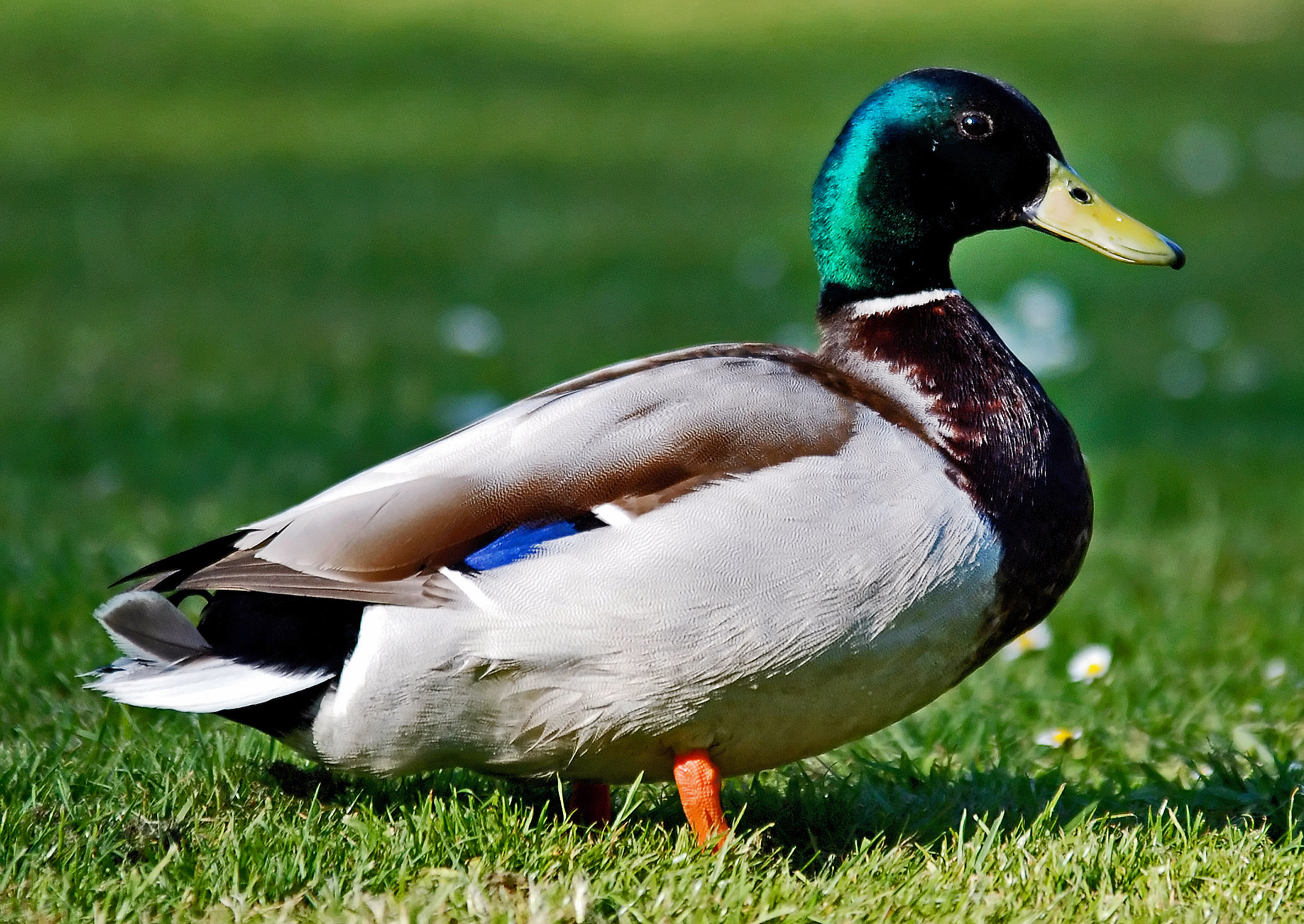
I have shoot a high quality picture of a male mallard, but since I don't know which picture to replace (if any) I'll leave it to you to include it in the article if appropiate.
Image: Mallard 080508.jpg
Link: http://upload.wikimedia.org/wikipedia/commons/7/7c/Mallard_080508.jpg —Preceding unsigned comment added by Soasta (talk • contribs) 16:01, 9 May 2008 (UTC)
[edit] Social behavior?
There are a lot of mallards on-campus where I go to school and I've noticed them group up in rather odd ways. Though many are seen roaming around solo, I notice groups of one male and one female, two males, two males and one female, three males and one female, but never two females together or anywhere near a balanced mix of males and females in large groups (though I rarely see more than four in a group at one time). If this is common mallard behavior (females not "socializing" with other females, quite unlike the males), it would be worth mentioning in this article, IMO. RobertM525 (talk) 04:30, 1 June 2008 (UTC)