Ma Rainey
From Wikipedia, the free encyclopedia
| Ma Rainey | |
|---|---|
 |
|
| Background information | |
| Birth name | Gertrude Malissa Nix Pridgett |
| Born | April 26, 1886 [1] Columbus, Georgia, USA |
| Died | December 22, 1939 (aged 53) Columbus, Georgia, USA |
| Genre(s) | Blues, jazz |
| Occupation(s) | Vocalist |
| Label(s) | Paramount |
| Associated acts | Rainey & Rainey, Assassinators of the Blues Rabbit Foot Minstrels |
Gertrude Malissa Nix Pridgett Rainey, better known as Ma Rainey (April 26, 1886[1] – December 22, 1939), was one of the earliest known American professional blues singers and one of the first generation of such singers to record.[2] She was billed as The Mother of the Blues. She did much to develop and popularize the form and was an important influence on younger blues women, such as Bessie Smith, and their careers.
Contents |
[edit] Career
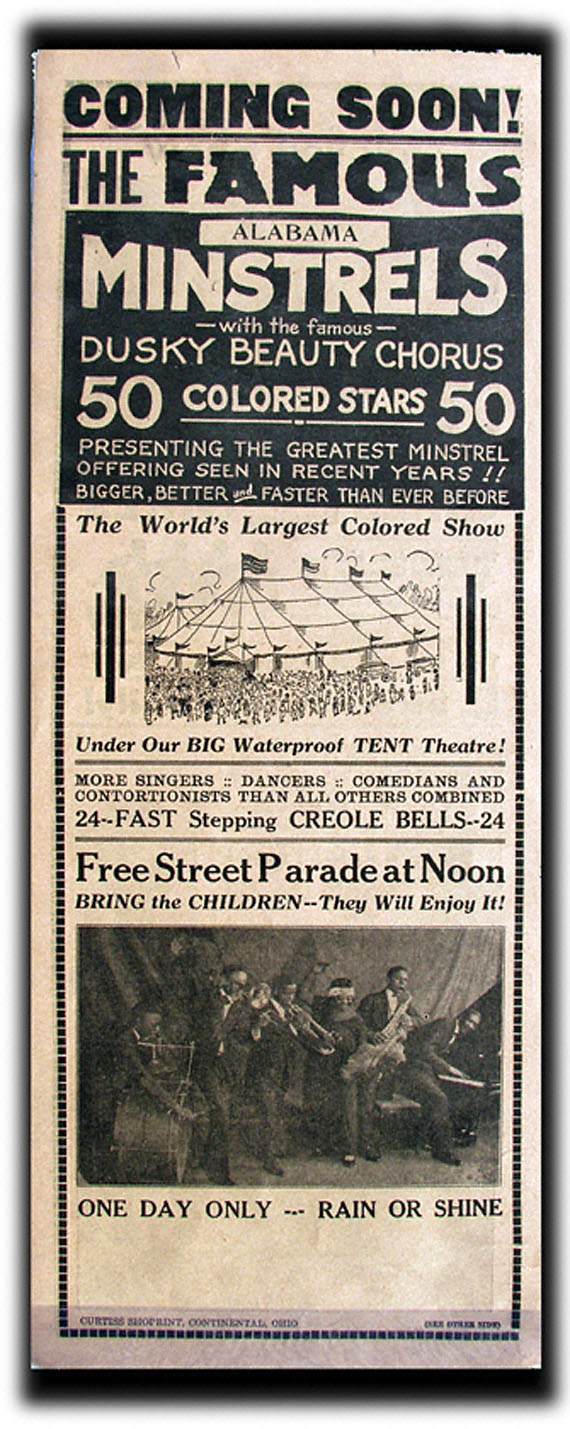
Rainey was born in Columbus, Georgia.[3] She first appeared on stage in Columbus in "A Bunch of Blackberries" at fourteen. She then joined a traveling vaudeville troupe, the Rabbit Foot Minstrels. After hearing a blues song at a theater in St. Louis, Missouri, sung by a local girl in 1902, she started performing in a blues style. She claimed at that time that she was the one who coined the name "blues" for the style that she specialized in.
In the one known interview she did, Rainey told the following story, In 1902 "a girl from town... came to the tent one morning and began to sing about the "man" who left her. The song was so strange and poignanat that it attracted much attention,and Rainey learned the song fron the visitor, and used it soon afterwards in her "act"." Audiences reacted strongly to the song.[4]
She married fellow vaudeville singer William "Pa" Rainey in 1904, billing herself from that point as "Ma" Rainey. The pair toured with the Rabbit Foot Minstrels as "Rainey & Rainey, Assassinators of the Blues", singing a mix of blues and popular songs. In 1912, she took the young Bessie Smith into the Rabbit Foot Minstrels, trained her, and worked with her until Smith left in 1915.
Also known, though less discussed, is the fact that she was bisexual.[5] She was arrested in Chicago in 1925 for hosting an ‘indecent party’ with a room full of semi-naked women. Rainey celebrated the lesbian lifestyle in "Prove It On Me Blues", but hid behind a cross-dressing man-hating persona that was quite distinct from her regular public image:
- Went out last night with a crowd of my friends,
- They must have been women, 'cause I don't like no men.
- It's true I wear a collar and a tie, Make the wind blow all the time
- They say I do it, ain't nobody caught me, Sure got to prove it on me.
– Ma Rainey, Prove It On Me[6]


In most of her songs, Ma projected herself as a passionate and often mistreated lover of men. In private, her preference was for young men. The poet Sterling Brown tells of approaching her as a fan with the musicologist John Work. She immediately propositioned them as she was having trouble with her young musicians. Brown wrote a moving poem about Ma Rainey and her huge popularity with Southern audiences.[7]
Ma Rainey was already a veteran performer with decades of touring in African-American shows in the U.S. Southern States when she made her first recordings in 1923. Rainey signed with Paramount Records and, between 1923 and 1928, she recorded 100 songs, including the classics "C.C. Rider" (aka "See See Rider") and "Jelly Bean Blues", the humorous "Ma Rainey's Black Bottom", and the deep blues "Bo Weavil Blues". In her career, Rainey was backed by such noted jazz musicians as cornet players Louis Armstrong and Tommy Ladnier, pianists Fletcher Henderson and Lovie Austin, saxophonist Coleman Hawkins, and clarinetist Buster Bailey. Rainey recorded two vocal duets with Papa Charlie Jackson in 1928, which proved to be her last recordings; Paramount terminated her contract soon afterwards, claiming that her material had gone out of fashion.[8]
Rainey's career dried up in the 1930s--as did the career of just about every other classic female blues singers of the previous decade. But her earnings were enough that she was able to retire from performing in 1933.[9]
[edit] Death
Rainey returned to her hometown, Columbus, Georgia, where she ran two theaters, "The Lyric" and "The Airdrome",[10] until her death from a heart attack in 1939.[11] She was inducted into the Blues Foundation's Hall of Fame in 1983, and the Rock and Roll Hall of Fame in 1990.[12]
[edit] Legacy

One year after Rainey's death, blues singer and guitarist Memphis Minnie recorded a tribute.[13]
French singer/song writer Francis Cabrel refers to Ma Rainey in the song "Cent Ans de Plus" on the 1999 album Hors-Saison. Cabrel cites the artist as one of a number of blues influences, including Charley Patton, Son House, Blind Lemon, Robert Johnson, Howlin' Wolf, Blind Blake, Willie Dixon, and Blues Boy Willie, whose father toured with Rainey.
American singer/songwriter Bob Dylan refers to Ma Rainey in the song "Tombstone Blues" on his 1965 album, Highway 61 Revisited.
The 1982 August Wilson play Ma Rainey's Black Bottom took its title from her song of the same name recorded before 1928, which ostensibly refers to the Black Bottom dance of the time.
In 1994, the U.S. Post Office issued a Ma Rainey 29-cent commemorative postage stamp.
In 2004, her song "See See Rider Blues" (1925) was inducted in the Grammy Hall of Fame, and was included by the National Recording Preservation Board in the Library of Congress' National Recording Registry in 2004.[14] The board selects songs in an annual basis that are "culturally, historically, or aesthetically significant".
[edit] Footnotes
- ^ a b Note: this is the usually stated date, although there is some evidence she was in fact born in 1882 - see talk page.
- ^ Southern, Eileen (1997). The Music of Black Americans: A History, 3rd edition, W. W. Norton & Company. ISBN 0-393-97141-4.
- ^ Find a Grave: Gertrude "Ma" Rainey
- ^ American Negro Songs and Spirituals John W. Work Crown Publishers page 326
- ^ The Ma Rainey page. lambda.net (1997). Retrieved on 2007-02-28.
- ^ Ma Rainey. (Recorded in 1928). Prove It On Me (RAM) [Audio]. Retrieved on 2007-02-28.
- ^ Poetry Out Loud
- ^ Barlow, William. "Looking Up At Down": The Emergence of Blues Culture. Temple University Press (1989), p. 164. ISBN 0-87722-583-4.
- ^ Santelli, Robert. The Big Book of Blues, Penguin Books, page 387, (2001) - ISBN 0141001453
- ^ Lieb, Sandra R. Mother of the Blues: A Study of Ma Rainey, Univ of Massachusetts Press, Page 1, (1981) - ISBN 0870233947
- ^ Santelli, Robert. The Big Book of Blues, Penguin Books, page 387
- ^ Ma Rainey Induction Year: 1990
- ^ Memphis Minnie Ma Rainey. OK 08511
- ^ 2004 National Recording Registry choices
[edit] References
- Lieb, Sandra (1981). Mother of the Blues: A Study of Ma Rainey. Univ. of Massachusetts Press. ISBN 0870233343.
- Davis, Angela Y. (1998). Blues Legacies and Black Feminism. Pantheon. ISBN 067945005X.
[edit] External links
- Gertrude “Ma” Rainey African American Registry
- Gertrude “Ma” Rainey at Allmusic
- Gertrude Pridgett “Ma” Rainey at Paramount Records
- Gertrude “Ma” Rainey at the New Georgia Encyclopedia
- http://www.bluesimages.com/images/museum_images/poster_ma_rainey_FULL.jpg