Image:Lunarparallax 22 3 1988.png
From Wikipedia, the free encyclopedia
No higher resolution available.
Lunarparallax_22_3_1988.png (554 × 508 pixels, file size: 31 KB, MIME type: image/png)

| This is a file from the Wikimedia Commons. The description on its description page there is shown below.
|
You can find the language-neutral modification of this image here: Image:Lunarparallax_22_3_1988_neutral.png
[edit] Summary
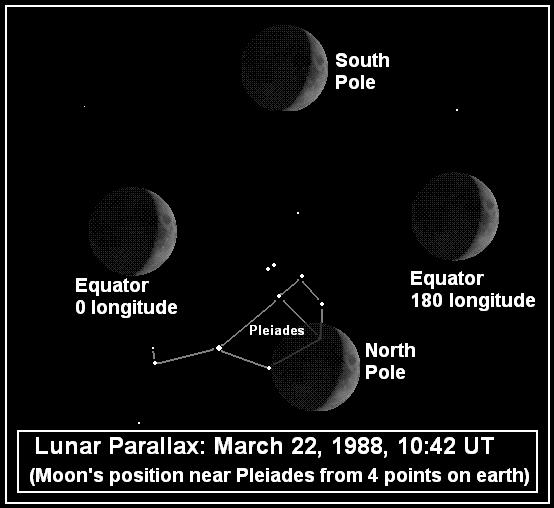
Example of lunar parallax from 4 points on earth
This is a simulated image, combining of 4 views of the sky and the moon's location relative to the background stars at a single point in time.
The bright stars visible are the star cluster Pleiades.
The date March 22, 1988 was chosen because the moon occulted stars within the pleides as visible from North America.
NOTE: This diagram is geometrically accurate, although not physically possible to see since the moon was not actually above the horizon in half the views. Specifically you can never see the Pleiades from the south pole! They were just picked as extreme views from the earth, the limit of what might be seen from a set of four locations in a square on a great circle and a moon just above the horizon in all four locations.
Credit: Tom Ruen, Full Sky Observatory
- This image was generated by my own solar system viewing software.
- Source bitmap for projection from Nasa's Clementine Spacecraft:
- USGS: Global simple cylindrical projection at 10 km/pixel. (http://astrogeology.usgs.gov/Projects/Clementine/images/albedo.simp750.jpeg)
 |
This image has been released into the public domain by its author, Tomruen. This applies worldwide. In some countries this may not be legally possible; if so: العربية | Български | Deutsch | Ελληνικά | English | Español | Français | Italiano | 日本語 | 한국어 | Polski | Русский | Српски / Srpski | Svenska | தமிழ் | Українська | 中文(繁體) | 中文(简体) +/- |
[edit] Source
en:Image:Lunarparallax 22 3 1988.png
history on en: 02:12, 21 May 2004 . . en:user:Tomruen . . 554x508 (31311 bytes) (Example of lunar parallax from 4 points on earth)
[edit] Licensing
|
I, the copyright holder of this work, hereby release it into the public domain. This applies worldwide. In case this is not legally possible: Afrikaans | Alemannisch | Aragonés | العربية | Asturianu | Български | Català | Česky | Cymraeg | Dansk | Deutsch | Eʋegbe | Ελληνικά | English | Español | Esperanto | Euskara | Estremeñu | فارسی | Français | Galego | 한국어 | हिन्दी | Hrvatski | Ido | Bahasa Indonesia | Íslenska | Italiano | עברית | Kurdî / كوردی | Latina | Lietuvių | Latviešu | Magyar | Македонски | Bahasa Melayu | Nederlands | Norsk (bokmål) | Norsk (nynorsk) | 日本語 | Polski | Português | Ripoarisch | Română | Русский | Shqip | Slovenčina | Slovenščina | Српски / Srpski | Svenska | ไทย | Tagalog | Türkçe | Українська | Tiếng Việt | Walon | 中文(简体) | 中文(繁體) | zh-yue-hant | +/- |
File history
Click on a date/time to view the file as it appeared at that time.
| Date/Time | Dimensions | User | Comment | |
|---|---|---|---|---|
| current | 09:05, 6 October 2005 | 554×508 (31 KB) | Helix84 | (i uploaded wrong images previously) |
| 09:03, 6 October 2005 | 554×508 (21 KB) | Helix84 | ||
| 08:58, 6 October 2005 | 554×443 (15 KB) | Helix84 | (Example of lunar parallax from 4 points on earth This is a simulated image, combining of 4 views of the sky and the moon's location relative to the background stars at a single point in time. The bright stars visible are the [[open cluster|star cluster]) |


