Talk:Lotus Seven
From Wikipedia, the free encyclopedia
[edit] The word "simple" in the first sentence
I know this is being pedantic, but I am bothered by the word "simple" in the first sentence. The Lotus Seven (and earlier variants) were among the first autos to possess a fully stressed space frame designed for lightness and strength. Far from being simple, the car's basic design (space frame) was extremely complex. Agreed, the Seven did not have opening doors or conventional windows, but the looks of the Seven belie the complexity behind the engineering. --Tom Bartlett 17:56, 15 January 2007 (UTC)
[edit] Peter Egan?
Peter Egan from Road & Track magazine has covered this car (specifically restoration and racing) for quite a few years. Those should be at the very least listed as references/further reading/etc. Pvera 20:16, 9 January 2007 (UTC)
[edit] Catherham Super 7
The Lotus Seven and Caterham Super 7 are not quite the same car.
- How do I get a Caterham 7 page created? It's currently a reditrect to here, and this statement is right -- they're not the same car. Alex 18:12, 21 October 2006 (UTC)
[edit] K-series?
I have just moved a block of text from Caterham to 'Historical note' here. The paragraph beginning a shrine has been erected leads me to doubt the whole of the section - there is no such place as Kayseries (K-series?) and I can get no Google hits for any ststue. -- RHaworth 2005 July 7 02:19 (UTC)
"It is characterised by extremely high acceleration (0 - 60 mph in 3.1 seconds) and a mid-range top speed (155 Mph)" True for some recent Caterham 7s, but certainly not true for the original Mark 1 Lotus 7.
Yes, my Louts has a top speed like that of a Volkswagen. The thing about it is that the handling makes you feel like Superman. You have to recall carefully whether you had to turn the wheel or whether you only thought you didn't want to hit the truck. David R. Ingham 05:41, 1 December 2005 (UTC)
[edit] wheel arches or fenders or wings?
"Fenders" seems quite standard US English to me and I think I have heard the British use "wings". "Wheel arches" is not even entirely clear to me. The Series I had motorcycle fenders and the later models had fenders similar to usual 1930s and 1940s cars but skimpier, so I don't see why this word would not apply. David R. Ingham 19:34, 22 January 2006 (UTC)
- Fenders is a US only word, and in the UK (home of the 7) would not be understood at all. The Series 1 had clamshell wings for the US market, and cycle wings for the UK. Series 2 had both for the UK market. Series 3 were all clamshell wings. Alex 10:26, 8 September 2006 (UTC)
-
- According to a Caterham manual, they are referred to as "cycle wings." Hope that helps. Riguy 01:35, 9 December 2006 (UTC)
[edit] Revert of "only because they are both expensive"
I am not sure of the relevance, for others, of this paragraph, but will provide arguments that it is correct, from an engineering point of view. To me, this is an important consideration in my pride of ownership.
I am not sure if the statistical and economic aspects are in disagreement or not.
To start the engineering discussion, see There's Plenty of Room at the Bottom. I did not believe what he said about small engines either, at one time, but when I did the back of the envelope calculation correctly I agreed with him. Breathing does not scale so well as stress but it clearly favors small scale. David R. Ingham 03:48, 8 February 2006 (UTC)
The entry said "This car helps to show that size and high strait line performance tend to go together, in production cars, only because they are both expensive (in fuel consumption and price), so the same buyers can afford both."
The revert edit said "This makes little sense, isn't true, and is irrelevant. Reverting." David R. Ingham 06:17, 8 February 2006 (UTC)
Feynman said "The stresses and expansion of the flywheel from centrifugal force, for example, would be the same proportion only if the rotational speed is increased in the same proportion as we decrease the size." (He goes on to say that very small engines would have trouble burning their fuel, but we are not talking here about engines smaller than model airplane engines.)
Breathing improves similarly, except for Reynolds number effects, which are smaller than the surface to volume effect. So scaling the same design of car down increases acceleration, until the vehicle won't hold the driver anymore or its weight becomes comparable to the driver's weight.
Top speed is greater on a larger scale, but, considering the way the engine power scales, it only increases with the weak Reynolds number effect.
This leaves only economics and statistics to explain why a Chrysler 300 accelerates better than an Isetta.
Returning to the relevance, the Lotus Seven shows that one does not have to do more than one's share in making the Earth uninhabitable, by global warming to have fun driving. David R. Ingham 03:58, 9 February 2006 (UTC)
I don't know if there is some point you're trying to make with that paragraph, but you're all over the map in your attempts to argue it here. We're not talking about nano-scale engines. Sevens use, for the most part, essentially everyday engines from normal cars in a lightweight sportscar body.
Also, weight isn't expensive in price, especially when you're comparing performance cars. Many expensive cars are heavy, but only because they have a lot of expensive equipment, which can be heavy. Many inexpensive cars are also heavy, because they just didn't have the engineering and materials thrown at them to make them lightweight. (Crown Vic, for example)
Also, the Lotus Seven does NOT show that size and straigh line performance go together. In straight line acceleration, it only shows the benefits of a high power-to-weight ratio. Since you say that it's expensive in fuel consumption, I have to assume you're trying to say something about large cars, because light weight/small size is NOT expensive in fuel consumption (it can be in price). This part alone gives that paragraph too much ambiguity to be left alone.
"Returning to the relevance," that sentiment isn't explicit or implicit in the paragraph, because it's too ambiguous and contradictory to even be said to have a meaning.
I honestly don't know what you're trying to get at, because you fail to make a coherent argument, in the discussion or in the article. I suspect you do have a point, though, and some work on expressing it would make it a useful contribution to the article. (I suspect you have more to contribute than most, if you own one.) User:Andy Christ
[edit] Clean up
I cleaned up through "Low speed acceleration", but the rest of the article is in need of attention. DocWatson42 05:35, 20 March 2006 (UTC)
[edit] First paragraph is aweful
If you want to charachterize this car by anything, it certainly shouldn't be its straight-line speed. Like all Loti, what makes it special is it's handling. I'd like to remove this section in the first paragraph, but I don't know what to replace it with. Any ideas?
- Couldn't agree more. The whole article is badly put together imho. OK, that means I should do something about it, but it really needs a complete restructure. Look at the section on handling; it talks about the height off the ground and "curtains"! Or the Frame and Body section that repeats the section Rigidity of the frame; dreadful! It's a tubular frame chassis, not a frame. "optional heaters and engine fans"; since when is an engine fan optional? The picture looks like a Birkin, not a Lotus; the indicators are square and should be round. Have a stab at it; you can't do any worse! Alex 10:46, 7 September 2006 (UTC)
-
- I started the update... Cleaned up the oipening section. Now for the other bits Alex 17:00, 21 October 2006 (UTC)
[edit] Pictures?
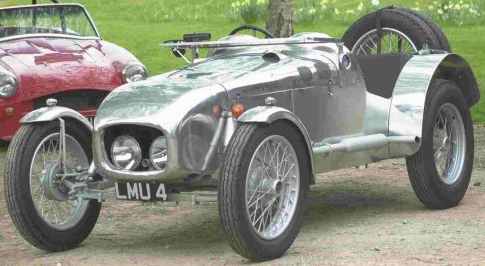
Shouldn't it be possible to include some pictures of the car? // Liftarn I agree so have added an existing picture from commons. 86.111.169.120 22:50, 28 March 2007 (UTC)
- Except that I'm suspicious it isn't a Lotus 7, or even a Caterham 7. The nosecone is the wrong shape; there's a visible outboard bolt on the front suspension; the bonnet is wrong, not enough louvres, and the two it does have are six slot and not the normal seven; there's pop-rivetting on the scuttle; the bench seats are not like Lotus/Caterham bench seats; the windscreen stanchions have 2 bolts and not 3; and there's too much of a gap between the top of the rear and the top of the wheel arches. Call me a nerd, I know, but it just doesn't look right. Alex 16:39, 29 March 2007 (UTC)
-
- Have a look at the category on Commons. Some of them is perhaps the real deal. // Liftarn
What about Image:LotusMk4.JPG? Is it a four or a seven? // Liftarn
- It's a seven. Unusual in that it has an ali nosecone, a plain bonnet & wire wheels; which probably makes it a pre-1960 series 1. Here's a mark 4; http://www.speedace.info/automotive_directory/car_images/lotus_mark_iv.jpg Alex 23:00, 27 April 2007 (UTC)
[edit] Continuing the edits....
The main paragraphs of this article, from Lotus_Seven#Analysis_of_the_Seven.27s_performance down, are pretty dire. It's my humble opinion that 90% of it could be removed on several grounds;
- it refers to the wrong car, the much later Caterham 7, not the Lotus
- it's incoherent in places; the section on handling is not about the handling at all. And Alignment of the wheels -- Nothing unusual is a spectacularly stupid non-observation.
- it's just plain wrong in a lot of places.
I'm going to rip & burn this, unless someone has some really novel reasons for keeping it. Alex 09:50, 6 May 2007 (UTC)
I have removed several of the ridiculous sections such as alignment of wheels that add nothing to the article, and several of the references to Caterham 7 information, but still needs more work! KingDoorknob 17:07, 8 June 2007 (UTC)
[edit] Replicas
There's so many such a list would probably be better placed on a separate page.
Also, it would be worth adding the officially licensed versions in addition: eg Strong Brothers (Chch, New Zealand) and the Avenger/Fiat powered South American ones, etc. Tartanperil 09:23, 13 June 2007 (UTC)
-
- Agreed. I just added the Lucalia Clubman, a seven-esque clubman by Lucalia Partnerships of Tasmania, Australia. The list is extensive, and probably deserves its own page.
-
- It's also not at all clear what's a Seven replica or not. The Elfin and the Lucalia clubmans are both seven-esque rather than Seven replicas. Are they appropriate for this page? The Lucalia, at least, was a short-run motor car that was primarily garage engineered, but I suspect this is the case for most of the cars on the list.
- pipeline (talk) 04:24, 20 November 2007 (UTC)
- As there is now a list of Seven replicas on a different page, is there really any need for the list to be on this page as well? It looks a bit unsightly. Norman22b16:18, 27 Febuary 2008 (GMT)
[edit] CKD6?
The article says the 7 was sold CKD to avoid tax laws. Did this apply to the Lotus 6, too? Was that 1 reason Chapman offered it as a kit? If so, add it to 6 page. Trekphiler 14:45, 29 August 2007 (UTC)
[edit] Explanation of "Series 1," etc.
Series 4 obviously comes after Series 1, but there is a need for an explanation of the differences between each of the series. The Caterham page, for example, refers to Caterham's purchase of the rights to build the Seven (all Series?) and its switch from Series 4 to Series 3. Isn't Series 4 the boxy fiberglass 1970s version? That needs a photo. Or was that a Caterham-only product?--Editing 20:22, 7 September 2007 (UTC)
To answer that last question: Series 4 was a Lotus product for a couple of years; Caterham took over production, used up the remaining stocks (so there were a few Caterham Series 4s) before reverting to the Series 3 design. —Preceding unsigned comment added by 77.98.196.144 (talk) 18:25, 10 March 2008 (UTC)