Talk:Ketamine
From Wikipedia, the free encyclopedia


[edit] Neurotoxicity
In the introduction, it is stated: "Ketamine has a wide range of effects in humans, including analgesia, anesthesia, hallucinations, neurotoxicity, arterial hypertension, and bronchodilation." It stands to reason that neurotoxicty does not have its place in this sentence, even if it is neurotoxic - it just doesn't go with the other adjectives in the sentence. Furthermore, if it used in analgesia and anesthesia, surely its neurotoxic potential is very low -- since there are many other drugs that have such effects, and ketamine would not be used should any actual chances of any kind of toxicity be real. -- Dragonfly31 —Preceding unsigned comment added by 82.10.111.212 (talk) 00:00, 12 December 2007 (UTC)
[edit] Out of Body..........
I would say that the out of body experience description is accurate in that when I was a novice user in my teens I had originally thought that Ketamine would put me to sleep. After having insufflated (snorted) a dose of approximately 0.5 grams of very pure substance (Ketaset), I and my companion experienced an intense experience where the room appeared to take the shape of a bowl which consisted of a maze of circuitry in which we were embedded, and left outside ourselves to view the two of us in this condition.
- I have used the ketamine drug intensively and have found most of the experiences described here to be true. Playing video games (quite difficult) and watching TV also brings about interesting effects from the drug. An increased empathy/identification with the characters and a looser dividing line between real/illusion respresented/tangible seem to result from moderate doses. I was once watching Jonathon Ross (comic UK celebrity interviewer/film reviewer) interview Ringo star and i actually thought i was participating in the conversation to some degree; it was like i was sitting on the couch along side them while being aware that i wasnt (like i said it was moderate dose). I think it relates in some way to narrative as making up rather distorted stories from incoming situational information seems to be a reliable feature of any K session (for example, i once thought i was director of broadcasting while i was at a warehouse rave and that i was responsible for all the ppl being in the right place and making sure the set was right).
-I'd have to agree with this person. Though I didn't use it recreationally, I was on it intravenously while recovering from a grade 3 compound fracture (eventually the limb was removed). Point is, one evening I believed I was participating in a live action video game and everytime I opened my eyes I had to start the "level" over but I kept opening them because there was something that was scaring my pants off. Apparently I tried to climb out of bed several times and started speaking to the nurses in a variety of accents (so I'm told). During the day I entertained myself with a mirror, a comb, and my heart monitor.-
[edit] Dangers
Is ketamine as safe as this article makes it sound? There is no mention of any negative effects beyond the few hours of the trip. Maybe there are none. Could someone more knowledgeable clarify? Agentsoo 2 July 2005 10:45 (UTC)
there are dangers; perhaps i will edit them in:
http://www.erowid.org/chemicals/ketamine/ketamine_health.shtml
I'm currently undergoing IV ketamine treatment for relief of pain from Reflex Sympathetic Dystrophy (RSD), which is due to wind-up or sensitization of the central nervous system, although the exact mechanisms responsible are still not understood. The first treatment was 40 mg/hr for 5 days in the intensive care unit on a neurology ward. Booster treatments are 10 mg/hr for 4 hrs on 2 consecutive days. Patients have to have a full cardiac work-up prior to, and are hooked up to a heart monitor during treatment because ketamine can cause extra stress on the heart. It also causes anxiety, which raises blood pressure and there is definitely decreased coordination. At 40 mg/hr they draw blood every day to monitor liver function as well.
Another type of danger :) The Dr had the hospital remove phones from these patient rooms, as some were making banking decisions or purchases from QVC while "under the influence" - could make for some unpleasant surprises!
Nervis Breakdown 05:42, 5 November 2005 (UTC)
The fact that it's in the same family as PCP should show evident dangers of it. But yes, from what I know, it's addictive and dangerous. Tolerance + addiction = bad. 4.234.51.29 21:50, 25 January 2007 (UTC)
As an anaesthetic, its about the safest there is. Yes, it has drawbacks (addiction the only really common one...) but when you look at it in comparison with, for example, thiopental, or even propofol, its incredibly safe! Of course, in some ways that makes it worse if its abused - users don't display the physical breakdown that may allow diagnosis of addiction to other drugs. (Dlh-stablelights 20:31, 8 June 2007 (UTC))
[edit] DXM connection?
I'm not sure having external links to DXM makes sense for this article. Anyone feel a need to leave it in? Overand 05:01, 10 July 2005 (UTC)
- External links don't make sense, though the article references do. --Tarnas 07:20, 1 August 2005 (UTC)
[edit] Smoked?
- "or smoked in combination with marijuana"
I hadn't heard of this particular method of use before, and I'm not sure it's common, or even feasable. Perhaps the (original?) author had confused Ketamine with its dissociative cousin PCP? Since this doesn't seem to be a common use, maybe it should be removed. Overand 05:01, 10 July 2005 (UTC)
-
- It is not common, and unfeasable as described. It might be possible to do it with special equipment, but ketamine burns up too quickly and does not become a vapor to be inhaled when lit normally. A myth linked to PCP. --Tarnas 07:24, 1 August 2005 (UTC)
-
- i have never seen it taken in this way, and i have spent a year sqautting around east london where was very commonly used recreationally.
-
- I've experienced this on two occasions, and had mixed results. I found it very wasteful and the vapour burnt my lungs and throat. Possible, but IMO, pointless.
It is wasteful, but it most certainly can be done.
I have smoked it, but did not experience any effect. it tasted like burning plastic, and so smoking should probably not be mentioned, as i am relatively sure what we are inhaling when we burn ketamine is quite unhealthy indeed.
[edit] History
The history section I just added needs some attention, and I think the article could stand to have the history more unified, leaving the other sections free of background information. Sorry it's so half-baked, I've just got to run to work right now and wanted to get the ball rolling. Overand 22:56, 10 July 2005 (UTC)
- Made a first go at this, could use more about its creator, its history in psychology/psychiatry/academia, and the course of its becoming illegal. --Tarnas 07:27, 1 August 2005 (UTC)
[edit] An epistemological problem
If a large enough amount is taken the user may go into or through a "K-hole", a state of wildly dissociated experience in which other worlds or dimensions that are difficult to describe with language are said to be perceived, all the while being completely unaware of one's individual identity or the outside world. . . . Users often do not remember this part of the experience after regaining consciousness.
How could this possibly be known? Obviously no one else knows anything about someone's subjective experience but what he reports, so if he can't remember it, where's the information come from? --Ian Maxwell 18:12, 2005 August 25 (UTC)
- Well, it says "often", presuming that some people remember their trip down the keyhole and emerged with some recollections. But it is baloney and should be removed. JFW | T@lk 20:22, 25 August 2005 (UTC)
-
- The "often do not remember" comment probably should be modified... the way it can work with some people is that they will experience several K-holes before they remember one or the earlier ones, though in my experience this is not common. Similar to dreaming: a person can forget their dreams, though we know that basically everyone dreams when sleeping, and the forgetter will at times recall a past dream or be able to remember a new one. —Tarnas 02:23, 26 August 2005 (UTC)
- Yes i think this is poorly put. Is it refering to a state of complete unconciousness, or an extreme disassociated state. It is possible to go into a K-hole (whatever that is, and its slightly different from all people) while being in an awake state and semi aware of situational factors (though these are often distorted as part of the trip).
-
-
- Officially modified! —Tarnas 03:43, 26 August 2005 (UTC)
-
Like it says, it's an extremely dissociated state. From how it was described in real life by a friend, the K-Hole is when you're on Ketamine to the point that you lose all touch with reality. 4.234.51.29 21:54, 25 January 2007 (UTC)
Although I see the problem with the logic of the sentence it can make sense. For example (hypothetically), if I when going into the hole I was in one room and when coming out of it I found myself in another room wearing wet clothes yet had no recollection of making the transition then I could state with certainty that I did not remember what happened although I know something must have. Speedything 13:42, 25 April 2007 (UTC)
[edit] Conflicting information on analgesic use
There seems to be two statements in the 'Medical Use' section that contradict each other:
Ketamine is a co-analgesic, requiring a concomitant low-dose opioid to be effective.
Ketamine is also a potent analgesic and can be used in sub-anaesthetic doses to relieve acute pain.
One of these really should go. Even if somehow both are true, they should be combined into a single statement.
- Pacula 11:11, 20 October 2005 (UTC)
I agree it's confusing. I believe the first reference is to chronic pain; the ketamine inhibits the pain due to wind-up or central sensitization, but an opiod is often still needed by chronic pain patients for muscle pain, etc that does not originate from the nervous system.
In acute pain however, a low dose of ketamine is usually sufficient to relieve whatever the source of pain may be.
It seems as though the two could be discussed in the same paragraph at least to make things more clear.
Nervis Breakdown 06:13, 5 November 2005 (UTC)
http://www.emedicine.com/emerg/topic802.htm
Pain is a complicated system involving many factors. Ketamine has analgesic properties in its own right, although as with many other analgesics the effect may be synergistic (increased) if analgesics with different mechanisms of action are used together - think paracetamol & codeine. The limitation of ketamine as a pure analgesic is its psychotropic effect, which dominates at doses close to that requires for analgesia. —The preceding unsigned comment was added by Iceinthecider (talk • contribs) .
- Do you have any references for the analgesic properties of ketamine? I have always heard that ketamine is effective only when combined with an opioid (the analgesia of the combination is greater than either alone) but ketamine by itself is not considered an effective analgesic. --Bk0 (Talk) 16:12, 8 October 2006 (UTC)
The conflicting statements may be a result of another effect of Ketamine. It's also used as a local (typically topical) anesthetic, which is thought to be caused by a totally different mechanism (blocking sodium channels) than the mechanism that causes the more widely known effects. You can read about this in this well referenced article: http://www.anesthesia-analgesia.org/cgi/content/full/96/4/1019#R4-122335
I've already modified the article to indicate the local anesthetic use, and suspected mechanism of action. --Vellmont 01:26, 13 December 2006 (UTC)
[edit] Structure
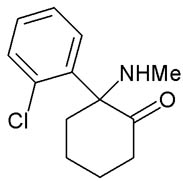
What is the correct structure of ketamine? There are two different structures on this page:  and
and 
At ketamine.com they have yet another structure, which is the same as was once on this page: http://www.ketamine.com/ketamine-structure.jpg
This page has the same as on ketamine.com, so do this page and this page. Unless someone can proof this is wrong, I'm changing it tomorrow. -- Sander 18:00, 2 January 2006 (UTC)
- Those last two structures are incorrect. Ketamine is an amine, and those last two structures (the ones with the chair cyclohexane conformation) completely omit ketamine's methylamino group. I hadn't noticed that before; they should be fixed or removed from the article. The structure you linked to (http://www.ketamine.com/ketamine-structure.jpg) is exactly equivalent to the first structure (Image:Ketamine.png), the orientation is just rotated and the rings flipped.
- Please do not remove the drugbox image, however I will fix the enantiomer image if no one else gets around to it over the next few days. --Bk0 (Talk) 00:14, 3 January 2006 (UTC)
- I'm really blind... You're right, they are the same. So just the other image needs fixing. Thanks for correcting me :) -- Sander 12:19, 3 January 2006 (UTC)
Hi, I made a picture of the S(+) enantiomer. I based the structure on one of my textbooks. As far as I could tell, it seems correct.
.png/180px-Ketamine_S(+).png)

Ld99 13:09, 10 October 2006 (UTC)
[edit] More safety info needed
While Ketamine is a relatively safe drug (physically speaking anyway), as mentioned this article could do with some safety information. In particular, ketamine's (and other selected dissociative's) neuroprotective effects are worth mentioning briefly. These are NMDA receptor glutamate-block mediated, and it would appear (check Medline) that these neuroprotective features may assist in reducing stroke and CVA glutamate excitatory damage to neural tissues. There is considerable research in this area.
[edit] History/Recreational - Raves? Club Drug?
In the history section, the article states:
The incidence of recreational ketamine use increased through the end
of the century, especially in the context of raves and other parties
I'm not sure this is entirely accurate. I think that the majority of 'recreational' use of Ketamine is in private settings; the effects of the drug at higher doses are not at all conducive to use in public settings. (It is, after all, an anesthetic.) I believe the Ketamine/Rave link is more significant in the UK, especially in the present, due to the differences in legality of Ketamine in the UK vs. the US. Either way, I think characterizing Ketamine as a "Club Drug" is somewhat innacurate. I believe the wording should at least be softened, perhaps to something along the lines of:
The incidence of recreational ketamine use increased through the end
of the century, partially due to an increase in its popularity in the
context of raves and other parties.
--Overand 00:14, 11 February 2006 (UTC) Reverted Ketamine, as stated in a poll by 60% of highschoolers across America, is the most accessable and mind-clearing drug. It's absolutely amazing! 32% can't live without it. --Dakota ~ ° 23:31, 17 February 2006 (UTC) ketamine is a cure for comedowns from ecstacsy.
o_O Where are all of these highschoolers getting Ketamine? I have yet to find any source for it. Most people I know haven't even heard of it. 209.247.22.129 18:25, 24 April 2007 (UTC)
[edit] Synthesis
Synthesis of ketamine can start with the reaction of cyclopentyl magnesium bromide (cyclopentyl grignard) and o-chlorobenzonitrile. After hydrolysation, a ketone is formed: o-chlorophenyl-cyclopentyl ketone.
This is followed by alpha bromination of the ketone, which gives alpha-bromo (o-chlorophenyl)-cyclopentyl ketone. Dissolving this ketone in methylamine leads to 1-hydroxycyclopentyl-(o-chlorophenyl)-ketone-N-methylimine.
Heating of this alpha-hydroxy-imine leads to a rearangement (cyclopentyl to cyclohexyl) and gives the final product 2-Methylamino-2-(o-chlorophenyl)-cyclohexanone, known as ketamine. --UgPanda 22:42, 26 May 2006 (UTC)
[edit] Remission lasted no more than seven days
This article says "More than a third continued to report such a benefit after seven days, and nearly a third reported a complete end of symptoms" (emphasis mine). Is there a source on the statement "Remission lasted no more than seven days"? --π! 15:33, 8 August 2006 (UTC)
- JAMA Psych Archives says subjects were tested (infused) on 2 days, a week apart; they were rated at several intervals, up to 7 days "postinfusion". "Thirty-five percent of subjects maintained response for at least 1 week." No conclusions can be drawn about greater than a week. It also states "71% met response and 29% met remission criteria the day following"; I wonder if the 29% is the "nearly a third reported complete end of symptoms" mentioned in the Post article. I notice that 71% + 29% = 100%, so I wonder what "remission" means. Unfortunately, I don't have access to the actual full text of the report.
[edit] Emergence Phenomena and Side Effects
There's a great article at emedicine.com about the advantages of ketamine as an anesthetic and analgesic, particularly in emergency situations. The risk of emergence phenomena, and their severity, in clinical practice, have been blown out of proportion in the developed world. They can be abolished almost completely simply by the preadministration of a benzodiazepine or one of a couple of other types of drugs. In the case that someone does have an emergence reaction, simple reassurance is enough to get them through it. It's still used widely in the developing world as a surgical anesthetic because its safety profile is so superior to other anesthetics and it doesn't require the same kind of expensive infrastructure that traditional anesthesia methods do, or an anesthesiologist. Its utility as a clinical drug has been neglected in the article and its hallucinatory side effects played up. I've got nothing against k-space, but there's a big difference between using the stuff in the pursuit of out-of-body phenomena and the like, and using it to do surgery or change burn dressings. Put simply, in a medical setting there is no excuse for anyone to have a negative recovery from ketamine. I'll be editing the article to reflect its clinical use as I have the opportunity. Porkchopmcmoose 18:24, 31 August 2006 (UTC)
[edit] Fix the Image?
"Stereochemistry shown in the picture is INCORRECT. The correct is opposite one." Anyone want to fix this up? It's at the bottom of the "recreational use" section. Hanzolot 00:08, 7 September 2006 (UTC)
- —Fixed. Porkchopmcmoose 19:23, 10 September 2006 (UTC)
- I didn't just mean remove the sentence, like, is the actual stereochemistry incorrect? As in, should the picture be changed? Hanzolot 23:11, 10 September 2006 (UTC)
- I did change the picture of the ketamine enantiomers to one I made showing the proper stereochemistry. The previous version(s) had it flipped. Or are you referring to something else? Porkchopmcmoose 00:35, 3 October 2006 (UTC)
- I didn't just mean remove the sentence, like, is the actual stereochemistry incorrect? As in, should the picture be changed? Hanzolot 23:11, 10 September 2006 (UTC)
[edit] Schedule II or III
This change was made with no discussion. Does anyone know which is the correct schedule for this drug? Is this sneaky vandalism? Thanks, delldot | talk 05:39, 22 December 2006 (UTC)
- After a quick google search, it looks to me like it's schedule III. So I've reverted and added a reference. If you have more info, go ahead and make the necessary changes or discuss them here. Peace, delldot | talk 05:52, 22 December 2006 (UTC)
[edit] Ketamine
I'm a NOOB, but according to the government of Canada website that I checked (I had supplied a link) Ketamine is a Schedule I drug here in Canada.
PS I was the one that edited... —The preceding unsigned comment was added by Suitsme (talk • contribs) 13:09, 22 December 2006 (UTC).
http://laws.justice.gc.ca/en/C-38.8/229687.html#rid-229689
[edit] Common Street Slang
I have revised the street slang to provide a source for all of the current terms. Future terms added to the article should add their own source to the header, such as: The GDCADA and Group XYZ give the following common street slang terms for ketamine.... ju66l3r 04:32, 10 February 2007 (UTC)
- Fantastic; Im glad you've found a source. I've considered ditching that section a few times. John Vandenberg 05:32, 10 February 2007 (UTC)
-
- I happened to come looking it up because of a rerun of South Park's "Little Whore Playset" spoof on Paris Hilton (the girls in town were going to have a rave party and take Ketamine, even though they didn't know what it was). I was pretty sure it was also known as Special K and the section looked like about 50% vandalism or neologism and 50% truth, so I went source hunting. Glad to help...I also feel pretty strongly about these half-baked lists like "slang" or "trivia" or "cultural refs" that don't come with any sourcing for verifiability. I usually try to wipe them when I can, but I figured someone somewhere had to have a page on Learn what you kids are talking about or similar when it came to a street drug. ju66l3r 06:37, 10 February 2007 (UTC)
-
-
- Ju66l3r's version of a well sourced "#Common_Street_Slang" section was recently removed by Cacycle (talk · contribs), with a decent enough reason. However, when asked a real question that required I refer to this list, I find it is effectively gone, so I am a bit miffed. I'll get over it and bookmark the old version, but what do others think? John Vandenberg 11:27, 20 June 2007 (UTC)
-
-
-
-
- Wikipedia is not a slang guide for good reasons, please see Wikipedia:What Wikipedia is not#Wikipedia is not a dictionary and Wikipedia:Wikipedia is not a dictionary. However, there are links to sites that list list such slang names in the article and you might want to check Wiktionary. The problem is that there is usually no reliable source about where, when, and by whom these names were actually used (the reference [1] was definitely not a reliable source in this context). Most slang terms are temporarily and spatially restricted, often to very small groups or circles of friends. Cacycle 20:26, 20 June 2007 (UTC)
-
-
-
-
-
-
- It is also called Kelly or Kelly Osbourne as a street name due to avoid detection i.e. "Is Kelly coming to the party", also I'm lead to believe this is due to Ms Osbourne's very white appearance.gherks 22:16, 19 August 2007 (BST)
-
-
-
[edit] We need more citations
This ketamine article needs way more citations, despite the many that I've put in. We especially need them in the Neuropharmacology and Recreational Use sections, since they're the most important sections and should be referenced. I'm no expert on this stuff, and the neuropharmacology section has some very advanced information, so whoever wrote that should definitely cite their sources. For the recreational use section, I feel that erowid citations would be acceptable, so go right ahead. Jolb 22:13, 23 February 2007 (UTC)
[edit] out of body experience..... exaggerated?
The drug was first given to American soldiers during the Vietnam War, but today in the developed world its use on humans has been dramatically curtailed because of exaggerated concern about its potential to cause emergence phenomena including out-of-body experiences in clinical practice.
I don't know much about the drug, which is what led me here, but after reading this paragraph, it seemed the use of exaggerated is very biased and not encyclopedic, although i did not remove it as i have not and do not plan on looking at the source cited in the paragraph. Kmccusker2 06:03, 12 March 2007 (UTC)
- Agreed, let me change it. Jolb 06:07, 12 March 2007 (UTC)
well, ok, that was a quick response, in the time it took me to click the link for the reference out of curiosity (nothing on exaggeration in source) you had already responded. impressive. Kmccusker2 06:16, 12 March 2007 (UTC)
- Lol, I keep a close eye on the few articles in my watchlist. Jolb 06:19, 12 March 2007 (UTC)
[edit] cutting with K
When coke is cut with ketamine it gets really damned sticky in your nose. I can't, of course, mention this, as it is original research. I will, however, continue researching. —The preceding unsigned comment was added by 66.124.231.38 (talk) 03:03, 4 April 2007 (UTC).
I assume this would have something to do with how water soluble they are? 209.247.22.129 18:24, 24 April 2007 (UTC)
C retains water vapour well. If was dried out (cooking over mild heat) this probably wouldn't have happened
anyone who cuts coke with K and thinks they'll get away with it is a damn fool.
[edit] Opioid
this change claims that K is an opioid, however I cant (quickly) see any source for this and a search indicates the old text was correct[2]. John Vandenberg 11:09, 20 June 2007 (UTC)
[edit] Recent finding on damage from abusing the Street stuff
On 21 June 2007 Hong Kong Medical Journal has put up a report regarding to the abuse of "Street" K, with the title as Street ketamine'–associated bladder dysfunction: a report of 10 cases. (Click the link to get there). The report has shown that the long term abuse of the K has caused damage to the liver, gall bladder and even a case of acute renal failure, though the scientist are speculating if this is caused by other toxins or chemical reactions. I was wondering if that this finding (along with source) can be included into the article as well. Can anyone answer this please? --Blackhawk charlie2003 03:28, 22 June 2007 (UTC)
[edit] Repeated Vandalization of References
The extensive reference section of this article has been repeatedly deleted by a vandal. It seems likely that some unscrupulous individual is dedicated to this vandalism, and often does it without numerous subsequent well-intentioned editors noticing, leaving countless readers at a loss to verify the carefully referenced claims in this article. After this vandalism is reverted, the vandal apparently takes his or her time before re-vandalizing this article, probably hoping that it will again go unnoticed for a maximal amount of time.
Is there some kind of mechanism that can be activated to make note of this dedicated vandalism effort that might thereby thwart it? 207.69.140.25 05:09, 27 June 2007 (UTC)
[edit] ketamine as a model of schizophrenia
hi, i'm kinda new to wiki, but have added a small paragraph to the "medical use" section regarding k's use as a model of schizophrenia. haven't cited any references, i'll dig them up in a few days. please don't pull it down in the mean time, it's all accurate.
[edit] Medical use: Experimental antidepressant
I added a para about a new (reported today, 7-25-07) study on how ketamine works chemically. I noticed that the footnotes in the "Experimental antidepressant" section are not done properly. They are simple text, and don't have ref tags, so they aren't numbered automatically. Somebody with more time than I have should fix that.
Karlchwe 17:19, 25 July 2007 (UTC)
- Fixed this yesterday. An anon IP butchered the references with a series of cutting and pasting operations that replaced all tags with numbers. [3] They also added a lot of material & references; I tried to fix this carefully rather than revert/remove it, which took a fair amount of work. Madeleine ✉ ✍ 13:35, 3 August 2007 (UTC)
[edit] Veterinary use
Is ketamine used by vets worldwide or is illegal in some places? Portillo 09:57, 3 August 2007 (UTC)
I believe it is illegal in Russia - and sadly, so are most other veterianary anaesthetics. Dlh-stablelights 16:49, 15 June 2007 (UTC)
- In the US, ketamine/diazepam and Telazol are the most common anesthetic induction agents. There is significant overlap with human medicine however, so drugs such as propofol and sevoflurane are also used. I imagine it is similar in other industrialized countries however I don't have any direct knowledge outside of the US. --Bk0 (Talk) 00:33, 4 August 2007 (UTC)
[edit] What a mess
Is it just me or does it seem like this article has become a hodgepodge of quotes cut and pasted from various studies? It seems like the conclusions could just be summarized and put into a better structured article. Any objections to a rewrite? --Selket Talk 16:27, 14 August 2007 (UTC)
- It needs a rewrite, some of the stuff is in first person even! Writing in first person is not encyclopedic. I think the first person stuff must have been copied and pasted from some book or interview instead of actually written specifically for this article. 68.2.35.62 06:48, 12 November 2007 (UTC)
agreed! I found "I" statements and realized this page really needed work...or at least for people to stop using the first person and follow wiki guidelines.--75.36.147.93 (talk) 08:37, 24 January 2008 (UTC)
[edit] Common Names
Commendable that you guys are urging all the so-called common names listed be added with-source, but just what is so special about the ones already there that they do not need sources? Ketaset and Ketalar, while used in the medical profession, are not exactly the names you hear on street corners. Furthermore, by far the most common name I've heard for ket is horse, far more than "kitty". I'll happily find a source for the horse, but shouldn't the other stuff be removed if there's no source for it? Like "placing a BET"? Jdcooper 03:40, 24 August 2007 (UTC)
Properties in perscribed form My friend was getting a surgery when she thinks she was given this drug, it helped her with her Social Anxiety, she wants to know what exactly she took that day, it was in liquid form, red possibly cherry flavored. —Preceding unsigned comment added by 76.103.48.146 (talk) 17:14, 31 August 2007 (UTC)
What is with the artificial claims and categorizations? --> "Like the other dissociative anaesthetics DXM and PCP, hallucinations caused by ketamine are fundamentally different from those caused by tryptamines and phenethylamines." /// Oh really? I would fundamentally disagree with this claim and say that the hallucinations are fundamentally similar, though they are different. Though why don't we go through them point by point? And since when did tryptamines and phenethylamines become mutually exclusive classes of substances? ---> "At low doses, hallucinations are only seen when one is in a dark room with one's eyes closed, while at medium to high doses the effects are far more intense and obvious." /// That sounds exactly like how LSD, psilocin bearing mushrooms and other typical hallucinogens works. At lower doses, you only get visuals in low light, but at higher doses, they're obvious in full light. ---> "These effects include changes in the perception of distances, relative scale, colour and durations/time, as well as a slowing of the visual system's ability to update what the user is seeing." /// And certainly nobody ever reports anything similar to that with LSD or mushrooms or mescaline? Changes in perception of distance or size? No, never. Colour? No. Colours don't seem altered while on other hallucinogens. Change in perception of time while on ketamine too? How completely different than with LSD or psilocin? And what's this about inability to update what the user is seeing? You mean that people see trails while on ketamine but that they have a different character than other drugs produce? ---> "Speech often sounds unintelligible i.e. alogia, and auditory hallucinations may occur." // Once again, that sounds absolutely nothing like a high dose LSD experience. Auditory hallucinations? ---> "Colors can also turn to sound and sound into color." // Nobody has ever reported synesthesia with LSD.
What is this absurd desire to separate dissociatives from "phenethylamines" and "tryptamines"? First of all, LSD is BOTH a phenethylamine and tryptamine. Secondly, DXM is both a dissociative and phenethylamine. Heroin is a phenethylamine. While I would agree that dissociatives produce hallucinogenic effects that are different in "character" or "flavour" than 'classic' hallucinogens, to say that they are "fundamentally different" is totally misleading. —Preceding unsigned comment added by 216.99.60.116 (talk) 07:03, 3 March 2008 (UTC)
[edit] Common Names Again
What's the point in putting 'wonk' as a common name? I've never heard it used in any context at all. You might aswell put another random bloody word in there too!!!!!86.1.183.223 —Preceding unsigned comment added by 86.1.183.223 (talk • contribs) 02:01, 6 September 2007
[edit] Neurotoxicity
As far as I know, whether ketamine causes this effect (neurotoxicity) is still a subject of significant debate, and this uncertainty makes it even less appropriate that it should not be listed as a possible effect without a reference. Reb42 (talk) 19:03, 2 January 2008 (UTC)
Adding one more thing - that is not to say that neurotoxicity hasn't ever been observed - just not in humans. Reb42 (talk) 19:09, 2 January 2008 (UTC)