Talk:John Adams
From Wikipedia, the free encyclopedia
hello my name is bob. i am really cool. i like to play my songs on the piano or the flute. —Preceding unsigned comment added by 12.54.20.66 (talk) 13:01, 2 June 2008 (UTC)


[edit] Old vandalism in Notes section?
What does the "yyoaoaoaschwing!" mean in this note. It was not always there.
40 ^ Kurtz (1967) yyoaoaoaschwifuck it fuck the worldng! p 331 —Preceding unsigned comment added by 66.93.212.216 (talk) 04:31, 27 January 2008 (UTC)
[edit] Important TV Series on John Adams
presently, beginning last nite at 9 pm is an important new biographical series on John Adams on HBO channel(s) ... which touts itself as being done accuratley and ESPECIALLY SHOWING HOW IT WAS during the period of the revolution — with accurate sets, props and depiction ... and i watched it last pm and it WAS very good...
INCLUDE REFERENCE to this immediately on main article AND leave the mity willy's paragraph here too
willy the saint sr / s / #!!
ps rememba de ala mo mudda's —Preceding unsigned comment added by 76.195.74.115 (talk) 12:59, 17 March 2008 (UTC)
[edit] comments
On September 24, 1765, Town Meeting of Braintree, held at Middle Parish Meeting House on Elm St. in Braintree(which is the present First Church Braintree), responded to a motion by young lawyer and Town Meeting representative, John Adams, to appoint a committee of five to draft an official protest to the invasive Stamp Act tax imposed by Britain in March, 1765. The protest was called The Braintree Instructions.
This group of Braintree Patriots: Rep. Ebenezer Thayer, Judge Samuel Niles, Captain John Hayward, Ensign James Penniman, and Norton Quincy, led by one great Patriot, John Adams, took the necessary steps to organize the first response against the tyranny of British taxation that would lead the colonies into the American Revolution.
It was here in Braintree,Ma. ten years before th shots were fired in Lexington and Concord, that these Patriots raised the first voices of Freedom in the Commonwealth of Massachusetts, and led to the first united call for Liberty in the American colonies. —Preceding unsigned comment added by Lilacsinblossom (talk • contribs) 15:25, 5 April 2008 (UTC)
Both the basic info table and the first sentence say Adams' birthdate is October 30. Then, under the "Early Life" heading, the first sentence claims October 22 as his birthdate. So which is it? Could he have been born again? -- Muzzy
The Article says, Most federalists would have preferred Hamilton to be a candidate but since he was born outside the country, he was ineligible for the presidency. However, this is not true because Hamilton was an citizen at the time the Constitution was written. Which allowed to be president change this.
Should we reprotect this article, because ever since it got unprotected there has been alot of vandalism. CP TTD
If you were from Quincy you might have learned that Braintree was founded in 1640, Quincy was later incorporated into it, but finally made city in 1888. Look it up. He wasn't from Braintree, he was from Quincy. I would know, I live there.
"Protest-Well, David McCullough certainly seems convinced that Adams was from Braintree. He persists in calling him John Adams of Braintree and goes so far to describe him as having been born in Braintree, not Quincy. -Anonymous"
Dear Quincy Resident, Why don't you come to Braintree and view the birth records of John Adams, John Quincy Adams, and John Hancock. There was no such place as Quincy. The north precinct of Braintree did not separate from Braintree and become it's own town (Quincy) until nearly the 19th century. When Abigail Adams climbed Penn's Hill with her young son John Quincy to watch the Battle of Bunker Hill,it was Braintree. Why don't you get your facts straight.' —Preceding unsigned comment added by 96.237.72.11 (talk) 04:12, 8 March 2008 (UTC)
back to John Adams
I vaguely recall that we aren't actually supposed to use either "Project Gutenberg" or "En******* Br******" here. I could be wrong. Anybody?
The text itself is truly public domain, so using the text confers no requirements of any kind. "Encyclopaedia Britannica" is an active trademark and should not be mentioned (except when talking _about_ EB such as this sentence). It is acceptable, but unnecessary, to credit Project Gutenberg. It is probably best not to mention either, as that might be construed as an endorsement. --LDC
Well, the reason I asked was that someone (Bryce Harrington? I forget) said something along the lines of "we shouldn't use the Project Gutenberg name." I believe he found something to this effect on their website, or had communication from someone in the PG project.
Project Gutenberg is a trademark, as is Encyclopaedia Britannica. They require a fee if their texts are distributed under their trademark. What that might mean, exactly, is sometimes unclear. But in order to distribute texts under their trademark requires that we not modify the text in any way. In the context of the wiki, that's obviously impossible. Anyone might come along and edit anything. So we can't distribute the texts under their trademark at all.
This does not preclude us from using the words at all! That isn't how trademark works. It's just that we can't use their trademark in such a fashion as to suggest that they support or endorse this project or any changes that we might have (accidentally or on purpose) made to their texts.
I am on the mailing list for Project Gutenburg, and Michael Hart knows who I am, I suppose, from our joint Slashdot interview. So I will ask for more clarification. --Jimbo Wales
Here is a fair use extract from the file:
 "You may distribute copies of this etext
 electronically, or by disk, book or any other
 medium if you either delete this "Small Print!" and all
 other references to Project Gutenberg,"
For reference, my original posting on this can be found at "BritannicaPublicDomain". BryceHarrington
I pulled this from my vast archive of each and every Inaugural Address presented by an elected American President. I predict that the next President will begin copyrighting his speeches so that this may no longer be done (intellectual property being what it is). -Grant
Technically, any speech given by anyone in the United States is copyrighted when it is given.
Aren't there some laws stating what data produced by the federal government are public domain?
- 17 USC 1 § 105: Copyright protection under this title is not available for any work of the United States Government, but the United States Government is not precluded from receiving and holding copyrights transferred to it by assignment, bequest, or otherwise. A Presidential speech made as part of the duties of his office (like the State of the Union, or an Inaugural address) would probably qualify as a "work of the US Government", and likely not be copyrightable. But a President is certainly entitled to copyright on any work he does on his own time, say, writing a memoir. That's also why things like the CIA Factbook are fair game. --LDC
[edit] Trivia
Is trivia worthy of mention in this article? John Adams and Thomas Jefferson were both invited to attend the 50th celebration of the signing of the Declaration of Independence on July 4th 1826. Both were too ill to attend. Both died on the same day which ironically was the same 50th celebration of the Declaration of Independence.
Well, that bit of trivia certainly is. It's one of the most remarkable coincidences in American history.AlbertSM (talk) 20:26, 24 March 2008 (UTC)
John Adams was elected to the office of selectman in his hometown of Braintree, Massachusetts.
[edit] Diplomat in France
I saw the third episode of the HBO miniseries "John Adams" last night, and it dealt with his disastrous efforts at trying to persuade the French to aid the U.S. (he always tended to offend people by being tactless). I don't see any of that covered in this article; don't ask me to put it in myself, because all I know is what I saw in the miniseries. The episode also had Adams becoming very seriously ill while trying to court the aid of the Dutch. Is this true, or was it invented for the show?AlbertSM (talk) 20:26, 24 March 2008 (UTC)
[edit] In Europe — vandalism
The "In Europe" section contains the following: --Queen Elizabeth II of Great Britain referred to this episode in July 7, 1976 at the White House. She said, "John Adams, America's first Ambassador, said to my ancestor, King George III, that it was his desire to help with the restoration of "the old good nature and the old good humor between our peoples." That restoration has long been made, and the links of language, tradition, and personal contact have maintained it."[24]--
Her Majesty would spell the word "humour". This is also the correct spelling of the word. So, therefore, should Wikipedia. Also, she is Queen of the United Kingdom, not Great Britain. One does not expect the average Wikipedia editor to understand such subtleties, but might someone change this? 79.73.45.103 (talk) 20:37, 4 February 2008 (UTC)
I think it is very rude if you put dalse information on here kids use this for projects and such for school please be respectful —Preceding unsigned comment added by 206.180.109.146 (talk) 15:43, 6 February 2008 (UTC)
[edit] HBO Miniseries on John Adams
I just found out, per a poster in the U.S. Post Office, that HBO will air a 7-part miniseries based on David McCullough's book, "John Adams," beginning Sunday, March 16, 2008 at 2000 (8 P.M.) HBO: John Adams Pooua (talk) 02:37, 16 February 2008 (UTC)
According to the mini series, all soldiers that were represented by John Adams were acquited, however the summary in "Boston Massacre: 1770" states that 2 soldiers were found guilty of manslaughter. Which is correct? —Preceding unsigned comment added by 68.175.19.144 (talk) 03:25, 5 April 2008 (UTC)
[edit] Last sentence in Early Life section
The last sentence in the Early Life section is ungrammitcal. It should either be a continuation of the previous sentence, with no period in between,'Who' not capitalized and 'is' replaced with 'was', or if it is going to be a separate sentence, then it should begin 'She was a descendant...' —Preceding unsigned comment added by 98.224.200.81 (talk) 15:15, 18 February 2008 (UTC)
[edit] Last paragraph in Post Presidency section
Year of death for Abigail ("Nabby") is listed as 1816 in the last paragraph of the Post Presidency section. The third paragraph of the Early Life section shows her year of birth and year of death as 1765–1813. Other sources agree with the 1813 date. Wwg927 (talk) 15:40, 20 March 2008 (UTC)
[edit] "Colossus of independence"
This quote was never used by Jefferson. See [1]Jvbishop (talk) 15:42, 5 April 2008 (UTC)
[edit] Many typographical errors
Possessive of Adams is Adams', not Adams's. —Preceding unsigned comment added by Gracestreet (talk • contribs) 03:54, 8 April 2008 (UTC)
[edit] Adams stamp image
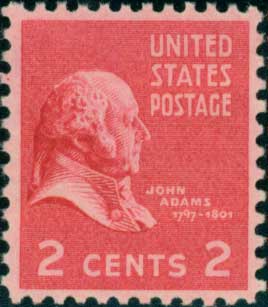
The stamp image being displayed is a used stamp and not a great quality image. I'm happy to offer the image at http://album.dweeb.org/images/Stamps/0806.jpg, for which I am the copyright holder (of that specific image, with possible US government copyrights additionally attached, as is the case with the image being used), if a better image is desired. In fact, I'd probably be willing to offer any of the 6300 images from my stamp collection site to Wikipedia, if there is value in doing so - Jokeboy (talk)
[edit] why the semi-protection?
just curious as to why this page is semi-protected and others aren't —Preceding unsigned comment added by 70.252.143.22 (talk) 17:23, 30 April 2008 (UTC)
[edit] Section needed
As this page is protected, someone else will have to do it. A "See also" section should be added to tbe bottom, just above the banner templates, with the link
- 70.51.9.170 (talk) 09:33, 8 May 2008 (UTC)