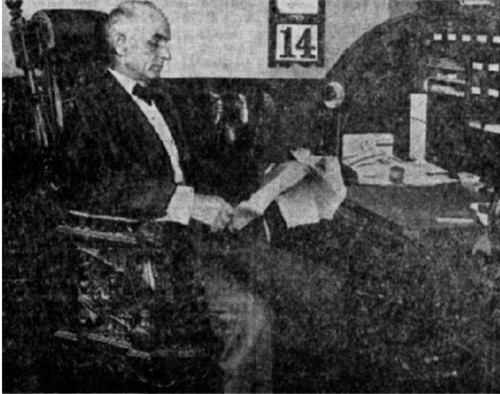
James Dahlman
From Wikipedia, the free encyclopedia
| James Charles Dahlman | |
 |
|
|
Mayor of Omaha
|
|
| In office 1906 – 1918 |
|
| Preceded by | Harry B. Zimman |
|---|---|
| Succeeded by | Edward Parsons Smith |
| In office 1921 – 1930 |
|
| Preceded by | Edward Parsons Smith |
| Succeeded by | John H. Hopkins |
|
|
|
| Born | 15 December 1856 DeWitt County, Texas |
| Died | 21 January 1930 (aged 73) Omaha, Nebraska |
| Nationality | American |
| Political party | Democratic |
| Spouse | Hattie Abbott Dahlman |
| Children | Ruth Baughman, Dorothy Dahlman |
| Occupation | Politician |
| Profession | Cattle industry |
| Religion | Agnostic |
James Charles Dahlman (December 15, 1856 – January 21, 1930), also known as Jim Dahlman, Cowboy Jim and Mayor Jim, was an eight-term mayor of Omaha, Nebraska, serving the city for 23 years. A German-American agnostic,[1] Dahlman grew up as a Texas cowboy, and eventually as a small town sheriff and mayor in western Nebraska before moving to Omaha.
Called the "perpetual Mayor," Dahlman was seen by many as a cover man for Omaha's vice elements. Earning the reputation as the "wettest mayor in America", the number of saloons in Omaha doubled during the first 10 years of his mayorship. The term "Dahlmanism" was coined to describe his politics.[2]
Contents |
[edit] Background
James Charles Dahlman was born in Yorktown, DeWitt County, Texas in 1856. He was the eldest son of Charles and Mary Dahlman, both German-Americans. At age 17 he won a Texas state riding competition, becoming a cowhand shortly afterwards. He became known as an expert with the lariat. In 1878, at the age of 22, Dahlman killed his brother-in-law during an argument and fled to western Nebraska, where he went by "Jim Murray."[3] Dahlman later learned a judge ruled the killing as self-defense. After beginning as a cowpuncher at the N-Bar Newman Ranch near Gordon for several years, Dahlman became a range boss.[4]
Dahlman was married in late 1884 to a school teacher named Hattie Abbott in Chadron, Nebraska.[5]
[edit] Early political career
Later he was a brand inspector for the Wyoming Stock Association at Valentine, and was soon elected sheriff of Dawes County.[6] In 1885 he became the mayor of Chadron, and was elected twice to that office.
While mayor of Chadron, Dahlman formed a friendship with a young, successful lawyer from Lincoln named William Jennings Bryan. For the next several years the pair maintained contact, with Dahlman raising funds in Chadron for Bryan's 1892 campaign for re-election to Congress. In 1894 Dahlman was a lieutenant in Bryan's re-election campaign, and when he became chairman of the Nebraska Democratic Party in 1896, Dahlman used his platform to nominate Bryan to run for President of the United States.[7] He served twice as a Nebraska delegate to Democratic National Conventions in 1892 and 1896.
After declining an offer as the police chief in Omaha in 1896, he served as Democratic state chairman and helped carry Nebraska for William Jennings Bryan. In 1899 Dahlman was hired by the Union Stockyards Company.[8]
[edit] Mayor of Omaha
Dahlamn was elected in 1906 to serve as Omaha mayor, the three elections he won in a row. He became a close ally of Tom Dennison, who reportedly supported his first campaign because Dahlman was "tolerant" of Dennison's Sporting District.[9] The Nebraska Legislature passed a law that enforced saloons to be open only during daylight hours in 1908. Mayor Dahlman led the opposition in Omaha, openly flaunting his defiance in a variety of establishments throughout the city.[10] In his first term Dahlman ensured Dennison's political standing within the city. However, running on an anti-Prohibition ticket, Dahlman quickly lost support of Bryan, who deeply supported Prohibition.[11]
Dahlman has been noted for his early concern for the city's citizens, particularly calling for prudence during Thanksgiving Day meals.[12] He was also condemned for his "loose" attitudes towards Omaha's vice elements. Religious leaders throughout the city started referring to "Dahlmanism"[13], which according to a period newspaper called the Omaha Bee, "exposes the most sacred interests of morality and public order. Its concealed friendliness to the elements of vice and crime renders Dahlmanism a menace to public morals."[14]
[edit] Governor's race
Dahlman lost a race for Governor of Nebraska against Chester H. Aldrich in 1910. Running on an anti-Prohibition and local control for cities, Dahlman lost to Aldrich's promises of progressive reform. Dahlman also hinted at moving the Nebraska State Capitol from Lincoln to Omaha.[15] However, Germans in Omaha and the National German-American Alliance supported Dahlman by providing him with 70% of their vote that year.[16]In what was called the "Dahlman element", the mayor gained a great deal of support from breweries across the state, but failed to significantly challenge Aldrich.[17]
After serving as a United States Marshal in 1910, he resigned in 1911 to become mayor of Omaha for the fifth time, and was mayor for three more terms afterwards.
[edit] Policy-making


Under Dahlman Omaha claimed its "strong city" status for the first time. Before him, the city had to get permission to give a policeman a raise. Dahlman led the battle to gain the city's autonomy, and was accused of wanting to "secede" Omaha from the state of Nebraska. State legislators scoffed at Omaha's ability to control her own affairs. A constitutional amendment was submitted to the voters, and they approved it. Other major accomplishments of Dahlman's mayorship included the city's purchase of the Florence Waterworks, the gas company and formation of the Metropolitan Utilities District in 1921.[18]
Dahlman was lambasted for his response to the Omaha Easter Sunday Tornado of 1913 after he refused federal aid and contributions from people across the country. The city suffered more than 100 related deaths, and there were millions of dollars in damage.
[edit] Civic involvement
Dahlman was a member of several social and philanthropic organizations, including the Omaha Community Chest, the Omaha Chamber of Commerce, the Young Men's Christian Association, the Omaha Library Commission, the Fraternal Aid Union, the Royal Arcanum, the Woodmen of the World, the Ancient Order of United Workmen, the Moose and the Elks. He was president of the Americanization League.[19]
[edit] Omaha Race Riot of 1919
In September of 1919 an African American named Willy Brown was dragged from the Douglas County Courthouse and lynched by a mob of white men. While there were reports that the violence was led by a variety of sources, current scholarship places responsibility on the shoulders of Tom Dennison, who was acting on behalf of Dahlman.[20] A contemporary grand jury trial corroborated this claim, stating the riot "was not a casual affair; it was premeditated and planned by those secret and invisible forces that today are fighting you and the men who represent good government."[21]
After keeping the mayorship for three terms in a row, Dahlman lost the 1918 election to Edward P. Smith, a reformist Republican who was supported by the powerful Omaha Church Federation and the Douglas County Dry League. He focused his slate on making Omaha a dry city, cleaning up the "vice" elements of the city, and securing a positive future for the city's businesses. Smith and the city commission that shared his reformist objectives were the bane of Tom Dennison. Dennison's men dressed in blackface, masqueraded around the city performing a variety of crimes, including raping a white woman, and afterwards went from saloon to saloon throughout the city raising the ire of many citizens.[22]
After Smith was lynched by the mob and saved by a last-minute rescue by unknown agents, his political career was over. He refused to take any action with the city commission, and in 1921 Dahlman's ticket was elected back into control of the city.[23]
[edit] Death
Dahlman died in office January 21, 1930. After his death, the Dahlman neighborhood, Dahlman School, Dahlman Park and Dahlman Avenue in Omaha were named after him. Dahlman was inducted into the Hall of Great Westerners in 1964.[24]
[edit] Political timeline
James Dahlman was a lifelong Democrat who served in the following positions:
| James Dahlman's political timeline | |||||
|---|---|---|---|---|---|
| Title | Place | Dates | |||
| Sheriff | Dawes County, Nebraska | 1888-1894 | |||
| Mayor | Chadron, Nebraska | 1894-1895 | |||
| Delegate from Nebraska | Democratic National Convention | 1892 and 1928 | |||
| State chair | Nebraska Democratic Party | 1896-1900 | |||
| Member | Democratic National Committee from Nebraska | 1900-1908 | |||
| Mayor | Omaha | 1906-18 and 1921-30 | |||
| Political offices | ||
|---|---|---|
| Preceded by Harry B. Zimman |
(Acting) Mayor of Omaha 1906 – 1918 |
Succeeded by Edward Parsons Smith |
| Preceded by Edward Parsons Smith |
Mayor of Omaha 1920 – 1930 |
Succeeded by John H. Hopkins (acting) |
[edit] See also
[edit] References
- ^ Folsom, B.W. (1999) No More Free Markets Or Free Beer: The Progressive Era in Nebraska, 1900-1924.]] Lexington Books. p 59.
- ^ Folsom, B.W. (1999) No More Free Markets Or Free Beer: The Progressive Era in Nebraska, 1900-1924.]] Lexington Books. p 61.
- ^ Larsen, L. and Cotrell, B. (1997). The Gate City: A history of Omaha. University of Nebraska Press. P 177.
- ^ Barns, C.G. (1970) The Sod House. University of Nebraska Press. p 99.
- ^ Larsen and Cotrell. (1997) p 179.
- ^ Barns, C.G. (1970) The Sod House. University of Nebraska Press. p 99.
- ^ Folsom, B.W. (1999) No More Free Markets Or Free Beer: The Progressive Era in Nebraska, 1900-1924.]] Lexington Books. p 57-59.
- ^ Carey, J. (1930) Mayor Jim: An Epic of the West.
- ^ "Dennison's Political Machine", NebraskaStudies.org. Retrieved 9/3/07.
- ^ Folsom, B.W. (1999) No More Free Markets Or Free Beer: The Progressive Era in Nebraska, 1900-1924.]] Lexington Books. p 50.
- ^ Larsen, L. and Cottrell, B. (1997) The Gate City: A History of Omaha. University of Nebraska Press. p. 177
- ^ "Thanksgiving in Omaha, 1909". Nebraska State Historical Society. Retrieved 9/3/07.
- ^ Folsom, B.W. (1999) No More Free Markets Or Free Beer: The Progressive Era in Nebraska, 1900-1924.]] Lexington Books. p 61.
- ^ Luebke, F.C. (1999) Germans in the New World: Essays in the History of Immigration. University of Illinois Press. p. 28.
- ^ "Buffalo County Nebraska and its People." Retrieved 9/4/07.
- ^ Folsom, B.W. (1999) No More Free Markets Or Free Beer: The Progressive Era in Nebraska, 1900-1924.]] Lexington Books. p 64.
- ^ Morton, J. and Watkins, A. (1918) "Party Rotation," History of Nebraska from the Earliest Explorations of the Trans-Mississippi Region. Lincoln, NE: Western Publishing and Engraving Company. p. 647. Retrieved 7/15/07.
- ^ "Douglas County". University of Nebraska at Omaha. Retrieved 9/3/07.
- ^ "The Nebraskan Society". Retrieved 9/5/07.
- ^ Luebke, F.C. (1995) Nebraska: An Illustrated History. University of Nebraska Press. p 246.
- ^ (nd) "Who Was to Blame?" NebraskaStudies.org. Retrieved 9/4/07.
- ^ (nd) "Who Was to Blame?" NebraskaStudies.org. Retrieved 9/4/07.
- ^ Larsen and Cotrell. (1997) p 176.
- ^ "National Cowboy & Western Heritage Museum". Retrieved 9/4/07.
[edit] External links
- "Recollections of Cowboy Life in Western Nebraska." An address given by James Dahlman at the Annual Meeting of the Nebraska State Historical Society on January 10, 1922.
- Photo of Dahlman
- (1909) "Mayor James C. Dahlman," Omaha Police Souvenir Book.
- Photo of Dahlman from the Omaha Police Souvenir Book.
- 1908 photo
[edit] Bibligraphy
- (1927) "Sketches of American mayors," National Municipal Review. 16(2). p 111-117.
|
|||||||||||