Image:Island of Hawai'i - Landsat mosaic.jpg
From Wikipedia, the free encyclopedia
Size of this preview: 600 × 600 pixels
Full resolution (5,076 × 5,076 pixels, file size: 4.91 MB, MIME type: image/jpeg)

| This is a file from the Wikimedia Commons. The description on its description page there is shown below.
|
[edit] Summary
| Description |
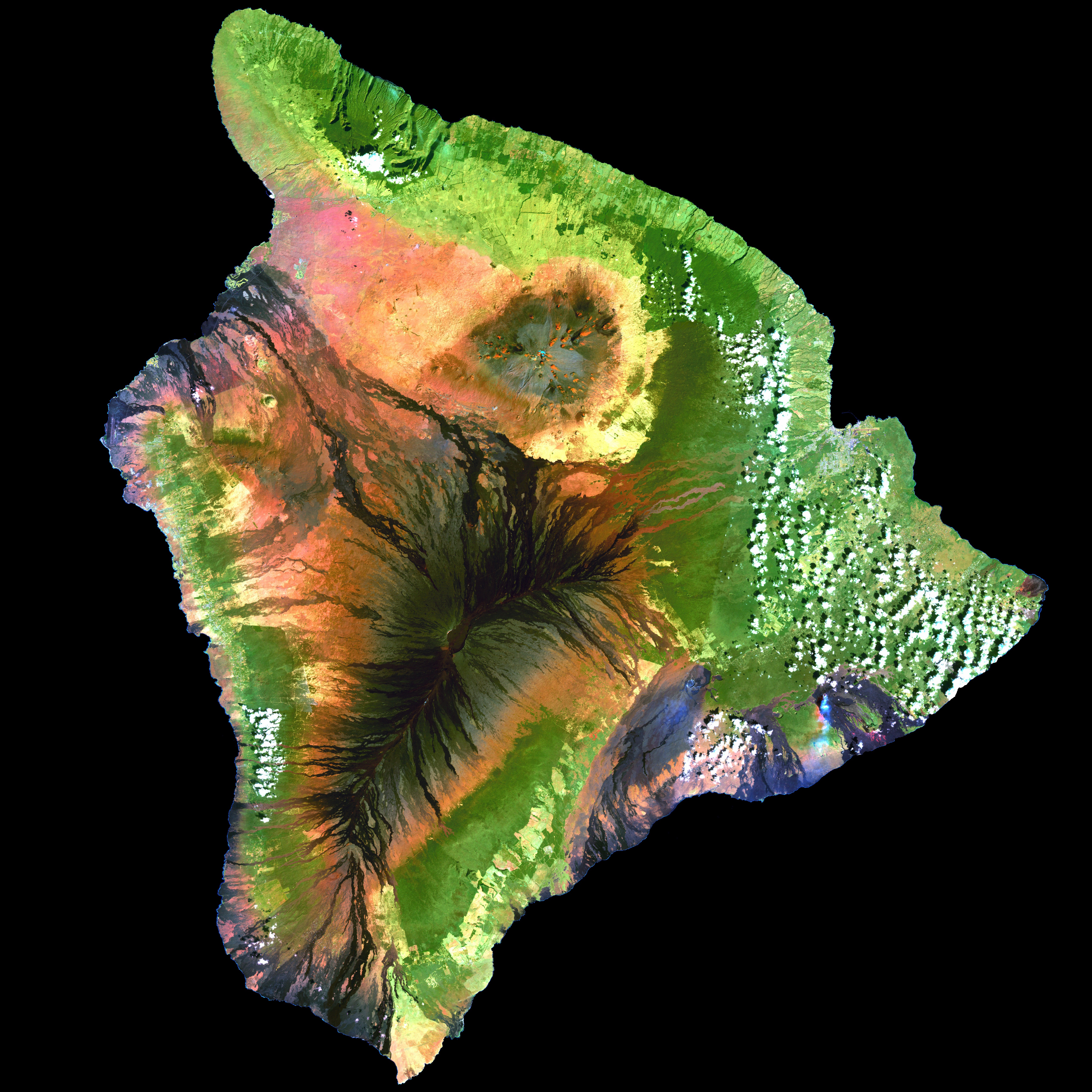
This simulated true-color image of the island of Hawai'i was derived from data gathered by the Enhanced Thematic Mapper plus (ETM+) on the Landsat 7 satellite between 1999 and 2001. |
|---|---|
| Source |
Image and its description. |
| Date |
1999-2001 |
| Author |
Hawaii Land Cover Analysis project, NOAA Coastal Services Center |
| Permission (Reusing this image) |
Public domain - original work of NASA and NOAA |
Description from [1]: Boasting snow-covered mountain peaks and tropical forest, the Island of Hawaii, the largest of the Hawaiian Islands, is stunning at any altitude. This false-color composite (processed to simulate true color) image of Hawaii was constructed from data gathered between 1999 and 2001 by the Enhanced Thematic Mapper plus (ETM+) instrument, flying aboard the Landsat 7 satellite. The Landsat data were processed by the National Oceanographic and Atmospheric Administration (NOAA) to develop a landcover map. This map will be used as a baseline to chart changes in land use on the islands. Types of change include the construction of resorts along the coastal areas, and the conversion of sugar plantations to other crop types.
Hawaii was created by a “hotspot” beneath the ocean floor. Hotspots form in areas where superheated magma in the Earth’s mantle breaks through the Earth’s crust. Over the course of millions of years, the Pacific Tectonic Plate has slowly moved over this hotspot to form the entire Hawaiian Island archipelago.
The black areas on the island (in this scene) that resemble a pair of sun-baked palm fronds are hardened lava flows formed by the active Mauna Loa Volcano. Just to the north of Mauna Loa is the dormant grayish Mauna Kea Volcano, which hasn’t erupted in an estimated 3,500 years. A thin greyish plume of smoke is visible near the island’s southeastern shore, rising from Kilauea—the most active volcano on Earth. Heavy rainfall and fertile volcanic soil have given rise to Hawaii’s lush tropical forests, which appear as solid dark green areas in the image. The light green, patchy areas near the coasts are likely sugar cane plantations, pineapple farms, and human settlements.
[edit] Licensing
 |
This image is in the public domain because it contains materials that originally came from the U.S. National Oceanic and Atmospheric Administration, taken or made during the course of an employee's official duties. |
 |
File history
Click on a date/time to view the file as it appeared at that time.
| Date/Time | Dimensions | User | Comment | |
|---|---|---|---|---|
| current | 11:52, 27 December 2007 | 5,076×5,076 (4.91 MB) | Avenue | ({{Information| |Description=This simulated true-color image of the island of Hawai'i was derived from data gathered by the Enhanced Thematic Mapper plus (ETM+) on the Landsat 7 satellite between 1999 and 2001. |Source=[http://veimages.gsfc.nasa.gov/2712/l) |
File links
Metadata
This file contains additional information, probably added from the digital camera or scanner used to create or digitize it. If the file has been modified from its original state, some details may not fully reflect the modified file.
| Orientation | Normal |
|---|---|
| Horizontal resolution | 72 dpi |
| Vertical resolution | 72 dpi |
| Software used | Adobe Photoshop 7.0 |
| File change date and time | 17:54, 16 May 2002 |
| Color space | 65535 |


