Image:Intercept Sight Reduction-00.png
From Wikipedia, the free encyclopedia
No higher resolution available.
Intercept_Sight_Reduction-00.png (456 × 488 pixels, file size: 5 KB, MIME type: image/png)

| This is a file from the Wikimedia Commons. The description on its description page there is shown below.
|
[edit] Summary
| Description |
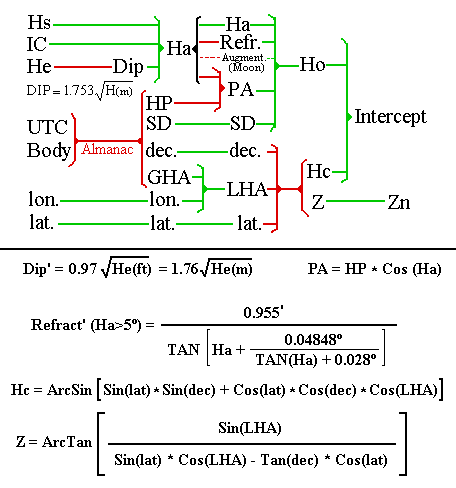
Schematic diagram of the basic computation process for sight reduction by the intercept method.
With the body name and UTC as arguments the four following are extracted from the Nautical Almanac
This step is the most complex in the sense that it cannot be done by any simple calculations locally. One needs to extract the information from the almanac or use a computer.
All the previous steps are common to all the different variants of the intercept method. We now come to the resolution of the spherical triangle which can be done by many different ways. The formulas which permit the calculation of Hc and Z are the two lower ones below the diagram. They can be easily calculated using a handheld calculator with trig functions or lookup tables such as H.O. 229 can be used. Lookup tables were the only method before the advent of calculators. Today, a cheap, programmable calculator will do the calculation instantly by just entering the three arguments: LHA (Local Hour Angle), dec., and lat. . With those three arguments we obtain:
The difference between Ho and Hc is the "Intercept distance" or error and Zn is Z reduced to the correct quadrant. This process can be done quite mechanically using an appropriate form where the appropriate boxes are filled sequentially. With Hc and Zn the navigator can plot a LOP (Line of Position). Take several LOPs and advance them all to a common time if necessary to obtain a position fix where they cross. |
|---|---|
| Source |
self-made |
| Date |
2007-07-24 |
| Author | |
| Permission (Reusing this image) |
see below |
[edit] Licensing
|


File history
Click on a date/time to view the file as it appeared at that time.
| Date/Time | Dimensions | User | Comment | |
|---|---|---|---|---|
| current | 17:18, 24 June 2007 | 456×488 (5 KB) | GS3 | ({{Information |Description=Schematic diagram of the basic computation process for sight reduction by the '''intercept''' method. :* Green lines and keys indicate only addition and subtraction and can be done with pencil and paper using an appropriate fo) |
| 17:11, 24 June 2007 | 456×488 (6 KB) | GS3 | ({{Information |Description=Schematic diagram of the basic computation process for sight reduction by the '''intercept''' method. :* Green lines and keys indicate only addition and subtraction and can be done with pencil and paper using an appropriate fo) | |
| 17:04, 24 June 2007 | 456×488 (6 KB) | GS3 | ({{Information |Description= Schematic diagram of the basic computation process for sight reduction by the '''intercept''' method. * Green lines and keys indicate only addition and subtraction and can be done with pencil and paper using an appropriate fo) |


