Holy Loch
From Wikipedia, the free encyclopedia


The Holy Loch (Scottish Gaelic "An Loch Sianta/Seunta") is a sea loch in Argyll and Bute, Scotland. Open to the Firth of Clyde at its eastern end, the loch is approximately one mile wide and between two and three miles long, varying with the tide. The town of Dunoon on the Cowal peninsula lies on the shores of the Clyde just to the south of the loch, and houses continue round the villages of Kirn, Hunter's Quay at the point with the landing slip for Western Ferries, Ardnadam and past Lazaretto Point, the village of Sandbank, with open countryside at the end of the loch, then on the northern shore Kilmun, and at Strone Point the village of Strone continues round to the western shore of the Clyde, almost joining Blairmore on Loch Long. The name Holy Loch is believed to date from the 6th century when Saint Munn landed there after leaving Ireland.
All the villages used to have piers served by Clyde steamers, and now Western Ferries runs between Hunter's Quay and McInroy's Point on the outskirts of Gourock, while the Caledonian MacBrayne service runs from Dunoon to Gourock pierhead. At the end of the loch a road runs past the Benmore Botanic Garden and Arboretum (also known as the Younger Botanic Gardens) to scenic Loch Eck and on towards Oban.
_Holy_Loch.png)
During World War II the loch was used by the Royal Navy as a submarine base, served by the depot ship Forth. The loch was used extensively for trials and exercises by Royal Navy submarines during the Second World War, the submarines Vandal and Untamed were lost in the Clyde after being sunk by accidents during exercises. Untamed was later salvaged.
Near the Holy Loch an anti-submarine boom was constructed between Dunoon and the Cloch Point Lighthouse to defend waters from German U-boats.
[edit] US Navy
Between 1960 and 1992, Holy Loch was the site of a United States Navy base. The base was known to the US Navy as "Refit Site One." It was the home base of SUBRON (Submarine Squadron) 14 of the U.S. Atlantic Polaris and Poseidon ballistic missile nuclear submarine (SSBN) fleet. SUBRON 14 consisted of a submarine tender (submarine depot ship), a floating dry dock, one or two work space and berthing barges, as well as, ten or so assigned Polaris/Poseidon Class Fleet Ballistic Missile (FBM) submarines.
The submarines, known as SSBN submarines, were assigned to the submarine squadron, though the specific subs assigned were consentingly changing because of shipyard periods and other navy priorities.
There were also a number of US Navy manned tugboats (YTB) and a floating crane assigned to the base. There was also a large number of small boats used to transport personnel and supplies from the shore to the ship. Among these small boats were 40ft and 50ft Utility Boats, LCM Mk6 and Mk8 landing craft some with the holds roofed over for personnel transport and 32ft officers motorboat. The ships divers had a LCM Mk6 modified as a dive boat. There was also a boat known as the "Box L" of uncertain heritage.
A person of note that served at the Holy Loch was Laurel Blair Salton Clark, known with affection to her shipmates as “Doc Salton”, was assigned as the Radiation Health Officer and Undersea Medical Officer at SUBRON 14. “Doc” was one of the astronauts that perished in the Space Shuttle Columbia disaster on February 1st, 2003.
Submarine Tenders Assigned to Site One:
USS Proteus (AS-19) March 1961 to 1963
USS Hunley (AS-31) 1963 to 1966
USS Simon Lake (AS-33) 1966 to 1970
USS Canopus (AS-34) 1970 to 1975
USS Holland (AS-32) 1975 to 1982
USS Hunley (AS-31) 1982 to 1987
USS Simon Lake (AS-33) 1987 to 1992
Large Floating dry dock assigned to Site One:
Tugboats assigned to Site One:
Piqua (YTB-793)
Saugus (YTB-780)
Natick (YTB-760)
Service Craft:
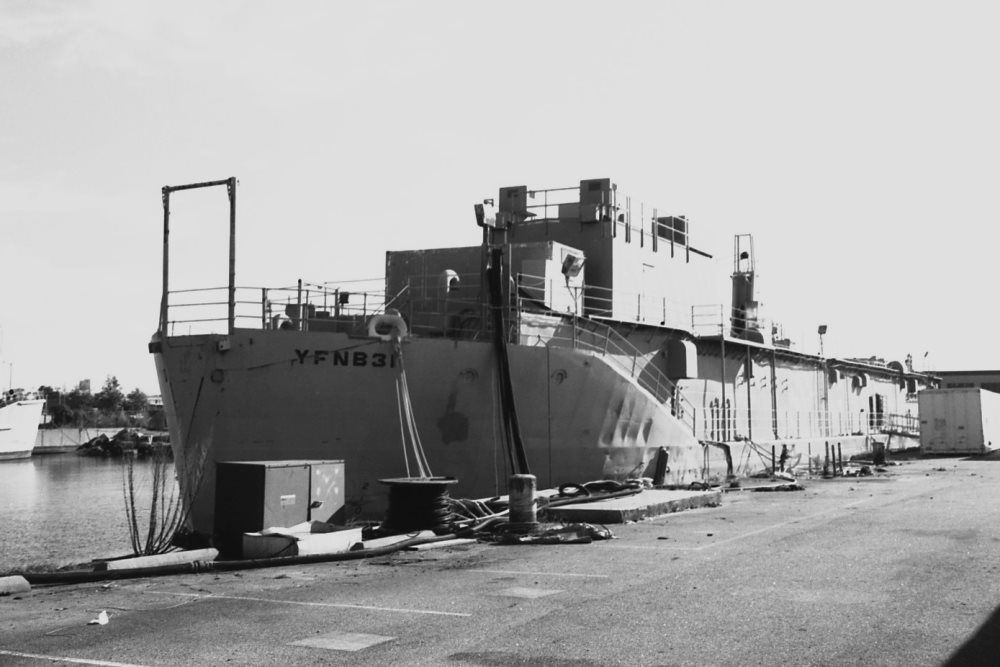
Living/Working barge - Boat Operations Department (YFNB-31)
Living/Working barge - Tech Rep Offices and Submarine Crew Temporary Berthing (YFNB-42)
Floating barge Crane (YD-245)
Trivia:
The base was the location of frequent demonstrations by the Campaign for Nuclear Disarmament and others opposed to the siting of nuclear arms on UK territory.
In the 1968 film Ice Station Zebra starring Rock Hudson, reference was made to the Navy base.
The 1988 film Down Where the Buffalo Go starring Harvey Keitel was centered around the base and focused on the life of a Navy Shore patrol officer (played by Keitel). It was filmed around the base and in Greenock.
[edit] External links
- Holy Loch Marina website
- Benmore Botanic Garden
- Holy Loch, Scotland Info
- USS Hunley (AS-31), Pictures while at the Holy Loch