Helen Duncan
From Wikipedia, the free encyclopedia
 |
The neutrality or factuality of this article or section may be compromised by unattributed statements. You can help Wikipedia by removing weasel worded statements. |
|
Part of a series on |
|
|---|---|
 |
|
| Spirit · Spiritualism Spiritualism (religious movement) |
|
| Related practices | |
| Mediumship · Reincarnation Channelling (mediumistic) · Spirit world Obsession · Spiritualist Church Faith healing · Fortune-telling |
|
| Related topics | |
| Mediumship · Animism Paranormal · Shamanism Parapsychology · Occult |
|
Helen Duncan (November 25, 1897 – December 6, 1956) was a Scottish medium best known as the last person to be imprisoned under the British Witchcraft Act of 1735.
Contents |
[edit] Early life
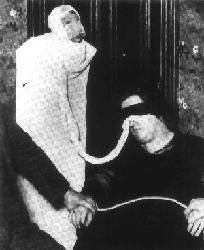
Duncan was born in Callander, Stirling, northwest of the city of Stirling, in November, 1897. The daughter of a cabinet-maker, she made her name as a medium by offering seances in which she appeared to summon the spirits of recently deceased persons by emitting ectoplasm from her mouth. A mother of six and the wife of a wounded veteran, she also worked part-time in a bleach factory.
[edit] Practising medium
In 1931, Duncan's method was examined by the London Spiritual Alliance. After an initial positive review, the Alliance denounced her as a fraud. Harry Price (director of the National Laboratory of Psychical Research) was also sceptical and had Helen Duncan perform a number of test seances. She was suspected of swallowing cheesecloth which was then regurgitated as 'ectoplasm'. She reacted violently at attempts to x-ray her, running from the laboratory and making a scene in the street, where her husband had to restrain her, destroying the controlled nature of the test. Her defenders claimed to have witnessed events that could not be explained by trickery.
In 1934, during a seance in Edinburgh, a sitter made a grab at one of her materialisations. The police were called, and the "spirit" was then alleged to be a stockinette undervest. Duncan was found guilty of affray and fake mediumship at Edinburgh Sheriff Court and sentenced to a £10 fine or one month in prison.[1] Duncan's apologists have later claimed that the verdict was not "guilty" but the Scottish verdict of "not proven", based on their interpretation that the conviction was for affray alone.[2]
[edit] HMS Barham sinking
During World War II, Duncan held a seance in Portsmouth at which she indicated knowledge that HMS Barham had been sunk. Because this fact had been kept from the public, the British Admiralty chose to attempt to discredit her. Police arrested her after another seance. She was initially arrested under section 4 of the Vagrancy Act 1824, a minor offence tried by magistrates. However, the authorities regarded the case as more serious, and eventually discovered section 4 of the Witchcraft Act 1735, covering fraudulent "spiritual" activity, which was triable before a jury. Charged alongside her for conspiracy to contravene this Act were Ernest and Elizabeth Homer, who operated the Psychic centre in Portsmouth, and Frances Brown, who was Duncan's agent who went with her to set up séances. There were seven counts in total, two of conspiracy to contravene the Witchcraft Act, two of obtaining money by false pretences, and three of public mischief (a common law offence).
The prosecution may be explained by the mood of near-paranoia surrounding the impending D-Day. The authorities were fearing that she could use her clairvoyant powers to reveal details of the D-Day landing plans.[3] There were also concerns that she was exploiting the recently-bereaved.
Duncan's trial for witchcraft was a minor cause célèbre in wartime London. A number of prominent people, among them Alfred Dodd, an historian and senior freemason, testified that they were convinced that she was authentic. Duncan was however, barred by the Judge from demonstrating her alleged powers as part of her defence against being fraudulent. The jury brought in a guilty verdict on count one, and the Judge then discharged the jury from giving verdicts on the other counts, as he held that they were alternative offences for which Duncan might have been convicted had the jury acquitted her on count one. Duncan was jailed for nine months. After the verdict, Winston Churchill wrote a memo to Home Secretary Herbert Morrison, complaining about the misuse of court resources on the "obsolete tomfoolery" of the charge.[4]
[edit] Repeal of the Witchcraft Act
Duncan is often referred to as the last person to be convicted of being a witch, but this view is incorrect in two important aspects. Firstly, the Witchcraft Act 1735 under which she was convicted dealt not with witchcraft but with people who falsely claimed to be able to procure spirits. Secondly, there was a subsequent conviction under the act, of Jane Rebecca Yorke of Forest Gate in East Ham later in 1944; Yorke was bound over to keep the peace.[1]
On her release in 1945, Duncan promised to stop conducting seances; however, she was arrested after another one in 1956. She died a short time later. Duncan's trial almost certainly contributed to the repeal of the Witchcraft Act, which was contained in the Fraudulent Mediums Act 1951 promoted by Walter Monslow, Labour Member of Parliament for Barrow-in-Furness. The campaign to repeal the Act had largely been led by Thomas Brooks, another Labour MP, who was a spiritualist.[1] However, her original conviction still stood, and a campaign to have her posthumously pardoned continues.
[edit] Notes
- ^ a b c Scotland’s Last Witch. History oddities. BBC History. Retrieved on 2008-02-29.
- ^ Hewitt, Graham. Latest legal moves to secure Helen's Pardon. Helen Duncan Medium Martyr. Retrieved on 2008-02-29.
- ^ Spell broken for 20th century witch. BBC, January 31, 1998
- ^ Mantel, Hilary (2001-05-03). Unhappy medium. Essays from the London Review of Books. The Guardian. Retrieved on 2008-02-29.
[edit] References
- Gaskill, Malcolm. "Britain's Last Witch," History Today 51 (2001).
- "Hellish Nell," The Daily Mirror, 6 December 2006: 24.
- "The Last Witch-hunt", The Daily Mail 7 February 2005: 15.
- "The Trial of Mrs Duncan", edited by C.E. Bechhofer Roberts (Jarrolds, London, 1945)
- "Harry Price: The Psychic Detective' by Richard Morris (Sutton 2006)
[edit] External links
- Records relating to Harry Price's investigation into Helen Duncan
- Helen Duncan website
- Article in World War II magazine about Duncan and the HMS Barham
- The Harry Price Website - Psychical researcher Harry Price's 1931 examination of Helen Duncan's seance room practices.
- Photograph of an alleged spirit manifestation by Helen Duncan
- Campaign to have Helen Duncan posthumously pardoned
|
|||||||||||