Heine–Borel theorem
From Wikipedia, the free encyclopedia
In mathematical analysis, the Heine–Borel theorem, named after Eduard Heine and Émile Borel, states:
For a subset S of Euclidean space Rn, the following two statements are equivalent:
- S is closed and bounded
- every open cover of S has a finite subcover, that is, S is compact.
In the context of real analysis, the former property is sometimes used as the defining property of compactness. However, the two definitions cease to be equivalent when we consider subsets of more general metric spaces and in this generality only the latter property is used to define compactness. In fact, the Heine–Borel theorem for arbitrary metric spaces reads:
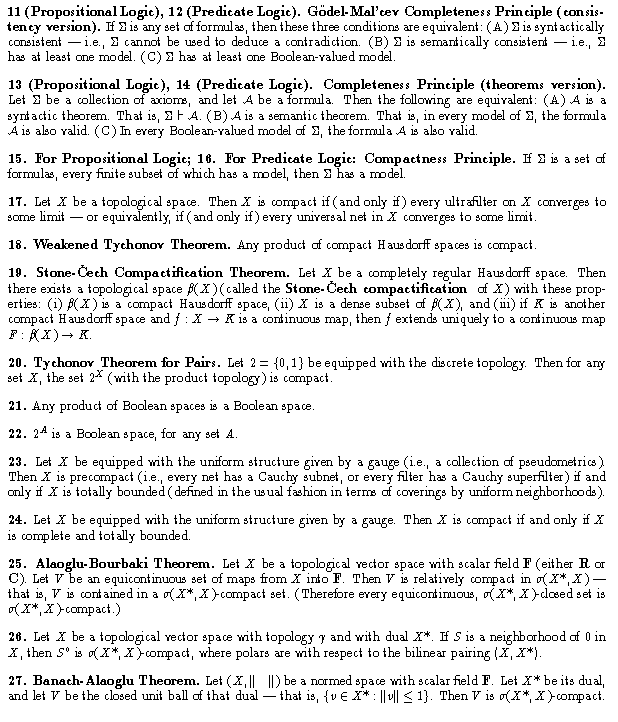
- A subset of a metric space is compact if and only if it is complete and totally bounded.
Contents |
[edit] History and motivation
The history of what today is called the Heine–Borel theorem starts in the 19th century, with the search for solid foundations of real analysis. Central to the theory was the concept of uniform continuity and the theorem stating that every continuous function on a closed interval is uniformly continuous. Dirichlet was the first to prove this and implicitly he used the existence of a finite subcover of a given open cover of a closed interval in his proof. He used this proof in his 1862 lectures, which got published only in 1904. Later Eduard Heine, Karl Weierstrass and Salvatore Pincherle used similar techniques. Emile Borel in 1895 was the first to state and prove a form of what is now called the Heine–Borel theorem. His formulation was restricted to countable covers. Lebesgue (1898) and Schoenflies (1900) generalized it to arbitrary covers.
[edit] Proof
If a set is compact, then it must be closed.
Let a set S be compact. A finite collection C of open sets which do not intersect at least one neighborhood of an accumulation point  cannot be an open cover of S, because the intersection of those neighborhoods not met forms an open set, which contains a point in S not covered by C.
Consider a collection C’ consisting of a neighborhood  for each
  . If S is not closed then it has an accumulation point not in S, call it
  . Then choose (when constructing C’), for each , an
  which is small enough to not intersect some neighborhood of . Then any subcover of C' has the form of C discussed previously, an thus cannot be an open subcover of S. This contradicts the compactness of S. Thus every accumulation point of S is in S, so S is closed.
If a set is compact, then it is bounded.
Why? Consider the open balls centered upon a common point, with any radius. This can cover any set, because all points in the set are some distance away from that point. Any finite subcover of this cover must be bounded, because it will bound it within the largest open ball within that subcover. Therefore, any set covered by this subcover must also be bounded.
If a set is closed and bounded, then it is compact.
If a set S in  is bounded, then it can be enclosed within an n-box
![[a_1, b_1] \times [a_2, b_2] \times ... \times [a_n, b_n]](../../../../math/6/9/4/6944b8ba85a9a445ee438f546ed76f4e.png)
where ak < bk;  for
for  . Call this n-box T0.
Through bisection of each of the sides of T0, T0 can be broken up into 2n sub n-boxes, each of which has 1 / 2n the size of T0.
Assume, by way of contradiction, that T0 is not compact. Then, given an infinite open cover C of T0, at least one of the 2n sections of T0 must require an infinite subcover of C (otherwise C itself would have a finite subcover, by uniting together the finite covers of the sections), call this section T1.
Likewise T1 's sides can be bisected, yielding 2n sections of T1, at least one of which must require an infinite subcover of C. Continuing in like manner yields a decreasing sequence of nested n-boxes:

whose length, when projected onto a given xj-axis is (bj − aj) / 2k, which tends to 0 as  .
.
Then
 , (Cantor’s Intersection Theorem)
but instead contains some point  . Since C covers T0, then it has some member
  such that
  . Since U is open, there is an n-ball
  . For large enough n,
  , but then the infinite number of members of C needed to cover Tn can be replaced by just one: U, a contradiction.
Thus, T is compact. Since S is closed and a subset of the compact set T, then by the lemma (below) it is also compact.
A closed subset of a compact set is compact.
Let K be a closed subset of a compact set T in . Let CK be an infinite open cover of K. If CK also covers T, then since T is compact, then CK has a finite subcover, and we are done.
Otherwise  is an open set containing points in T not covered by CK. Let

be an open cover of T. Since T is compact, then CT has a finite subcover CT'. Since  covers points in T not covered by CK, then
  . Thus
  where CK' must be a finite subcover of CK. Since does not cover
  , then
  , so CK has a finite subcover.
[edit] Generalizations
The proper generalization to arbitrary metric spaces is:
- A subset of a metric space is compact if and only if it is complete and totally bounded.
This generalisation also applies to topological vector spaces and, more generally, to uniform spaces.
Here is a sketch of the "⇒"-part of the proof, in the context of a general metric space, according to Jean Dieudonné:
- It is obvious that any compact set E is totally bounded.
- Let (xn) be an arbitrary Cauchy sequence in E; let Fn be the closure of the set { xk : k ≥ n } in E and Un := E − Fn. If the intersection of all Fn were empty, (Un) would be an open cover of E, hence there would be a finite subcover (Unk) of E, hence the intersection of the Fnk would be empty; this implies that Fn is empty for all n larger than any of the nk, which is a contradiction. Hence, the intersection of all Fn is not empty, and any point in this intersection is an accumulation point of the sequence (xn).
- Any accumulation point of a Cauchy sequence is a limit point (xn); hence any Cauchy sequence in E converges in E, in other words: E is complete.
A proof of the "<="-part can be sketched as follows:
- If E were not compact, there would exist a cover (Ul)l of E having no finite subcover of E. Use the total boundedness of E to define inductively a sequence of balls (Bn) in E with
- the radius of Bn is 2−n;
- there is no finite subcover (Ul∩Bn)l of Bn;
- Bn+1 ∩ Bn is not empty.
- Let xn be the center point of Bn and let yn be any point in Bn+1 ∩ Bn; hence we have d(xn+1, xn) ≤ d(xn+1, yn) + d(yn, xn) ≤ 2−n−1 + 2−n ≤ 2−n+1. It follows for n ≤ p < q: d(xp, xq) ≤ d(xp, xp+1) + ... + d(xq−1, xq) ≤ 2−p+1 + ... + 2−q+2 ≤ 2−n+2. Therefore, (xn) is a Cauchy sequence in E, converging to some limit point a in E, because E is complete.
- Let I0 be an index such that
 contains a; since (xn) converges to a and is open, there is a large n such that the ball Bn is a subset of - in contradiction to the construction of Bn.
The proof of the "=>" part easily generalises to arbitrary uniform spaces, but the proof of the "<=" part is more complicated and is equivalent to the ultrafilter principle [1], a strong form of the axiom of choice. (Already, in general metric spaces, the "<=" direction requires the Axiom of dependent choice.)
[edit] Notes
- ^ Eric Schechter (1997). Handbook of Analysis and Its Foundations. Academic Press. ISBN 0-12-622760-8. UF24, p. 506.
[edit] References
- P. Dugac (1989). "Sur la correspondance de Borel et le théorème de Dirichlet-Heine-Weierstrass-Borel-Schoenflies-Lebesgue". Arch. Internat. Hist. Sci. 39: 69-110.
- proof of Heine-Borel theorem on PlanetMath
[edit] See also
[edit] External links
- Ivan Kenig, Dr. Prof. Hans-Christian Graf v. Botthmer, Dmitrij Tiessen, Andreas Timm, Viktor Wittman. (2004). The Heine-Borel Theorem (avi • mp4 • mov • swf • streamed video). Hannover: Leibniz Universität.