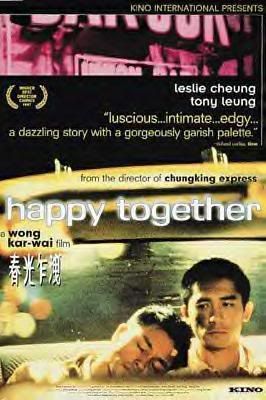
Happy Together (film)
From Wikipedia, the free encyclopedia
| Happy Together | |
| [[Image:[IMG]http://i85.photobucket.com/albums/k66/aagizer/HappyTogether.jpg[/IMG] writer = Wong Kar-wai|200px]] | |
|---|---|
| Directed by | Wong Kar-wai |
| Produced by | Chan Ye-cheng |
| Starring | Tony Leung Leslie Cheung Chang Chen |
| Distributed by | Kino International |
| Release date(s) | 1997 |
| Running time | 96 min |
| Language | Cantonese Mandarin Spanish |
| Preceded by | Fallen Angels (1995) |
| Followed by | In the Mood for Love (2000) |
| IMDb profile | |
| Chinese name | |
| Simplified Chinese: | |
| Traditional Chinese: | |
| Pinyin: | chūn guāng zhà xiè |
Happy Together (Chinese: 春光乍泄; pinyin: chūn guāng zhà xiè) is a 1997 Hong Kong movie directed by Wong Kar-wai, starring Leslie Cheung and Tony Leung Chiu Wai, that depicts the eventual conclusion of a turbulant romance between two men.
The film received positive appraisals from several film festivals; this included winning Best Director at the Cannes Film Festival.[1]
Contents |
[edit] Plot outline
A gay couple, Ho Po-Wing (Leslie Cheung) and Lai Yiu-fai (Tony Leung Chiu Wai), from pre-handover Hong Kong visit Argentina to renew their ailing relationship. The two have a continual pattern of abuse, followed by break-up then reconciliation. One of their main goals there is to visit the Iguazu waterfalls which serves as a leitmotiv in the movie.
The movie unfolds in the following sections:
Part 1
As the two arrive into Argentina, they pick a car. During the ride however, they get into an argument and break up. Lai (played by Tony Leung) is the more stable and committed of the two, and desires nothing more than a fairly normal life. He tries to deal with the break up rationally and gets a job at a local nightclub. Ho (played by Leslie Cheung) has an extremely destructive personality and is not able to commit to a monogamous relationship. Ho seems to be motivated by a both a need for attention as well as a need to simply hurt Fai. Ho picks up numerous other men, and even goes so far to bring them to the club that Lai works at. Lai tries very hard to lead a normal life at this point, but is nearly driven to the brink.
Part 2
One day Ho Po-Wing turns up severely beaten at Lai Yiu-fai's apartment, who takes him in and begins to take care of him. Ho's hands are injured so at this point, he relies on Lai for nearly everything. Initially, Lai works hard to keep Ho at bay physically and emotionally. However in the end, they get back together. Their actions indicate a continual pattern of abuse, break-up, finally followed by reconciliation. As in the previous times, in the beginning Ho does try to make the relationship work, but gradually the destructive side of his personality takes over and the familiar cycle of mutual abuse and dependence starts once more.
Part 3
As Lai and Ho's relationships starts falling apart again, Lai befriends Chang, a fellow Chinese from Taiwan at work. In some sense, Chang is Ho's opposite. Whereas Ho is manipulative and volatile, Chang is straightforward and stable. After Ho fully recovers, he resumes his playboy lifestyle and leaves Lai. Lai copes with the loss by spending more and more time with Chang. It is hinted that Chang is attracted to Lai, stating that he 'deep, low voices', and asking Lai to record something on a portable tape-recorder before Chang leaves Buenos Aries. Chang's unassuming self-awareness and sincerity help Lai out of his depression, contributing to his eventual realization that his relationship with Ho Po-Wing is based on an ideal which no longer has any basis in reality.
Part 4
After a few months, Ho again contacts Lai, but this time, Lai has the strength to avoid starting the cycle. While on the surface, Ho is angry about Lai's rejection, privately he also mourns this loss. Eventually, Lai finds the strength to visit the waterfalls and return to Hong Kong.
[edit] Critical reception
 |
This article or section deals primarily with the United States and does not represent a worldwide view of the subject. Please improve this article or discuss the issue on the talk page. |
Due to the international recognition that the film received, it was reviewed in several major U.S. publications. Edward Guthmann, of the San Francisco Chronicle, gave the film an ecstatic review, lavishing praise on Wong for his innovative cinematography and directorial approach; whilst naming Jack Kerouac, William Burroughs amongst those who would have been impressed by his film.[2] Stephen Holden, of the New York Times, said it was more coherent, heartfelt movie than the Wong's previous films, without losing the stylism and brashness of his earlier efforts.[3]
However, Jonathan Rosenbaum gave the film a mixed review in the Chicago Reader. Rosenbaum, in a summary of the film, criticized it for having a vague plotline and chastised Wong's "lurching around".[4] In Box Office Magazine, Wade Major gave the film one of its most negative reviews; saying that it offered, "little in the way of stylistic or narrative progress, although it should please his core fans." He deprecated Wong's cinematography, labelling it "random experimentation" and went on to say this was inexcusable due to the lack of narrative.[5]
Wong, in reply to the interpretation of the film said:
- "In this film, some audiences will say that the title seems to be very cynical, because it is about two persons living together, and at the end, they are just separate. But to me, happy together can apply to two persons or apply to a person and his past, and I think sometimes when a person is at peace with himself and his past, I think it is the beginning of a relationship which can be happy, and also he can be more open to more possibilities in the future with other people."[6]
[edit] Box Office
During its Hong Kong theatrical release, Happy Together made HK $8,600,141 at the box office. The tally is unspectacular, but respectable given the subject matter and restrictive Category III rating. It was also typical of a Wong Kar Wai film.
Happy Together also had a limited theatrical run in North America through Kino International, where it grossed US $320,319.
[edit] Awards and nominations
- 1997 Cannes Film Festival
- Won: Best Director (Wong Kar-wai)
- Nominated: Palme d'Or
- 1998 Arizona International Film Festival
- Won: Audience Award - Most Popular Foreign Film
- 1997 Golden Horse Awards
- Won: Best Cinematography (Christopher Doyle)
- Nominated: Best Director (Wong Kar-wai)
- Nominated: Best Actor (Leslie Cheung)
- 1997 Hong Kong Film Awards
- Won: Best Actor (Tony Leung Chiu-Wai)
- Nominated: Best Picture
- Nominated: Best Director (Wong Kar-wai)
- Nominated: Best Actor (Leslie Cheung)
- Nominated: Best Supporting Actor (Chang Chen)
- Nominated: Best Art Direction (William Chang)
- Nominated: Best Cinematography (Christopher Doyle)
- Nominated: Best Costume and Make-up Design (William Chang)
- Nominated: Best Film Editing (William Chang, Wong Ming-lam)
- 1998 Hong Kong Film Critics Society Awards
- Film of Merit
- 1998 Independent Spirit Awards
- Nominated: Best Foreign Film
[edit] See also
[edit] References
- ^ IMDb - Awards section Retrieved February 19
- ^ "Misery Loves Company in `Happy Together'", San Francisco Chronicle, Edward Guthmann, 1997-10-14. Retrieved February 19, 2008
- ^ "NY Times Review", New York Times, Stephen Holden. Retrieved February 19, 2008
- ^ "Cult Confusion", Chicago Reader, Jonathan Rosenbaum, 1997. Retrieved February 19, 2008
- ^ Template error: argument title is required. Retrieved February 19, 2008
- ^ Wong Kar-wai Exclusive Interview Retrieved February 19, 2008
[edit] External links
|
|||||