Han van Meegeren
From Wikipedia, the free encyclopedia
| Han van Meegeren | |
 Before his trial Han van Meegeren demonstrated his forgery techniques before an expert panel by painting his last forgery Jesus among the Doctors.
|
|
| Born | 10 October 1889 Deventer, Overijssel |
|---|---|
| Died | 30 December 1947 (aged 58) Amsterdam |
| Occupation | Painter, Art forger |
| Spouse | Anna de Voogt, Jo Oerlemans |
| Children | Jacques Henri Emil, Pauline, Viola de Boer (stepdaughter) |
| Parents | Hendrikus Johannes van Meegeren and Augusta Louisa Henrietta Camps |
Han van Meegeren (10 October 1889 in Deventer, Overijssel – 30 December 1947 in Amsterdam), born Henricus Antonius van Meegeren, was a Dutch painter and portraitist, and is considered to be one of the most ingenious art forgers of the 20th century.[1]
As a child Van Meegeren developed an enthusiasm for the marvelous colours used by painters of the Dutch Golden Age, and later set out to become an artist himself. When art critics decried his work as tired and derivative, Van Meegeren felt that the critics had destroyed his career. Thereupon, he decided to prove his talent to the critics by forging paintings of some of the world's most famous artists, including Frans Hals, Pieter de Hooch, Gerard ter Borch and Johannes Vermeer. He so well replicated the styles and colours of the artists he copied, that the best art critics and experts of the time regarded his paintings as genuine, and sometimes exquisite. His most successful forgery was The Disciples at Emmaus, created in 1937 while living in the south of France. This painting was hailed by some of world’s foremost art experts as the finest Vermeer they had ever seen.
During World War II, wealthy Dutchmen, wanting to prevent a sellout of Dutch art to Adolf Hitler and the Nazi Party, avidly bought Van Meegeren's forgeries. Nevertheless a falsified "Vermeer" ended up in the possession of Reichsmarschall Hermann Göring. Following the war, the forgery was discovered in Göring's possession, and Han van Meegeren was arrested 29 May 1945 as a Collaborator, as the officials believed that he had sold Dutch cultural property to the Nazis. These crimes threatened extensive prison time and so Van Meegeren fearfully confessed to the forgery. On 12 November 1947 Van Meegeren was convicted of falsification and fraud charges, and was sentenced to a modest punishment of one year in prison. He never served his sentence, however; before he could be incarcerated Van Meegeren suffered a heart attack and died on 30 December 1947. It is estimated that Van Meegeren duped buyers out of several million dollars.
Contents |
[edit] Artistic development
Han (a diminutive version of Henri or Henricus) van Meegeren was born the third child of Roman Catholic parents in the town of Deventer. He was the son of Augusta Louisa Henrietta Camps and Hendrikus Johannes van Meegeren, an French and history teacher at the Kweekschool (training college for schoolmasters) in the city of Deventer.
[edit] Early years
Early on, Han felt neglected and misunderstood by his father, as the elder Van Meegeren strictly forbade Han’s artistic development, and constantly derided him. He was often forced by his father to write a hundred times the phrase: “I know nothing, I am nothing, I am capable of nothing."[2][3] While attending the Higher Burger School, he met teacher and painter Bartus Korteling (1853 - 1930), who would become his mentor. Korteling had been inspired by Johannes Vermeer and showed the young Van Meegeren how Vermeer had manufactured and mixed his colours. Korteling had rejected the Impressionist Movement and other modern trends, as decadent, degenerate art, and his strong personal influence probably later led Van Meegeren to rebuff contemporary styles, and to paint exclusively in the style of the Dutch Golden Age.[4]


Van Meegeren's father did not share his son’s love of art, and instead, encouraged Han to study architecture. In 1907 Van Meegeren, compelled by his father's demands, left home to study at the Technische Hogeschool in Delft (Delft Technical College), the hometown of the Johannes Vermeer. In addition to his architectural studies, Van Meegeren received drawing and painting lessons as well. During his studies Van Meegeren easily passed his preliminary examinations, but because he did not wish to become an architect, he never took the Ingenieurs (final) examination. He nevertheless proved to be an apt architect, and in fact designed the clubhouse for his rowing club DDS in Delft (see image). This building still exists and has been designated a protected monument.[5]
In 1913 Van Meegeren gave up his architecture studies and concentrated on drawing and painting at the art school in The Hague. On 8 January 1913 he received the prestigious Gold Medal from the Technical University in Delft, for his Study of the Interior of the Church of Saint Lawrence (Laurenskerk) in Rotterdam.[2] The award was given every five years to an art student that created the best work, and was accompanied by a gold medal.
On 18 April 1912 Van Meegeren married a fellow art student, Anna de Voogt, who was expecting their first child.[6] After the marriage ceremony, the couple went to live with Anna’s grandmother in Rijswijk. Their son Jacques Henri Emil was born on 26 August 1912 in Rijswijk. Jacques van Meegeren would also become a painter; he died on 26 October 1977 in Amsterdam.
[edit] Career as a painter

In the summer of 1914 Van Meegeren moved his family to Scheveningen. He completed the diploma examination at the Royal Academy of Art in The Hague, receiving his diploma in drawing on 4 August 1914. The diploma would allow him to teach, and soon he took a position as the assistant to the Professor of Drawing and Art History—Prof. Gips—for the small monthly salary of 75 guldens. In March 1915 his daughter Pauline (later called Inez) was born. To supplement his income, Han would sketch posters and paint pictures (generally Christmas cards, still-life, landscapes, and portraits) for the commercial art trade.[6] Many of these paintings are quite valuable today.[7]
Van Meegeren showed his first paintings publicly in The Hague, where they were exhibited from April to May 1917 at the Kunstzaal Pictura. In December 1919 he was accepted as a select member to the Haagse Kunstkring, an exclusive society of writers and painters, who met weekly on the premises of the Ridderzaal. In his studio at The Hague, opposite the Royal Palace Huis ten Bosch, Van Meegeren would paint the tame Roe Deer belonging to Princess Juliana.[8][6] He made many sketches and drawings of the deer and in 1921 painted Hertje (The fawn), which became quite popular in the Netherlands. Van Meegeren undertook numerous journeys to Belgium, France, Italy and England, and acquired a name for himself as a talented portraitist. He earned stately fees through commissions by the English and American society-circles, which spent their winter vacations on the Côte d'Azur. His clients were impressed by his understanding of the 17th century techniques of the Dutch masters. Throughout his life Van Meegeren would paint pictures to which he would sign his own signature, which differed greatly from the marks he used on his forgeries.[9]
By all accounts infidelity was responsible for the break up of Van Meegeren’s marriage to Anna de Voogt, and they were divorced on 19 July 1923.[10][11] Anna left with the children and moved to Paris, where from time to time, Van Meegeren would visit his children. Van Meegeren now dedicated himself to portraiture and began producing forgeries, as a means to increase his income.[12] In 1928 he was remarried, in Woerden, to the actress Johanna Theresia Oerlemans (also known under her stage-name Jo van Walraven), with whom he had been living for the past three years. Jo had previously been married to art critic and journalist, Dr. C H. de Boer (Karel de Boer), and she brought their daughter, Viola, into the Van Meegeren household.[6]
[edit] The forgeries
In the Netherlands Han van Meegeren had become a well-known and wealthy painter. Hertje (1921) and Straatzangers (1928) were particularly popular, and until 1927 he had received mostly praise for his works from the art critics. His first imitations were painted in 1923–his Laughing Cavalier and Happy Smoker–both in the style of Frans Hals. By 1928 the similarity of Van Meegeren’s paintings of those of the old masters began to draw the reproach of Dutch art critics, which were, at that time, more interested in the Cubist, Surrealist and other movements. It was said that Van Meegeren’s gift was in imitation and that, outside of copying other artist’s work, his talent was limited.[3] One critic wrote that Van Meegeren was "A gifted technician who has made a sort of composite facsimile of the Renaissance school, he has every virtue except originality."[13] In response to these comments Van Meegeren published a series of aggressive articles in the monthly magazine De Kemphaan (“The Game Cock”). Between April 1928 - March 1930, and together with painter, Theo van Wijngaarden, and journalist, January Ubink, Van Meegeren raged against the art community, and in the process lost any sympathy with the critics.[14]
Van Meegeren felt that his genius had been misjudged, and set out to prove to the art critics that he could not only copy the style of the Dutch masters in his paintings, but that he could produce a work of art so magnificent that it would rival the works of master painters. He moved with his second wife, Jo, to the South of France and began preparations for this ultimate forgery, which took him six years (1932 - 1937). In a series of early exercises he forged works by Frans Hals, Pieter de Hooch, Gerard ter Borch and Johannes Vermeer.[15] In the end he chose to forge a painting by the Dutch painter Johannes Vermeer, who had died in 1675, as his masterpiece. Vermeer had not been particularly well-known until the beginning of the twentieth century; his works were both scarce—only about 35 of Vermeer's works have survived—and extremely valuable.[16]
Van Meegeren delved into the biographies of the old masters, studying their lives, their occupations, their trademark techniques and their catalogues. In October of 1932 Dr. Abraham Bredius published an article about a recently discovered Vermeer which he described as a painting of a Man and Woman at a Spinet.[17] The painting was later sold to Amsterdam banker, Dr. Fritz Mannheimer. .
[edit] Inventing the "perfect forgery"
In 1932 Van Meegeren moved to the village of Roquebrune-Cap-Martin with his second wife. There he rented the furnished mansion, “Primavera”. In Roquebrune he set out to define the chemical and technical procedures which would be necessary to create his perfect forgeries. Van Meegeren bought authentic 17th century canvas to paint on, and mixed his own paints from raw materials (such as lapis lazuli, white lead, indigo, and cinnabar) using old formulas to ensure that they were authentic. In addition he used badger hair paintbrushes, similar to those Vermeer was known to have used. He came up with a scheme of using phenolformaldehyde to cause the paints to harden after application, making the paintings appear as if they were 300 years old. After completing a painting, Van Meegeren would bake it at 100 °C (212.0 °F) to 120 °C (248.0 °F) to harden the paint, and then roll it over a cylinder to increase the cracks. Later he would wash the painting in black (India) ink to fill in the cracks.[18]

It took Van Meegeren six years to work out his techniques, and when he was done he was pleased with his work, on both an artistic and deceptive level. Two of these trial paintings, using the falsification technology he had developed, were “Vermeers”: Lady Reading Music after Vermeer’s Woman in Blue Reading a Letter at the Rijksmuseum in Amsterdam, and Lady Playing Music after Vermeer’s Woman with a Lute near a window hanging in the Metropolitan Museum of Art in New York City. Van Meegeren did not sell these paintings, both are now at the Rijksmuseum.
Following a journey to the 1936 Summer Olympics in Berlin, Van Meegeren painted The Disciples at Emmaus, using the ultramarine blues and yellows preferred by Johannes Vermeer and other Dutch Golden Age painters. After learning that the experts assumed Vermeer had studied in Italy, Van Meergeren used The Supper at Emmaus by Michelangelo Merisi da Caravaggio, located at Italy’s Pinacoteca di Brera, as a model for his next work. He had always wanted to walk in the steps of the masters, and he felt that his forgery, The Disciples at Emmaus, was a fine work in its own right. Van Meegeren gave the forgery to his friend, the attorney C. A. Boon, telling him it was a genuine Vermeer, and asked him to show it to the famous art connoisseur and Vermeer expert, Dr. Abraham Bredius, who was living nearby in Monaco. Bredius examined the forgery in September 1937,[19] and despite some initial doubts he accepted it as a genuine Vermeer and praised it highly.
The painting was purchased by The Rembrandt Society for 520,000 guilders ($300,000 or about $4 million today.[20]) with the aid of a wealthy ship-owner Willem van der Vorm, and donated to the Museum Boijmans Van Beuningen in Rotterdam. In 1938, the piece was highlighted in a special exhibition at the Rotterdam museum along with 450 Dutch masterpieces dating from 1400-1800. In the "Magazine for [the] History of Art", A. Feulner wrote that: “In the rather isolated area, in which the Vermeer picture hung, it was as quiet as in a chapel. The feeling of the consecration overflows on the visitors, although the picture has no ties to ritual or church."[21]
In the summer of 1938 Han van Meegeren moved to Nice. Using the proceeds from the sale of The Disciples at Emmaus he bought a 12 bedroom estate at Les Arènes de Cimiez. On the walls of the estate hung several Old Masters (genuine this time). Two of Van Meegeren’s better forgeries were made here, Interior with Cardplayers and Interior with Drinkers, both displaying the signature of Pieter de Hooch. During his time in Nice, Van Meegeren painted his Last Supper I, in the style of Vermeer.[22]
In September 1939, as the Second World War threatened, Han van Meegeren returned to the Netherlands. He remained at a hotel in Amsterdam for several months and in 1940 moved to the village of Laren. Throughout 1941 Van Meegeren issued his designs, which he would publish in 1942 as Han van Meegeren: Teekeningen I (Drawings nr I) a large and luxurious book. During this time Van Meegeren created several forgeries, including The Head of Christ, The Last Supper II, The Blessing of Jacob, The Adulteress and The Washing of the Feet, all in the manner of Vermeer. On 18 December 1943 he separated from his second wife, Jo Oerlemans. The divorce was meant as a formality only: a large share of his capital was transferred to her accounts as a safe-guard against the uncertainties of the war.
In December 1943 the Van Meegerens moved to Amsterdam, where they took up residence in the exclusive Keizersgracht 321.[23] His forgeries had earned him between 5.5 to 7.5 million guilders (or about $25-30 million today[20]).[24] He used this money to purchase a large amount of real estate, jewelry and works of art, and to further his luxurious life-style. In a 1946 interview, he told Marie Louise Doudart de la Grée that he owned 52 houses and 15 country houses around Laren, among them "grachtenhuizen", beautiful mansions along the famous Amsterdam canals.[2]
[edit] The forger fools Hermann Göring
Under the German occupation of the Netherlands, one of Van Meegeren’s agents sold a Vermeer forgery, Christ with the Adulteress, to Nazi banker and art dealer Alois Miedl in 1942. Experts could probably have identified it as a forgery; as Van Meegeren's health declined, so did the quality of work. He chain-smoked, drank heavily and became addicted to morphine-laced sleeping pills. Fortunately for Van Meegeren, there were no genuine Vermeers available for comparison, since most museum collections were in protective storage, as a prevention against war damage.[25] Miedl later sold it to Reichsmarshall Hermann Göring for 1.65 million guilders ($625,000 or $7 million today.[20])
Hermann Göring showcased the Vermeer forgery at his residence in Carinhall (about 65 kilometers north of Berlin). On 25 August 1943 Hermann Göring hid his collection of looted artwork, including Christ with the Adulteress in an Austrian salt mine, along with 6,750 other pieces of artwork looted by the Nazis. On 17 May 1945, the allied forces entered the salt mine, where Captain Harry Anderson discovered the previously unknown "Vermeer".
In May of 1945, the allied forces questioned banker and art dealer, Alois Miedl, regarding the newly discovered Vermeer. Based on Miedl's confession, the painting was traced back to Van Meegeren. On 29 May 1945 Han van Meegeren was arrested and charged with fraud and aiding and abetting the enemy. He was remanded to Weteringschans prison. As an alleged Nazi collaborator and plunderer of Dutch cultural property the authorities threatened Van Meegeren with extensive prison time.[13] Faced with these bleak choices, and after spending three days in jail, he confessed to forging paintings attributed to Vermeer and Pieter de Hooch.[26] He exclaimed: "The painting in Göring’s hands is not, as you assume, a Vermeer of Delft, but a Van Meegeren! I painted the picture!".[27] It took some time to verify this and for several months Van Meegeren was detained in the Headquarters of the Military Command, at Herengracht 468 in Amsterdam.[28] Between July and about November/December of 1945, and in the presence of reporters and court-appointed witnesses, Van Meegeren painted his last forgery, Jesus among the Doctors, also called Young Christ in the Temple.[29]. After the trial painting was finished he was transferred to the fortress-prison Blauwkapel. Van Meegeren was released from prison in January or February of 1946.
[edit] Trial, sentence and death
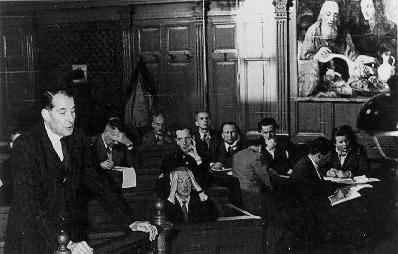
The trial of Han van Meegeren began on 29 October 1947 in Room 4 of the Regional Court in Amsterdam.[30] The collaboration charges had been dropped, since the expert panel had found that the "Vermeer" sold to Hermann Göring by Han van Meegeren had been a forgery and was, therefore, not the cultural property of the Netherlands. The public prosecutor, H. A. Wassenbergh, brought charges of forgery and fraud against Han van Meegeren, and demanded that the defendant serve two years in prison for his crimes.
The court commissioned an international group of experts to address the authenticity of Van Meegeren's paintings. The commission included curators, professors and doctors from the Netherlands, Belgium and England and was led by the director of the chemical laboratory at the Royal Museums of Fine Arts of Belgium, Dr. Paul Coremans.[31][32] The commission examined the Vermeer and Frans Hals paintings which Han van Meegeren had designated as forgeries. With the help of the commission Dr. Coremans was able to determine the chemical composition of Han van Meegeren’s paints. He found that Van Meegeren had prepared the paints by mixing them with the plastic bonding agent Albertol, a phenolformaldehyde resin.[11] A bottle with exactly that ingredient had been found in Van Meegeren's studio. This chemical component was introduced and manufactured in the 20th century, proving that the “Vermeers” and “Frans Halses” examined by the commission were not painted in the 17th century by the Dutch masters, but were in fact recent endeavours, made by Van Meegeren.[33] Thus, the test results obtained by the commission appeared to confirm that the works were forgeries created by Van Meegeren, but their authenticity would continue to be debated by some of the experts until 1967 and 1977, when new investigative techniques were used to analyze the paintings (see below).
On 12 November 1947 the Fourth Chamber of the Amsterdam Regional Court found Han van Meegeren guilty of forgery and fraud, and he was sentenced to a minimal one year in prison[34] On 26 November 1947, the last day to appeal the ruling, Van Meegeren suffered a heart attack and was rushed to the Valeriuskliniek hospital in Amsterdam.[35]. While at the hospital, Van Meegeren suffered a second heart attack on 29 December, and was pronounced dead at 5:00 pm on 30 December 1947 at the age of 58. His family and several hundred of his friends attended his funeral at the Driehuis Westerveld Crematorium chapel. In 1948 his urn was buried in the general cemetery in the village of Diepenveen (municipality of Deventer).[36]
[edit] Aftermath

The court ruled that Van Meegeren’s estate be auctioned and the proceeds from his property and the sale of his counterfeits be used to refund the buyers of his works and to pay income taxes on the sale of his paintings. In December of 1945 Van Meegeren had filed for bankruptcy. On 5 and 6 September 1950, the furniture and other possessions in Van Meegeren’s Amsterdam house at Keizersgracht 321 were auctioned by order of the court, along with 738 other pieces of furniture and works of art, including numerous paintings by old and new masters from Van Meegeren's private collection. The house was auctioned separately on 4 September. Together with his Amsterdam house, estimated to be worth 65,000 guilders, the proceeds of the sale amounted to 123,000 guilders. Van Meegeren’s unsigned painting The Last Supper I was bought for 2,300 guilders, while the forgery Jesus among the Doctors (which Van Meegeren had painted while in detention) sold for 3,000 guilders (about $800 or about $7,000 today.[20]) Today the painting hangs in a Johannesburg church. The sale of the Van Meegeren’s entire estate amounted to 242,000 guilders[37] ($60,000, or about $0.5 million today[20]).
Throughout his trial and bankruptcy, Van Meegeren maintained that his second wife, Jo, had nothing to do with the creation and sale of his forgeries. A large part of his considerable wealth had been transfered to her when they were divorced during the war, and the money would have been confiscated, if during her husband's trial she had been ruled to be an accomplice. To all authors, journalists and biographers Van Meegeren told the same story: "Jo didn’t know" and they believed him. Some biographers believe, however, that Jo must have known the truth.[3] Her involvement was never proven, and she was able to keep her substantial capital. Jo outlived her husband by many years, always in great luxury, until her death at the age of 91.
[edit] M. Jean Decoen's objection
M. Jean Decoen, a Brussels art expert and restorer, stated in his 1951 book that he believed two of Van Meegeren's paintings, The Disciples at Emmaus and The Last Supper II, to be genuine Vermeers. Decoen went on to state that conclusions of Dr. Paul Coreman’s panel of experts were wrong and that the paintings should again be examined.[38][39]
The buyer of The Last Supper II, Interior with Drinkers, and The Head of Christ, ship-owner Daniel George van Beuningen, demanded that Dr. Paul Coremans publicly admit that he had erred in his analysis of Van Meegeren’s paintings. When Coremans refused, Van Beuningen sued him, alleging that Coremans’ wrongful branding of The Last Supper II diminished the value of his “Vermeer” and asking for compensation of £500,000 (about $1.3 million or about $10 million today.[20]) The trial was set for 2 June 1955, but was delayed owing to Van Beuningen's death on 29 May 1955. Approximately seven months later, the court heard the case on behalf of Van Beuningen's heirs. The court found in favour of Coremans, and the findings of his commission were upheld.[40]
[edit] The Carnegie Mellon examination
In 1967, the Artists Material Center at Carnegie Mellon University in Pittsburgh examined several of the “Vermeers” in their collection. Under the direction of Dr. Robert Feller and Dr. Bernard Keisch, the examination confirmed that several of their paintings were, in fact, created using materials invented in the 20th century. They concluded that the “Vermeers” in their possession were modern and could thus be Van Meegeren forgeries. This confirmed the findings of the 1946 Coremans commission, and refuted the claims made by M. Jean Decoen.[41] The test results, obtained by the Carnegie Mellon team are summarized below.
Han van Meegeren knew that white lead was used during Vermeer’s time, but of course Van Meegeren had to obtain his stocks through the modern colour trade, which had changed significantly since the 17th century. During Vermeer’s time, Dutch lead was mined from deposits located in the Low Countries; however, by the 19th century most lead was imported from the rich ores of Australia and the Americas. Thus, modern white lead differs greatly from the white lead Vermeer would have used, both in the isotope composition of the lead and in the content of trace elements found in the ores. Dutch white lead was extracted from ores containing high levels of trace elements of silver and antimony.[42] On the other hand, the modern white lead used by Han van Meegeren contained neither silver nor antimony, as those elements are now separated from the lead during the modern smelting process.[43]
Forgeries in which modern lead or white lead pigment has been used can be recognized by using a technique called Pb(Lead)-210-Dating.[44] Pb-210 is a naturally occurring radioactive element that is part of the Uranium-238 Radioactive decay series, and has a half life of 22.3 years. To determine the amount of Pb-210, the alpha radiation emitted by another element, Polonium-210 (Po-210), is measured.[45] Thus it is possible to estimate the age of a painting, within a few years' span, by extrapolating the Pb-210 content present in the paint used to create the painting.[43][46]
The white lead in the painting The Disciples at Emmaus had Polonium-210 values of 8.5 +/- 1.4 and Radium-226 (part of the Uranium-238 Radioactive decay series) values of 0.8 +/- 0.3. In contrast, the white lead found in Dutch paintings from 1600-1660 had Polonium-210 values of 0.23 +/- 0.27 and Radium-226 values of 0.40+/- 0.47.[41]
[edit] Legacy
Van Meegeren played different roles, some of which were shrouded in fraudulent intentions, as he sought to fulfill his goal of besting his critics. Early on Han’s father may have foreseen his path, as his father once told him: “You are a cheat and always will be."[47] On the other hand his brothers and sisters perceived him as loyal, generous and affectionate; and he was always loving and helpful to his own children. The question “what was his character” cannot been answered unequivocally. With Han van Meegeren everything was double-edged and his character presents itself as fragments rather than unity.
After Van Meegeren was released he continued to paint, signing his works with his own name. His new-found popularity ensured quick sale of Van Meegeren's new paintings, often selling at prices that were many times higher than they had before he had been unmasked as a forger. Van Meegeren also told the news media that "he had an offer from a Manhattan gallery to come to the U.S. and paint portraits "in the 17th century manner" at $6,000 a throw."[48]
A Dutch opinion poll conducted in October of 1947 placed Han van Meegeren’s popularity second in the nation, behind only the Prime Minister's. The Dutch people viewed Van Meegeren as a cunning trickster, who successfully fooled the Dutch art experts, and more importantly fooled Hermann Göring himself. In fact, according to a contemporary account, when Göring was informed that his “Vermeer” was actually a forgery "[Göring] looked as if for the first time he had discovered there was evil in the world".[13] Han van Meegeren remains one of the most ingenious art counterfeiters of the 20th century.[24] After his trial, however, he declared: “My triumph as a counterfeiter was my defeat as [a] creative artist."[49]
[edit] List of forgeries
[edit] Known forgeries

List of known forgeries by Han van Meegeren:[50][51][52]
- A counterpart to The Laughing Cavalier after Frans Hals (1923) once the subject of a scandal in The Hague in 1923, its present whereabouts are unknown.
- The Happy Smoker after Frans Hals (1923) hangs in the Groninger Museum in the Netherlands
- Man and Woman at a Spinet 1932 (sold to Amsterdam banker, Dr. Fritz Mannheimer)
- Lady Reading Music 1935 - 1936 (unsold, on display at the Rijksmuseum.)
- Lady Playing Music 1935 - 1936 (unsold, on display at the Rijksmuseum.)
- Portrait of a Man 1935 - 1936 in the style of Gerard ter Borch (unsold, on display at the Rijksmuseum.)
- Woman Drinking 1935 - 1936 (unsold, on display at the Rijksmuseum.)
- The Disciples at Emmaus, 1936 - 1937 (sold to the Boymans for 520,000 - 550,000 guldens, about $300,000 or $4 Million today)
- Interior with Drinkers 1937 - 1938 (sold to D G. van Beuningen for 219,000 - 220,000 guldens about $120,000 or $1.6 Million today)
- The Last Supper I, 1938 - 1939
- Interior with Cardplayers 1938 - 1939 (sold to W. van der Vorm for 219,000 - 220,000 guldens $120,000 or $1.6 Million today)
- The Head of Christ, 1940 - 1941 (sold to D G. van Beuningen for 400,000 - 475,000 guldens about $225,000 or $3.25 Million today)
- The Last Supper II, 1940 - 1942 (sold to D G. van Beuningen for 1,600,000 guldens about $600,000 or $7 Million today)
- The Blessing of Jacob 1941 - 1942 (sold to W. van der Vorm for 1,270,000 guldens about $500,000 or $5.75 Million today)
- Christ with the Adulteress 1941 - 1942 (sold to Hermann Göring for 1,650,000 guldens about $624,000 or $6.75 Million today)
- The Washing of the Feet 1941 - 1943 (sold to the Netherlands state for 1,250,000 – 1,300,000 guldens about $500,000 or $5.3 Million today, on display at the Rijksmuseum.)
- Jesus among the Doctors- September 1945 (sold at auction for 3,000 guldens, about $800 or $7,000 today)
Posthumously, Van Meegeren's forgeries have been shown in exhibitions around the world, including exhibitions in Amsterdam (1952), Basel (1953), Zurich (1953), Haarlem in the Kunsthandlung de Boer (1958), London (1961), Rotterdam (1971), Minneapolis (1973), Essen (1976-1977), Berlin (1977), Slot Zeist (1985), New York (1987), Berkeley, CA (1990), Munich (1991), Rotterdam (1996), The Hague (1996) and more recently at the Haagse Kunstkring, The Hague (2004) and Stockholm (2004), and have thus been made broadly accessible to the public.[53][54][55]
[edit] Potential forgeries
It is possible that other fakes made by Han van Meegeren hang in art collections all over the world, probably in the style of 17th-century Dutch masters, including works in the style of Frans Hals and the School of Frans Hals, Pieter de Hooch, and Gerard ter Borch. In interviews with journalists[56] regarding discussions with his father[57] Jacques van Meegeren revealed his father had created a number of other forgeries. Some of these paintings include:
- Boy with a Little Dog and The Rommelpotspeler after Frans Hals. The Frans Hals catalogue by Frans L. M. Dony[58] mentions four paintings by this name attributed to Frans Hals or the "school of Frans Hals", one of these could easily be by Van Meegeren.
- A counterpart to Vermeer’s Girl with a Pearl Earring. A painting called Smiling Girl hangs in the National Gallery of Art in Washington, D.C. (bequest Andrew W. Mellon) that fits with Jacques’ description and has been recognized by the museum as a fake. It was attributed to Theo van Wijngaarden, friend and partner of Van Meegeren, but could have been painted by Van Meegeren.
- Lady with a Blue Hat after Vermeer which has hung since the 1930’s as a Vermeer in the Thyssen-Bornemisza Museum (now in Madrid). In 1958 it was recognized as a fake; it was stolen around that time. It’s present whereabouts are unknown.
[edit] Original artwork
Van Meegeren was a prolific artist, and produced thousands of original paintings, in a number of diverse styles. This wide range in painting and drawing styles often irritated art critics. Some of his typical works are classical still lifes in convincing 17th century manner, impressionistic paintings of people frolicking on lakes or beaches, jocular drawings where the subject is drawn with rather odd features, surrealistic paintings with combined fore- and backgrounds. Van Meegeren's portraits, however, were probably his finest works.[5][57]
Among his original works is his famous Deer, pictured above. Other works include his prize-winning St. Laurens Cathedral; a Portrait of the actress Jo Oerlemans (his second wife) ; his Night Club from the Roaring Twenties; the cheerful watercolor A Summer Day on the Beach and many others.
[edit] Notes and references
- ^ Dutton, Denis (2005). "Authenticity in Art", in Jerrold Levinson: The Oxford handbook of aesthetics. Oxford [Oxfordshire]: Oxford University Press, 261-263. ISBN 0-19-927945-4.
- ^ a b c Doudart de la Grée, Marie-Louise(Amsterdam 1966) Geen Standbeeld voor Van Meegeren (No Statue for Van Meegeren). Nederlandsche Keurboekerij Amsterdam. OCLC 64308055 (N.B. Although in Dutch, it most important as a primary source of knowledge. Many citations from Doudart can be read in English in Kilbracken 1951.)
- ^ a b c Godley, John (Lord Kilbracken) (1951). Van Meegeren, master forger. p:127 - 129. New York: Charles Scribner’s Sons. LC call number: ND653.M58 K53 1966. OCLC 31674916
- ^ (Godley, 1951:129 - 134)
- ^ a b Kreuger, Frederik H. (2007) A New Vermeer, Life and Work of Han van Meegeren. Rijswijk, Holland: publishing house Quantes. page 22. ISBN 978-90-5959-047-2
- ^ a b c d Dutton, Denis (1993). "Han van Meegeren (excerpt)", in Gordon Stein; foreword by Martin Gardner: Encyclopedia of hoaxes. Detroit: Gale Research. ISBN 0-8103-8414-0.
- ^ Kreuger 2007
- ^ Kreuger 2007
- ^ Kreuger 2007:208
- ^ Godley, 1951:143-147
- ^ a b Bailey, Anthony (2002). Vermeer: A View of Delft. Clearwater, Fla: Owl Books, 253. ISBN 0-8050-6930-5.
- ^ Kreuger 2007:46 and 56
- ^ a b c Wynne, Frank. "The forger who fooled the world", UK Telegraph, May 8, 2006. Retrieved on 2007-05-25.
- ^ Van Meegeren, Han (partly under alias) (April 1928–March 1930). De Kemphaan.
- ^ Goll, Joachim (1962). Art counterfeiter. p.183. Leipzig: E.A.Seemann Publishing House. Language: German (with pictures Number 106 – 122 and literature pp. 249 – 250).
- ^ Bailey, 2003:233
- ^ Bredius, Abraham (October 1932). "An unpublished Vermeer". Burlington Magazine 61:145.
- ^ Godley, 1951:43-56, 86-90
- ^ Bredius, Abraham (November 1937). "A new Vermeer". Burlington Magazine 71:210-211.
- ^ a b c d e f To obtain the relative value in U.S. currency for a given year the number of guilders was divided by the rate of exchange (guilders or pounds per dollar) for that year. The value in U.S. currency for a given year was then entered into the formula at What is the Relative Value? to obtain the relative value in currency in “today’s” money (Consumer Price Index for 2005).
- ^ Schueller, 1953: 28
- ^ The Last Supper I was later recovered in September 1949, during a search of the estate of Dr. Paul Coremans; x-ray examinations revealed that Van Meegeren had reused the canvas of a painting by Govert Flinck.
- ^ Boissevain, Jeremy (1996) Coping With Tourists: European Reactions to Mass Tourism. Berghahn Books. p233. ISBN 1571818782
- ^ a b Bailey, 2002:234
- ^ Bailey 2003:255
- ^ Kreuger 2007
- ^ Schueller, 1953:16
- ^ Kreuger 2007:146
- ^ Kreuger 2007:152-155
- ^ Godley, 1951:268-281
- ^ Coremans, Paul B. (1949). Van Meegeren’s faked Vermeers and De Hooghs: a scientific examination. Amsterdam: J. M. Meulenhoff. OCLC 2419638.
- ^ Schueller, 1953: 18-19
- ^ Roth, Toni (1971). "Methods to determine identity and authenticity". The art and the beautiful home 83:81-85.
- ^ .TIME Magazine "Truth & Consequences" Monday, Nov. 24, 1947.
- ^ Godley, 1951:282
- ^ ten Dam, René. Dood in Nederland (Dead in the Netherlands) (dutch). Retrieved on 2007-05-25.
- ^ TIME Magazine"Not for Money" Monday, Sep. 18, 1950.
- ^ Decoen, Jean (1950). Back to the truth, Vermeer-Van Meegeren :Two genuine Vermeers. Rotterdam: Editions Ad. Donker. Illustrations: b/w. OCLC 3340265.
- ^ Schueller, 1953:48-58
- ^ Godley, 1951:256-258
- ^ a b Keisch, Bernard, Robert L. Feller, A. S. Levine and R. R. Edwards (1967). "Dating and authenticating works of art by measurement of natural alpha radiation". 155 (3767):1238-1242 PubMed.
- ^ Strauss, R.(1968). "Analysis of investigations of pigments from paintings of south German painters in the 17th and 18th century." (With 62 slides). Thesis. Technical University Munich.
- ^ a b Exhibition catalog Essen and Berlin. Falsification and Research (1976) "Museum Folkwang, Essen and Staatliche Museen Preußischer Kulturbesitz, Berlin". Berlin. Language: German. ISBN 3-7759-0201-5.
- ^ Keisch, Bernard (1968). "Dating works through their natural radioactivity: Improvements and applications". Science 160:413-415. PubMed
- ^ Flett, Robert (October 8, 2003). Understanding the Pb-210 Method.
- ^ Froentjes, W., and R. Breek (1977). "A new study into the identity of the [portfolio] of Van Meegeren". Chemical Magazine: 583-589.
- ^ Doudart de la Grée, 1946a:145, 230
- ^ TIME Magazine The Price of Forgery Monday, Nov. 18, 1946.
- ^ Doudart de la Grée, 1946a:224
- ^ Van Brandhof, Marijke (1979). "Early Vermeer 1937. Contexts of life and work of the painter/falsifier Han van Meegeren". (Catalogue of Han van Meegeren work pp. 153-163, with numerous illustrations of the pictures with the signature H. van Meegeren.) Dissertation. Utrecht: The Spectrum.
- ^ De Boer, H., and Pieter Koomen (1942). Photographs of the paintings of Han van Meegeren: Han van Meegeren (Teekeningen I). With a preface by Drs-Ing. E. A. van Genderen Stort. 'sGravenhage: Publishing House L. J. C. Boucher.
- ^ Kostelanetz, Richard- with contributions from H. R. Brittain... [et al.] (2001). A dictionary of the avant-gardes. New York: Routledge, 636. ISBN 0-415-93764-7.
- ^ Mondadori, Arte Arnaldo (1991). "Genuinely wrong" (Villa Stuck, München). Fondation Cartier.
- ^ Schmidt, Georg (ed.) (1953). "Wrong or genuine?" (Basel, Zurich). Basel Art Museum.
- ^ Van Wijnen, H. (1996). "Exhibition catalog Rotterdam". Han van Meegeren. (With 30 black-and-white and 16 colour pictures.) The Hague. Language: Dutch.
- ^ Schueller, 1953:46-48
- ^ a b Kreuger, Frederik H. (2004). The life and work of Han Van Meegeren, master-forger page 173. (Published in Dutch as Han van Meegeren, Meestervervalser. Includes 130 illustrations, some in colour, many of them new.) OCLC 71736835.
- ^ Frans L.M. Dony (1976) Frans Hals (1974, Rizolli Editore Milano) (1976, Lekturama Rotterdam). Note: This book is considered by the Frans Hals Museum in Haarlem to be the best survey of the works of Frans Hals.
[edit] Further reading
Han van Meegeren biographies
- Baesjou, Jan (1956). The Vermeer forgeries: The story of Han van Meegeren. G. Bles. OCLC 3949129
- Moisewitsch, Maurice (1961). The Van Meegeren mystery. London: A&C Black.
- Godley, John Raymond Lord Kilbracken (1967). Van Meegeren: A case history. London: Thomas Nelson and Sons, Ltd. 1967, New York: Charles Scribner's Sons. OCLC 173258
- Werness, Hope B., and Denis Dutton (1983). "Han van Meegeren fecit". The forger’s art: Forgery and the philosophy of art. Berkeley: University of California Press.
- Guarnieri, Luigi (2004) La doppia vita di Vermeer. Mondadori Mailand. ISBN 3-88897-381-3 Biography/novel about Han van Meegeren, in which Guarnieri borrows large parts of Lord Kilbracken's 1967 Van Meegeren biography.
- Wynne, Frank (2006). I was Vermeer: the rise and fall of the twentieth century's greatest forger. New York: Bloomsbury. ISBN 978-1-58234-593-2.
- Kreuger, Frederik H.: A New Vermeer : Life and Work of Han van Meegeren. Quantes Publishers, Rijswijk 2007. ISBN 978-90-5959-047-2
Novels about or inspired by Han van Meegeren
- Kreuger, Frederik H. (2005). The Deception. Novel and His Real Life. The Netherlands: Quantes Uitgeverij. ISBN 90-5959-031-7.
- Gaddis, William; William H. Gass (Introduction) (1955). The Recognitions. Penguin Classics (1993-reprint). ISBN 3-442-44878-6.
Films about or inspired by Han van Meegeren
- Fritz Kirchhoff (director). Verführte Hände (literally: Enticed hands) [Film].
- Peter Greenaway (director). A Zed & Two Noughts [Film]. In this film actor Gerard Thoolen plays "Van Meegeren", a surgeon and painter modeled after Han van Meegeren.
- Jan Botermans and Gustav Maguel (1951). Van Meegeren’s false Vermeers [Film]. (See Sepp Schueller, p. 57.)
Plays inspired by Han van Meegeren
- Bruce J. Robinson(2007). Another Vermeer [Play]. Produced by the Abingdon Theatre Company of New York City
[edit] External links

- The Meegeren website with many examples of Van Meegeren's own paintings, as well as updated information regarding his personal and professional life.
- His own paintings, a private collection including biography, all his forgeries, articles and literature
- Most of his forgeries
- Pictures in the Rijksmuseum Amsterdam
- Photo from Van Meegeren’s trial
| Persondata | |
|---|---|
| NAME | Han van Meegeren |
| ALTERNATIVE NAMES | Henricus Antonius van Meegeren |
| SHORT DESCRIPTION | Art forger |
| DATE OF BIRTH | 10 October 1889 |
| PLACE OF BIRTH | Deventer, Overijssel |
| DATE OF DEATH | 30 December 1947 |
| PLACE OF DEATH | Amsterdam |