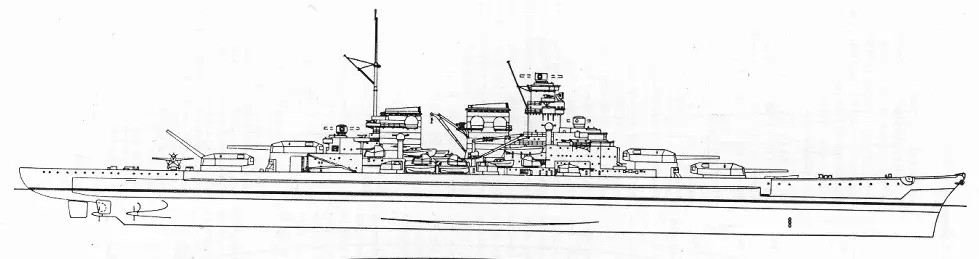
H class battleship (1939)
From Wikipedia, the free encyclopedia
 |
|
| Class overview | |
|---|---|
| Planned: | 6 |
| Cancelled: | 2 |
| General characteristics | |
| Displacement: | 55,453 tons design 62,497 tons fully laden |
| Length: | 872 ft (266 m) |
| Beam: | 122 ft (37 m) |
| Draft: | 32 ft 6 in (9.9 m) design 36 ft 6 in (11.1 m) fully loaded |
| Propulsion: | 12 × MAN double-acting 2-stroke 9-cylinder diesels |
| Speed: | 30 knots (56 km/h) |
| Range: | 16,000 nautical miles (30,000 km) at 19 knots (35 km/h) |
| Complement: | 2,600 |
| Sensors and processing systems: |
FuMO 23 radar system, but not specified |
| Armament: | 8 × 40.6 cm (16.0 in) Schiffskanone C/34 12 × 15 cm (5.9 in) guns 16 × 10.5 cm (4.1 in) AA 16 × 3.7 cm (1.5 in) AA 24 × 2 cm (0.79 in) AA 6 × 21 in (53 cm) torpedo tubes |
| Armor: | Belt: 295 mm (11.6 in)–175 mm (6.9 in) Main Deck: 80 mm (3.1 in)–50 mm (2.0 in) Armored Deck: 120 mm (4.7 in)–100 mm (3.9 in) Torpedo Bulkhead: 45 mm (1.8 in) Armored Bulkheads: 220 mm (8.7 in) Main Turrets: 380 mm (15 in)–125 mm (4.9 in) Secondary Turrets: 100 mm (3.9 in)–40 mm (1.6 in) Conning Tower: 400 mm (16 in) Torpedo detonation plate around key sections |
| Aircraft carried: | One catapult with four aircraft, probably Arado 196 seaplanes |
The H-39 design was a type of battleship proposed by Nazi Germany before the outbreak of World War II. This was basically an enlarged version of the Bismarck class, and was designed as part of the proposed Plan Z fleet.
Contents |
[edit] The Bismarck class
The F - G design, a 35,000-ton battleship program was started in 1932, and was laid down before the Anglo-German Naval Treaty of 1935. These would become the Bismarck class, the largest battleships built by Germany, and the heaviest battleships in any European navy. Despite this they had a number of design flaws, which the admirals of the Kriegsmarine were determined to correct in their next design, the H class. In 1937, Germany's Oberkommando der Kriegsmarine (OKM) ordered a study for a new battleship class to succeed the Bismarck design.
[edit] Gunnery problems
From the beginning Hitler insisted on 50.8 cm (20.0 in) guns, instead of a 40.6 cm (16.0 in) caliber. The naval staff had difficulties in persuading him that any design mounting guns larger than 16 in was not practical. Any battleship which mounted 20 in guns would have to weigh 80,000-120,000 tons, with a length of 1,000 ft (300 m). This would also mean reconstructing German ports so as to service such a ship. Additionally a German 16 in gun design had already been developed in conjunction with the 38.0 cm (15.0 in) design. Any new design for a much larger gun would dramatically lengthen the design and construction process. Finally Hitler agreed with the H-39 design as proposed.
[edit] The design
The H-39 class design was basically an enlarged version of the Bismarck class. Though they both looked much alike the H-39 class varied in many important points from its earlier half-sisters. The most noticeable difference was the two smokestacks of the H-39 class, instead of one like Bismarck. The Bismarck also used steam turbines for propulsion, while the H-39 class was designed for diesel engines, and had a 60% increase in operating range over the earlier ships. The twelve propulsion diesels would also provide a top speed of 30 kn (56 km/h). These space requirements also prevented a hangar/catapult arrangement amidships as in Bismarck. The hangars for four Arado Ar 196 floatplanes were placed in the aft superstructure with rails running on either side of the aft turrets to a centerline catapult aft of turret D.
[edit] Construction
In 1938 OKM developed Plan Z which would enlarge the Kriegsmarine by 1945. Part of this called required a total of six H class battleships to be laid down. In August Hitler ordered that the Bismarck class be completed by late 1940 and that the construction of the H class would begin in 1939. In January 1939 the Plan Z was adopted and the order for the six H class battleships was placed. The sometimes reported names for "H" and "M" (Hindenburg, Friedrich der Grosse and Grossdeutschland) are pure speculation. No names were ever selected for the ships. Construction contracts were with the following Naval yards:
- Schlachtschiff "H" to Blohm + Voss at Hamburg
- Schlachtschiff "M" to Blohm + Voss at Hamburg
- Schlachtschiff "J" to Deutsche Schiff- und Maschinenbau AG at Bremen
- Schlachtschiff "N" to Deutsche Schiff- und Maschinenbau AG at Bremen
- Schlachtschiff "L" to the Kriegsmarinewerft at Wilhelmshaven
- Schlachtschiff "K" to Deutsche Werke at Kiel
"H" was laid down on 1939-07-15 and "J" on 1939-09-01. "K" was scheduled to be laid down on September 15 but this was postponed because of the outbreak of World War II. A hold was also placed on construction of the two ships already started. At the time that construction was frozen "H" had 14,055-tons of material ordered, 5,800-tons delivered but only 766-tons worked into the keel. There had been less work on the "J". 3,531-tons of material had been ordered but only 40-tons put into the keel.
[edit] Other designs
During 1941 and the "H class" was redesigned ("H-41") and it was proposed to bore out the existing guns to 42 cm (16.5 in) / 48 cm (18.9 in) caliber. One of the reasons behind this conversion was to give these ships a larger caliber weapon than those planned for any known Allied battleship. This and the later "H-42" never got off the drawing board. Then in late 1943, Hitler's original idea of a huge 50.8 cm (20.0 in) gunned battleship was drawn up. This was designated "H-44", but with the stress on German war production at a high level it was decided by late 1944 to abandon the project. The assembled steel was later used to make U-boats.
[edit] Coastal artillery
While only ten of the four-dozen main gun barrels needed for the ships were completed, without the ships it was decided to use the guns constructed for coastal artillery. Four guns were emplaced at Battery Trondenes outside Harstad, Norway. A twin battery was built on the island of Engeløy further south, as Batterie Dietl. Three guns were set up in Hel near Danzig, as Battery Schleswig Holstein. After extensive testing the guns were transported from Hel to Sangatte, France and set up as Battery Lindemann, from where they fired across the English Channel at Dover. Today, the Adolf Gun at Battery Trondenes is open as a museum during the summer season.
[edit] Comparison
Compared with other battleships of the day the "H class" would have fared better than the Bismarck class. Not only did they have improved armoured protection but better armament as well. Statistics show that their weight of broadside would have placed them in fifth place behind the Yamato class, the Iowa class, the Vittorio Veneto class, and the Richelieu class. They would have out-classed every British battleship afloat. However, the proposed British Lion class battleships, armed with nine 16 in (406 mm) guns would likely have outgunned them, and sporting an extra 85 mm of belt armor (380 mm), would have enjoyed greater protection than the H-class.
[edit] Armament
Range @ 33 degrees - 40,245 yards (36,800 m)
- 40.6 cm Schiffskanone C/34 (960 shells)
- 40.6 cm Sprgr L/4.8 m KZ m Hb High explosive shell (1030 kg.)
- 40.6 cm Sprgr L/4.6 m Bd Z Hb Semi-armour piercing shell (1030 kg.)
- 40.6 cm Sprgr L/4.4 m Bd Z Hb Armour piercing shell (1030 kg.)
[edit] See also
[edit] References
- Garzke Jr., William; Dulin Jr., Robert (1985). Battleships, Axis and Neutral Battleships in World War II.