User:Grahame/The University Computer Club (UWA)
From Wikipedia, the free encyclopedia
The University Computer Club (UCC) is a Guild affiliated club at University of Western Australia. It was founded in 1974[1] and recently celebrated its thirtieth birthday. The club has a significant history in computing in the state of Western Australia, forming two years before UWA's computer science department.
Most UCC activities take place in the club room. The room is located in Cameron Hall on UWA's Crawley Campus, and is open most days and weekends into the late evening. Popular activities are programming, study avoidance, electronics and various types of gaming. UCC is organised around several autonomous committees, running the machines, performing administrative tasks and providing oversight.
Contents |
[edit] Club History
[edit] Early Activities
The first computer purchased by the club was an Alpha Micro AM100 named Murphy, but before that time the club was pooling its resources to gain time on the University's PDP-6 located at the WA Regional Computing Centre. Murphy has kept in storage for many years, and now current and past members are hoping to restore the machine.
FIXME precis of UCC history
[edit] Achievements and Awards
In 1980 the UCC won an award from the Silver Jubilee Trust for Young Australians[1].. The award reads:
Award for 1980 presented to University Computer Club for the purpose of providing students with access to practical experience in computer use and management, promoting community understanding of computer benefits, and providing computer services to service groups who could not otherwise afford them.
In 1992, members brought the UCC Coke machine online, it was only the second operational vending machine on the Internet[1], after the one at Carnegie Mellon University.
In 1999 UCC was awarded the Guild's Best Club Award.
In 2007, UCC was Certified by Wikipedia's Jimbo Wales as "Officially Notable"[2]
[edit] Activities
[edit] Community Involvement
UCC members were heavily involved in the organisation of linux.conf.au in 2003.
Several members are well-known contributors to open source projects, including GNOME, Monotone, Debian, Dropbear, FreeBSD, Ubuntu, Avahi and Squid.
- Adrian Chadd [3][4]
- Trent Lloyd [5][6]
- Grahame Bowland [7][8]
- Matt Johnston [9][10]
- Quinn [11]
- Peter Lewis [12] [13] [14]
FIXME Plays nicely with Perth Linux Users Group, Computer Angels WA, ACMS WA, WAIA
[edit] Mentoring and Career Development
Many UCC members continue their involvement with the club past their departure from the University (via graduation or otherwise). The club has a strong culture of informal mentoring.
Several members have gone on to work for FIXME, Google, Eazel, UWA, Telstra, DDD, FIXME
[edit] Projects
UCC members have produced some remarkable hacks. Some of the most egregious are documented below.
[edit] flame
In 1989, Flame BBS came into existence, running on Remote Access.
Morphed in XXXX to a XXX mud running on Vax 11/750, Linux 0.99pl18 ... etc, etc
[edit] Computer automation
The UCC door, snack machine and Coke machine are all computer controlled. A central system "dispense" provides an electronic credit system.


The Coke machine was obtained in 1992. Before the widespread development of the world wide web the status of the machine could be determined using the finger protocol using the Unix command - finger coke@ucc.gu.uwa.edu.au. [15] The Coke machine appeared in many of the early internet service guides and indexes. [16]
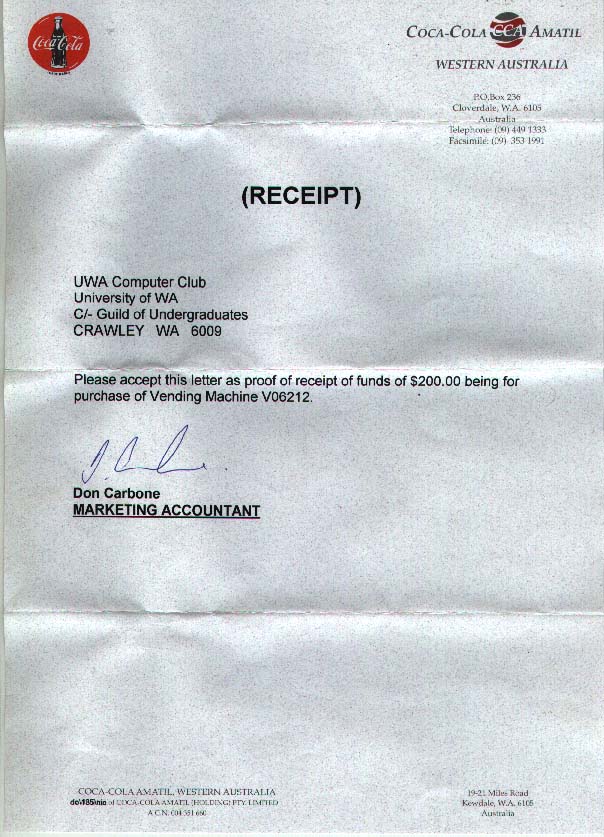
In 1995 it achieved notoriety when it became known to Directors of Coca Cola in Atlanta. They sent a representative from the subsiduary to request the machine be disconected, to rectify the problem UCC purchased the machine.[17][18] The control software for the machine was rewritten during that year after the first iteration was lost and a web interface added.
The snack machine orginal firmware was replaced to enable control over a standard RS-232 serial connection. The firmware enables text to be displayed, keys on the front panel to be read and a copy of the source code for the firmware to be downloaded. In daily operation it is controlled by server software running on a Linux machine. Club members log in on the keypad of the snack machine with their UNIX numeric user ID, and a PIN. Once logged in snacks can be vended, drinks can be dispensed from the coke machine, and the clubroom door can be opened.
Drinks can be dispensed over the World-Wide-Web, from a terminal or from the keypad of the snack machine.
The electronic door latch is driven by an old modem; ATH1 is sent to open the door. The door sensors were handled by a "black box (http://www.blackbox.com/) " RS-232 switch, this eventually broke, so now we are using a DECserver serial terminal server to probe the door sensors and report their presence over Jabber.
In 1999, UCC briefly had installed until it was stolen a mirrorball rotated by the roller of a dot-matrix printer.
[edit] Facilities
The club provides access to powerful, interesting and varied computing resources. Computers available to members include Silicon Graphics workstations, a 14 CPU Sun Enterprise 6000 [1], Alpha workstations and two original BeBox systems (one production and one pre-production). As well as these specialist machines, the Club Room also has approximately 10 desktop systems available for members use, running Linux, Windows, MacOS X and Solaris. Unlike most computing resources on campus, these computers are available without studying in any particular faculty.
[edit] Current Systems and Machine Room

One weekend in 1996, club members built themselves a machine room. It provides a small, insulated area in which to securely host servers. It is air-conditioned in order to cope with Australian summers. The club servers centrally authenticate via LDAP, and allow club members access to many operating systems. These include Solaris, Tru64, Linux, Mac OS X and BSD.
[edit] Previous Systems
AlphaMicro http://en.wikipedia.org/wiki/Alpha_Micro C64 Amiga VAX 11/750 Sun 3 Star NeXT
[edit] External links
[edit] References
- ^ a b c Hawkes, Dr. E: UCC History Project
- ^ See http://www.youtube.com/watch?v=SmGmePKBteo
- ^ http://www.nanog.org/mtg-9910/ppt/adrian.ppt
- ^ http://www.linux.org.au/conf/2003/speakers.html
- ^ http://www.linux.org.au/conf/2003/speakers.html
- ^ http://lca2007.linux.org.au/Programme
- ^ http://viewmtn.angrygoats.net/about
- ^ http://memes.angrygoats.net/forms/haiku
- ^ http://viewmtn.angrygoats.net/about
- ^ http://matt.ucc.asn.au/dropbear/dropbear.html
- ^ http://www.quinn.echidna.id.au/Quinn/Config/
- ^ http://www.quinn.echidna.id.au/Quinn/Config/
- ^ http://www.stairways.com/main/history
- ^ http://en.wikipedia.org/wiki/Stairways_Software_Pty_Ltd
- ^ West, John (11 Apr 1993), alt.hackers post "A Coke machine on the internet???", <http://groups.google.com/group/alt.hackers/browse_thread/thread/22a8dcb7add2357b/d7c733efc6cad3c8>. Retrieved on 16 May 2007
- ^ Yanoff, Scott A. (3 Jun 1993), biz.comp.services post " Updated Internet Services List", <http://groups.google.com/group/biz.comp.services/browse_thread/thread/c13edfec112c438/44191a278d17c690>. Retrieved on 16 May 2007
- ^ Morris, Peter. "Fizzer as Net bubble bursts", The West Australian, June 21, 1995.
- ^ purchase receipt
Category:Computer clubsCategory:Australian_student_societies