Gesta Hungarorum
From Wikipedia, the free encyclopedia
 |
Sections should be added to this article, to conform with Wikipedia's Manual of Style. Please discuss this issue on the talk page. |
- Gesta Hungarorum may also refer to Gesta Hunnorum et Hungarorum, written by Simon of Kéza.


Gesta Hungarorum (Latin for The Deeds of the Hungarians), is a record of early Hungarian history written by the otherwise unknown author Magister P, who is often cited simply as Anonymous. He describes himself only as a "faithful servant of King Bela"; there are more than one King Bela who could be meant. Gesta Hungarorum is preserved in a manuscript from around 1200. It is a mixture of oral tradition, older sources and inventions of the author.
The chronicle was written as a literary work based on similar western chronicles which were then fashionable. The author tries to define all local ruling families of the Kingdom of Hungary as descendants of the ruling Árpáds or at least of their allies, and to glorify the merits of the Árpáds with respect to the Magyar occupation of the Carpathian basin in the tenth century.
Gesta Hungarorum mixes ascertainably correct facts, inaccuracies and information that cannot be confirmed from other sources. One may choose to believe this information or not. Some parts are considered by most modern authors as simply inventions (by the author or by his predecessors) to contradict the Frankish and other chronicles. Some personal names are simply derived from local toponyms. Some of the work can be recognized as directly based on earlier sources that narrate the history of the Magyar peoples moving into the Carpathian basin.
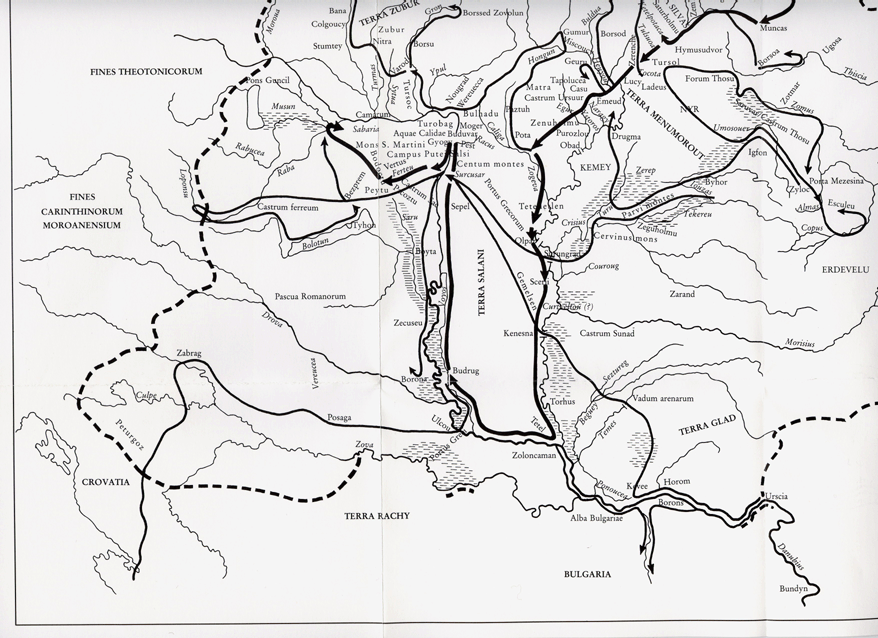
Gesta Hungarorum's main subject of controversy concerns the mentioning of the existence of the local rulers of Gelou, Glad and Menumorut in Transylvania at the arrival of the Magyars in the tenth century (see Origin of Romanians). The very existence of these three dukedoms mainly inhabited by Vlachs and Slavs is controversial. and denied by some historians (Hungarian, Slovak), while others (Romanian, Hungarian, Serbian) propound opposing arguments. The main arguments against their existence is the presence of provably wrong information in some other parts of the Gesta, and the fact that Gesta Hungarorum mentions Cumans among the peoples who lived in Transylvania at that time, whereas the Cumanians actually arrived there 150 years after the Hungarians. There is opposing opinion which claims that the author of the Gesta actually confuses Cumanians with Pechenegs, who spoke a similar language to that of the Cumanians and lived in approximately the same territory.
Hypotheses about the identity of the mysterious author "Magister P" include:
- The notary (chancellor) of King Béla III of Hungary (1172-1196) - today this is the generally accepted author.
- The chancellor of King Béla II of Hungary (1131-1141), a certain Petrus who was in 1124 the chancellor of the previous king Stephen II.
- Péter Pósa, bishop of Bosnia.
[edit] Literature
- Neagu Djuvara. O scurtă istorie a românilor, povestită celor tineri. Bucharest, 2002.
[edit] See also

- Sources of early Hungarian history
- Chronicon Pictum (Viennese Illuminated Chronicle)
[edit] External links
- Quotes from Gesta Hungarorum regarding Transylvania and Banat
- Gesta Hungarorum text (in Hungarian)
- Map showing area of Central Europe according to Gesta Hungarorum
|
|||||||||||||||||||||||

 |
This Hungarian history article is a stub. You can help Wikipedia by expanding it. |