User:Geronimo20/Sandbox/ref3
From Wikipedia, the free encyclopedia
[edit] Shellfish
- US Fish and Wildlife Service: Office of Law Enforcement (2006) Importing & Exporting Shellfish, Fish, & Fishery Products. Retrieved 28 May 2008.
- How does the Service define shellfish?
Shellfish are all species of oyster, clam, mussel, or scallop (Class Pelecypoda) or shrimp, crab, or lobster (Class Crustacea) that are live, shucked, or in the shell, fresh or frozen, whole or in part.
- How does the Service define fishery product?
A fishery product is any dead fish or part of a dead fish (Class Osteichthyes, bony fishes or Class Chondrichthyes, sharks, skates, and rays) or any product of a fish, including their eggs. Frogs or other aquatic animals are not fishery products. Fishery products do not include live fish of any kind.
[edit] Lobsterpots
- (US) Lobstering History
- (US) History of Lobster Fishing and Processing
- Innocent Coral Reef Damage
- []
[edit] Lobster fishing
- Forsyth, William S (1960) Lobster and Crab Fishing. Second Edition. Adam and Charles Black. ASIN B000X9M4CA
- Spence, Alan. Crab and Lobster Fishing. ISBN 978-0852381540
- Lobster Boats-Icons of the Maine Coast
- The American Lobster
- Lobster fishing in Bernera past and present
- Maine Lobster History
- Interactive map of lobster fishing zones - Maritimes
- Fisheries: Lobster Fishing in Maine
- Lobster Fishing in the Northumberland Strait portion of Lobster Fishing Areas 25 and 26A
- Scandinavian lobsters get better protection
- The life of an American lobster
- lobster fishing, Tourism in Brittany
- Fishing in Ireland
- []
[edit] Fishing assessment- 2 May 08
Fishing articles Importance Top High Mid Low None Total Quality A 1 1 2 Good article GA 1 1 B 2 5 3 3 13 Start 6 10 4 2 22 Stub 4 9 10 4 27 Assessed 3 16 23 14 9 65 Unassessed 4 3 165 172 Total 3 20 23 17 174 237
[edit] Fishing discussion topics
Ratio of "importance: What percent topics should be "top", "low" etc.
[edit] Shoaling
[edit] Opotiki Harbour Development
- [http://www.seaaroundus.org/ seaaroundus} <= NOTE
[edit] Steve O'Shea
[edit] collapsible table
|
width="120"|World oceans |
|||||||
|---|---|---|---|---|---|---|---|
| Region | Area million sq km |
Percent of total |
Volume[1] million cu km |
Percent of total |
Mean depth km |
Max depth km |
Coastline km |
| World oceans | 361.132 | 1,370[3] | 10.924 | 356,000 | |||
| Pacific ocean[4] | 155.557 | 679.6 | 4.028 | 10.924 | 135,663 | ||
| Atlantic ocean[5] | 76.762 | 313.4 | 3.926 | 8.605 | 111,866 | ||
| Indian ocean[6] | 68.556 | 292.131 | 269.3 | 3.963 | 7.258 | 66,526 | |
| Southern ocean[7] | 20.327 | 91.5 | 7.235 | 17,968 | |||
| Arctic ocean[8] | 14.056 | 17 | 1.205 | 4.665 | 45,389 | ||
| Lakes[9] | 2.6[10] | 1.637 | |||||
| Rivers |
[edit] pelagic zone
Paddy Ryan. Deep-sea creatures. Te Ara - the Encyclopedia of New Zealand, updated 21-Sep-2007 ++this is brilliant++
- definitions
- definitions2
- Pelagic fish
- New Zealand’s oceanic species
- Pelagic Fisheries
- What is a pelagic fish?
- Pelagic species
- Pelagic Fisheries Research Program
[edit] continued...
- Agriculture in Australia
- Agriculture in China
- Agriculture in the People's Republic of China
- Economy of Japan#Fishing
- Ningde
- Maine Salmon
- Industrial agriculture (animals)
- Agriculture and aquaculture in Hong Kong
- Maritime history of the United Kingdom#Fishing and whaling
- Rock carvings at Alta#Hunting and Fishing scenes
- Kite types
- Indigenous boats
- Inshore Fishing Boats
- Fishing Britannica
- Bongo net
The Bongo Paired Plankton Net
[edit] CB...CALBOBL Net[11]
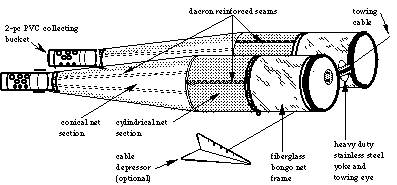
The bongo net, referred to as CB in the CalCOFI database, has been the standard CalCOFI sampler since replacing the CAL1MOBL in 1978. The net frame consists of two anodized aluminum circles, 0.71 m in diameter, connected by a central yoke which is in turn connected to the towing cable. The central yoke makes this sampler a "bridle-free bongo net" which allows the mouth openings to be vertical during the tow. The nets are 3 m in length, a 1.5 m cylindrical portion joined to 1.5 m conical portion tapering to a detachable cod end. At least one ( starboard net), the principal ichthyoplankton sample net, is made from 0.505 mm square mesh nylon. The sample from the port side net is used for other purposes; the mesh size is either 0.505 mm or 0.333 mm depending on requirements. The cod end of each net is constructed of 0.333 mm mesh. The ratio of mesh aperture area to mouth area is 4.8:1 for the 0.505 mesh net.
Plankton samples are obtained by retrieving the sampler at an oblique angle. A 22 kg weight is attached to the bottom of yoke frame. While the survey ship is making 1-2 knots, a fixed amount of towing cable is paid out, the net is held at depth for 30 seconds and then retrieved at a constant rate (20 m/min). Ship speed is adjusted to maintain the towing cable at a constant angle to the vertical ( 45 degrees +/- 3 degrees). During each plankton tow 300 m of towing cable is paid out; thus the vertical depth sampled is approximately 210 m. In shallow areas the amount of towing cable paid out is adjusted so that the net fished to approximately 15 m off the bottom.
[edit] Plankton Nets[12]
[edit] Bongo Paired Zooplankton Net[13]
General Information One of the simplest biological samplers, zooplankton nets are made in a wide variety of styles and sizes. The two nets in the MARMAP Bongo vertical-haul net system shown here each have a mouth diameter of about 25 cm.
History The historic roots of plankton sampling reach back to the early 19th century when Thomson invented a net he used to sample crab and barnacle larvae. From this simple collecting device has evolved an astounding array of instrument types and collecting strategies for sampling in an immense and often hostile environment. The history of nets and their use in collecting zooplankton from the world's oceans, continental shelves, coastal embayments, and freshwater bodies are almost as varied as the subjects zooplankton biologists have undertaken to study. An account of the tools that have been employed to collect zooplankton has been recently prepared by Wiebe and Benfield (2000), and provides a description of standard sampling methods. Wiebe and Benfield provide a chronological listing of the instrument systems and categorized systems presented in the text.
When sampling plankton, an investigator is attempting to answer two questions in a quantitative way: 1) What living plankton organisms does the sea contain at a given time? 2) How does this material vary from season and from year to year? In the early history of ocean sampling, an assumption was made that plankton were evenly distributed in the oceanic waters and because of this one could take small samples which would be representative of large oceanic areas (if the volume of water filtered by the net could be determined exactly and providing some of the organisms caught by the net would not escape through the net mesh). This premise was tested in a variety of ways by many investigators, and many of the sources of error associated with sampling plankton by nets and with counting methods to analyze the samples were identified.
Ultimately the research community recognized that there were large scale spatial variations in the concentration of planktonic forms. This spatial variability led to a reassessment of sampling that produced the tools we use today.
The Bongo net was invented in the mid-20th century. Today, bongo nets are available both in opening/closing and non-closing form. However, the most commonly used net is a non-closing MARMAP Bongo Net, developed around 1980.
How It Works A pulley with a 19 mm diameter chain or cable is used to lower the nets into the water column. A collecting bucket, attached to the cod-end of the net, is used to contain the zooplankton sample. Finally, when the net is retrieved from the ocean, the collecting bucket can then be detached and easily transported to a laboratory.
Technical Information Advantages: Very simple to operate Light weight
Disadvantages: Nets do not open and close
[edit] Bongo Net[14]
Bongo nets provide a vertical sample of the zooplankton from a depth to the surface.
photo of a Cod end
The bongo net is actually two identical nets that can be towed either vertically or obliquely (diagonally) from a depth to the surface. Bongo nets give us an idea of what plankton exists within a certain depth range (e.g., from 250 m to the surface). The nets are lowered to a depth and then are quickly brought to the surface at a rate of 1 m/s. All the plankton on the net sides are washed down into a cod end (a small bucket at the bottom of the net; picture right). One net sample is preserved in formalin for later analysis; the other sample is frozen and can serve as a duplicate, if needed. Often we will use the formalin-preserved sample to conduct species analysis and then calculate the biomass captured using the frozen sample.
Our bongo nets rarely catch any animals larger than shrimp or juvenile fish larvae (around 30 mm) since they can avoid the nets. Our nets use a 236 um (0.236 mm) mesh.
 External images External images |
|
|---|---|
 |
Bongo net 1 |
|
Bongo net 2] |
|
Bongo net 3] |
|
Bongo net 4] |
|
Bongo net 5] |
- Kite fishing
[edit] Kite fishing
| External images |
|
|---|---|
|
kite fishing rig |
|
dropline kite fishing rig |
Kite fishing is presumed to have been first invented in China. It was, and is, also used by the people of New Guinea and other Pacific Islands - either by cultural diffusion from China or independent invention.
Kites can provide the boatless fishermen access to waters that would otherwise be available only to boats. Similarly, for boat owners, kites provide a way to fish in areas where it is not safe to navigate such as shallows or coral reefs where fish may be plentiful. Kites can also be used for trolling a lure through the water.
Suitable kites may be of very simple construction. Those of Tobi Island are a large leaf stiffened by the ribs of the fronds of the coconut palm. The fishing line may be made from coconut fibre and the lure made from spiders webs.[15]
Modern kitefishing is popular in New Zealand, where large delta kites of synthetic materials are used to fish from beaches[16], taking a line and hooks far out past the breakers. Kite fishing is also emerging in Melbourne where sled kites are becoming popular, both off beaches and off boats and in freshwater areas. The disabled community are increasingly using the kites for fishing as they allow mobility impaired people to cast the bait further out than they would otherwise be able to.
[edit] Bottom Longline method[17]
The Bottom Longline method is similar to the old kontiki style of fishing. On Bottom Longlines a heavy duty mainline of around 80 to 100 kg nylon is required.
Lines weaker than this are unable to safely take the inevitable nicks and scuffs the mainline encounters over time as it runs out along the bottom.
The mainline is connected to the kiteline with a braided cord that has a flag sewn onto it.
A two or four litre plastic bottle is attached to the braided cord and is filled with sand or water to prevent the kites from lifting the mainline and hooks off the bottom or out of the water completely in strong wind conditions.
Traces and weights are connected to the mainline as the kite tows the line offshore.
The weights, clipped onto the mainline in front of the hooks, ensure the mainline is held hard on the bottom maximising the rigs fishing efficiency and also preventing the metre long traces from wrapping around the mainline and becoming tangled during setting.
The Bottom Longline is an ideal system for the east coast.
This rig will tow out up to 25 hooks per set (the legal limit per longline) and while it is possible to operate a longline rig single handed it is much easier when two or more persons are involved.
By far the easiest of the kitefishing methods to operate, the Bottom Longline must be used from clear snag - free areas and is very popular in areas such as Whakatane, Tauranga, Papamoa, Waihi, Pukehina, and Northland beaches like Orewa, Omaha, Pakiri, Te Arai, Uretiti and Tokerau.
[edit] Dropper Rig method[18]
Many west coast beaches are also good for the Bottom Longline system such as Baylys Beach, Muriwai, Kariotahi, Port Waikato and Mokau but the west coast poses a few draw backs as well.
With its often high surf and strong long shore currents and its abundance of large sharks it can be quite challenging for a newcomer to kitefishing.
By all means kitefishing with a longline on the west coast is feasible, and with experience can be extremely productive, but the ultimate rig for fishing this coast is the Dropper Rig system.
This style of landbased fishing is only practical with kites. The Dropper Rig method can be fished over clear sandy beaches, as with the Bottom Longline, but also can be adapted to cast out other lines, fish dhan lines or ledger rigs on or near reefy areas or troll for kahawai and kingfish.
Basically, anything you could do from a boat can be done with a Dropper Rig from the shore.
Unlike the Bottom Longline which requires the mainline to be a specific lineweight , small kite powered Dropper Rigs can be made up on as little as 8 kg line and run from a surfcasting rod right through to large kite powered rigs designed to tow out up to 20 hooks on 65 kg mainlines.
All Dropper Rigs are extremely versatile in their uses.
The basic Dropper Rig configuration has the mainline and kiteline supported clear of the water out to the fishing position. Fifty metres below the kite a separate line, (the dropper line) is attached to the braided cord junction that joins the mainline to the kiteline.
The dropper line drops down to a plastic bottle that is weighted to prevent the kite from lifting the terminal tackle out of the water.
The leader line extends from the bottle to the sea bed.
The hook section, which is just like a mini longline, is connected to the leader line by a safety trace which should be no more than 80% of the breaking strain of the mainline.
This safety trace offers additional protection for the kites and mainline should the kitefisher unwittingly be fishing over rocky areas with the wrong terminal tackle or happen to hook into a few large sharks or stingrays.
If the gear is snagged or you hook something too big to land the safety trace snaps and everything except the hook section is safely recovered. Careful consideration should be given to the number of hooks set .
If too many fish are caught you could risk overloading the breaking strain of the safety trace and losing your catch. Because the east coast and west coast fishes so differently it is safe to set more hooks on the east coast.
For example, a 65 kg Dropper Rig could easily set up to 20 hooks per set on the east coast, sharks aren't such a big problem there, but the number of hooks fished with the same rig on the west coast should be reduced to 10 per set. N.Z. Kitefishing Club president David Edlington looks pretty happy with this 4.25 kg Dropper Rig caught snapper
This is by far the best system to use on the raging west coast as it is unaffected by high surf or strong rips.
It's always a good idea to use the Dropper Rigs over clear snag free areas at least until you are familiar with how they operate and become proficient with this method of kitefishing before adapting the terminal tackle to fish the trickier areas such as near reef.
Depending on the size of the Dropper Rig you choose, the ease of use will vary. Inevitably the smaller the rig the easier it is to handle by one person.
Dropper Rigs are a little more complex than the Bottom Longline Rig but are undoubtedly the most versatile and safest of the kitefishing methods.
The only draw back of a Dropper Rig is that when the rig is being used in areas where boats are present or where there is offshore reefs, the mainline must be kept clear of the water.
It is critical that the kite you use is perfectly balanced with the weight of the mainline and number of hooks it is powering.
[edit] Kite fishing Tips[19]
Kite fishing is an awesome way to be able to spend the day on the beach with Friends and Family. You dont need a boat, so there is no being sea sick; all you need is just a good wind and the right rig option for you--be it a manual or electric option.
There are a few different rig options to choose from, Dropper Rig, Bottom Rig or Rod assisting rigs, it all depends on what sort of location it would be mostly used.
All Sunset Kite Fishing products are New-Zealand-made; and only the highest quality materials are used to ensure longevity.
Our kites, drogues and flags are made from UV resistant rip-stop sailcloth and our kites are double stitched with reinforced sleeves to prevent wear to the material when flown.
Instructions are also included in all of our kite and longline products which are written in plain english so they are easy to follow and understand.
For the Sandy Coastal area use either 80kg Bottom Longline Rig , 100kg Bottom Longline Rig , 80kg Dropper Rig , Kayak Rig and the 2 Kite Dropper Rig as these all drag across the sea floor you do not want to get caught up in amongst rocks.
For the Rocky coastal areas the Casting Kite Rig is ideal as it is carried out by the kite rather than being dragged.
If you prefer to fish with your lucky fishing rod be it either a boat rod or surf rod than the Rod Assisting options are Casting Kite Rig or the Pocket Sled Kite Rig
- When fishing many West Coast beaches you will be faced with a backround of cliffs posing a problem at high tide to launch your kite. Find gaps along these cliffs where the wind can funnel through.
- Always fish at least 300m apart to avoid tangle ups with other fishermen.
- If the wind is blowing on an angle, then tack a kite with plastic bags at the bottom of the wing tips to “steer” it straight.
- When baiting, always place the hook through the end of the bait once to reduce the possibility of the bait spinning and wrapping itself around the mainline or backbone.
- Pre-bait hooks before letting the line out to prevent seagulls and crabs removing bait before it reaches the water.
- In high or unsettled winds, it is advantageous to use a Drogue which is like a wind sock to steady your kite.
- For those that have the manual plastic reel try not to load the line to tight when retrieving as it will blow the reel.
[edit] Drogue[20]
The drogue or wind sock is designed to stabilize the kite in heavy wind by taking the air spilled by the kite into a smaller area through the funnelled shape of the drogue. this gives the kite direction and stability in strong wind and stops the ducking and diving effect. The drogue is also used to tack the kite by tying a small loop into either leader of the drogue (causing one to be shorter than the other) it will pull the direction of the kite to the leader that has been shortened. The drogue is an important accessory for the kite when used correctly in high winds for stability.
[edit] Kite, Longline & Dropper Rigs[11]
price and cabability
Now for the exciting process of getting the gear up to 1.5km out to sea! The kite is used to silently pull the hooks further out than you could ever go by casting with a fishing rod. After some time, depending on the location and the weather conditions, we retrieve the line and the kite. This is the most exciting part. When the kite comes in closer we see the fish splashing in the water! After pulling in the fish and leaving the kite flying in the sky, we reset the gear and let the kite take the line out again.
Fish such as snapper, kingfish, gurnard, kahawai, trevally, John Dory and even sharks can be caught in this way. Any fish that are within the legal limit can be kept
[edit] KITE FISHING SETUP GUIDE[12]
[edit] History
Kite fishing is an old Oceanic method of troll fishing. The English traveller, Sir Henry Middleton, is said to be the first European to see kite fishing in the South Seas during his visit there from 1604 to 1606, and he introduced the kite in sports fishing in 1616. For this purpose kite flying astern of a moving boat were used, especially for tuna and other big game fish. The flying fish bait was securely tied to the hook. The fishing line lead from the rod to the kite and then back to the water. Thus the hook skipped realistically over the top of the waves. When a fish struck the bait, the line broke away from the kite and the fisherman was free to play the catch.[21]
[edit] Slow troll[22]
I still enjoy kite flying, only these days it is from the stern of a boat! And the kites I fly today are a far cry from the newsprint and balsa wood versions we used to make. These high tech kites I use are for one purpose, and that is to catch fish.
The method is relatively easy. It just takes a little practice to keep the boat motion either with the engine or with a drift such that the kite remains in the same relative vertical space all the time.
The kite acts as an outrigger of sorts, although you might better name it and "up" rigger.
The kite is launched and flown from the stern of a boat, usually on a line from a special rod and reel. The fishing line is attached at the kite similar to an outrigger, only instead of keeping the line out, it keeps it up. Boat speed determines where the bait is in the water.
Usually a slow troll or drift, this fishing is designed for live bait. A live blue runner, or ballyhoo, or other bait fish is suspended from the kite right on the surface of the water. The bait's attempts to get below the surface coupled with the motion of the kite keep the bait in and out of the water, right on the surface. It really drives billfish in the area crazy!
But don't be fooled into thinking that this is strictly a billfish tactic. King mackerel, cero mackerel and occasionally wahoo are also caught from kite rigs. My fishing partner has even caught yellowfin and blackfin tuna from his kite.
[edit] Kite Fishing Instructional How To[23]
Many different styles of fishing have originated in the hopes of catching sailfish, sharks, and other top water game fish. Perhaps the most effective of these types of fishing is kite fishing. Kite Fishing is a technique of fishing that involves flying kites, and using the kites to suspend live baits on the top of the water. This type of fishing is highly effective for sport fishing off the coast of Ft. Lauderdale, where the Gulf Stream current and the natural reef running along the coastline, coincide. Sportfishing charter boats have been using this technique for 20 years to hook into the wide array of big game species that swim through our waters. This article is written in order to teach basic tactics on how to go about kite fishing.
For kite fishing, live bait is required. Start off by catching or buying live baits. Only certain types of baitfish will work effectively in the kite. These baitfish include goggle eyes (probably the most effective bait for this type of fishing), tinker mackerels, blue runners, pilchards, mullet, sardines and threadfin herring. There are some other types of baitfish that can be used in the kite, but these types survive the best.
Start out by selecting your spot to fish. When kite fishing, you are mostly immobile. You will drift whichever way the current is moving, but as far as covering ground with your engines, you can only make small corrections. So first thing is to select a good area or depth of water to fish. Off the shore of Fort Lauderdale, one of the best areas is the 90’-120’ natural reef that runs along its coast. Other good areas are where there is a rip current, a temperature gradient, a color change or over the top of an artificial reef, such as a shipwreck. These are all good areas to begin fishing, and bear in mind that winds and currents will push you around a bit, so plan ahead.
Kite fishing is a very exciting way to hook into big game fish. You get to see the whole bite sequence and the hook up ratio is usually very high. It takes quite a bit of practice to become proficient with kite fishing technique. Keep trying though. I have yet to find a more effective or exciting way to catch sailfish off the coast of Ft. Lauderdale.
[edit] Kite towed longline
The basic idea is very simple. When the wind id blowing offshore, a kite is used to tow out a line to which baited hooks have been attached.
Kite fishing can be a lot of hard work. Sometimes you can get 25 fish on 25 hooks, and hauling them in takes a bit of muscle power.
Can also use Kon Tiki rafts with square sails. Or, if the wind is strong enough, can use large, heavy weight plastic bags. Inflate by holding them intoi the wind. Then tie the open end with string and fasten the bag to a longline.
But kites beat any other method hands down. A quality delta wind fishing kite has tremendous pulling poer, even in lighter winds. A kite can also be made to tack at an angle to the wind without much loss of pulling power. But it is important the kite is a quality one. Lesser kits will keep crashing into the sea, or as wind conditions fluctuate, they will not provide sufficient pulling power.
Nowdays you can buy a battery powered torpedo shaped drone to use for towing your longline out to sea. These have the advantage that they do not depend on wind conditions.[24]
Quality contemporary kites are made from rip-stop nylon sail cloth. The spars are fibreglass and the overall finish and stitchings must be first rate. [25]
[edit] Fishing kites[26]
A bit of history to begin with. The technique of using fishing kites to drop a baited line into the water originated with the ancient Chinese. Later, Pacific islanders came up with similar ideas, for example the Solomon Islanders. In more modern times, it seems that a certain Captain Bob Lewis was responsible for making fishing with kites more popular in the West. Bob Lewis did a lot of his fishing in the sailfish-rich waters off southern Florida, in the U.S.A.
Traditional kites for fishing also appear throughout the Malay Peninsula. Early forms of these kites were as simple as a large leaf threaded with strips of fine bamboo, with a hook hung from a long length of line. This form of kite fishing is still used in some parts of Asia today.
Modern Fishing Kites
Today, kites used for fishing are mainly simple sleds, diamonds and deltas that are adjusted to fly low. That makes sense since the idea is to take the fishing line out far away from the angler. For example, to get across surf and into deeper water where bigger fish can be caught. Kite fishing is also done out of boats, where the odds of catching a fish are increased by flying more than one kite at once. Commercial kite fishing systems have been around since the late 80s.
In really light conditions, keen anglers just attach a helium-filled balloon to their kites to keep them in the air!
The price range seems to be around US$50 to US$150. At the bottom end are small sleds such as the Pocket Sled Kite from Paul's Fishing Kites. The same company sells the Casting Kite in the middle of the price range and their Mega Kite for around US$150.
That's a lot more than for comparable simple recreational kites. But I suppose they have to be very waterproof, and also quite strong in case they get dragged through the water. Or perhaps anglers spend so much on other gear that the retailers hope they can get away with offering pricey kites!
Here's a run down on how kites are used for fishing these days:
   * different sized kites can be used to drop anywhere from 2 to 25+ hooks into the water, from a single line
   * some fishermen use kites to drop their hooks up to 2 kilometers (1 mile+) out to sea!
   * the kites are sometimes used to lay bait on the surface of the water
   * most commonly used to fish live baits for sailfish, dolphin fish and tuna
   * also effective for baiting marlin, king mackerel, tarpon, sharks and freshwater bass
The advantages of using kites for fishing, particularly when using live baits include:
   * both the windward and leeward sides of a boat can be fished
   * baits fluttering near the surface send out vibrations that attract predators
   * the vertical pull holds leaders out of the water where fish are less likely to see them and shy away
[edit] Kites for commercial fishing[27]
 Water kite |
Net-spreading underwater kites and kite vanes aid the control of large fishing nets. Remotely-controllable paravane Robert A. Kirby et al
[edit] Kites for recreational, sport, and subsistence fishing[28]
 Tow-line depressing water kite |
 Water kite for fishing |
 Water kite (paravane) as lure for fishing. |
There are several ways kites are used in recreatonal and sport fishing. Lofting drop lines is one, but things don't stop there. Net-spreading underwater kites, soil kites (kiting achors), kiting bait, control-kite trolling of bait, recreational kiting during fishing sessions, aerial photography of fishing environment using kites, and out and back cycles of trolling bait using a kite. Recreational fishing, commercial fishing, and scientific and military uses of depressors of tow lines use water kiting to accomplish the effects wanted. The Use of Kites for Fishing—George Webster wrote comprehensively on kite fishing. Jetty/Pier Fishing.; _ Paravanes for Sportfishing. A plan view of a Solomon islander's leaf fishing kite is shown in a photograph held by the Pitt-Rivers Museum is viewable at Natural History Magazine online; Pick from the Past, Natural History, April 1957: "Go Fly a Kite". [29]
[edit] Kites for Sailfishing[30]
While the technique of using a kite to deploy a fisherman’s baited line can trace its origins back to the ancient Chinese and the innovative Pacific islanders, it was Capt. Bob Lewis that really defined the use of the fishing kite in the sailfish-rich waters off southern Florida. By using a kite to suspend a frisky live bait, Capt. Bob soon realized the inherent benefits of such a technique (in fact there are many). First, the kite kept the bait swimming in frantic circles very close to the ocean’s surface and within easy reach of the sailfish and other gamefish that he was targeting. It also kept the heavier leader material suspended vertically above the bait and out of the water, leaving less to spook a wary adversary. And by fishing the kite on the upwind side of the vessel, it allowed a larger spread of additional lines to be deployed, covering a much larger swath of ocean.
Today, the technique of kite fishing has been adapted to many far-flung locations such as North Carolina for yellowfin tuna, the canyons of the Northeast for bluefin tuna and even the partyboats of California on their long-range trips lasting many days off the Pacific coast of Mexico. But its roots in modern fishing lie firmly attached to the south Florida region and Capt. Bob Lewis. Today’s anglers have modified the original kites to fly in a variety of winds, even attaching helium balloons in order to put their baits aloft in the calmest of conditions. Flying multiple kites, done by weighting the edges of the kites so they fly apart from each other, has also become standard fare as has fishing multiple lines from each kite in order to cover even more ground in search of sailfish. As an early innovator of kite fishing, Capt. Bob would smile at these modern twists upon his original theme.
[edit] The Sled Kite
Some kite fishermen use sled kites.[31]
[edit] See also
- Kite
- Kite applications
- Kite shape
[edit] Notes
- ^ [http://encarta.msn.com/media_461547746/The_World's_Oceans_and_Seas.html The World's Oceans and Seas. Encarta. Retrieved 19 April 2008.
- ^ CIA Factbook: The world
- ^ Elert, Glenn Volume of Earth's Oceans. The Physics Factbook. Retrieved 19 April 2008.
- ^ CIA Factbook: [https://www.cia.gov/library/publications/the-world-factbook/print/zn.html Pacific ocean.
- ^ CIA Factbook: [https://www.cia.gov/library/publications/the-world-factbook/geos/zh.html Atlantic ocean.
- ^ CIA Factbook: [https://www.cia.gov/library/publications/the-world-factbook/geos/xo.html Indian ocean.
- ^ CIA Factbook: [https://www.cia.gov/library/publications/the-world-factbook/geos/oo.html Southern ocean.
- ^ CIA Factbook: [https://www.cia.gov/library/publications/the-world-factbook/geos/xq.html Arctic ocean.
- ^ [O'Sullivan, Patrick E and Reynolds, Colin S (2005) The Lakes Handbook. Blackwell Publishing. ISBN 0632047976
- ^ Shiklomanov, I A, (1993) World fresh water resources in Glick, P H, ed., Water in Crisis: Oxford University Press, p 13-24.
- ^ [1]
- ^ [2]
- ^ [3]
- ^ http://www.pac.dfo-mpo.gc.ca/sci/osap/projects/plankton/electron_e.htm
- ^ KiteLines Fall 1977 (Vol. 1 No. 3) Articles on Kite Fishing.
- ^ Big Dropper Rigs
- ^ [4]
- ^ [5]
- ^ [6]
- ^ [7]
- ^ Gabriel & von Brandt, Page 149
- ^ about.com links to kite fishing
- ^ [8]
- ^ Burgess, Page 123-4
- ^ Burgess, Page 125
- ^ [9]
- ^ Kite applications#Kites for commercial fishing
- ^ Kite applications#Kites for recreational, sport, and subsistence fishing
- ^ Kite Fishing in Palau/
- ^ [10]
- ^ The Sled Kite
[edit] References
- Gibson, Barry (ed) (2002) Offshore Salt Water Fishing. Creative Publishing International. ISBN 1589230108
- Bannerot, Scott and Bannerot, Wendy (2003)The Cruiser's Handbook of Fishing. McGraw-Hill Professional. ISBN 0071427880
- Gabriel, Otto and von Brandt, Andres (2005) Fish Catching Methods of the World. Blackwell Publishing. ISBN 0852382804
- Waldman, John (2005) 100 Weird Ways To Catch Fish. Stackpole Books. ISBN 0811731790
- Gruenwald, Tom (1999) Salt Water Fishing Tactics. Creative Publishing International. ISBN 0865730857
- Burgess, Allan () The Complete Guide To Surfcasting. FishingMag. ISBN 0958293317
[edit] External links
- about.com links to kite fishing
- Tournament anglers demonstrate kite fishing is not just for sailfish.
- The Kite Society of Great Britain
- The Use of Kites for Fishing—George Webster
[edit] Images
| External images |
|
|---|---|
|
World production for 2004 |
| External images |
|
|---|---|
|
Demersal trawl |
| External images |
|
|---|---|
|
Midwater trawl |
| External images |
|
|---|---|
|
Purse seine |
| External images |
|
|---|---|
|
Danish seine |
| External images |
|
|---|---|
|
Bottom set gillnet |
}}
| External images |
|
|---|---|
|
Demersal longline |
}}
| External images |
|
|---|---|
|
Dropline |
}}
| External images |
|
|---|---|
|
Squid jig |
| External images |
|
|---|---|
|
Scallop dredge |
| External images |
|
|---|---|
|
Fish trap |
| External images |
|
|---|---|
|
Turtle excluder and bycatch reduction device |
| External images |
|
|---|---|
|
Turtle excluder device |
| External images |
|
|---|---|
|
Vessel monitoring system |
Wikipedia:Articles for deletion/Koli culture Wikipedia:WikiProject Military history/Assessment/Early thermal weapons
A factory ship, is a ship equipped to process a whale or fish catch at sea.


The term mother ship dates back to the nineteenth century whaling trade when small, fast ships were used to chase and kill whales. The dead meat from several boats was then brought back to the larger, slower ship for processing and storage until the return to land. This model enabled a far more efficient method of whaling. Though whaling is much lower-scale than in earlier days, the single large storage ship model is still used extensively by fishermen. Such ships are also known as factory ships.
From Britannica::also called Mother Ship, originally, a large ship used in whaling, but now, more broadly, any ship that is equipped to process marine catches for various consumer uses. It most commonly serves as the main ship in a fleet sent to waters a great distance from home port to catch, prepare, and store fish or whales for market. The present-day factory ship is an automated, greatly enlarged version of the early whaler that sailed into remote waters and processed only whale oil onboard, discarding the carcass. More modern ships converted the entire whale into usable products. The efficiency of these ships and the increasingly effective methods that were used to hunt whales threatened a number of whale species with extinction and necessitated moratoriums on the hunting of most species. This led to a precipitous decline in the use of factory ships for whaling, but their use for fishing has grown dramatically. Such countries as Russia and Japan maintain extensive fishing fleets centred on factory ships.
From Britannica::::Factory or processing trawlers::::These are the largest type of fishing vessel. After catching and sorting, the fish is transferred to the processing deck, where it is processed and packaged. It is then frozen and stored in the hold. Many vessels have facilities for extracting oil and for making fish meal from waste products. Factory trawlers accommodate large crews and stay at sea for many weeks. They often support a fleet of smaller trawlers; when they load fish from other vessels rather than catching it themselves, they are called Klondykers.
From Britannica::Motherships::This category generally covers vessels carrying small fishing boats that return to the mother ship with their catch. They are generally ocean-going vessels with extensive on-board facilities for processing and freezing the catch. The category can also include factory trawlers supporting a fleet of smaller catching vessels that are not carried on board.
From Britannica::::The establishment of 200-mile fishing limits (see above History of commercial fishing) has altered fishing patterns and, with them, the types of vessels used by many countries. In the United States and Canada, fishing vessels have grown with the introduction of processing or factory trawlers, while the huge fleets of this type of vessel operated by Soviet-bloc countries and Japan have shrunk.
From Britannica::::Aquaculture is the propagation and husbandry of aquatic plants and animals for commercial, recreational, and scientific purposes. This includes production for supplying other aquaculture operations, for food and industrial products, for stocking sport fisheries, for producing aquatic bait animals, for fee fishing, for ornamental purposes, and for use by the pharmaceutical and chemical industries. These activities can occur both in natural waters and in artificial aquatic impoundments.
[edit] Fishing
- Terminology and the scope of this project
In the fishing industry:
- "Fish" is often synonymous with "seafood", and as such, fish and fish products include aquatic invertebrates such as molluscs, crustaceans, and echinoderms, and even aquatic plants.
- "Fish" does not quite extend to marine mammals, and one does not "fish" for whales. But seal hunting is more ambiguous, and seal hunters are often referred to as "fishermen". See seal hunting.
- Seafood can be found in seas and coastal areas, but also well away from the sea in fresh water rivers and lakes
- Shellfish is a misnomer, because they are definitely not fish. The term finfish is sometimes used to distinguish ordinary (vertebrate) fish from (invertebrate) shellfish.
- Definitions of the Fishing Industry
The fishing industry includes any industry or activity ... concerned with taking, culturing, processing, preserving, storing, transporting, marketing or selling fish or fish products. There are three principal industry sectors:
- The commercial sector comprises enterprises and individuals associated with wild-catch or aquaculture resources and the various transformations of those resources into products for sale. It is also referred to as the "seafood industry", although non-food items such as pearls are included among its products.
- The recreational sector comprises enterprises and individuals associated for the purpose of recreation, sport or sustenance with fisheries resources from which products are derived that are not for sale.
- The traditional sector comprises enterprises and individuals associated with fisheries resources from which Aboriginal and Torres Strait Islander people derive products in accordance with their traditions.
The fishing industry includes all the activities involved in the commercial and recreational production of fish and shellfish. The catching, processing, marketing, and conservation of fish and shellfish are all parts of the industry. The industry also provides various other products from the sea, such as seaweeds.
Fishing industry: Includes both recreational, subsistence and commercial fishing, and the harvesting, processing, and marketing sectors.
The fishing industry in Alaska is a diverse business encompassing everything from giant factory trawlers with crews of over 100 workers, to small two-man gillnetting boats, to over 70 onshore processing plants
Six possibilities are explored on this site. * Fisheries scientist * Aquaculturist * Seafood handler and processor * Fisheries manager * Commercial fisher * Fisheries and Marine officer
Fish industry complex of the region is presented by more than 170 fish catching and fishes processing enterprises with labour force of 12 thousand persons.
- []
- []
- []
[edit] sport fishing as a fishing industry
[edit] Commercial fishing
- Google search: Define:Commercial fishing: Fishing for a commercial purpose, ie to sell the catch.
- New Zealand Commercial Fishing Regulations: The Regulations include conditions applying generally to foreign-owned New Zealand fishing vessels and registered fish carriers in relation to reporting, communication and observer requirements; carrying of equipment; transhipment of fish; and related matters. Furthermore, the Regulations include restrictions in relation to specified species of fish, and conditions governing the use of specified fishing equipment.
- Potomac River Fisheries Commission: Commercial Fishing is the taking or catching or attempted taking or catching of seafood (oysters, crabs, finfish or soft shell clams) for market or profit. The taking of crabs by crab pot; finfish by use of nets (other than dip nets), seines, trot lines, hook & lines or pots; soft shell clams by means of hydraulic dredge; and the taking of fee paying persons to catch or attempt to catch fish, crabs, oyster, or clams, shall all be deemed a commercial action requiring a license issued by the Potomac River Fisheries Commission
- []
- []
[edit] Fishery
Results:
- a workplace where fish are caught and processed and sold
- A fishery (plural: fisheries) is an organized effort by humans to catch fish or other aquatic species, an activity known as fishing. ...
en.wikipedia.org/wiki/Fishery
- The process of attempting to catch fish, which will be retained or released
- a place engaged in the occupation or industry of catching fish or taking seafood from bodies of water; a place where such an industry is conducted.
- the sum of all fishing activities on a given resource eg shrimp fishery, or activity of catching fish from one or more stocks eg North Sea cod fishery, or it may also refer to a single type or style of fishing eg trawl fishery.
- A place where fish are caught or reared, or a specific target species in a specific locale taken with specific gear (eg, California longline fishery, Gulf of Mexico mixed species fishery, Atlantic Blue Crab trap/pot fishery). ...
- The organized harvest of a certain species of fish or shellfish.
- The aquatic region in which a certain species of fish lives.
- Habitat that supports the propagation and maintenance of fish.
- the occupation or industry of catching, processing and selling fish and shellfish; an area where fish or shellfish are caught.
- fish-er-ee i) Place where fish are caught or reared, ii) the occupation or industry of catching or rearing fish.
- The area, fishing method, and time period in which a specific species of fish is harvested. The Copper River drift gillnet sockeye salmon harvest would be considered a fishery.
- All the activities involved in catching a species of fish or a group of species.
[edit] Fisheries
Results:
- A fishery (plural: fisheries) is an organized effort by humans to catch fish or other aquatic species, an activity known as fishing. ...
en.wikipedia.org/wiki/Fisheries
- Areas set aside and managed for fishing enterprises.
- an established area where fish species are cultivated and caught.
- the occupation or industry of catching, processing and selling fish and shellfish; an area where fish or shellfish are caught.
[edit] Aquaculture
Pearling & Aquaculture: Major species under commercial aquaculture production in Western Australia include pearls, mussels, barramundi, abalone, silver perch, marron and yabbies
- []
- []
- []
- []
[edit] Google counts
- Fishing and Aquaculture: 65,700
- Fishing and Fisheries: 212,000
- Aquaculture and Fishing: 16,200
- Aquaculture and Fisheries: 111,000
- Fisheries and Fishing: 19,400
- Fisheries and Aquaculture: 301,000
- Fishing: 172,000,000
- Fisheries: 18,200,000
- Fishery: 6,790,000
- Aquaculture: 7,850,000
- Fish farms: 1,220,000
- Fish farm: 583,000
- Farmed fish: 150,000
- Farm fish: 59,300
- Commercial Fishing: 1,260,000
- Fishing Industry: 1,430,000
- Fish products: 809,000
- Fish product sales: 32
- Fish products sales: 15
- Fish sales: 48,800
- Fish marketing: 63,100
- Fish markets: 401,000
- Capture fishery: 10,900
- Capture fisheries: 97,700
- Wild fishery: 7,480
- Wild fisheries: 24,300
- Capturing fish: 8,150
- Capture fish: 38,700
- Captured fish: 26,300
- Catching fish: 681,000
- Caught fish: 473,000
- Fish catch: 341,000
- Harvesting fish: 34,600
- Harvested fish: 26,400
- Fish harvest: 36,000
- Hunting fish: 65,300
- Fish hunting: 48,200
- Fish hunt: 473,000
- Hunting for seals: 2,140
- Hunting seals: 28,400
- Seal hunting: 115,000
- Seal hunter: 296,000
- Fishing for seals: 46
- Fishing seals: 614
- Seal fishing: 7,140
- Seal fisherman: 46
- Fish processing facility: 12,800
- Fish factory: 82,400
- Fish plant: 74,400
- Fish processing vessel: 5,200
- Factory ship: 65,600
[edit] Fishing collapse
- Conservation group warning fishing industry of ocean acidification impacts
- World Fisheries Face Collapse Within Decades - UN
- []
- []
- []
[edit] Fishing safety
- Proceedings of the International Fishing Industry Safety and Health Conference
- [http://www.cdc.gov/niosh/docs/2006-114/ Proceedings of the Second International
Fishing Industry Safety and Health Conference]
- Fishing Industry Memorial - Cannery Row!
- []
- []
- []
- []
[edit] General
- Hunting & Fishing Industry Research
- []
- []
- []
- []
- []
- []
the taking of fish and other seafood and resources from oceans, rivers, and lakes for the purpose of marketing them. Fishing is one of the oldest employments of humankind. Ancient heaps of discarded mollusk shells, some from prehistoric times, have been found in coastal areas throughout the world, including those of China, Japan, Peru, Brazil, Portugal, and Denmark. These mounds, known as kitchen middens (from the Danish køkkenmødding), indicate that marine mollusks were among the early foods of humans. Archaeological evidence shows that humans next learned to catch fishes in traps and nets. These ventures were limited at first to the lakes and rivers, but as boats and fishing devices were improved, humans ventured into sheltered coastal areas and river mouths and eventually farther out onto the continental shelves, the relatively shallow ocean plains between the land and the deeper ocean areas. In some shelf areas where seaweed was abundant, this was also incorporated into the diet. Fishing technology continued to develop throughout history, employing improved and larger ships, more sophisticated fishing equipment, and various food preservation methods. Commercial fishing is now carried on in all types of waters, in all parts of the world, except where impeded by depth or dangerous currents or prohibited by law. Commercial fishing can be done in a simple manner with small vessels, little technical equipment, and little or no mechanization as in small local, traditional, or artisanal fisheries. It can also be done on a large scale with powerful deep-sea vessels and sophisticated mechanical equipment similar to that of modern industrial enterprises. Both plants and animals are taken from the sea. Two types of fish are caught: demersal, living at or near the bottom, although sometimes in mid-water; and pelagic, living in the open sea near the surface. Cod, haddock, hake, pollock, and all forms of flatfish are common demersal fish. Herring and related species and tuna and their relatives are examples of pelagic fish. Both demersal and pelagic fish can sometimes be found far from coastal regions. Other aquatic animals that may be the object of commercial fishery include, most notably, crustaceans (lobsters, spiny lobsters, crabs, prawns, shrimps, crayfish) and mollusks (oysters, scallops, mussels, snails, squid, octopuses). Certain mammals (whales, porpoises), reptiles (serpents, crocodiles), amphibians (frogs), many types of worms, coelenterates (coral, jellyfish), and sponges are also sought by commercial fishermen. Most of these animals are legally regarded as fish in many countries. The most important water plants commercially obtained in seawater and fresh water are algae. Seaweed is harvested in the water or collected on the seashore. Algae play an important ecological role in many countries, not only as human food but also as fodder for cattle, as fertilizer, and as a raw material for certain industries. Fisheries are classified in part by type of water: fresh water—lake, river, and pond—and salt water—inshore, mid-water, and deep sea. Another classification is based on the object—as in whaling, salmon fishing, and sponge fishing. Sometimes fisheries are classified according to the method of fishing employed: harpooning, seining, trawling, and lining. This article discusses organized fishing for profit, with an emphasis on mechanized industrial methods, gear, and vessels. The history and methods of whaling, which is less fishing than the hunting of an aquatic mammal, are discussed separately in the article whaling. For angling, or recreational fishing, see the article fishing. For information on the use and value of fish and marine products as food, see the article nutrition, human.- Britannica
[edit] Misc
Hauss portals: